Overview
Marico is an Indian fast-moving consumer goods (FMCG) company, best known for its portfolio of trusted household brands with a massive production output of approximately 150,000 bottles daily from its Pondicherry unit.
As consumer demand grew, the company faced a critical challenge in maintaining its commitment to quality: ensuring flawless print on every bottle during high-speed production. Manual inspection methods were proving inefficient and error-prone, leading to a high rate of false positives, increased costs, and risked letting defective bottles reach the market.
Opportunity
Maintaining reliable print quality at high processing speeds presents significant challenges on modern production lines.
- Required 360° bottle inspection in under 0.5 seconds — a speed impossible to achieve with reliability using traditional methods.
- Manual inspection of ~150,000 bottles daily proved unsustainable, leading to fatigue-driven errors, missed print flaws, and risks to brand integrity and compliance.
- Verifying legal box text accuracy — often overlooked even by skilled operators.
JIDOKA's Approach
- Mounting and 360° Rotation
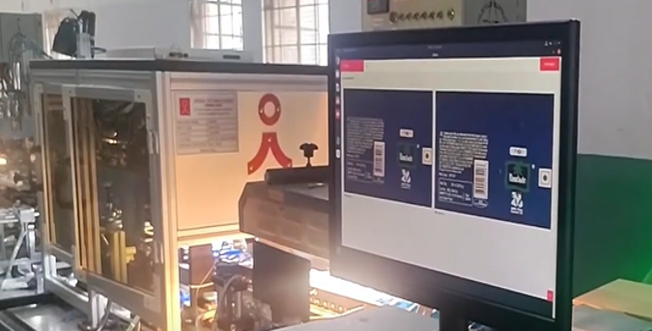
The inspection begins with the KompassTM-enabled TigrisTM system, where each bottle is mounted securely into a holder. This holder rotates the bottle a full 360°, ensuring that every surface of the label and print area is available for detailed inspection. - High-Speed Image Capture with Dual Cameras
To keep up with the fast-moving conveyor line, two cameras are deployed in sequence. This dual-camera setup allows the system to capture images rapidly and without compromise, ensuring smooth inspection even at high throughput speeds. - Image Stitching for Complete 2D Reconstruction
As the bottle rotates, 125 narrow image stripes are captured from different angles. These stripes are digitally stitched together to form a complete 2D panoramic image of the bottle’s surface. This reconstruction enables a comprehensive inspection of the entire print area. - Object Detection for Defect Identification
The generated 2D image is then processed using object detection algorithms. At this stage, the system automatically identifies critical defects such as print shift, smudges, or missing elements, ensuring that even minor deviations are flagged for corrective action. - Verification Through OCR
To further validate quality, Optical Character Recognition (OCR) technology is applied to the reconstructed image. This step verifies that all printed product information—such as names, batch codes, and expiry dates—is both accurate and legible, aligning with compliance and brand standards. - Automated Rejection of Defective Bottles
Any bottle found to have a defect is immediately removed from the production flow by a pneumatic-based rejection system. This system is fully synchronized with the inspection process, ensuring defective units are efficiently separated from the outfeed conveyor without slowing down operations. - Real-Time Alerts via Andon System
An Andon-inspired alert system continuously monitors defect trends. If repeated defects are detected within a defined time frame, it triggers an alarm. This proactive measure enables operators to investigate and resolve issues before they impact larger production volumes.


Big Wins
Marico's Breakthrough with Jidoka
$25K Cost savings
Significantly reduces inspection labour costs, market returns and false positives.
99.7% Accuracy
Detect sprinting defects reliably, preventing escapes to the market.
<0.3% False Positives
Ensures near-perfect detection with minimal errors.
120 Bottles per Minute
Boosts throughput to meet rising production demand.
Conclusion
With Jidoka's KompassTM-enabled TigrisTM solution, Marico eliminated defective printed bottles, protected its brand reputation, and ensured flawless product quality for its consumers. The transformation achieved a near-zero defect escape rate, boosted detection efficiency by 15%, and set a new benchmark for high-speed, reliable inspection in FMCG packaging.