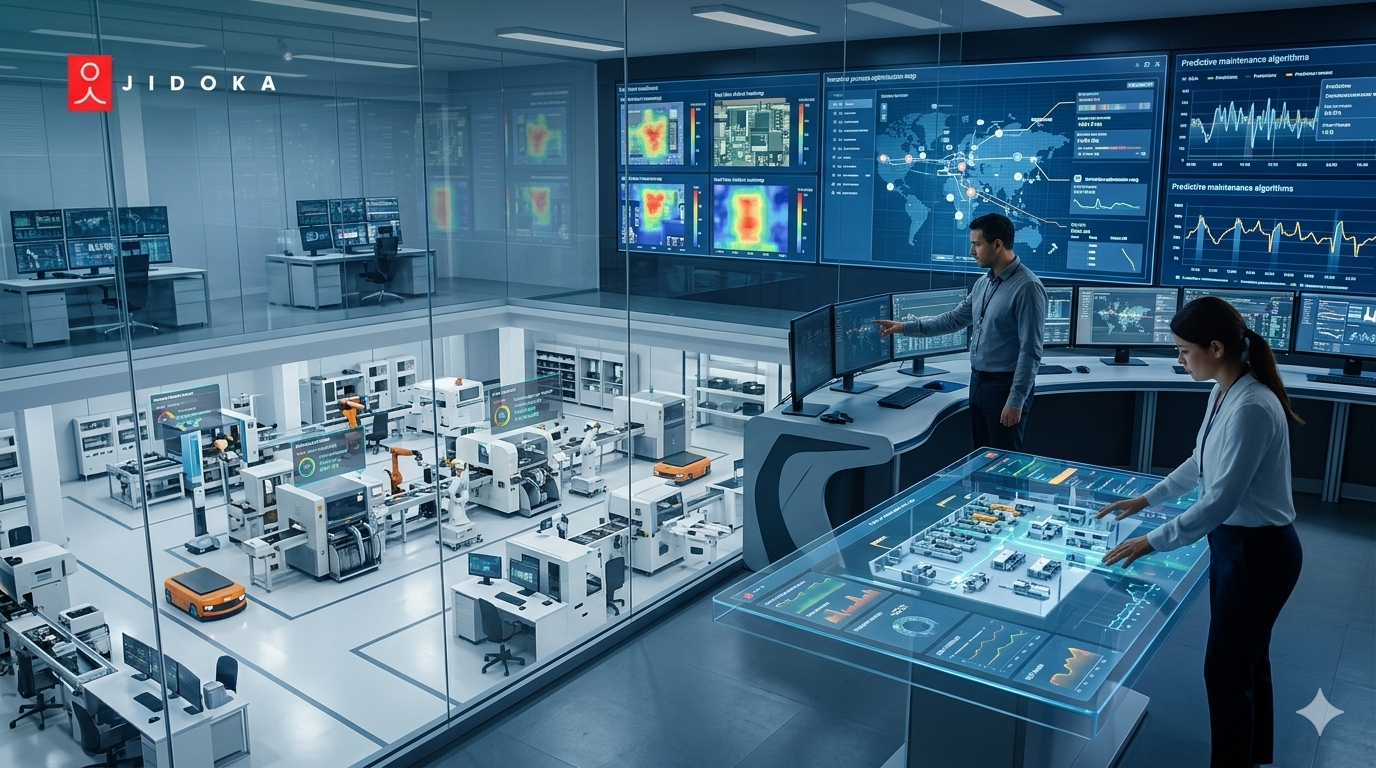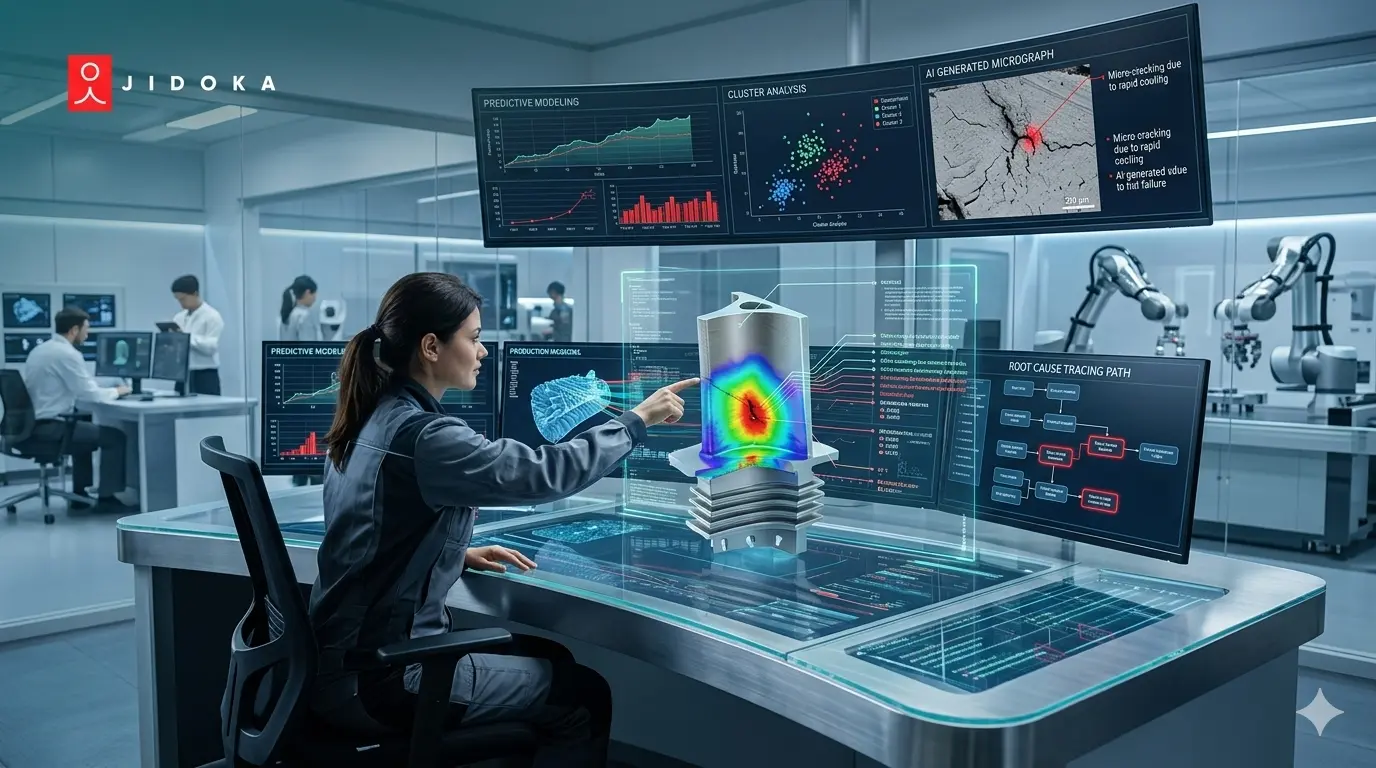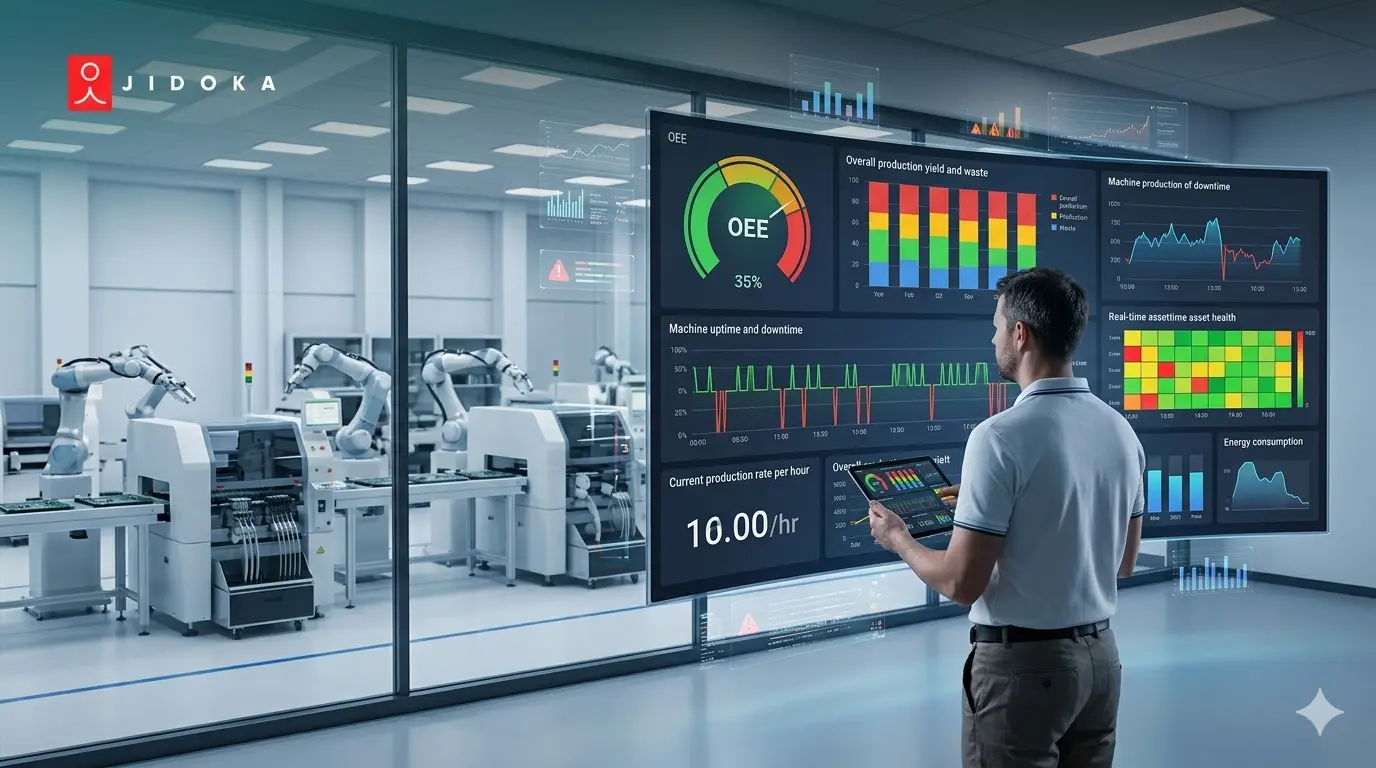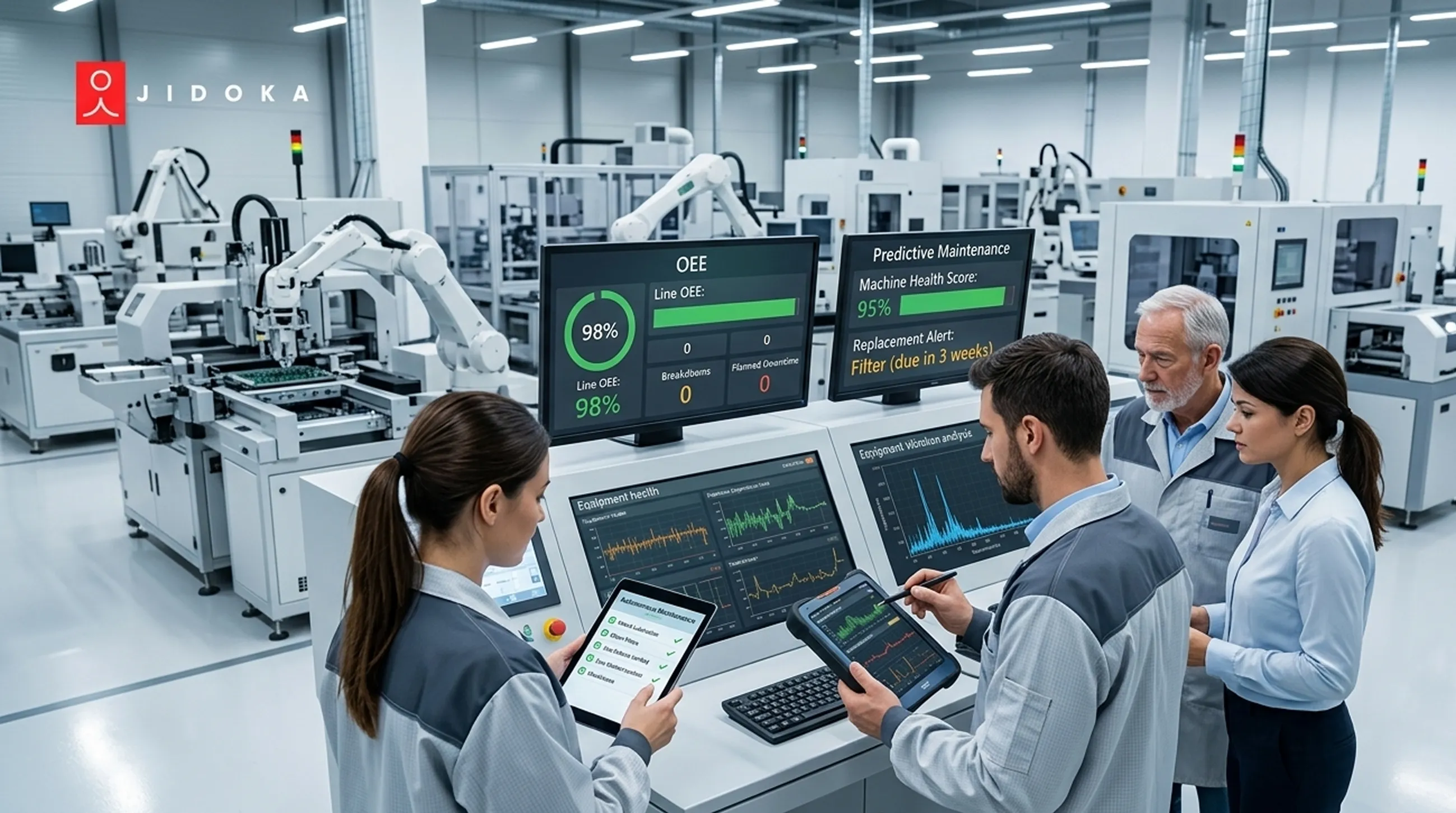
Manufacturing runs on intelligence now. The market reaches $399+ billion by 2029 because human labor cannot match the precision modern lines demand. Old industrial control systems are often too rigid to update. They fail to keep up with today's speed.
That is why 92% of manufacturers prioritize smart factory solutions like AI and edge computing. You need a partner to make this shift work. This guide reviews the top factory automation companies defining the future of Industry 4.0 technology, including the AI-focused team at Jidoka-Tech. Partnering with the right factory automation companies keeps your production efficient.
Top 5 Factory Automation Companies (Categorized by Strength)
Finding the right partner is hard. Most lists just name the biggest players. We break down the top factory automation companies by their actual strengths. This helps you compare smart factory solutions that match your floor's reality.
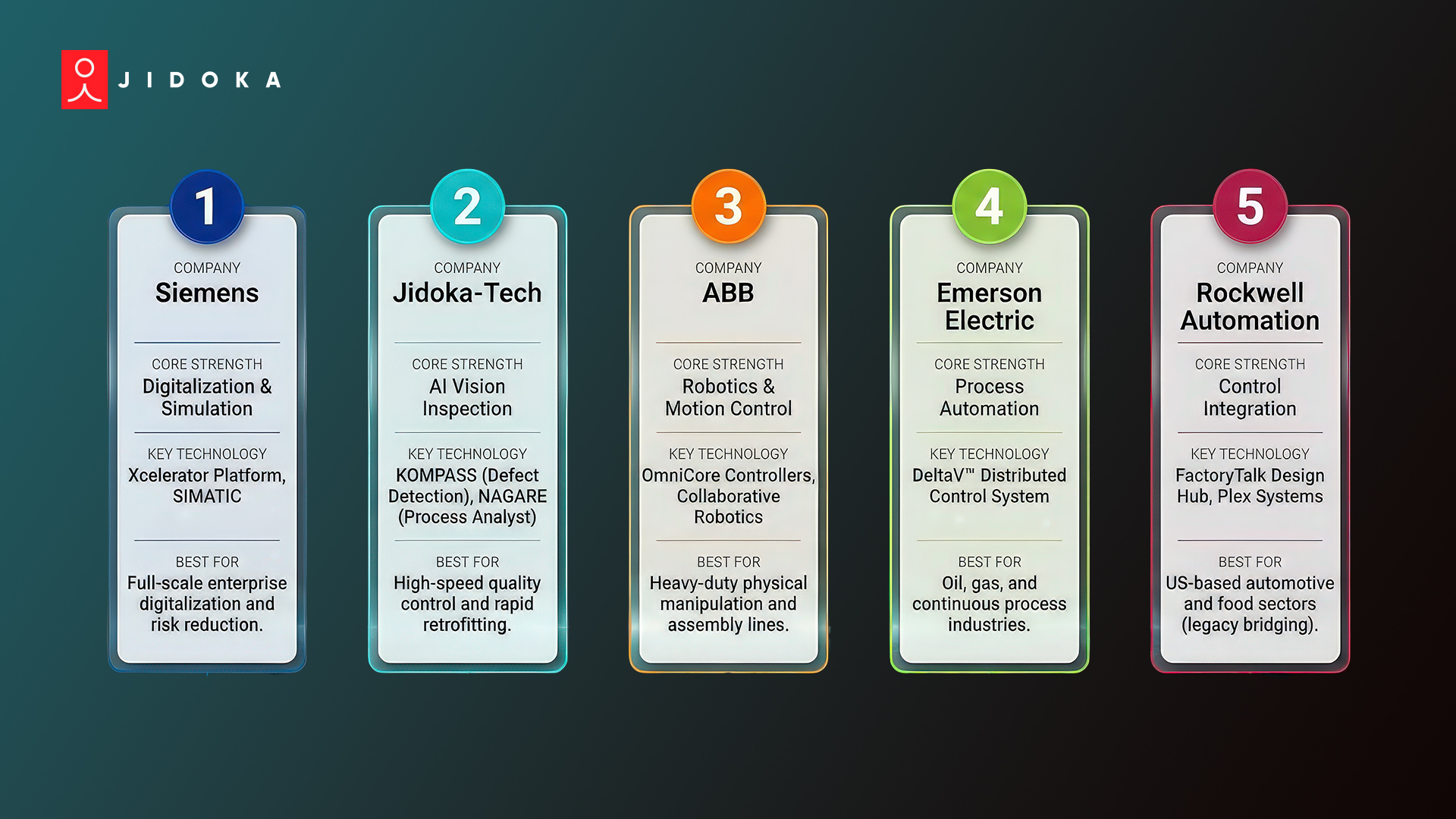
1. Siemens (The Digital Twin Leader)
Siemens defines factory automation software for massive operations. Their approach centers on "Digital Twins," allowing you to simulate entire production environments before installing hardware.
This virtual validation minimizes risk for large plants, making them a standout among factory automation companies for risk-averse enterprises.
Key Features:
- Industry 4.0 Technology: Full lifecycle simulation reduces commissioning time by 30%.
- Control Systems Integration: The Xcelerator platform unifies mechanical, electrical, and software design into one workflow.
- Enterprise Manufacturing Software: SIMATIC systems replace rigid hardware with flexible software-defined automation, enabling faster updates.
Best For: Large-scale manufacturing requiring end-to-end digitalization and virtual commissioning.
Tech Stack Use: SIMATIC Automation Workstation, Xcelerator, Teamcenter, Opcenter, Mendix.
Client Reviews: 4.4/5 Stars (Gartner Peer Insights)
2. Jidoka-Tech (The AI & Vision Inspection Specialist)
Jidoka-Tech builds systems that perform under real production pressure. Unlike generalist factory automation companies, they focus entirely on visual intelligence.
Their team aligns cameras, lighting, and edge units so the system works across all shifts. Plants running this setup report consistent performance even at 12,000+ parts per minute.
Key Features:
- Machine vision inspection: KOMPASS reaches 99.8%+ accuracy on live lines, reviewing each frame in under 10 ms.
- Real-time monitoring systems: NAGARE tracks 100% of assembly steps through existing cameras, cutting rework by 20–35%.
- AI-powered manufacturing: The system handles reflective metals and textured parts, learning new variants with 60–70% fewer samples.
Best For: High-speed quality control and manufacturers needing rapid smart factory solutions for defect detection.
Tech Stack Use: KOMPASS (Defect Detection), NAGARE (Process Optimization), Edge Computing Units, Python-based Deep Learning Models.
Client Reviews: 4.9/5 Stars (Direct Client Feedback)
3. ABB (The Robotics & Motion Powerhouse)
ABB powers heavy industry with precise motion control. They stand out among factory automation companies for handling physical tasks like welding and assembly.
If you need manufacturing automation companies that move heavy loads with extreme accuracy, ABB delivers the hardware that other factory automation companies cannot match.
Key Features:
- Collaborative Robotics: GoFa™ cobots work safely alongside humans without safety cages, handling payloads up to 12 kg.
- Automated Production Lines: The OmniCore controller platform reduces energy consumption by 20% while increasing motion speed.
- Smart Factory Solutions: RobotStudio allows you to program and test robots offline, preventing downtime on the actual line.
Best For: Manufacturers needing heavy-duty physical manipulation, welding, or assembly combined with predictive maintenance solutions.
Tech Stack Use: OmniCore Controllers, GoFa™ Cobots, RobotStudio, and B&R Industrial Control Systems.
Client Reviews: 4.4/5 Stars (Gartner Peer Insights)
4. Emerson Electric (The Process Automation Expert)
Emerson stands out among factory automation companies for fluid-based sectors. They specialize in "continuous process" industries where stopping production is catastrophic.
While many factory automation companies focus on assembly, Emerson integrates safety directly with control loops. This makes them a standard for industrial control systems in oil, gas, and chemical plants.
Key Features:
- Real-time monitoring systems: The DeltaV™ DCS manages complex fluid dynamics instantly to prevent hazards.
- Predictive maintenance solutions: Analytics tools track equipment health to stop downtime before it starts.
- Boundless Automation: A software-defined architecture that merges data from the field to the edge seamlessly.
Best For: Oil, gas, and chemical industries requiring continuous operation.
Tech Stack Use: DeltaV™ DCS, Ovation™, AMS Device Manager, PACSystems™.
Client Reviews: 3.9/5 Stars (Gartner Peer Insights)
5. Rockwell Automation (The North American Control Standard)
Rockwell Automation sets the standard for industrial control systems in North America. They dominate among manufacturing automation companies by bridging OT and IT effectively.
Unlike other factory automation companies, Rockwell integrates legacy setups with modern smart factory solutions, keeping automotive and food lines running without total overhauls.
Key Features:
- Control systems integration: FactoryTalk Hub connects disparate hardware for unified data visibility across the plant floor.
- Supply chain automation: Plex Systems delivers cloud-native smart manufacturing capabilities to track inventory and production.
- Legacy Support: They excel at connecting older Allen-Bradley hardware to modern analytics, extending equipment life.
Best For: US-based automotive and food manufacturers needing robust legacy system integration.
Tech Stack Use: FactoryTalk® Design Hub, Allen-Bradley® PLCs, Plex Systems, Studio 5000.
Client Reviews: 4.3/5 Stars (Gartner Peer Insights)
Three Trends Defining the Future of Automation
Automation changes fast. You need to watch specific shifts to keep your lines running efficiently. Top factory automation companies drive these changes right now to prevent obsolescence.
Trend A: Edge Computing vs. Cloud
Sending data to the cloud takes too long for modern speeds. Assembly lines cannot wait for a server to respond. Edge computing industrial technology solves this by processing data directly on the sensor.
This speed allows factory automation companies to offer real-time decision-making without lag. You get instant feedback exactly where the work happens.
Trend B: Collaborative Robotics (Cobots)
Robots work with people now, not inside cages. Collaborative robotics let humans and machines share the same space safely. This partnership reduces idle time by 85%.
Leading factory automation companies prioritize these safe, flexible bots over rigid arms. You gain the agility that traditional manufacturing automation companies often fail to provide.
Trend C: AI-Powered Predictive Maintenance
Fixing broken machines costs too much money. Smart factory solutions now focus on prevention rather than reaction. Predictive maintenance solutions use data to spot failures days before they happen.
AI-powered manufacturing keeps your uptime high. The best factory automation companies integrate this logic directly into your industrial control systems to ensure continuous production.
Adopting these advanced smart factory solutions does not mean replacing your entire floor. You can apply this Industry 4.0 technology to your current setup right now.
How Jidoka-Tech Upgrades Legacy Lines Without Disruption
You don't need to rip out your current lines to get smart factory solutions. Jidoka-Tech builds an AI-powered manufacturing system that upgrades your existing hardware under real production pressure.
Our team aligns cameras, lighting, PLC timing, and edge computing industrial units so the system works across all shifts. Plants running Jidoka’s setup report consistent performance even at 12,000+ parts per minute.
Our strength comes from combining two tools that extend machine vision inspection beyond standard checks:
1. KOMPASS: High-Accuracy Inspector This tool reaches 99.8%+ accuracy on live lines. It reviews each frame in under 10 ms and learns new variants with 60–70% fewer samples. It handles difficult materials like reflective metals. KOMPASS supports factory automation companies needing consistency where human eyes fail.
2. NAGARE: Process and Assembly Analyst NAGARE tracks 100% of assembly steps through existing cameras. It flags missing parts or wrong sequences in real time, cutting rework by 20–35%. This reinforces industrial control systems by catching errors before they move down the line.
Jidoka runs this full factory automation software on local edge units to avoid delays. Stop guessing and start detecting. Let Jidoka-Tech audit your line today.
Conclusion
Factory automation companies promise speed, but bad integration kills progress. Rigid industrial control systems fail to handle new product variations, often stalling your output.
If you choose the wrong factory automation companies, you risk investing in hardware that becomes obsolete in months. You lose budget on downtime while competitors overtake you. Do not let static tech anchor your growth.
Jidoka-Tech provides smart factory solutions that adapt to your current line instantly. We modernize your setup using flexible AI-powered manufacturing without the heavy capital risk.
See our system in action. Schedule your Jidoka-Tech audit today to fix your quality control for good.
Frequently Asked Questions (FAQs)
1. How long does it take to install these systems?
Factory automation software like Jidoka's installs in weeks, not months. While heavy industrial control systems require significant downtime for rewiring, our smart factory solutions deploy edge computing industrial units rapidly. You see results from automated production lines almost immediately.
2. Can automation handle high-mix/low-volume products?
Yes. Unlike rigid robotics automation manufacturers, AI-powered manufacturing adapts instantly. Deep learning models in our machine vision inspection systems switch between varying SKUs without manual reprogramming. This flexibility makes smart factory solutions viable for custom, short-run batches.
3. Is it expensive to maintain?
Modern factory automation companies use SaaS models to cut upfront capital. Remote over-the-air updates for predictive maintenance solutions remove the need for costly on-site visits. This keeps your Industry 4.0 technology current and your operational costs predictable.
4. How do we handle legacy equipment?
You do not need new machines. Edge computing industrial gateways connect old PLCs to modern real-time monitoring systems via protocols like Modbus. We bridge the gap, allowing factory automation companies to upgrade their existing industrial control systems without ripping out a single wire.