
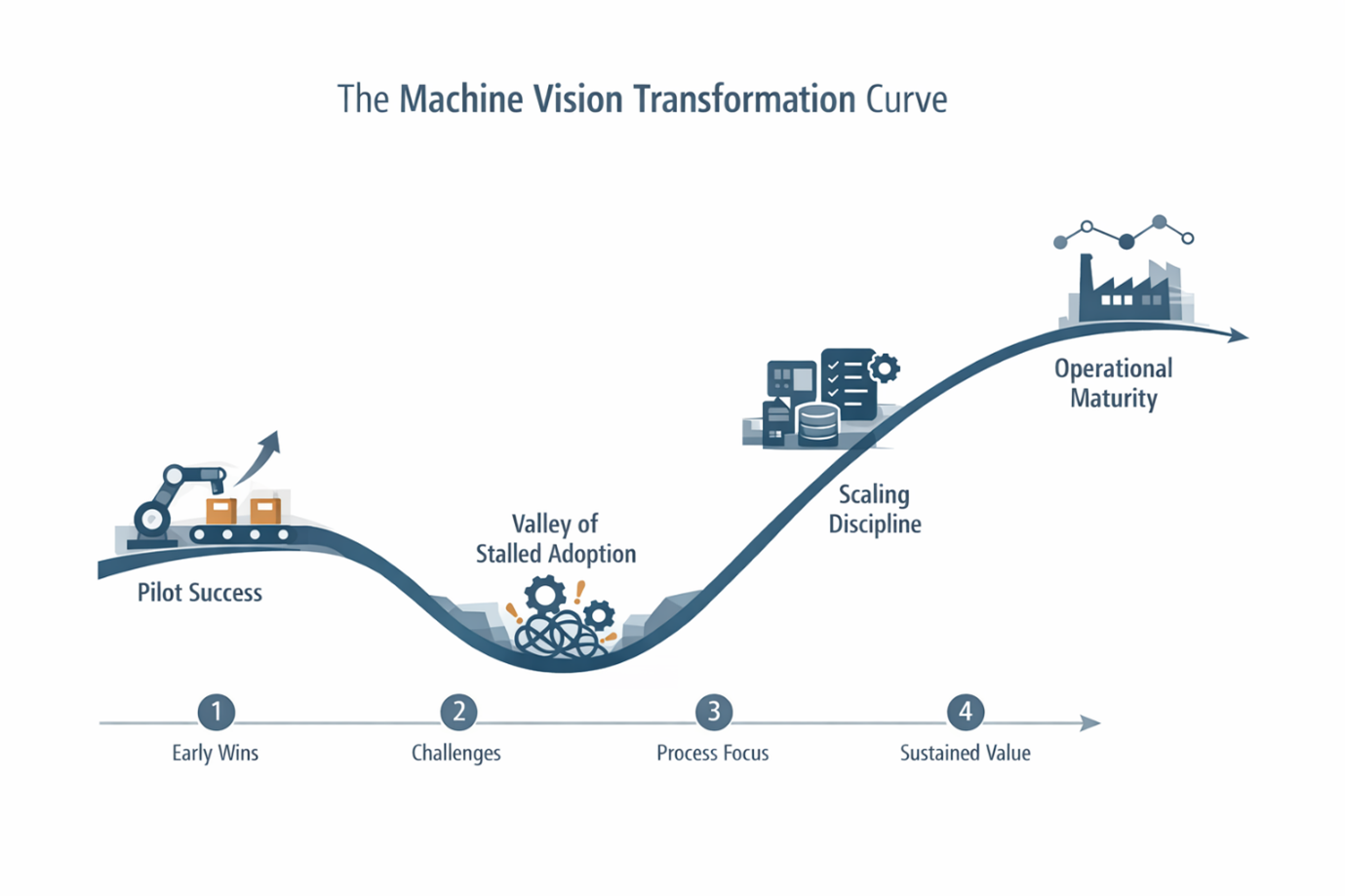
1. The Illusion of early success
Most organisations significantly overestimate their readiness after successful machine vision pilots.
- Vision models correctly identify defects in controlled environments
- Demonstrations impress stakeholders and leadership
- Early wins create optimism and urgency to scale
However, these results often mask deeper limitations.
A pilot that works on one line, one product, or one site does not guarantee scalability. What performs well in a controlled setting rarely translates seamlessly into production reality.
Early success is not the same as scale readiness. Yet, it is often treated as proof that the organisation is ready.
2. Entering the “Valley” of Stalled Adoption
The slowdown—or “valley”—in AI vision programs is rarely caused by failing algorithms. Instead, it emerges from systemic organisational friction.
- Vision systems struggle to integrate with MES, QMS, or ERP platforms
- Data standards vary across lines, plants, or regions
- Ownership of models, data, and outcomes remains unclear
- ROI projections remain theoretical rather than realised
Many machine vision initiatives stall not because AI cannot detect defects, but because the organisation is not ready to act on those detections, consistently and at scale.
3. The Discipline Required to Scale Machine Vision
Recovering momentum requires discipline, not more experimentation. Leaders must shift focus from adding new features to strengthening fundamentals.
- Standardising image data, labelling practices, and performance metrics
- Clearly defining operational ownership of model performance and outcomes
- Embedding vision insights into daily quality and production workflows
- Treating model drift, retraining, and validation as routine operations
These activities may appear less exciting than deploying new AI models, but this is where scalable value is created. Without this foundation, even the most advanced vision systems remain isolated experiments rather than operational assets.
4. True Indicators of Machine Vision Maturity
Mature AI vision organisations look very different from early adopters. Their progress is not measured by the number of cameras deployed, but by how decisions improve.
- Defects are prevented upstream, not just detected downstream
- Insights are shared and reused across lines and plants
- Quality shifts from inspection‑driven to prediction‑driven
- Continuous improvement becomes systematic rather than reactive
At this stage, machine vision becomes part of the operational fabric. The technology fades into the background, not because it is unimportant, but because it is fully embedded and trusted.
5. Leadership’s Role: Awareness Over Acceleration
Leaders do not control the shape of the machine vision transformation curve, but they do control how honestly they assess their position on it.
The most damaging mistake is not moving slowly; it is assuming a level of progress that the organisation has not yet earned. Decisions on investment, rollout speed, and expected returns depend entirely on an accurate understanding of this readiness.
In AI machine vision, leadership success is not about pushing harder, it is about seeing clearly.
Conclusion: From Vision Pilots to Operational Reality
Most AI‑based machine vision initiatives do not fail at the beginning. They lose direction in the middle, when early success creates unrealistic expectations and organisational preparedness lags behind technical capability.
The organisations that succeed are not those that deploy the most cameras or models the fastest, but those that remain honest about their maturity and disciplined in how they scale.
For leaders, recognising and respecting the machine vision transformation curve is what separates stalled pilots from real operational impact.
.png)