Floor managers often treat SOP compliance as a paperwork task. It is actually an execution task. Non-compliance costs your company millions. Most errors happen because people do not follow their own manufacturing standard operating procedures.
Outdated digital work instructions or complex FDA SOP requirements cause friction. This guide shows you how to stop errors with SOP audit manufacturing and SOP deviation tracking. SOP compliance in manufacturing works when your team follows the plan every shift. High SOP compliance protects your bottom line.
Why SOP Compliance Breaks Down on the Manufacturing Floor
Floor rules often sit in binders while workers do things their own way. You need to see where SOP compliance in manufacturing fails to stop the bleeding.
A) The Gap Between Written Procedures and Real Execution
Auditors frequently find that teams ignore their own manufacturing standard operating procedures. The document says one thing but the line does another. This gap happens for several reasons.
- Obsolete version control SOPs leave old instructions at the workstation.
- Training relies on signatures instead of actual skill tests.
- Staff create local shortcuts to meet speed targets.
Without tight SOP compliance these small drifts turn into major quality failures. High SOP compliance protects your brand. Consistent SOP compliance ensures safety for every worker on the floor.
B) What Passive Enforcement Actually Costs
Relying on paper checklists is risky. By the time you notice a mistake, the product is already finished. A lack of process compliance enforcement hurts quality. One missed step can lead to a recall or a fine. In fast-paced plants, bad habits spread quickly.
New hires learn the wrong way from veterans. This creates a cycle where operator SOP adherence fails every single day. Poor SOP compliance ruins your reputation and profits.
Understanding these failure points helps you build a system that actually works across all shifts.
How to Build SOP Compliance That Holds Across Shifts and Sites
Creating SOP compliance in manufacturing requires more than just writing rules. You must build a system that people can actually use. Follow these steps to improve SOP compliance across your entire facility.
Step 1. Write SOPs That Operators Can Actually Follow
Most manufacturing standard operating procedures fail because they are too wordy. Use clear, simple language.
- Use the active voice to give direct commands.
- Replace long paragraphs with digital work instructions and photos.
- Test every procedure with a new operator to find confusing steps.
If an operator has to guess what a step means, SOP compliance will drop. Good SOP compliance starts with clarity at the workstation.
Step 2. Version Control and Real-Time Distribution
Old documents on the floor cause huge problems during an SOP audit manufacturing. You must control your documents.
- Use digital systems to push updates to every screen instantly.
- Ensure version control SOPs track who saw the update and when.
- Remove all paper copies that might show outdated info.
Meeting FDA SOP requirements is impossible if you use the wrong version of a document. Tight SOP compliance relies on having one single source of truth for every process.
Step 3. Training Tied to Competency, Not Completion
A signature on a "read and understood" form does not prove someone can do the job. You need to verify skills to maintain SOP compliance.
- Use hands-on tests to confirm operator SOP adherence.
- Track how long it takes for new training to change behavior on the floor.
- Link your quality management SOPs to specific training modules.
When operators know exactly why a step matters, SOP compliance stays high even during busy shifts.
SOP Compliance Action Plan: From Paper to Performance:
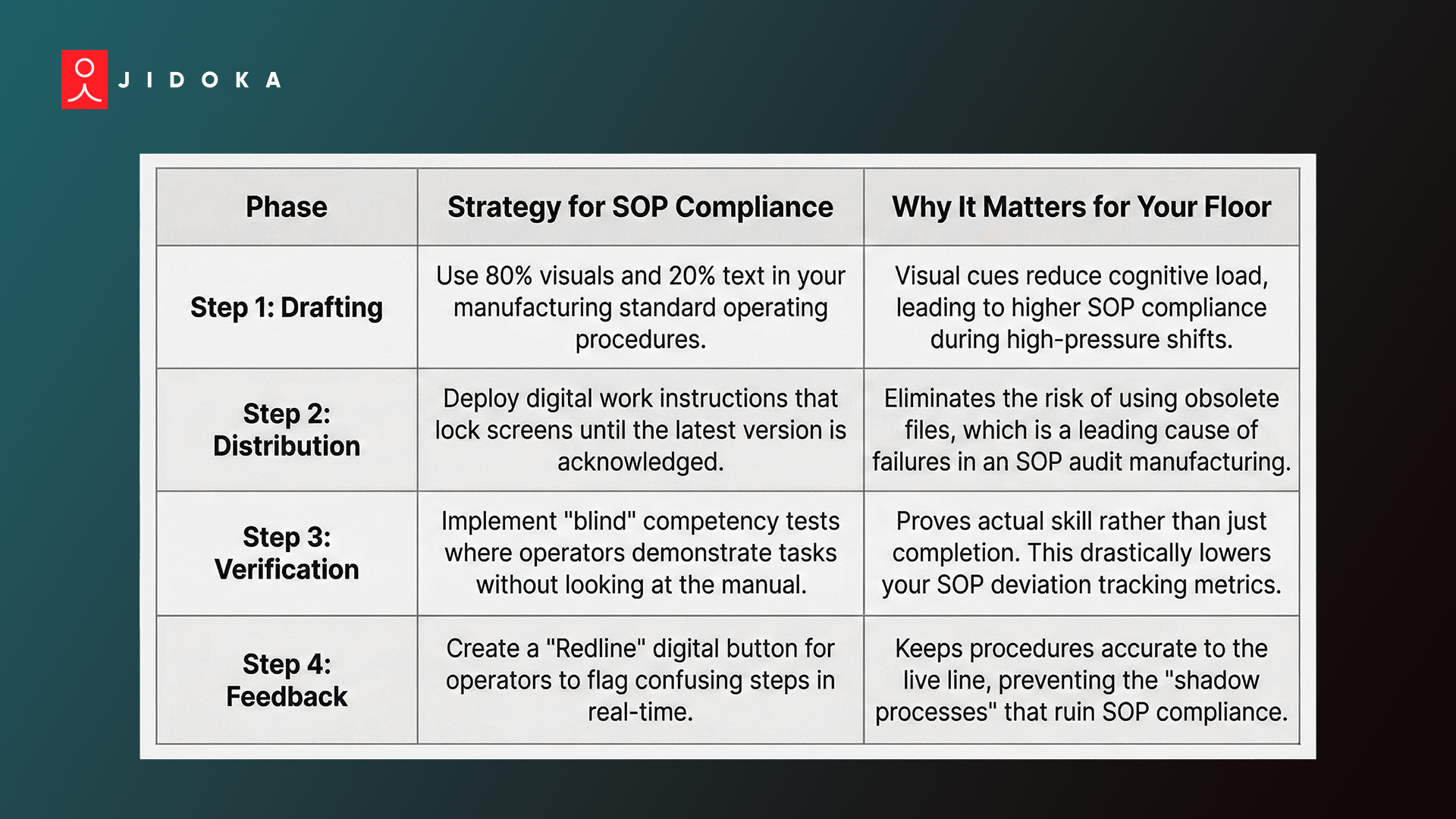
Building these habits ensures your team stays ready for any surprise inspection.
SOP Compliance Audits: Types, Methods, and What Auditors Actually Look For
Audits keep your processes from drifting. You need a mix of scheduled and surprise checks to maintain SOP compliance in manufacturing. High SOP compliance depends on honest data from the shop floor.
A) Four Audit Types Every Manufacturer Should Run
You cannot wait for a yearly inspection to find errors. Use these four audit types to improve SOP compliance:
1. Daily or Shift Audits: Supervisors check high-risk tasks every few hours. This catches operator SOP adherence issues before they ruin a batch.
2. Weekly Audits: Focus on equipment setup and recurring process steps. This ensures manufacturing standard operating procedures stay relevant.
3. Monthly or Quarterly Audits: These formal reviews align with FDA SOP requirements and ISO standards. They require full records and sign-offs.
4. Event-Triggered Audits: Run these after a quality failure or a new hire starts. These identify where SOP compliance broke down during a specific incident.
B) What SOP Deviation Tracking Requires to Be Useful
Logging a mistake is only half the work. You must act on the data to keep SOP compliance high. Effective SOP deviation tracking includes:
- Real-Time Logging: Record every deviation with a timestamp and operator ID.
- Severity Levels: Classify errors to prioritize CAPA manufacturing responses.
- Root Cause Analysis: Determine if the error came from a training gap or a bad SOP.
A high SOP deviation tracking rate on one shift shows you where to focus your training. Better SOP compliance comes from solving these patterns, not just blaming individuals.
When you track these details, you move from guessing to knowing exactly how your line runs.
SOP Enforcement Strategies That Work Beyond the Audit
Checking on your team once a week is not enough. You need systems that keep SOP compliance in manufacturing active every minute. True SOP compliance happens when the process itself prevents mistakes.
A) Active Enforcement vs. Passive Monitoring
Passive systems like paper logs only tell you about a mistake after it happens. Active process compliance enforcement stops the error before it costs you money.
- Layered Process Audits (LPAs): Different management levels check the same critical steps daily. This keeps operator SOP adherence high across all shifts.
- Workflow Gates: Digital tools can lock a machine until the operator confirms they finished the previous step in the manufacturing standard operating procedures.
- Real-Time Alerts: Use systems that text or email a supervisor the moment a deviation occurs.
These methods turn your quality management SOPs from suggestions into requirements. Strong SOP compliance means your team does the right thing even when no one is watching.
B) SOP Compliance Metrics That Drive Behavior
You cannot manage what you do not measure. Use these KPIs to track your SOP compliance levels:
- Right-first-time execution rate: This tracks how often a task is finished without any SOP deviation tracking logs.
- SOP access rate: High numbers here show that operators actually use their digital work instructions.
- Training-to-effective lag: Measure how fast your team adopts a new rule after an update.
Focusing on these numbers makes SOP compliance a part of your daily culture. When everyone sees the data, SOP compliance improves naturally.
How Jidoka Tech Automates SOP Compliance Across Every Step
Jidoka Tech automates SOP compliance with an AI inspection system built for production pressure. Their setup handles 12,000+ parts per minute and 300 million inspections daily using local edge units to stop delays.
1. KOMPASS: This high-accuracy inspector reaches 99.8%+ accuracy on live lines, reviewing frames in under 10ms. It handles reflective metals and textured parts with 70% fewer samples.
2. NAGARE: This analyst tracks 100% of assembly steps via existing cameras. It flags missing parts or wrong sequences in real time, cutting rework by 35%.
Jidoka ensures your manufacturing standard operating procedures are followed every shift. Explore how DianaHR helps manage the human side of your compliance training and documentation.
Conclusion
Maintaining SOP compliance is the foundation of high-quality production. However, ensuring SOP compliance in manufacturing is difficult when teams rely on static manufacturing standard operating procedures.
Gaps in operator SOP adherence often lead to SOP deviation tracking errors that complicate every SOP audit manufacturing. Without consistent SOP compliance, plants risk quality failures and regulatory fines that disrupt the entire supply chain.
These preventable mistakes stall growth and impact your bottom line. Jidoka Tech solves this by using AI vision to automate SOP compliance. Our NAGARE system verifies assembly steps in real time, ensuring your team executes every process correctly.
Connect to Jidoka Tech to see how AI vision can transform your factory floor today.
FAQs
1. What is SOP compliance in manufacturing?
SOP compliance in manufacturing means your team executes manufacturing standard operating procedures exactly as written. This ensures high SOP compliance across all shifts. It requires tracking operator SOP adherence and using version control SOPs to keep every single instruction updated and audit-ready.
2. What are common causes of SOP compliance failures?
Most failures happen when manufacturing standard operating procedures are outdated or hard to find. Poor operator SOP adherence often stems from a lack of digital work instructions. Without active process compliance enforcement, minor errors turn into major SOP deviation tracking issues.
3. How often should you run an SOP audit manufacturing?
You should conduct an SOP audit manufacturing daily for high-risk tasks. Monthly reviews of quality management SOPs help maintain SOP compliance in manufacturing. Regular checks ensure FDA SOP requirements are met and identify any hidden SOP deviation tracking patterns early.
4. What is SOP deviation tracking in audits?
SOP deviation tracking is the process of logging every time a process misses the manufacturing standard operating procedures. This data is vital for a successful SOP audit manufacturing. It helps you improve SOP compliance by identifying recurring gaps in training.
5. How does AI vision support SOP compliance?
AI vision systems monitor operator SOP adherence in real-time. By tracking assembly steps, these tools ensure SOP compliance in manufacturing by flagging errors instantly. This automation creates a digital trail for SOP deviation tracking and simplifies every SOP audit manufacturing.
6. What is a Layered Process Audit (LPA)?
A Layered Process Audit involves multiple management levels checking operator SOP adherence. It strengthens SOP compliance in manufacturing by ensuring manufacturing standard operating procedures are followed correctly. This layered approach identifies SOP deviation tracking issues before they impact your final product.