Eingehende Materialien sind für bis zu 50 % der Qualitätsmängel am Endprodukt verantwortlich (NexPCB Knowledge Base). Diese Zahl zeigt, wo Qualitätsprobleme ihren Ursprung haben, und wirft eine schwierigere Frage auf: Wenn Ihre Prüfschleusen nur an festen Kontrollpunkten existieren, was passiert dann mit der Qualität zwischen diesen Punkten?
Die meisten Werke führen Produktqualitätsprüfungen in definierten Phasen durch: Eingangsprüfung, Zwischenprüfung, Pre-Shipment-Review und Endabnahme. Die Logik dahinter ist schlüssig. Die strukturelle Lücke besteht jedoch darin, dass schleusenbasierte Prüfungen Mängel nur dann erfassen, wenn jemand vor Ort ist, um sie zu kontrollieren. Dieser Artikel bietet Ihnen die vollständige Checkliste für alle vier Phasen und erläutert den einen Überwachungsansatz, der das abdeckt, was manuelle Kontrollen nicht leisten können.
Die Produktqualitätsprüfung ist die strukturierte Verifizierung von Materialien, Komponenten und Fertigwaren in definierten Phasen: IQC (Eingang), IPQC (In-Prozess), Pre-Shipment und Endfreigabe. Jede Phase nutzt unterschiedliche Kriterien, Stichprobenverfahren und Annahmeschwellen, um zu verhindern, dass Mängel nachgelagerte Prozesse oder Kunden erreichen.
Was die Produktqualitätsprüfung abdeckt und warum sie in Phasen strukturiert ist
Das Vier-Phasen-Modell ist keine Branchenkonvention, der man blind folgen sollte. Jede Phase existiert, weil ein Mangel, der später entdeckt wird, jedes Mal ein Vielfaches an Kosten für die Behebung verursacht.
Die Eingangsprüfung (IQC) verifiziert Rohmaterialien und Komponenten, bevor sie in die Produktion gelangen. Die In-Prozess-Qualitätskontrolle (IPQC) prüft unfertige Erzeugnisse an definierten Kontrollpunkten während der Montage. Die Pre-Shipment-Inspektion (PSI) validiert fertige Waren vor der Verpackung und dem Versand anhand der Einkaufsspezifikationen. Die Ausgangsprüfung (OQC), auch Endfreigabe genannt, ist die formale Bestätigung, dass alle vorangegangenen Prüfnachweise geprüft wurden und die Sendung den Annahmekriterien entspricht.
Die Kostenlogik macht das Vier-Phasen-Modell so wertvoll. Ein Mangel, der bei der IQC entdeckt wird, kostet in der Behebung etwa das 1-Fache: Die eingehende Charge wird abgelehnt, ein NCR beim Lieferanten erstellt und saubere Ware nachbestellt. Derselbe Mangel, der erst bei der Endfreigabe gefunden wird, kostet das 10-Fache oder mehr: verschwendete Produktionszeit für fehlerhafte Baugruppen, Nacharbeit an Fertigwaren sowie das Risiko von Rückbelastungen oder Rückrufen durch den Kunden. Fertigungsdaten von McKinsey bestätigen dieses 1:10-Eskalationsverhältnis in ausgereiften Produktionsbetrieben.
KI-basierte kontinuierliche Überwachung bietet den größten Mehrwert im Zeitfenster zwischen IPQC und OQC. Manuelle Kontrollen in festen Intervallen können Prozessabweichungen, die sich schleichend zwischen den Prüfungen ansammeln, nicht erkennen. Die folgenden Abschnitte behandeln die Anforderungen der einzelnen Checklisten-Phasen und wie diese Lücke geschlossen werden kann.
Checkliste Phase 1: Eingangsprüfung (IQC)
Bevor eine Komponente Ihre Produktionslinie erreicht, muss die IQC fünf Punkte verifizieren: Entspricht das Material den Angaben des Lieferanten, erfüllt es die Spezifikationen, sind Menge und Dokumentation korrekt, werden Nichtkonformitäten erfasst und spiegelt die Lieferantenbewertung die tatsächliche Leistung wider? Eine rigorose Produktqualitätsprüfung in dieser Phase ist die wirkungsvollste Maßnahme, die ein Qualitätsteam ergreifen kann.
Dies ist die Produktqualitätsprüfung am frühestmöglichen Punkt. Ein defektes Befestigungselement, das die IQC aufgrund unzureichender Stichproben passiert, führt zu fehlerhaften Baugruppen in der gesamten Produktionscharge. Entdecken Sie es hier, oder zahlen Sie später Zinseszinsen für den Fehler.
- Schritt 1: Überprüfen Sie die Qualitätsaufzeichnungen des Lieferanten und das Analysenzertifikat (CoA) anhand der Einkaufsspezifikationen, bevor eine Charge das Werk betritt. Lehnen Sie jede Sendung ohne vollständige Dokumentation ausnahmslos ab.
- Schritt 2: Entnehmen Sie Stichproben der eingehenden Charge gemäß AQL nach MIL-STD-105E oder ISO 2859-1. Wählen Sie das Prüfniveau basierend auf Chargengröße, Kritikalität der Komponente und der Historie des Lieferanten. Verwenden Sie nicht standardmäßig dasselbe AQL-Niveau für jeden Lieferanten.
- Schritt 3: Führen Sie eine Maßprüfung anhand technischer Zeichnungen mit kalibrierten Instrumenten durch und dokumentieren Sie die Ergebnisse als bestanden/nicht bestanden gemäß der AQL-Annahmezahl. Ergänzen Sie dies durch eine Sichtprüfung auf Oberflächenfehler, Kennzeichnungen und Verpackungszustand sowie eine funktionale Stichprobenprüfung für alle Komponenten, die bei der Montage eine spezifische Funktion erfüllen müssen.
- Schritt 4: Dokumentieren Sie alle Nichtkonformitäten und erstellen Sie ein NCR für den Lieferanten. Legen Sie ein definiertes SLA für die Antwort und die Korrekturmaßnahmen des Lieferanten fest. Ein mündliches Versprechen zur Fehlerbehebung ist kein Ersatz für eine schriftliche CAPA.
- Schritt 5: Aktualisieren Sie die Lieferanten-Scorecard mit der Fehlerquote der aktuellen Charge. Markieren Sie Lieferanten, deren Fehlerquote bei drei aufeinanderfolgenden Chargen über 1 % liegt, für eine formelle Überprüfung der Lieferantenentwicklung.
- Schritt 6: Stellen Sie jede Charge, die die AQL-Annahmezahl überschreitet, zurück oder unter Quarantäne. Eine teilweise Verwendung von Chargen unter Quarantäne ist ohne eine dokumentierte und vom Qualitätsmanager unterzeichnete Risikoakzeptanz nicht zulässig.
- Schritt 7: Lassen Sie die IQC-Ergebnisse in die IPQC-Risikogewichtung für die Produktion mit dieser Komponente einfließen. Eine Charge, die mit AQL 4.0 bestanden hat, birgt ein höheres Produktionsrisiko als eine, die mit AQL 1.0 bestanden hat.
Framework-Name: IQC-Risikogewichtungsprotokoll
Bewerten Sie jede eingehende Charge auf einer Skala von 1 bis 5 in drei Dimensionen, um die angemessene Prüftiefe zu bestimmen. Addieren Sie die drei Werte und wenden Sie die unten stehende Interpretation an.
Bewertungsmatrix für das IQC-Risikogewichtungsprotokoll. Interpretation der Punktzahl: 3-7 = vollständige 100%-Prüfung erforderlich; 8-11 = Standard-AQL-Stichprobenprüfung; 12-15 = reduzierte Stichprobenprüfung zulässig. Überprüfen Sie jede einzelne Dimension mit der Bewertung 1 unabhängig von der Gesamtsumme.
Checkliste Stufe 2: Prozessbegleitende Qualitätskontrolle (IPQC)
Die IPQC ist der Bereich, in dem die meisten mittelständischen Fertigungsunternehmen die größte Lücke in ihrem Qualitätsprüfsystem haben. Eine manuelle Tor-Prüfung liefert nur eine Momentaufnahme zum Zeitpunkt der Kontrolle. Sie sagt nichts darüber aus, was in den drei Stunden zwischen den Prüfungen passiert ist.
Ein Mitarbeiter, der um 9:15 Uhr eine Drehmomentprüfung überspringt, produziert bis zur nächsten Kontrolle um 11:00 Uhr fehlerhafte Baugruppen. Bis dahin können bereits 200 Einheiten weitergeleitet worden sein. Bei Projekten, die wir in mittelständischen Montagebetrieben durchgeführt haben, ist dieses Muster die häufigste Ursache für Nacharbeitscluster am Ende der Linie: nicht eine einzelne große Abweichung, sondern eine kleine Prozessdrift, die über ein bis drei Stunden unentdeckt blieb.
- Schritt 1: Überprüfen Sie die Einhaltung der SOP bei jedem Montageschritt anhand digitaler oder schriftlicher Arbeitsanweisungen. Verlassen Sie sich bei sicherheitskritischen oder hochkomplexen Schritten nicht auf das Gedächtnis der Mitarbeiter. Physische oder digitale Poka-Yoke-Kontrollen sind die Methode zur Verifizierung, nicht die Anweisung selbst.
- Schritt 2: Überprüfen Sie an jedem definierten Kontrollpunkt das Vorhandensein der Komponenten, die korrekte Ausrichtung und den Drehmomentwert. Protokollieren Sie die Drehmomentwerte zur Rückverfolgbarkeit. Ersetzen Sie jedes Drehmomentwerkzeug, das nicht innerhalb des vorgeschriebenen Intervalls kalibriert wurde.
- Schritt 3: Überwachen Sie die Taktzeit an jeder Station als Indikator für Prozessabweichungen. Markieren Sie jede Station, deren Taktzeit mehr als 5 % über oder unter dem Standard liegt, zur Untersuchung. Eine konstante Überschreitung deutet meist auf ein Prozessproblem hin; eine konstante Unterschreitung kann darauf hindeuten, dass ein Schritt übersprungen wird.
- Schritt 4: Führen Sie zu Schichtbeginn sowie nach jedem Linienwechsel, Materialchargenwechsel oder Werkzeugtausch eine Erstmusterprüfung (FAI) durch. Geben Sie die Produktion erst frei, wenn die FAI-Protokolle ein positives Ergebnis ausweisen.
- Schritt 5: Dokumentieren Sie jeden Bedienfehler, jede Prozessabweichung und jeden Beinahe-Unfall in Echtzeit. Eskalieren Sie Abweichungen, die den definierten Schwellenwert überschreiten, umgehend an den Schichtleiter. Eine Zusammenfassung am Schichtende ersetzt keine Echtzeit-Eskalation.
- Schritt 6: Setzen Sie für eine lückenlose visuelle Qualitätskontrolle KI-gestützte Prozessüberwachung wie Nagare von Jidoka Technologies ein, um jeden Montageschritt in Echtzeit mit den digitalen Arbeitsanweisungen (SOPs) abzugleichen. Dies schließt die Kontrolllücke zwischen manuellen Prüfstationen ohne zusätzlichen Personalaufwand.
„Nagare überwacht 100 % der Montageschritte in Echtzeit anhand digitaler SOPs und reduziert Nacharbeiten um 35 %, indem Abweichungen erkannt werden, bevor sie sich im weiteren Prozessverlauf auswirken.“ - Jidoka Technologies
Checkliste Stufe 3: Versandkontrolle (PSI)
Die PSI ist die dritte Stufe der Qualitätsprüfung und das Kontrollinstrument, das viele Käufer fälschlicherweise als Ersatz für vorgelagerte Prüfungen nutzen. Das ist sie nicht. Die PSI bestätigt lediglich, dass die Produktion korrekt durchgeführt wurde. Wenn die PSI die einzige Qualitätskontrolle ist, die ein Käufer festlegt, verlässt er sich auf eine Stichprobenprüfung der Fertigwaren, um Probleme zu finden, die durch IQC und IPQC hätten verhindert werden müssen.
Mängel bei der PSI haben kommerzielle Konsequenzen, die bei prozessbegleitenden Fehlern nicht auftreten. Ein fehlerhaftes Endprodukt, das an einen Kunden ausgeliefert wird, führt zu Rückbelastungen, Retouren und potenziellen Marktrückrufen. Wir beobachten beim Übergang von der Pilot- zur Serienfertigung, dass Käufer, die sich zu sehr auf die PSI verlassen, durchweg höhere Nacharbeitskosten pro Einheit tragen als diejenigen, die in vorgelagerte Qualitätsprüfungen investieren.
- Schritt 1: Gleichen Sie die Menge der Fertigwaren mit der Bestellung, dem Lieferschein und den Produktionsunterlagen ab. Genehmigen Sie den Versand von Unter- oder Überlieferungen nur nach schriftlicher Zustimmung des Kunden.
- Schritt 2: Ziehen Sie eine AQL-Stichprobe aus der fertigen Charge und führen Sie eine visuelle und funktionale Prüfung durch. Verwenden Sie dabei das mit dem Kunden vereinbarte AQL-Niveau und keinen weniger strengen internen Standard.
- Schritt 3: Überprüfen Sie die Unversehrtheit der Verpackung (keine Schäden oder Verunreinigungen, korrekte Versiegelung), die Richtigkeit der Kennzeichnung (Produktcode, Chargennummer, Ursprungsland) sowie die Lesbarkeit von Barcodes oder QR-Codes bei der gesamten Stichprobe.
- Schritt 4: Stellen Sie sicher, dass alle Konformitätsdokumente (Prüfberichte, Konformitätsbescheinigungen, regulatorische Erklärungen) vollständig sind, der Charge beiliegen und mit den Versanddetails übereinstimmen. Eine Sendung, die aufgrund fehlender Ursprungsnachweise beim Zoll blockiert wird, ist ein vermeidbares PSI-Versäumnis.
- Schritt 5: Prüfen Sie das Produkt anhand der Abnahmekriterien des Kunden, nicht nur anhand interner Qualitätsstandards. Wenn die Kundenvorgaben von den internen Standards abweichen, gilt ausnahmslos der jeweils strengere Standard.
- Schritt 6: Dokumentieren Sie die Chargenfreigabe (Annahme, Ablehnung oder bedingte Annahme) mit Name, Rolle und Datum der zeichnungsberechtigten Person. Eine bedingte Annahme ohne dokumentierte Risikobegründung und Zustimmung der Stakeholder ist keine gültige Freigabe.
Checkliste Phase 4: Endfreigabe und Qualitätsfreigabeprüfung
PSI und Endfreigabe sind nicht dieselbe Phase. PSI ist eine AQL-basierte Stichprobenprüfung der fertigen Charge. Die Endqualitätsprüfung (OQC oder Qualitätsfreigabe) ist die formelle Bestätigung der Freigabeberechtigten, dass alle Prüfnachweise aus allen vier Phasen geprüft wurden und die Annahmekriterien erfüllen. Beides ist erforderlich. Diese zu vermischen, stellt ein Compliance- und Haftungsrisiko dar.
Die Unterschrift der Freigabeberechtigten ist kein bloßer Stempel auf dem PSI-Ergebnis. Es handelt sich um eine Prüfung der Nachweise. Eine Produktionscharge kann die PSI-Stichprobenprüfung bestehen und dennoch eine Qualitätssperre aufweisen, wenn IPQC-Aufzeichnungen ungelöste kritische NCRs zeigen oder die Dokumentation der Phase unvollständig ist. Der Schritt der Qualitätsfreigabeprüfung hat in der Pharma-, Automobil- und Lebensmittelindustrie regulatorische Bedeutung: Eine Freigabe ohne vollständige Nachweise ist ein Audit-Befund, kein bloßes bürokratisches Problem.
- Schritt 1: Bestätigen Sie, dass die IPQC-Datenzusammenfassung für den Produktionslauf keine offenen kritischen Nichtkonformitäten aufweist. Sollte eine kritische NCR offen sein, wird die Freigabe blockiert, bis diese durch bestätigte Korrekturmaßnahmen geschlossen oder auf der entsprechenden Entscheidungsebene mit dokumentierter Risikobegründung formell akzeptiert wurde.
- Schritt 2: Stellen Sie sicher, dass alle bei IQC, IPQC und PSI erfassten NCRs entweder mit Nachweisen über Korrekturmaßnahmen geschlossen oder formell mit dokumentierter Risikobegründung und Zustimmung der Stakeholder akzeptiert wurden. Ungeklärte NCRs sind nicht freigabefähig.
- Schritt 3: Prüfen Sie den PSI-Bericht und bestätigen Sie, dass die Chargenfreigabe den im Qualitätsplan definierten Annahmekriterien entspricht. Eine bedingte PSI-Annahme ohne formelle Qualitätsfreigabe ist keine gültige Grundlage für eine Freigabe.
- Schritt 4: Holen Sie die Qualitätsfreigabe von der dokumentierten freigabeberechtigten Person ein. Erfassen Sie Name, Rolle, Berechtigungsstufe und Datum. Dieser Datensatz ist die rückverfolgbare Autorisierung für den Versand und das erste Dokument, das bei Kunden- oder behördlichen Audits angefordert wird.
- Schritt 5: Aktualisieren Sie ERP und QMS mit dem Chargenfreigabestatus und erstellen Sie das Konformitätszertifikat (CoC). Bestätigen Sie, dass das CoC die korrekte Chargennummer, den Prüfstandard und den Namen der freigabeberechtigten Person enthält.
Archivieren Sie alle Prüfaufzeichnungen aus IQC, IPQC, PSI und OQC gemäß der Rückverfolgbarkeits- und Aufbewahrungsrichtlinie. Die Mindestaufbewahrungsdauer richtet sich nach Kundenspezifikationen oder regulatorischen Anforderungen, üblicherweise 3–7 Jahre für Konsumgüter und 10–15 Jahre für medizinische oder Automobilanwendungen.
„Die Qualitätsfreigabe ist keine Inspektion. Sie ist die Bestätigung, dass alle vorangegangenen Prüfnachweise gesichtet wurden und den Annahmekriterien des Kunden sowie den regulatorischen Anforderungen entsprechen.“ - Jidoka Technologies
Wie KI-Überwachung die Lücken schließt, die manuelle Inspektionen offen lassen
Das hier beschriebene vierstufige Modell der Produktqualitätsprüfung weist einen strukturellen Fehler auf, den kein aktualisiertes Verfahren beheben kann. Jede manuelle Kontrollstelle erzeugt eine Überwachungslücke zwischen den Prüfintervallen. Eine Prozessabweichung von 2–3 % pro Schicht summiert sich über einen Produktionslauf hinweg. Eine Drehmomentabweichung, die klein beginnt, wird zu einem Fehlercluster, bevor der nächste Prüfer eintrifft.
Die PSI-Endkontrolle erkennt Fehler erst dann, wenn die Korrekturkosten am höchsten sind. Wenn ein fehlerhaftes Teil bei der PSI ankommt, ist es bereits montiert, verpackt und versandbereit. Die Frage ist daher nicht, ob man eine PSI durchführen sollte, sondern wie man verhindert, dass Fehler überhaupt erst bis zur PSI gelangen.
Die Continuous-QI-Ebene setzt genau hier an. Das Betriebsmodell: Eine KI-Überwachung läuft als kontinuierliche Hintergrundebene zwischen den manuellen Qualitätskontrollen und bietet eine 100-prozentige IPQC-Abdeckung, ohne dass zusätzliches Personal erforderlich ist. Vorhandene IP-Kameras werden mit einer lokalen Edge-KI-Einheit verbunden, die jedes Bild in unter 10 ms durch trainierte Inspektionsmodelle analysiert. Jede Abweichung wird anhand digitaler SOPs protokolliert, und die Bediener werden alarmiert, bevor sich der Fehler auswirken kann.
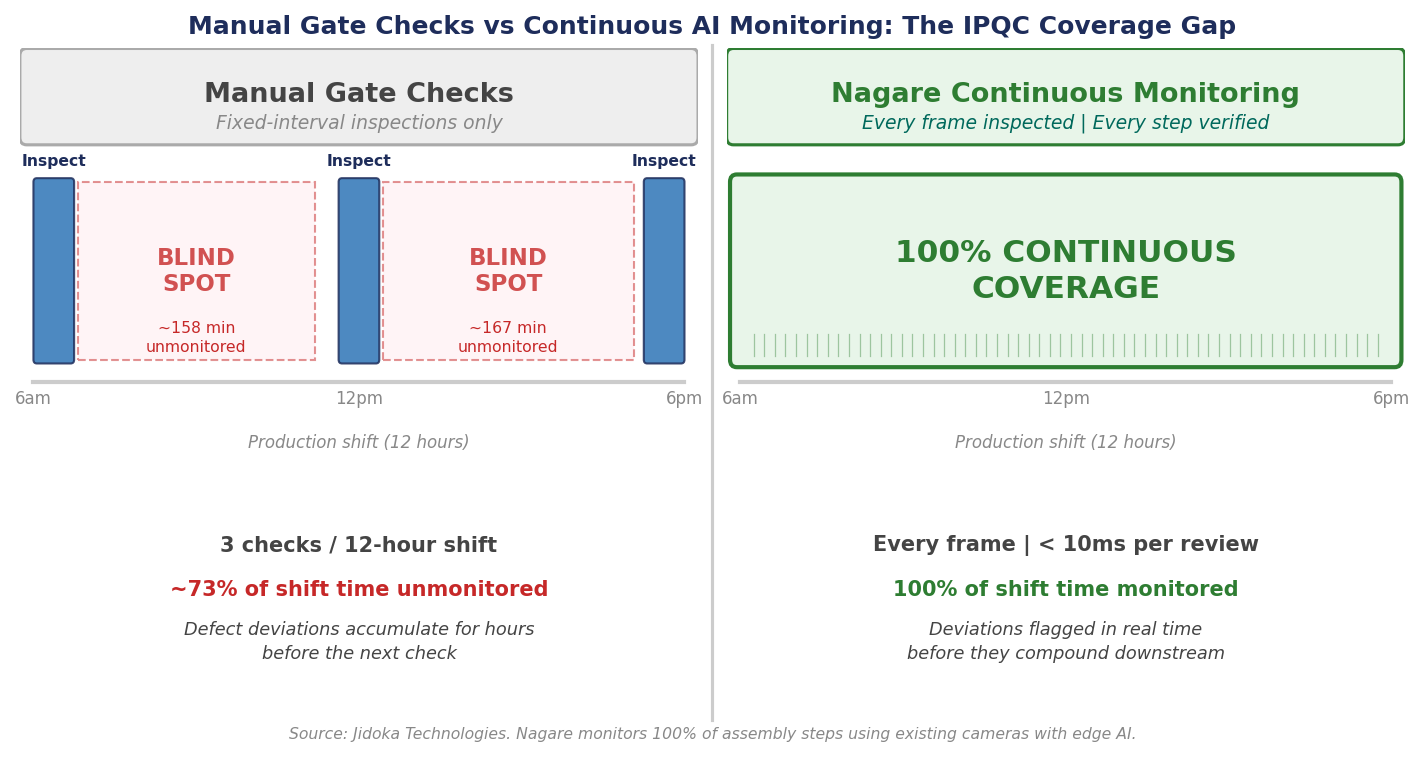
Nagare von Jidoka Technologies basiert auf dieser Architektur. Es überprüft jeden Montageschritt mit bis zu 12.000 Teilen pro Minute unter Verwendung vorhandener Kameras, ohne Cloud-Abhängigkeit, wobei alle Inferenzdaten lokal verbleiben. Die KOMPASS-Integration von Jidoka erreicht eine Genauigkeit von 99,8 % bei der Endkontrolle in der Qualitätssicherung für die visuelle Fehlererkennung. Das wirtschaftliche Argument ist eindeutig: Eine Reduzierung der Nacharbeit um 35 %, wie sie in dokumentierten Jidoka-Projekten erzielt wurde, amortisiert die Plattformkosten in der Regel innerhalb von 12 Monaten.
Um herauszufinden, wo Ihr aktueller Inspektionsprozess die größten unüberwachten Lücken aufweist, fordern Sie ein Nagare-Implementierungsaudit unter jidoka-tech.ai an. Das Implementierungsteam von Jidoka gleicht Ihre vorhandene Kamerainfrastruktur mit Ihrem IPQC-Kontrollplan ab und identifiziert die Abdeckungslücken noch vor einer Kaufentscheidung.
Fazit
Das vierstufige Modell der Produktqualitätsprüfung existiert, weil früh erkannte Fehler nur einen Bruchteil der Kosten verursachen, die bei einer späteren Entdeckung anfallen würden. IQC stoppt Lieferantenprobleme, bevor die Produktion beginnt. IPQC stoppt Prozessabweichungen, bevor sie sich zu einer fehlerhaften Serie summieren. PSI bestätigt, dass die fertige Charge den Kundenkriterien entspricht. Die Endfreigabe autorisiert den Versand mit einem nachvollziehbaren Nachweisprotokoll.
Die meisten Hersteller wenden dieses Modell manuell und nur an festen Kontrollpunkten an, wodurch der Prozessverlauf weitgehend unüberwacht bleibt. Plattformen wie Nagare schließen diese Lücke, indem sie jede vorhandene Kamera in eine kontinuierliche IPQC-Station verwandeln. Wenn Ihr Prozess auf Stichproben an Kontrollpunkten und am Ende der Linie basiert, verstecken sich die Kosten für Nacharbeiten genau in den Lücken zwischen diesen Prüfungen.
Fordern Sie ein Jidoka Technologies Nagare-Implementierungsaudit an , um es in Ihrer eigenen Fertigung zu erleben.
Häufig gestellte Fragen
1. Was ist eine Produktqualitätsprüfung?
Die Produktqualitätsprüfung ist die systematische Überprüfung von Materialien, Komponenten und Fertigwaren anhand definierter Spezifikationen in den wichtigsten Produktionsphasen. Sie umfasst vier Hauptstufen: IQC (Eingangskontrolle), IPQC (prozessbegleitende Kontrolle), Versandvorbereitung und Endfreigabe. Jede Stufe ist darauf ausgelegt, unterschiedliche Fehlerarten mit den geringstmöglichen Korrekturkosten zu erfassen.
2. Was ist der Unterschied zwischen IQC und Endkontrolle?
Die IQC prüft Rohmaterialien und Komponenten, bevor die Produktion beginnt. Die Endkontrolle (OQC oder Qualitätsfreigabe) ist der Kontrollpunkt am Ende des Prozesses, an dem das fertige Produkt anhand der Kundenakzeptanzkriterien überprüft wird. Die IQC verhindert, dass fehlerhafte Eingangsstoffe in die Produktion gelangen; die Endkontrolle bestätigt, dass die Ergebnisse vor dem Versand den Standards entsprechen. Beide Stufen sind erforderlich und können einander nicht ersetzen.
3. Was beinhaltet eine Checkliste für die prozessbegleitende Qualitätskontrolle (IPQC)?
Eine IPQC-Checkliste umfasst die Einhaltung von SOPs, die Überprüfung von Vorhandensein und Ausrichtung der Komponenten, Drehmoment- und Passformkontrollen an definierten Prüfpunkten, die Überwachung der Taktzeit, die Erstmusterprüfung zu Schichtbeginn sowie die sofortige Eskalation bei Prozessabweichungen. KI-Überwachungssysteme wie Nagare können die meisten dieser Prüfungen kontinuierlich für 100 % der Produktion automatisieren, anstatt sich auf stichprobenartige Kontrollen zu verlassen. Dadurch werden die blinden Flecken zwischen den Prüfintervallen geschlossen, die bei einer manuellen IPQC unvermeidbar sind.
4. Was ist ein AQL-Prüfniveau?
AQL (Acceptable Quality Level) ist ein statistischer Stichprobenstandard, der die maximal zulässige Fehlerrate in einem Produktionslos definiert. Die gängigen Niveaus reichen von AQL 1.0 (am strengsten, für kritische Komponenten) bis AQL 4.0 (am tolerantesten, für geringfügige kosmetische Mängel). MIL-STD-1916 und ISO 2859-1 sind die am häufigsten herangezogenen AQL-Standards, die in der Fertigungsindustrie bei der Produktqualitätsprüfung und bei Qualitätskontrolltests Anwendung finden.