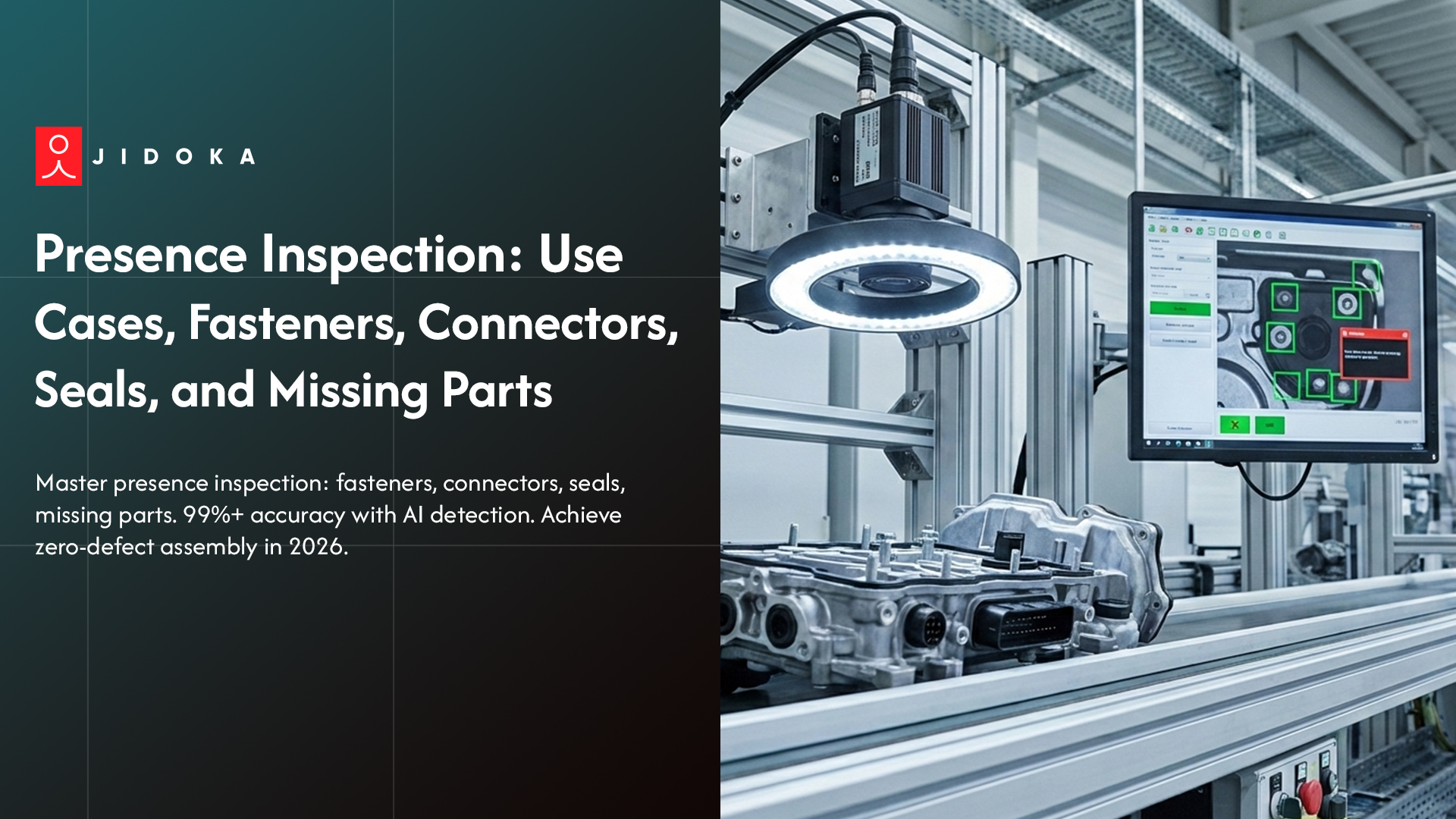
Eine einzige fehlende Schraube kann Ihre Anlage zum Stillstand bringen, Nacharbeiten auslösen oder einen Rückruf auslösen. Durch die Anwesenheitsprüfung werden diese Störungen gestoppt, bevor sie sich flussabwärts ausbreiten. Es stellt sicher, dass jedes Befestigungselement, jeder Stecker und jede Dichtung genau dort ist, wo sie sein sollten. Mit der Anwesenheitskontrolle sind Sie nicht mehr auf müde Augen oder stichprobenartige Kontrollen angewiesen. Sie erhalten in Echtzeit den Nachweis, dass jede Einheit vollständig ist.
Bei manuellen Kontrollen werden bei jeder Schicht Mängel übersehen. Die KI-gestützte Anwesenheitsprüfung erkennt fehlende Bauteile, falsche Teile und schlechte Sitze bei voller Geschwindigkeit. Sie unterstützt auch die Erkennung fehlender Komponenten und die Überprüfung der Montage bei komplexen Konstruktionen.
Jidoka Tech wendet diesen Ansatz in großem Maßstab an und hilft Herstellern dabei, jedes Teil in Echtzeit zu überprüfen. Dieser Leitfaden zeigt, wie die Anwesenheitskontrolle Ihnen hilft, die Qualität zu schützen, Abfall zu reduzieren und die Produktion am Laufen zu halten.
Anwendungsfälle bei der kritischen Anwesenheitsprüfung: Verbindungselemente, Steckverbinder, Dichtungen und fehlende Teile
Jede Produktionslinie hat Schwachstellen. Manche scheitern langsam. Andere scheitern in einer einzigen Schicht. Was sie gemeinsam haben, ist einfach: Eine fehlende oder falsche Komponente kann alles zum Erliegen bringen.
Eine Anwesenheitskontrolle dient dazu, diese Ausfälle frühzeitig zu erkennen. Es bestätigt, dass jedes benötigte Teil vorhanden ist, korrekt platziert ist und der Baugruppenkonstruktion entspricht, bevor das Produkt weiterbewegt wird.
Hier sind die häufigsten und teuersten Anwendungsfälle.
1, Überprüfung des Vorhandenseins von Verbindungselementen: Grundlage für die mechanische Montage
Verbindungselemente halten die Strukturen stabil. Eine einzige fehlende Schraube kann zu Vibrationen, Produktschäden oder Sicherheitsproblemen führen, sobald das System unter Last steht.
Bildverarbeitungssysteme erkennen Schrauben, Bolzen, Unterlegscheiben und Nieten in komplexen Baugruppen. Sie überprüfen Anzahl, Typ, Position und Sitztiefe. Wenn ein Verbindungselement locker, falsch ausgerichtet oder falsch ist, meldet das System es, bevor es zu einem Drehmomentausfall kommt. Dadurch wird verhindert, dass kleine Fehler zu Feldausfällen werden.
2. Überprüfung der Stecker- und Kabelbaugruppe
Die Stecker müssen vollständig und in der richtigen Ausrichtung sitzen. Selbst eine geringfügige Fehlausrichtung kann zu einem Stromausfall oder einer Signalunterbrechung führen.
Die Anwesenheitskontrolle bestätigt jeweils Anschluss ist vorhanden, richtig ausgerichtet und vollständig eingesetzt. Das System vergleicht Live-Bilder mit CAD-Referenzen, um die Platzierung innerhalb der Toleranzen zu überprüfen. Dies ist besonders wichtig für Kabelbäume mit Dutzenden oder Hunderten von Endpunkten.
3. Überprüfung der Dichtung: Hermetische Integrität
Dichtungen schützen vor Leckagen, Verunreinigungen und Druckverlust. Eine fehlende oder gefaltete Dichtung kann eine ganze Produktcharge ruinieren.
Bei der Hintergrundbeleuchtung werden transparente Dichtungen freigelegt. Durch die Kantenerkennung werden falsch ausgerichtete oder teilweise zusammengedrückte Dichtungen hervorgehoben. Auf diese Weise können Dichtungen überprüft werden, die bei normaler Beleuchtung unsichtbar sind.
4. Fehlende Komponenten und Vollständigkeit der Montage
Jede fertige Einheit muss ihrer Stückliste entsprechen. Zählung von Komponenten und die Layoutvalidierung bestätigen, dass nichts fehlt oder extra ist.
Bei der Analyse verbundener Komponenten werden Teile getrennt und gezählt, auch wenn sie sich berühren. Wenn der Build nicht der erwarteten Konfiguration entspricht, stoppt das System die Leitung.
Technologien und Algorithmen zur Erkennung von Präsenzinspektionen: Wie KI fehlende Komponenten identifiziert
Moderne Anwesenheitsprüfsysteme sind nicht mehr auf feste Regeln oder statische Vorlagen angewiesen. Sie verwenden adaptive Bildverarbeitungsmodelle, die aus realen Produktionsdaten lernen. Dadurch können sie mit Bauteilschwankungen, Lichtveränderungen, Oberflächenreflexionen und Layoutänderungen umgehen, ohne ständig neu programmieren zu müssen.
Im Kern kombinieren diese Systeme mehrere sich ergänzende Methoden. Jedes löst einen anderen Teil des Verifikationsproblems.
1. Faltungsneuronale Netze zur Erkennung und Klassifizierung von Komponenten
Neuronale Netze scannen jedes Bild, um Teile zu lokalisieren, ihren Typ zu identifizieren und ihre Ausrichtung zu verstehen. Da sie aus Tausenden von Beispielen lernen, erkennen sie dieselbe Komponente, auch wenn sich ihr Aussehen geringfügig ändert.
Dies macht sie unter realen Werksbedingungen zuverlässig, wo Teile niemals perfekt identisch sind.
2. Objektzählung und Blob-Analyse für die Komponentenaufzählung
Einige Baugruppen schlagen einfach fehl, weil ein Teil fehlt oder ein zusätzliches Teil fehlt. Zählalgorithmen trennen jedes Objekt im Bild voneinander und stellen sicher, dass die Summe der erwarteten Menge entspricht. Dies funktioniert auch dann, wenn sich Komponenten berühren oder überlappen, was bei Trays, Kits und Verpackungen häufig der Fall ist.
3. Überprüfung der Position und Validierung des Layouts
Erkennung allein reicht nicht aus. Die Komponenten müssen an der richtigen Stelle sitzen. Bei der Layoutvalidierung werden erkannte Positionen mit Referenzlayouts oder CAD-Modellen verglichen. Wenn ein Teil falsch platziert oder gedreht wurde, kennzeichnet das System es, bevor das Gerät zur nächsten Station fährt.
4. Erkennung mehrerer Objekte und Identifizierung von Fremdkomponenten
Fortgeschrittene Modelle können sowohl erwartete als auch unerwartete Elemente erkennen. Wenn ein falsches Teil, ein zusätzliches Befestigungselement oder ein Fremdkörper in der Baugruppe auftaucht, behandelt das System dies als Defekt und löst einen Stopp oder eine Warnung aus.
Anwendungen in der Praxis: Von Leiterplatten über OP-Trays bis hin zu Automobilbaugruppen
Die Anwesenheitsprüfung ist nicht mehr auf Nischenanwendungsfälle beschränkt. Sie gehört heute zu den Standardebenen der Qualitätskontrolle in Branchen, in denen hohe Stückzahlen gelten und reguliert werden. Was sich von Branche zu Branche ändert, ist die Art des Risikos, die Produktionsgeschwindigkeit und die Kosten eines Ausfalls.
1. Überprüfung der Komponenten der Leiterplattenmontage
Elektronikhersteller überprüfen anhand der Anwesenheitsprüfung, ob alle Widerstände, Kondensatoren, Stecker und integrierten Schaltungen vor dem Löten korrekt platziert sind. Ein einziges fehlendes oder falsches Bauteil kann eine ganze Platine unbrauchbar machen.
Bildverarbeitungssysteme vergleichen jedes Board mit seinem Referenz-Layout und seiner Materialliste und erkennen Abweichungen vor dem Reflow. Dadurch wird Ausschuss vermieden, Nacharbeiten werden reduziert und die Funktionsfähigkeit wird gewährleistet.
2. Überprüfung der Fahrzeugmontage
Die Fahrzeugmontage umfasst Hunderte von Befestigungselementen, Steckverbindern und Dichtungen pro Einheit. Manuelle Prüfungen können auf dieser Ebene nicht skaliert werden. Bei der Anwesenheitsprüfung werden die Anzahl der Schrauben, der Sitz der Steckverbinder, die Anordnung der Dichtungen und die Ausrichtung der Teile an jeder Station überprüft.
Fehler werden sofort erkannt, wodurch verhindert wird, dass defekte Fahrzeuge die Endprüfung oder den Kunden erreichen.
3. Inspektion von medizinischen Geräten und chirurgischen Behältern
Bei der Herstellung medizinischer Geräte können fehlende Instrumente oder falsche Verpackungen zu Verstößen gegen die Vorschriften und zu Risiken für Patienten führen. Die Anwesenheitskontrolle bestätigt, dass alle Werkzeuge, Zubehörteile und Etiketten vor der Sterilisation und dem Versand vorhanden und korrekt angebracht sind. Das System erstellt auch eine digitale Aufzeichnung für Audits und behördliche Berichterstattung.
Präsenzprüfung im Vergleich zu manueller Inspektion: Leistungsvergleich und Auswirkung auf den ROI
Die meisten Hersteller beginnen mit manuellen Prüfungen. Mit der Zeit erkennen sie die Grenzen. Müdigkeit, Schnelligkeit, Druck und sich wiederholende Arbeit reduzieren die Konstanz. Mit steigendem Produktionsvolumen werden diese Lücken kostspielig.
Die Anwesenheitsprüfung ändert das, indem sie für jede Einheit und jede Schicht die gleiche Genauigkeit bietet.
1. Genauigkeit und Fehlervermeidung
Die Genauigkeit der manuellen Inspektion sinkt mit fortschreitender Schicht. Fehlende Verbindungselemente, vertauschte Stecker und nicht abgedichtete Verbindungen rutschen häufig durch. Bei der automatisierten Anwesenheitsprüfung wird auf jedes Produkt dieselbe Entscheidungslogik angewendet.
Es erkennt fehlende, falsche oder falsch ausgerichtete Komponenten, bevor sich Fehler in der Folgezeit bemerkbar machen, wodurch Garantieansprüche und Kundenbeschwerden reduziert werden.
2. Durchsatz und Produktionseffizienz
Manuelle Kontrollen verlangsamen die Leitung oder erzwingen die Probenentnahme. Durch die Probenentnahme können Defekte ausweichen. Die Anwesenheitsprüfung läuft inline mit voller Geschwindigkeit. Es überprüft jede Einheit, ohne die Produktion zu unterbrechen.
Dies beseitigt Inspektionsengpässe und hilft den Teams, auch bei steigenden Mengen eine stabile Produktion aufrechtzuerhalten.
3. Finanzieller ROI und Kosten-Nutzen-Analyse
Die meisten Systeme amortisieren sich innerhalb eines Jahres. Einsparungen ergeben sich aus weniger Nacharbeiten, weniger Rückrufen, geringerem Arbeitsaufwand und verbesserter Ertrag. Der langfristige Vorteil ist ein stabiler Prozess, der verhindert, dass aus kleinen Fehlern große Verluste werden.
Vergleichstabelle: Anwesenheitsprüfung und manuelle Inspektion
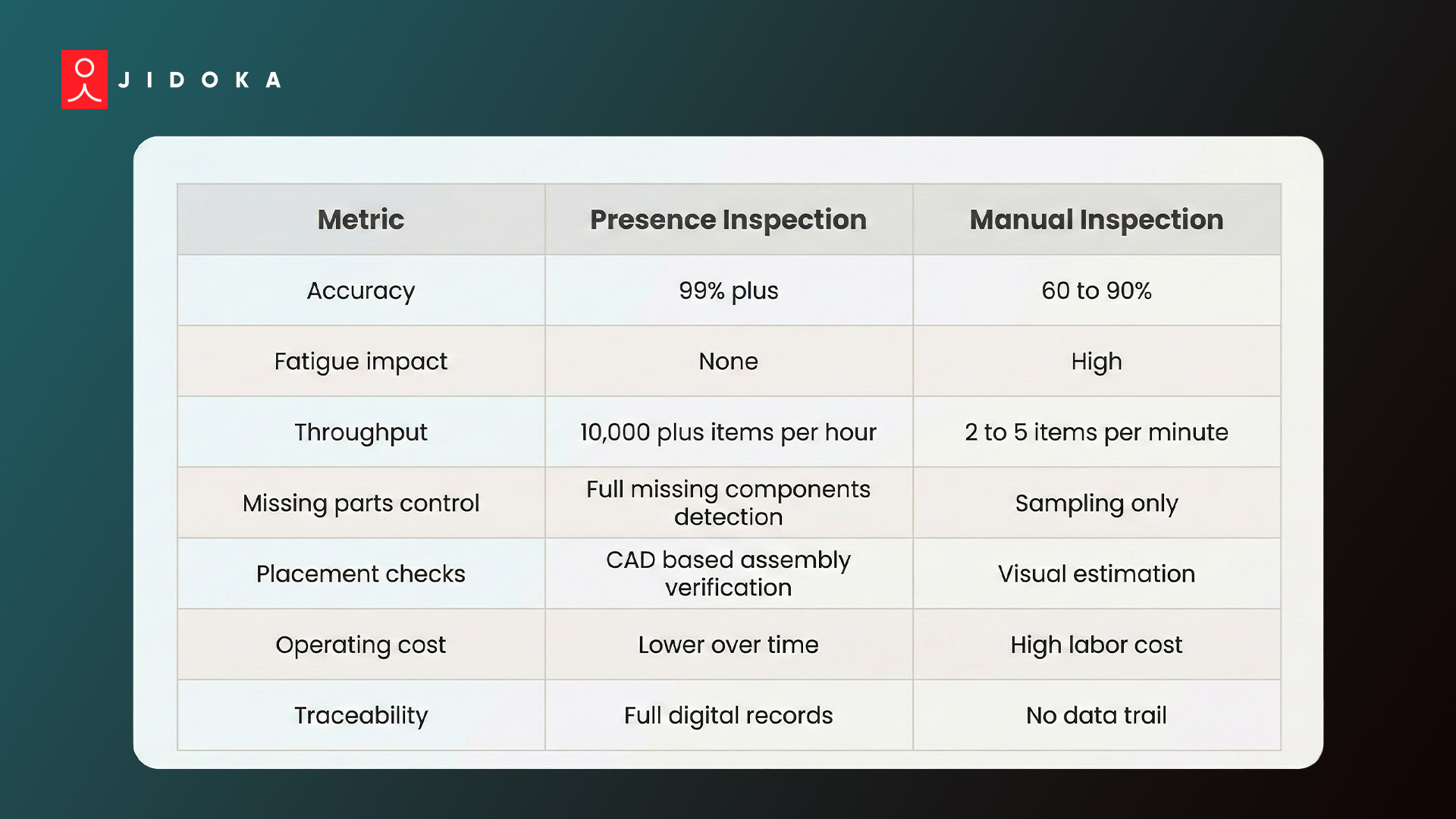
Als Nächstes werden Sie sehen, wie Jidoka Tech mit großen Produktionsmengen umgeht.
Schnelle Zuverlässigkeit: Durchführung von 300 Millionen täglichen Anwesenheitsprüfungen mit Jidoka Tech
Jidoka Tech führt Anwesenheitsprüfungen unter echtem Produktionsdruck durch, bei denen Geschwindigkeit, Vibration und Lichtschwankungen zu Fehlschlägen führen. Wir richten Kameras, Beleuchtung, SPS-Timing und Kantenberechnung so aus, dass die Anwesenheitsprüfung in jeder Schicht stabil bleibt.
Die Jidoka-Linien fahren in Über 12.000 Teile pro Minute und bis zu 300 Millionen Inspektionen pro Tag.
1. KOMPASS: Hochgenauer Inspektor
- Genauigkeit von über 99,8% auf Live-Leitungen
- Unter 10 ms pro Bild
- Erlernt neue Varianten mit weniger Proben
- Geeignet für reflektierende Metalle und strukturierte Teile
2. NAGARE: Prozess- und Montageanalyst
- Spuren 100% Bahnhofsstufen
- Kennzeichnet fehlende Teile und falsche Sequenzen
- Reduziert die Nacharbeit um 20— 35%
Dieses Setup unterstützt die Erkennung fehlender Komponenten und die Überprüfung der Montage, ohne den Durchsatz zu verlangsamen. Buchen Sie eine Live-Demo mit Jidoka Tech um zu sehen, wie die Anwesenheitsprüfung fehlende Teile in Echtzeit an Ihrer Produktionslinie erkennt.
Fazit
Bei der Anwesenheitsprüfung wird überprüft, ob alle erforderlichen Komponenten vorhanden sind, korrekt sitzen und dem Bauplan entsprechen, bevor ein Produkt in Betrieb genommen wird. Wenn die Anwesenheitsprüfung fehlschlägt, sehen sich die Teams mit fehlenden Verbindungselementen, vertauschten Steckern und nicht abgedichteten Verbindungen konfrontiert, die bei manueller Überprüfung nicht funktionieren.
Diese Fehler führen zu Nacharbeiten, Lieferverzögerungen, Garantieansprüchen, Audits und Sicherheitsvorfällen, die das Vertrauen schädigen und die Produktion zum Erliegen bringen. Ein einziger unentdeckter Defekt kann Rückrufe oder behördliche Maßnahmen auslösen.
Jidoka Tech begegnet diesen Risiken durch die Erkennung fehlender Komponenten und die Überprüfung der Montage in Echtzeit, sodass die Teams eine kontinuierliche Übersicht über jede Station erhalten, ohne die Leistung zu beeinträchtigen.
Sprechen Sie mit dem Jidoka-Team um Ihre aktuellen Inspektionslücken und Ausfallrisiken zu überprüfen.
Häufig gestellte Fragen
1. Was ist Anwesenheitskontrolle in der Fertigung?
Bei der Anwesenheitsprüfung wird überprüft, ob alle erforderlichen Teile vorhanden sind, korrekt sitzen und dem Bauplan entsprechen. Sie unterstützt die Erkennung fehlender Bauteile, die Überprüfung der Montage, das Fehlen von Komponenten und die Überprüfung der Stückliste, sodass Hersteller vollständige Bauarbeiten bestätigen und unvollständige Produkte vor der Endprüfung unterbinden können.
2. Wie erkennt die Anwesenheitsprüfung fehlende oder zusätzliche Teile?
Bei der Anwesenheitsprüfung werden KI-Modelle, Komponentenzählung, Blob-Analyse und Layoutvalidierung verwendet, um fehlende Teile zu erkennen. Es vergleicht Live-Bilder mit Referenzdaten, kennzeichnet zusätzliche oder fehlende Komponenten und unterstützt die Qualitätskontrolle der Montage in Produktionsumgebungen mit hoher Geschwindigkeit.
3. Kann die Anwesenheitsprüfung Verbindungselemente und Stecker verifizieren?
Ja, die Anwesenheitskontrolle wird unterstützt Überprüfung der Verbindungselemente und Steckverbinderprüfung durch Überprüfung von Menge, Typ, Ausrichtung und Sitztiefe. Es überprüft das Vorhandensein von Komponenten auf das Vorhandensein von Komponenten und bestätigt die Genauigkeit der Platzierung. So können die Teams die Überprüfung der Montage mechanischer und elektrischer Konstruktionen abschließen.
4. Funktioniert die Anwesenheitsprüfung bei Dichtungen und transparenten Teilen?
Bei der Anwesenheitsprüfung werden Dichtungen und Dichtungen mithilfe von Hintergrundbeleuchtung und Kantenerkennung überprüft. Sie unterstützt die Dichtheitsprüfung, erkennt partielle Kompressionen und erkennt fehlende Komponenten an transparenten Teilen. So wird verhindert, dass Leckagen, Verunreinigungen und unvollständige Baugruppen in nachgelagerte Prozesse gelangen.
5. Wie verbessert die Anwesenheitskontrolle die Produktionseffizienz?
Die Anwesenheitsprüfung läuft Inline mit voller Geschwindigkeit, führt die Überprüfung der Montage durch, reduziert Nacharbeiten, unterstützt die Stücklistenverifizierung und verstärkt maschinelles Sehen Arbeitsabläufe bei der Montage. Es ersetzt manuelle Kontrollen, verbessert die Ausbeute und ermöglicht eine kontinuierliche Qualitätskontrolle der Montage, ohne dass es zu Verzögerungen kommt.