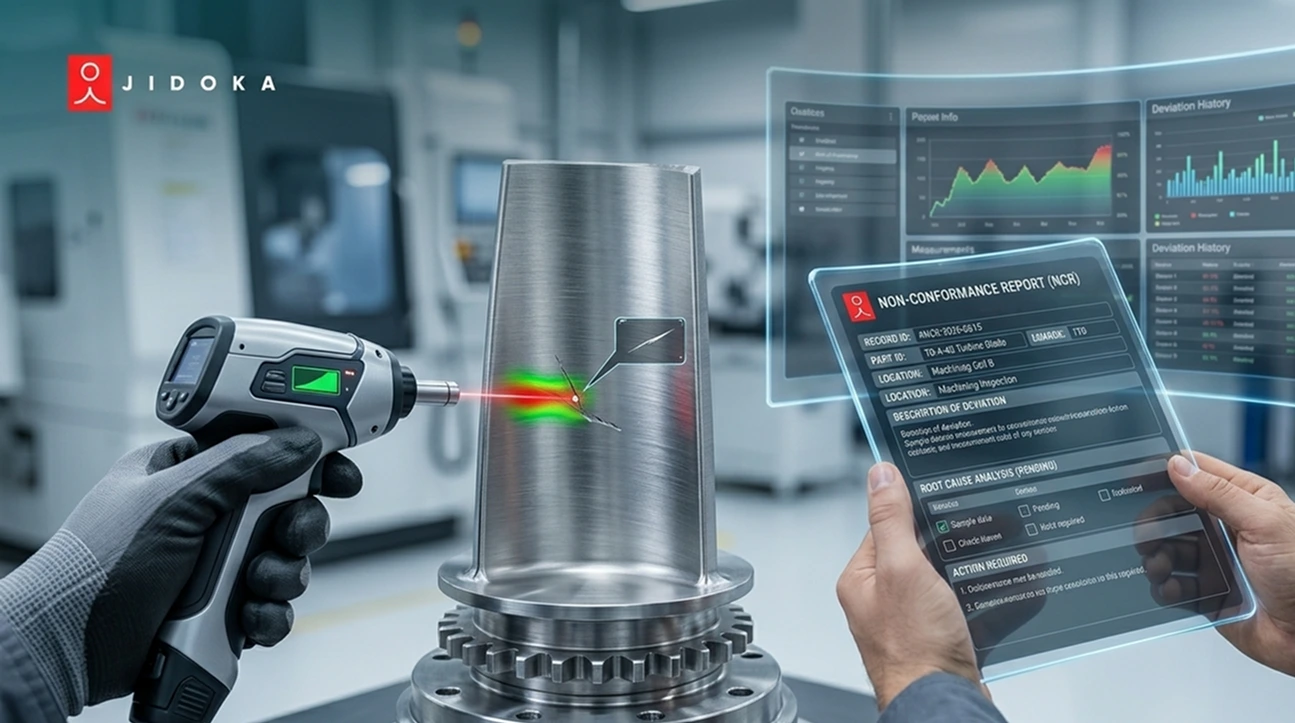
Addressing a manufacturing anomaly requires documentation, not a quick floor fix. In 2025, undocumented fixes resulted in a 62 percent repeat failure rate within 30 days across global assembly lines (Global Supply Chain Audit 2025).
Companies ignoring formal quality deviation report processes spend an average of $310,000 yearly on scrap that could have been avoided (Industrial Quality Review 2024). This guide breaks down exactly how to structure and resolve your non conformance reports permanently.
Key Takeaway: A non conformance report documents a manufacturing defect and initiates the process to resolve it. By immediately shifting from non conforming product handling into a structured corrective action plan manufacturing strategy, facilities reduce recurring defect rates by up to 54 percent annually (Manufacturing Quality Council 2025).
What Is a Non Conformance Report in Manufacturing?
A non conformance report is an official quality document that identifies a product or process failing to meet defined specifications. It isolates the exact defect, halting further production until engineers determine a safe disposition for the affected material.
The Trigger for an NCR Manufacturing Process
The ncr manufacturing process activates the moment a deviation crosses a defined threshold: an out-of-tolerance dimension, a failed material hardness test, a visual defect exceeding the Acceptable Quality Level, or a process parameter running outside its control limits. Speed matters. Operators must stop the line and open the paperwork immediately, before additional units compound the problem.
Jidoka's defect detection systems identify these triggers automatically during production, flagging non-conformances in real time and generating the data trail that feeds directly into the ncr process. Facilities in automotive and electronics manufacturing run KOMPASS AI across every station specifically to close the gap between defect occurrence and NCR initiation.
Immediate Non Conforming Product Handling
Physical quarantine is the first physical act in non conforming product handling. The affected parts must move to a locked cage or designated red-tag area, completely separated from conforming inventory. Every quarantined unit gets a label showing the lot number, date, defect description, and the name of the person who initiated the non conformance report.
The reason for secure segregation is not bureaucratic. It is to prevent accidental shipment. In a busy warehouse, unmarked or loosely tagged non-conforming parts routinely re-enter the good stock flow. A quarantine area with physical access control stops that. Jidoka's sorting and counting systems automate the physical separation step at scale, removing the risk of manual re-integration errors.
Types of Quality Deviations
Not all deviations carry the same risk. A surface cosmetic scratch below a defined threshold is a minor deviation. A dimension outside tolerance that affects fit or function is a major deviation. A safety-relevant failure or regulatory violation is a critical deviation requiring immediate escalation and customer notification.
Triage by severity determines the speed and depth of the ncr process response. Facilities that categorize and triage quality deviation report data respond to critical failures 40 percent faster than those using flat reporting systems (Quality Management Journal 2025). Severity classification at the point of detection, not after investigation, is what makes that speed possible.
With the non-conformance contained and classified, the documentation process determines whether the investigation succeeds or fails.
How Do You Write a Quality Deviation Report?
Writing a quality deviation report requires objective facts, precise measurements, and photographic evidence. Engineers must avoid assumptions, documenting only the physical reality of the defect to provide a flawless baseline for the root cause analysis phase.
For context on how documentation connects to broader production quality programs, see Jidoka's guides on in-process inspection and pre-shipment inspection for the upstream stages where NCR data originates.
Identifying the Exact Specification Failure
A non conformance report that says 'part looks wrong' is not a quality document. It is a note. The correct format cites the exact blueprint dimension or ISO standard violated: 'OD measured 47.3mm vs. 45.0±0.2mm per DWG-7891-A Rev.3, Clause 4.2.1. Out of specification by +2.1mm.' That language creates an airtight baseline for root cause investigation.
Vague language forces engineers to re-examine every workstation to find the source of a problem that precise documentation would have already pinpointed. A quality deviation report with a specific measurement, a specific drawing reference, and a specific lot number bounds the investigation scope to a single machine, a single shift, and a single process parameter.
Documenting Lot Numbers and Traceability
The traceability section of the non conformance report records the exact machine number, tool identifier, operator shift code, raw material batch number, and production date and time. These fields determine whether 10 parts are affected or 10,000. Without this data, containment is guesswork.
Jidoka's operator training and skills assessment tools generate automatic operator activity logs that feed directly into NCR traceability fields. The digital work instruction and Poke-Yoke systems create a timestamped record of every step performed, giving the ncr process a complete digital trace with no manual reconstruction required.
Setting the Initial Disposition Status
Four options exist for non-conforming material: rework (bring it into specification), scrap (destroy it), return to supplier (RTS, for incoming material failures), or use-as-is (accepted with an engineering waiver documenting the accepted risk). Each option must be authorized by the appropriate role before the parts move.
Standardizing disposition terminology across the facility reduces internal communication errors by 22 percent during active containment phases (Supply Chain Compliance Network 2024). When every department uses the same four words for the same four actions, there is no ambiguity about whether parts heading to 'rework' will be re-inspected before re-entering the conforming stock flow.
Moving From NCR to a Corrective Action Plan Manufacturing Strategy
A structured corrective action strategy upgrades an isolated report into a systemic facility improvement. It forces management to investigate why the failure occurred and mandates permanent changes to machinery, training, or materials to eliminate the root cause entirely.
Executing the Root Cause Analysis
The ncr process splits into two stages at this point. The correction fixes the immediate part: rework it, scrap it, or contain it. The corrective action fixes the system that allowed the defect to occur. Most facilities do the first. Fewer do the second. The repeat failure rate at 62 percent is the result.
Two tools cover most manufacturing root cause scenarios. The 5 Whys traces a defect back through five layers of causation: the part was undersize because the tool was worn; the tool was worn because the replacement interval was wrong; the interval was wrong because the process engineer used outdated material data; and so on until the actual system failure surfaces. The fishbone diagram (corrective preventive action method) maps causes across machines, methods, materials, measurement, environment, and people simultaneously, useful when the root cause involves multiple interacting factors.
Designing the Corrective Preventive Action
A corrective preventive action that relies on telling operators to 'be more careful' is not a corrective action. It is a hope. Effective CAPA physically prevents the error from recurring: a fixture that prevents misorientation, a sensor that rejects out-of-spec parts before the next operation, a machine interlock that halts the line if a parameter drifts past the control limit.
Jidoka's digital work instruction and Poke-Yoke enforcement systems are built exactly for this purpose: embedding corrective preventive action into the physical workflow so operators cannot proceed past a non-conforming state, rather than relying on their attention to catch it. For pharmaceutical and electronics environments where regulatory compliance requires verified poka-yoke, this approach also generates the audit trail that satisfies FDA or ISO 9001 documentation requirements.
Assigning Cross-Departmental Accountability
A CAPA that only quality signs off on will not get implemented. Production will not prioritize a process change that engineering did not approve. Engineering will not resource a machine modification that production did not request. This cross-department process requires named owners and hard deadlines across all three departments, not a recommendation memo that sits in a quality folder.
Cross-functional CAPA teams deploy permanent solutions 35 percent faster than isolated quality departments working alone (American Society for Quality 2025). One named owner per action item with a fixed due date, visible on a shared tracking system, is the structural minimum for that speed advantage.
Why Does CAPA Quality Management Prevent Recurrence?
CAPA quality management requires facilities to physically verify that a deployed solution prevents the defect from returning. This validation step proves that the corrective system change solved the underlying issue rather than masking a symptom.
The Validation and Verification Stage
A CAPA that gets deployed and never audited is not capa quality management. It is an expensive guess. Effective validation requires three audit points: 30, 60, and 90 days after the corrective action is implemented. The 30-day check runs a process capability study (Cpk) on the corrected workstation and confirms zero defect recurrence in the first production batch under the new process.
The 60-day audit confirms that the standard operating procedure has been revised and that the new process is documented, not just practiced. The 90-day final gate reviews full production data from two complete months under the new system. A CAPA cannot close until that statistical record shows the defect rate at zero. Closing it early because the manager is confident is not validation.
Updating the Standard Operating Procedures
The final mandatory step in the ncr manufacturing process is rewriting the official training documentation. If the root cause was a worn tool interval, the maintenance schedule gets updated. If it was a machine parameter setting, the setup sheet changes. If it was an operator technique, the work instruction is revised and every operator on that process re-certifies.
This step converts a one-time fix into institutional knowledge. The operator skills assessment and training systems Jidoka provides ensure that retraining on a revised SOP is documented, timestamped, and tied to the specific non conformance report that triggered the change. When a key operator leaves, the corrective knowledge stays in the system.
Automating the NCR Workflow
Paper-based ncr process management fails predictably: reports get lost, disposition decisions go undocumented, CAPA deadlines slip past unnoticed, and the 30-day audit never happens because nobody set a calendar reminder. Digital quality management systems eliminate every one of those failure modes.
Facilities replacing paper NCRs with digital workflows experience a 48 percent reduction in overdue corrective actions (Smart Factory Insights 2026). Jidoka's KOMPASS AI feeds live defect classification data directly into the NCR trigger, and NAGARE AI tracks non conforming product handling status across general manufacturing and warehousing environments, keeping every non conformance report status visible in real time.
How Jidoka Technologies Closes the Loop on NCR and CAPA
Jidoka's Vision AI platforms address the two biggest NCR failure points: late defect detection and disconnected documentation. KOMPASS catches deviations at the workstation level before they become batch-level containment events. NAGARE enforces the Poke-Yoke and work instruction compliance that CAPA actions mandate.
- KOMPASS AI: Runs defect detection and assembly validation at 99.8%+ accuracy, generating the precise defect data that converts a vague floor observation into a complete quality deviation report.
- NAGARE AI: Enforces Poke-Yoke and digital work instructions at each station, making the corrective actions from capa quality management physically enforced in the production flow.
- Industries: Active across automotive, electronics, pharmaceuticals, and FMCG: all environments where documented non conformance reports are regulatory requirements, not optional.
See how KOMPASS and NAGARE integrate with your QMS to automate NCR triggering and CAPA tracking. Book a deployment assessment with Jidoka's engineering team.
Conclusion
A non conformance report is your facility's most valuable tool for exposing weaknesses before they reach your customer. By linking every quality deviation report directly to a structured corrective action plan manufacturing workflow, and validating that solution at 30, 60, and 90 days, you convert a reactive paper exercise into a permanent defect prevention system.
Stop applying temporary fixes to problems that will return next month. Digitize your ncr process today and protect your production margins. Contact Jidoka to see how automated defect detection feeds your NCR workflow in real time.
Frequently Asked Questions
1. What is a non conformance report?
A non conformance report is a formal document used in manufacturing to record when a product, material, or process deviates from expected specifications. It triggers an immediate investigation and dictates whether the defective items should be scrapped, reworked, or accepted under a formal engineering waiver.
2. How does non conforming product handling work?
Non conforming product handling involves physically identifying and isolating defective items from the main production line. Technicians move these items to a secure quarantine area and apply bright physical tags showing lot number, defect description, and initiation date, ensuring bad parts are never accidentally shipped to a customer.
3. Is it a corrective action plan manufacturing strategy?
A corrective action plan manufacturing strategy is a structured approach to identifying the root cause of a defect and implementing a permanent systemic fix. It moves beyond repairing the broken part and focuses entirely on changing the machine, process, or material condition that allowed the defect to occur in the first place.
4. What is the difference between an NCR and a CAPA?
An NCR documents the physical defect and dictates what to do with the broken part right now. A CAPA is the subsequent systemic investigation that changes the manufacturing process to prevent that specific defect from recurring. The NCR captures the problem; the CAPA eliminates the root cause that created it.
5. Who is responsible for the NCR manufacturing process?
Quality inspectors typically initiate the non conformance report, but the full ncr process requires input from multiple departments. Machine operators, manufacturing engineers, and supply chain managers must all collaborate to determine the disposition, identify the root cause, and build the corrective action plan that closes the NCR permanently.