Las imágenes planas ya no son suficientes para proteger las líneas de producción modernas. Una cámara de inspección visual tradicional solo ve píxeles, no altura. Pasa por alto abolladuras, deformaciones y errores de profundidad que se cuelan silenciosamente en las piezas terminadas. Esa brecha explica por qué los fabricantes ahora confían en los sistemas de inspección por visión 3D para detectar problemas antes de que se conviertan en un problema mayor.
Con tolerancias más estrictas y líneas más rápidas, incluso una desviación de un milímetro provoca retrabajos o rechazos. Los sistemas de inspección por visión 3D resuelven esto añadiendo datos de profundidad, volumen y superficie a la inspección. Puedes medir formas, verificar ajustes y detectar defectos en tiempo real.
Este cambio ya no es opcional. Las plantas que buscan garantía de calidad automatizada necesitan una inspección que piense en tres dimensiones. Ahí es donde la inspección impulsada por IA, la tecnología de detección de profundidad y la detección de defectos en 3D transforman el funcionamiento real del control de calidad en la planta.
Los 3 mejores sistemas de visión 3D (clasificados por caso de uso)
Elegir entre sistemas de inspección por visión 3D depende de qué inspecciones, qué tan rápida sea tu línea y cuánta flexibilidad necesites en la planta. Algunos sistemas priorizan la estabilidad y un control estricto del hardware.
Otros se centran en la velocidad, el software y la IA. A continuación, los analizaré uno por uno, comenzando por el referente de la industria.
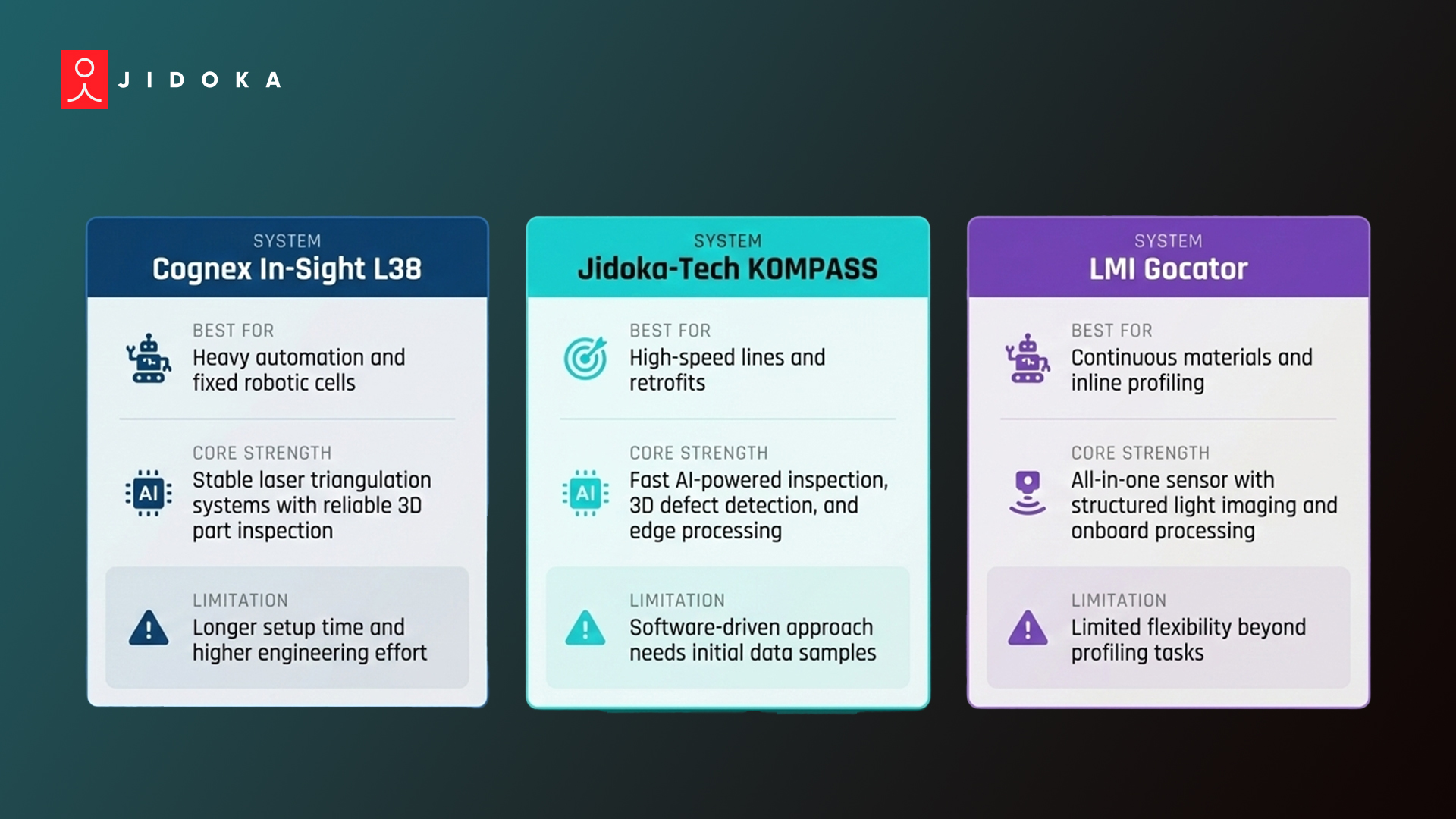
1. Cognex In-Sight L38 – El estándar de la industria
Ideal para: Automatización industrial pesada, celdas robóticas fijas y fábricas que ya están estandarizadas con hardware de Cognex para sistemas de inspección por visión 3D.
Tecnología clave:
- Sistemas de triangulación láser para captura de profundidad de alta precisión
- Cámara de inspección visual integrada con procesamiento a bordo
- Análisis de nubes de puntos de alta resolución para verificación de formas
- Compatibilidad nativa con guía de visión robótica y PLC
Por qué destaca: Cognex ofrece estabilidad y precisión en entornos exigentes. Su detección de profundidad basada en láser funciona bien con piezas rígidas y alineación robótica. La configuración requiere tiempo y experiencia, pero una vez ajustado, el sistema funciona de forma fiable a gran escala.
2. Jidoka-Tech KOMPASS – El especialista en IA y modernización
Ideal para: Bienes de consumo de alta rotación (FMCG), electrónica, componentes de automoción y plantas que necesitan sistemas de inspección por visión 3D que funcionen de forma constante en todos los turnos sin ralentizar la línea.
Tecnología clave:
- Visión por IA integrada que funciona totalmente en unidades de borde (edge)
- Detección de defectos en 3D con revisión de fotogramas en menos de 10 ms
- KOMPASS para comprobaciones de alta precisión de superficies y formas
- NAGARE para el seguimiento de secuencias utilizando cámaras existentes
Por qué destaca: Jidoka-Tech desarrolla inspecciones basadas en IA para la presión real de la producción. Las plantas reportan resultados estables a velocidades extremas y cientos de millones de comprobaciones diarias. Al combinar KOMPASS y NAGARE, el sistema gestiona la inspección y el seguimiento de procesos sin retrasos en la nube ni necesidad de un reentrenamiento complejo.
3. LMI Technologies Gocator—El sensor todo en uno
Ideal para: Perfilado en línea, flujo continuo de materiales y fábricas que requieren sistemas de visión 3D estables para inspección de chapa metálica, caucho, papel y procesos de bobinado.
Tecnología clave:
- Imágenes de luz estructurada para captura de superficie de ancho completo
- Tecnología de detección de profundidad integrada con procesamiento interno
- Sistemas de medición volumétrica incorporados para comprobaciones de altura y perfil
- Herramientas nativas para inspección de superficies 3D y perfilado de líneas
Por qué destaca: Gocator integra todo en un solo dispositivo. El procesamiento ocurre dentro del sensor, lo que reduce la complejidad del sistema y el esfuerzo de configuración. Ofrece un rendimiento fiable en tareas de inspección continua donde la precisión de la forma, el grosor y el perfil es fundamental en cada segundo.
Capacidades clave: ¿Qué diferencia a estos sistemas?
Todos los sistemas de visión 3D capturan profundidad, pero el rendimiento real depende de cómo miden, procesan y reaccionan en la línea. Las diferencias se hacen evidentes cuando aumentan la velocidad de producción, la variación de la superficie y el volumen de datos.
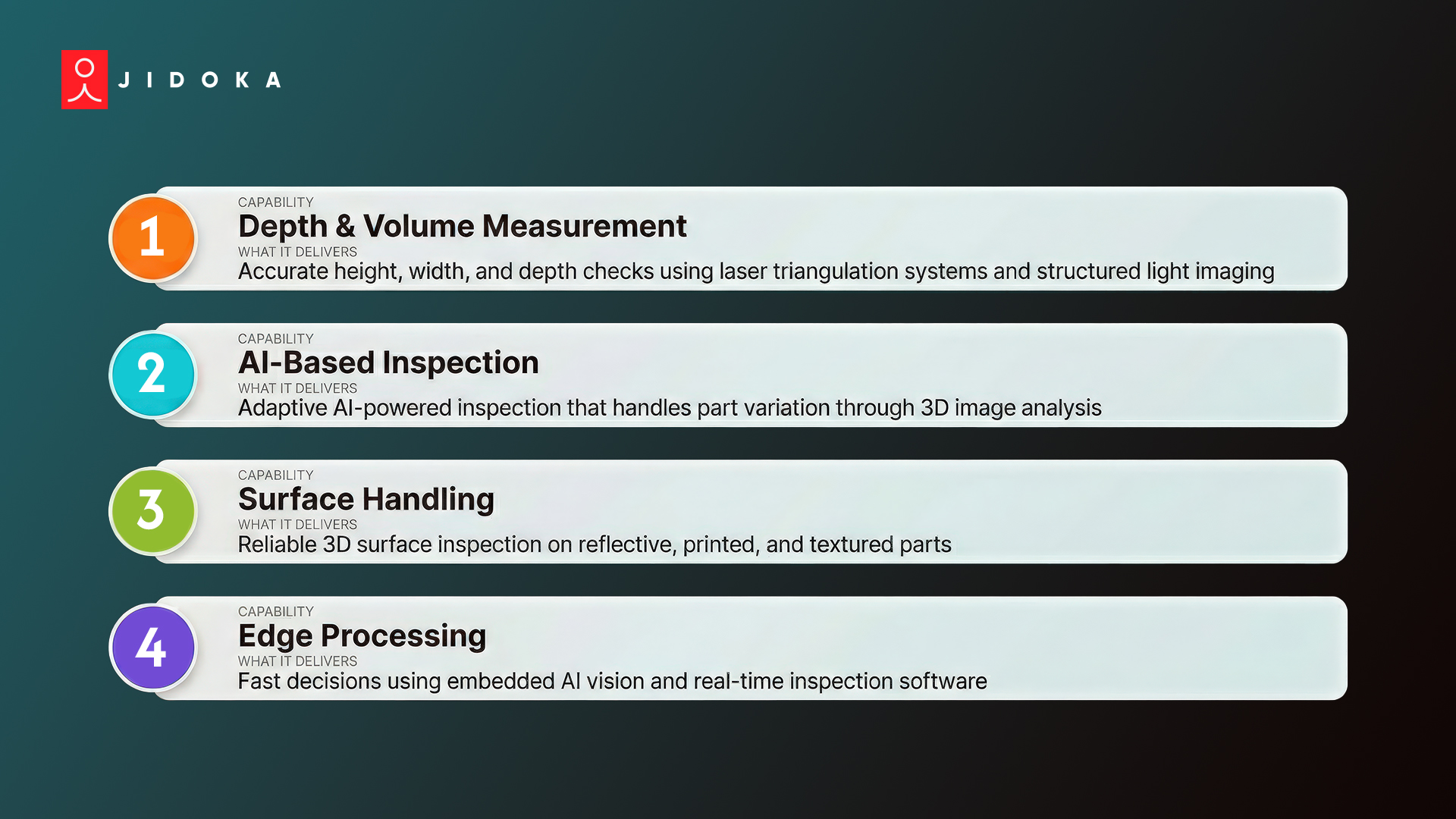
Detección de profundidad y medición volumétrica: Triangulación láser y la imagen de luz estructurada generan datos precisos de altura y volumen. Esto permite realizar inspecciones de piezas en 3D, medición de holguras y comprobaciones de espesor en una sola pasada mediante sistemas de medición de precisión.
Integración de IA y aprendizaje profundo: La inspección moderna basada en IA aprende de ejemplos en lugar de seguir reglas fijas. La visión artificial integrada se adapta a las variaciones de las piezas, los cambios de iluminación y los cambios de orientación sin necesidad de reprogramación constante.
Gestión de superficies complejas: El control avanzado de iluminación y el análisis de nubes de puntos permiten la inspección de superficies en 3D en metales reflectantes, etiquetas impresas y piezas texturizadas donde los sistemas 2D fallan.
Aquí es donde los sistemas robustos de inspección por visión 3D marcan la diferencia en las plantas de producción reales.
Por qué Jidoka-Tech es la opción inteligente para las líneas modernas
Jidoka-Tech desarrolla sistemas de inspección basados en IA que resisten la presión de la producción real. El equipo alinea cámaras, iluminación, temporización de PLC y unidades de procesamiento en el borde para que los sistemas de visión 3D se mantengan estables a lo largo de los turnos y las velocidades de línea.
Las plantas que utilizan Jidoka reportan un rendimiento constante de 1más de 2000 piezas por minuto y hasta 300 millones de inspecciones al día. Esa fiabilidad proviene de la combinación de dos sistemas que llevan la inspección más allá de las comprobaciones básicas.
1. KOMPASS actúa como el inspector de alta precisión. Alcanza una precisión superior al 99,8 %, revisa fotogramas en menos de 10 ms, aprende nuevas variantes con menos muestras y gestiona metales reflectantes, áreas impresas y piezas texturizadas mediante detección de defectos en 3D.
2. NAGARE funciona como analista de procesos. Rastrea cada paso del ensamblaje a través de las cámaras existentes, señala las piezas faltantes en tiempo real y reduce el retrabajo en un 20–35%.
Todo se ejecuta localmente en unidades de borde, lo que mantiene los sistemas de inspección por visión 3D rápidos, receptivos y fiables. Implemente sistemas precisos de inspección por visión 3D en su línea de producción en días, no en meses. Descubra cómo Jidoka-Tech se integra en su configuración actual sin ralentizar la producción.
Conclusión
Los problemas de calidad ya no provienen de defectos evidentes. Surgen de pequeños errores de profundidad, variaciones en la superficie y pasos de proceso omitidos que los sistemas 2D nunca detectan. Por eso, los sistemas de inspección por visión 3D se sitúan ahora en el centro del control de calidad moderno.
Cognex se adapta a la automatización pesada con un perfilado láser estable. LMI funciona bien para materiales continuos y mediciones en línea. Cada uno tiene su lugar. El desafío comienza cuando las líneas funcionan más rápido, las piezas varían más y el tiempo de inactividad se vuelve costoso.
Ahí es donde Jidoka-Tech destaca. Su inspección impulsada por IA se ejecuta en unidades de borde, se adapta a las variaciones y se integra en las líneas existentes sin interrupciones. Con detección de defectos en 3D, seguimiento de procesos y decisiones en tiempo real,
Conectemos con Jidoka-Tech para lograr una implementación rápida y una inspección consistente en su línea de producción.
Preguntas frecuentes
1. ¿Es la visión 3D más lenta que la inspección 2D?
No. Los sistemas modernos de inspección por visión 3D utilizan visión artificial integrada y procesamiento en el borde para analizar datos de profundidad y superficie en milisegundos. Con una inspección optimizada basada en IA, el rendimiento iguala a las líneas de alta velocidad sin ralentizar software de inspección en tiempo real.
2. ¿Pueden los sistemas 3D inspeccionar piezas reflectantes o texturizadas?
Sí. Los sistemas avanzados de triangulación láser, la iluminación controlada y el análisis de nubes de puntos permiten una inspección de superficies 3D fiable en metales reflectantes, etiquetas impresas, vidrio y componentes texturizados donde una cámara de inspección visual estándar fallaría.
3. ¿Necesito expertos en IA para operar estos sistemas?
No. Los sistemas líderes de inspección por visión 3D se entrenan con muestras visuales, no con código. Los ingenieros de línea pueden gestionar la detección de defectos en 3D, el control de calidad automatizado y el análisis de imágenes 3D sin necesidad de conocimientos en ciencia de datos ni de escribir reglas complejas.
4. ¿Pueden los sistemas de inspección por visión 3D funcionar con líneas de producción existentes?
Sí. Muchos sistemas de inspección por visión 3D son independientes del hardware y fáciles de adaptar. Se integran con configuraciones de cámaras de inspección visual existentes, PLC y robots, permitiendo una inspección basada en IA y un control de calidad automatizado sin tener que reconstruir la línea.
5. ¿Qué tan precisos son los sistemas de inspección por visión 3D en la producción real?
La precisión se mantiene alta en condiciones reales. Gracias a la tecnología de detección de profundidad, los sistemas de medición de precisión y la detección de defectos en 3D, los sistemas modernos de inspección por visión 3D logran consistentemente una precisión de inspección superior al 99 por ciento en líneas de producción de alta velocidad.