.jpg)
Las fábricas dependían antes de la vista humana para detectar defectos. Ese modelo falla cuando aumenta la velocidad. Las empresas líderes en visión artificial ahora impulsan la calidad mediante una IA que supervisa cada unidad, cada segundo, sin cansarse. Sientes la presión cuando aumentan los residuos, los clientes se quejan o las auditorías retrasan los envíos. Un sistema moderno de inspección por visión artificial soluciona esto detectando patrones que pasan desapercibidos para las personas y actuando en tiempo real.
Este cambio explica por qué los compradores buscan empresas líderes en visión artificial en lugar de simples cámaras o scripts. Quieren resultados. Menos rechazos erróneos. Datos más limpios. Producción estable en todos los turnos. Estas empresas de visión artificial combinan aprendizaje profundo, cámaras inteligentes y procesamiento en el borde para mantener las líneas en movimiento y a los equipos seguros.
Esta guía detalla quién lidera el mercado, en qué destaca cada uno y cómo elegir sin margen de error.
La estrella emergente: inspección visual basada en IA
Esta categoría abarca las principales empresas de visión artificial diseñadas desde cero con IA. Se centran en los resultados en la línea de producción, no en herramientas aisladas. Estos equipos gestionan el software, el hardware y la implementación de forma integral para que la calidad se mantenga estable a la velocidad real de la fábrica.
1. Jidoka Tech
Jidoka Tech desarrolla software de inspección visual con IA integral que funciona directamente en las líneas de producción. Con más de 48 clientes de confianza en todo el mundo y más de 100 implementaciones exitosas, el enfoque se mantiene en una precisión estable a la velocidad real de la fábrica.
Características clave
- KOMPASS motor de aprendizaje profundo para la detección y clasificación de defectos
- Inferencia en el borde para decisiones de inspección en tiempo real
- Modular NAGARE hardware que se adapta a las configuraciones de transportadores existentes
- Retroalimentación con intervención humana para la mejora continua del modelo
Servicios ofrecidos e ideales para: Implementación de sistemas de inspección por IA, automatización de líneas de producción, optimización de la detección de defectos y fabricantes que enfrentan rechazos falsos, desviaciones de calidad y cuellos de botella en la inspección.
Por qué están en la lista: Jidoka Tech combina modelos de aprendizaje profundo, computación de borde, cámaras industriales e integración a nivel de línea en un solo sistema. Destacan entre las principales empresas de visión artificial al vender precisión en la inspección y reducción de residuos, no herramientas aisladas.
2. Cognex Corporation
Cognex es una de las principales empresas de visión artificial, reconocida por la implementación a gran escala de inspecciones basadas en IA en fábricas y almacenes. Sus sistemas respaldan controles de calidad consistentes en entornos de alto volumen que exigen velocidad y repetibilidad.
Características clave
- Plataforma OneVision para crear y gestionar modelos de IA
- Cámaras inteligentes In-Sight para tareas de inspección integradas
- Herramientas VisionPro para la automatización avanzada del procesamiento de imágenes
- Soporte para control de calidad en tiempo real en todas las instalaciones
Servicios ofrecidos e ideales para: sistemas de inspección por visión artificial, software de inspección visual por IA, automatización mediante visión por computadora, e ideales para fabricantes globales que ejecutan programas de inspección en múltiples plantas.
Por qué están en la lista: Cognex se ha ganado su lugar entre las principales empresas de visión artificial al combinar modelos de IA gestionados en la nube, cámaras inteligentes y software listo para la producción. Su ecosistema permite la inspección visual automatizada, la clasificación de defectos mediante IA y la supervisión de líneas de producción a escala empresarial.
3. Keyence Corporation
Keyence se sitúa entre las mejores empresas de visión artificial gracias a sus sistemas de inspección basados en hardware, diseñados para ofrecer velocidad y precisión. Sus soluciones se centran en la calidad de imagen y en la estabilidad de las mediciones en entornos industriales exigentes.
Características principales
- Cámaras inteligentes de alta resolución hasta 25 megapíxeles
- Sistemas de visión 2D y 3D integrados
- Herramientas integradas para la inspección visual automatizada
- Configuración rápida con ajustes mínimos para los operarios
Servicios ofrecidos y aplicaciones ideales: sistemas de inspección por visión artificial, inspección para automatización industrial, fabricación de cámaras inteligentes y líneas de producción de alta variedad donde la claridad de imagen y la precisión de medición determinan los resultados de la inspección.
Por qué están en la lista: Keyence destaca entre las principales empresas de visión artificial al priorizar la óptica, los sensores y la fiabilidad del hardware. Sus sistemas permiten la detección automatizada de defectos y el control de calidad en tiempo real sin depender excesivamente de complejos procesos de entrenamiento de IA.
4. Basler AG
Basler AG se centra en tecnología de visión a nivel de cámara en la que confían muchas de las principales empresas de visión artificial e integradores de sistemas para crear configuraciones de inspección estables en entornos industriales exigentes.
Características clave
- Cámaras industriales con protección IP67 para plantas de producción
- serie de cámaras ace 2 para captura de imágenes de alta velocidad
- Compatibilidad con sistemas de visión 2D y 3D
- Amplia compatibilidad con paquetes de software de visión artificial
Servicios ofrecidos e ideales para: componentes de sistemas de inspección por visión artificial, soluciones de cámaras industriales, automatización de procesamiento de imágenes, y fabricantes e integradores que construyen líneas de inspección personalizadas que requieren durabilidad
Por qué están en la lista: Basler se gana el reconocimiento entre las principales empresas de visión artificial al ofrecer hardware de cámara fiable que respalda la inspección visual automatizada y tecnología de inspección de alta velocidad. Su enfoque basado en sensores se adapta a entornos donde la consistencia, el tiempo de actividad y la calidad de imagen son más importantes que el software empaquetado.
5. Teledyne Technologies
Teledyne Technologies se centra en la velocidad y precisión extremas, apoyando a las principales empresas de visión artificial con sistemas de imagen diseñados para la inspección industrial ininterrumpida donde cada milisegundo cuenta.
Características clave
- Cámaras de escaneo lineal para la inspección continua de materiales
- Sensores de obturador global para imágenes sin distorsión
- Captura de alta velocidad de fotogramas para líneas de producción rápidas
- Soporte para automatización de procesamiento de imágenes en el borde (edge)
Servicios ofrecidos y aplicaciones ideales: sistemas de inspección por visión artificial, tecnología de inspección de alta velocidad, inspección para automatización industrial, ideal para líneas de producción de acero, papel, textiles y materiales continuos que operan a velocidad constante
Por qué están en la lista: Teledyne destaca entre las principales empresas de visión artificial por su especialización en sensores y cámaras de alta velocidad que potencian la detección automatizada de defectos. Su tecnología permite un control de calidad en tiempo real en entornos donde los sistemas de visión estándar no son suficientes.
6. SICK AG
SICK AG desarrolla sistemas de visión industrial donde la inspección impulsa directamente la automatización. La empresa ofrece soluciones de sistemas de inspección por visión artificial que conectan los datos visuales con máquinas, robots y lógica de control en la planta de producción.
Características clave
- Sistemas de visión 3D para detección y posicionamiento de objetos
- Sensores de visión diseñados para la inspección en automatización industrial
- Integración directa con PLC y controladores de robots
- Control de calidad en tiempo real vinculado a las acciones de la máquina
Servicios ofrecidos y aplicaciones ideales: sistemas de inspección por visión artificial, automatización mediante visión por computadora, robótica guiada por visión, logística, recolección robótica, manipulación de materiales y líneas de producción automatizadas
Por qué están en la lista: SICK AG se gana su lugar entre las principales empresas de visión artificial al enfocarse en la visión orientada a la acción. Su conjunto de herramientas combina sensores, automatización de procesamiento de imágenes e integración de control, de modo que la inspección visual automatizada derive en una respuesta física inmediata, en lugar de un análisis diferido.
7. OMRON Corporation
OMRON Corporation ofrece sistemas de inspección basados en IA diseñados para una configuración rápida y resultados estables. Su enfoque se centra en las empresas líderes de visión artificial que requieren una detección de defectos fiable sin largos ciclos de entrenamiento ni ajustes complejos.
Características clave
- Sistemas de visión de la serie FH con AI Fine Matching
- Aprendizaje rápido de modelos para la detección de defectos estéticos
- Soporte para inspección visual automatizada a velocidad de línea
- Controladores integrados para el monitoreo de líneas de producción
Servicios ofrecidos e ideales para: sistema de inspección por visión artificial, software de inspección visual con IA, detección automatizada de defectos, ideal para líneas de electrónica, automoción y embalaje con cambios frecuentes de producto
Por qué están en la lista: OMRON destaca entre las principales empresas de visión artificial al reducir el tiempo de aprendizaje de la IA manteniendo la estabilidad en la inspección. Su conjunto de herramientas combina cámaras inteligentes, IA integrada y automatización del procesamiento de imágenes para facilitar el control de calidad en tiempo real sin configuraciones complejas.
8. Intel Corporation
Intel apoya a las principales empresas de visión artificial potenciando los sistemas de inspección en el borde (edge). Su enfoque se centra en la inferencia rápida, el procesamiento de baja latencia y el despliegue estable para la inspección basada en IA en plantas de producción.
Características clave
- Kit de herramientas OpenVINO para inferencia optimizada en el borde
- Aceleración de hardware para inspección visual impulsada por IA
- Soporte para cargas de trabajo de control de calidad en tiempo real
- Arquitectura de visión informática escalable en el borde
Servicios ofrecidos e ideales para: Habilitación de IA en el borde, aceleración de sistemas de inspección por visión artificial, automatización del procesamiento de imágenes y fabricantes que ejecutan modelos de IA directamente en líneas de producción con requisitos estrictos de latencia.
Por qué están en la lista: Intel se gana un lugar entre las principales empresas de visión artificial al permitir la detección de defectos mediante aprendizaje profundo en el borde. Su conjunto de hardware y software permite la inspección visual automatizada, el monitoreo de líneas de producción y la IA de clasificación de defectos sin depender de la nube.
9. Sony Semiconductor
Sony Semiconductor desempeña un papel fundamental entre las principales empresas de visión artificial al suministrar sensores de imagen que definen la precisión de la inspección. Su tecnología de sensores influye directamente en cómo los sistemas de inspección por visión artificial detectan defectos a velocidad de producción.
Características principales
- Sensores CMOS de obturación global para una captura sin distorsiones
- Imágenes de alta sensibilidad para inspección visual automatizada
- Compatibilidad con tecnología de inspección de alta velocidad
- Diseños de sensores optimizados para la inspección en automatización industrial
Servicios ofrecidos e ideales para: tecnología de sensores de imagen, fabricación de cámaras inteligentes, bases de sistemas de inspección por visión artificial, y fabricantes de cámaras y fábricas que desarrollan software de inspección visual mediante IA basado en datos de imagen fiables.
Por qué están en la lista: Sony Semiconductor se gana su lugar entre las principales empresas de visión artificial al controlar la calidad de imagen desde el nivel del sensor. Su tecnología permite la detección automatizada de defectos, el control de calidad en tiempo real, la detección de defectos mediante aprendizaje profundo y una automatización estable del procesamiento de imágenes antes incluso de que se ejecuten los modelos de IA.
10. National Instruments
National Instruments respalda a las principales empresas de visión artificial mediante sistemas de inspección basados en software que los ingenieros personalizan para casos de uso complejos en fábricas, donde la flexibilidad es más importante que los flujos de trabajo predefinidos.
Características principales
- Vision Development Module para lógica de inspección personalizada
- Compatibilidad con la automatización y medición del procesamiento de imágenes
- Integración estrecha con hardware de pruebas y automatización
- Soporte de implementación para sistemas de inspección en el borde (edge)
Servicios ofrecidos e ideales para: desarrollo de software de visión, personalización de sistemas de inspección por visión artificial, inspección de automatización industrial y equipos de ingeniería que construyen estaciones de inspección personalizadas y líneas de producción basadas en I+D.
Por qué están en la lista: National Instruments obtiene reconocimiento entre las principales empresas de visión artificial al permitir un control profundo sobre la lógica de inspección. Su stack tecnológico admite la inspección visual automatizada, la IA de clasificación de defectos y la monitorización de líneas de producción donde los equipos necesitan un control total sobre el comportamiento de la IA y la visión.
Resumen de las 10 principales empresas de visión artificial en EE. UU.:
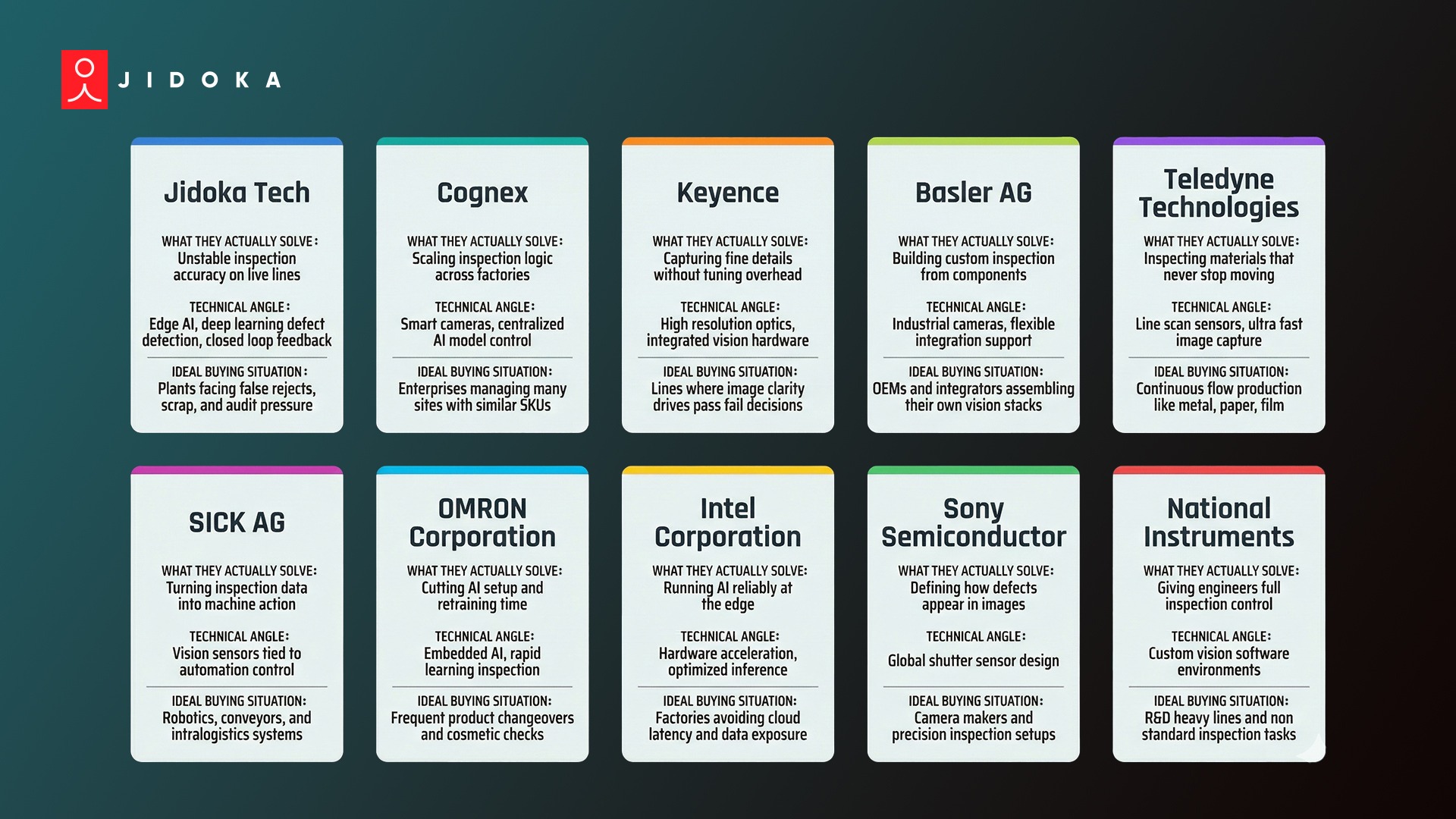
Conclusión
La inspección manual y la visión basada en reglas siguen siendo un problema en las plantas de producción. Los defectos pasan desapercibidos, los rechazos falsos se acumulan y los equipos de calidad luchan contra resultados inestables en cada turno. Los datos permanecen fragmentados, por lo que las causas raíz siguen ocultas. Las líneas se ralentizan, los costes aumentan y los clientes lo notan.
Las consecuencias son graves. El desperdicio aumenta, el reprocesamiento reduce los márgenes y los envíos sufren retrasos. Las auditorías se vuelven estresantes. Con el tiempo, las marcas pierden credibilidad y los equipos pierden la confianza en los datos de inspección. Ignorar estos problemas cuesta mucho más que solucionarlos.
Ahí es donde Jidoka entra en juego. Jidoka ofrece un software de inspección visual por IA diseñado para líneas de producción reales, no para demostraciones de laboratorio. Gracias a la implementación de sistemas de inspección por visión artificial en el borde (edge), la detección de defectos mediante aprendizaje profundo y una integración estable, Jidoka ayuda a los fabricantes a recuperar el control, reducir el desperdicio y mantener una calidad constante a gran velocidad.
Contacte con Jidoka Tech para ver cómo la inspección por IA puede estabilizar la calidad de su producción.
Preguntas frecuentes
1. ¿En qué se diferencia Jidoka de otras empresas líderes en visión artificial?
Jidoka se distingue de las principales empresas de visión artificial al ofrecer un sistema completo de inspección, no herramientas aisladas. Combina software de inspección visual por IA, visión mediante computación en el borde (edge), inspección visual automatizada e integración en la línea de producción para reducir los rechazos falsos y estabilizar el control de calidad en tiempo real.
2. ¿Cómo reduce la IA los rechazos falsos en la inspección visual?
Las reglas tradicionales fallan ante la variabilidad. El software de inspección visual por IA utiliza detección de defectos mediante aprendizaje profundo y clasificación por IA para aprender los patrones aceptables. Este enfoque mejora la detección automatizada de defectos, respalda el control de calidad en tiempo real y mantiene estable la precisión del sistema de inspección por visión artificial en todos los turnos.
3. ¿Debe la inspección por visión ejecutarse en sistemas de borde (edge) o en la nube?
Las configuraciones de sistemas de inspección por visión artificial basadas en el borde (edge) ofrecen decisiones más rápidas y un manejo de datos más seguro. La visión mediante computación en el borde permite la inspección visual automatizada y el monitoreo de la línea de producción en tiempo real, mientras que las plataformas en la nube ayudan con el análisis, la generación de informes y el seguimiento del rendimiento en múltiples sitios.
4. ¿Cuánto tiempo lleva implementar un sistema de visión artificial?
La velocidad de implementación depende del diseño. Las plataformas modulares de sistemas de inspección por visión artificial que utilizan software de inspección visual por IA pueden estar operativas en un plazo de cuatro a ocho semanas. Los proyectos personalizados de automatización con visión artificial suelen tardar más debido a las necesidades de integración, ajuste y validación.