La fabricación avanza a gran velocidad. La mayoría de las máquinas simplemente funcionan hasta terminar, incluso si generan errores. Comprender el significado de Jidoka cambia eso. Este concepto nació con el Sistema de Producción Toyota. Los expertos lo llaman “Autonomatización” porque aporta un toque humano a la automatización.
Un sistema de fabricación Jidoka estándar se detiene en el momento en que detecta un defecto. Este enfoque de control de calidad en la manufactura esbelta evita el desperdicio y ahorra dinero. Detener la línea de producción ahora evita tener que reparar miles de piezas más tarde.
Conocer el significado de Jidoka le ayuda a construir una fábrica más inteligente. El significado de Jidoka convierte a las máquinas "tontas" en herramientas inteligentes capaces de detectar sus propios errores.
¿Qué significa "jidoka"?
El significado de Jidoka proviene de tres raíces japonesas específicas. "Ji" representa al trabajador. "Do" se refiere al movimiento. "Ka" significa la acción. Al combinarlas, se obtiene la fabricación con autonomatización. Este sistema de fabricación Jidoka añade inteligencia humana a las máquinas estándar, transformando herramientas básicas en activos inteligentes.
Este concepto comenzó con el Sistema de Producción Toyota para mejorar el control de calidad en la manufactura esbelta. Sakichi Toyoda construyó un telar que se detenía instantáneamente cuando se rompía un hilo.
Demostró que detenerse a tiempo ahorra dinero.
- Las máquinas se detienen al detectar un fallo.
- Los trabajadores controlan el flujo de la línea.
- Los sistemas de detección de defectos detectan los errores a tiempo.
- La automatización del control de calidad elimina los residuos.
Comprender el significado de Jidoka garantiza que su equipo valore la precisión por encima de la velocidad. El significado de Jidoka protege su reputación. Puede ver cómo funciona observando las cuatro acciones específicas que se llevan a cabo durante la producción.
Los 4 pasos de Jidoka (cómo funciona)
La implementación de un sistema de fabricación Jidoka requiere las siguientes cuatro acciones claras. Estos pasos muestran el verdadero significado de Jidoka en un entorno de trabajo diario. Utilice estas etapas para garantizar que el control de calidad de la fabricación ajustada se mantenga alto.
Así es como se pone en práctica el significado de Jidoka.
Paso 1: Detectar la anomalía
Su sistema de fabricación Jidoka comienza cuando una máquina o un operario detecta un error. Los sistemas modernos de detección de defectos utilizan IA o sensores para encontrar estos fallos al instante. Este paso muestra el verdadero significado de Jidoka al detener los errores antes de que aumenten. Usted identifica el problema exactamente donde ocurre.
Paso 2: Detener la producción
La línea se detiene en el momento en que ocurre un error. Este paso de calidad de parada de máquina mantiene su inventario limpio. Usted detecta el problema en el momento. El significado de Jidoka requiere una parada total para garantizar que se corrija el proceso. Esto evita que envíe piezas defectuosas a sus clientes.
Paso 3: Corregir la condición inmediata
Su equipo soluciona el problema rápidamente para que la línea vuelva a moverse. Esto mantiene su control de calidad de fabricación ajustada en el camino correcto. Usted resuelve el fallo para que la producción se reanude sin generar más residuos. Mantiene el flujo de trabajo constante.
Paso 4: Investigar la causa raíz
Termine realizando un análisis de causa raíz. Esto evita que el mismo error vuelva a ocurrir mañana. Este paso impulsa la mejora continua en la fabricación de su taller. El significado de Jidoka le ayuda a convertir un problema en una lección. Este conocimiento hace que su fábrica sea más fuerte con el tiempo.
Seguir estos cuatro pasos aclara el significado de Jidoka para todo su equipo. Puede ver el significado de Jidoka en acción a través de las herramientas específicas utilizadas en la planta.
El kit de herramientas: Andon y Poka-Yoke
Necesita herramientas específicas para que el significado de Jidoka funcione en la planta de producción. Estas herramientas proporcionan la automatización del control de calidad necesaria para el éxito moderno. Dos sistemas principales le ayudan a mantener el control de calidad de la fabricación ajustada todos los días.
1. El sistema Andon
La configuración ajustada del sistema Andon utiliza señales visuales como luces o paneles. Indica a todos el estado de la línea de producción. Una luz verde significa flujo, mientras que una luz roja indica una parada. Esta herramienta hace que el significado de Jidoka sea visible para todo el equipo. Garantiza que nunca ignore un problema.
2. Mecanismos Poka-Yoke
A prueba de errores poka-yoke son técnicas que hacen imposible cometer un error. Piense en un enchufe que solo encaja de una manera. Estas soluciones mecánicas respaldan el significado de Jidoka al prevenir errores antes incluso de que comiencen.
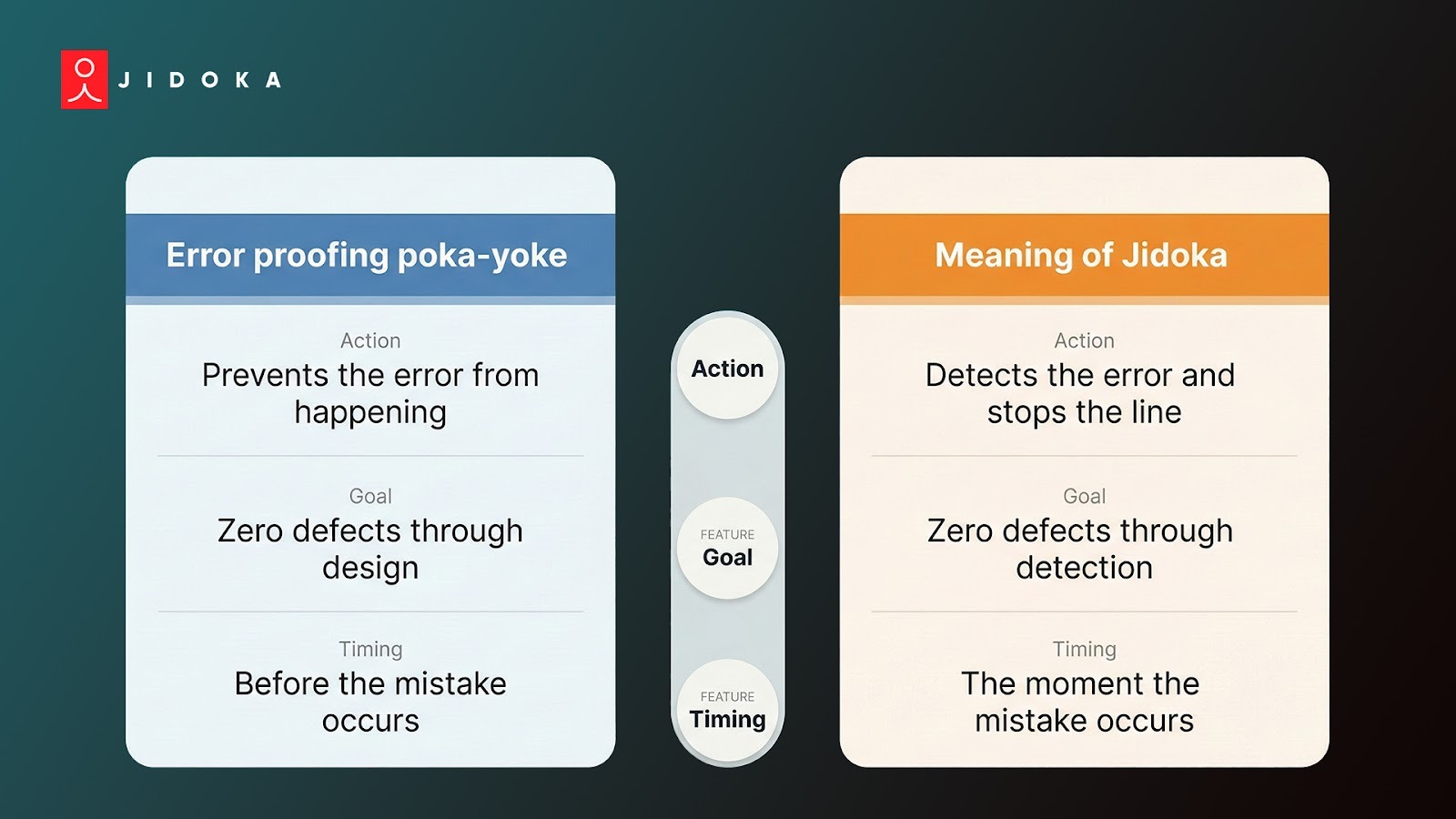
Comprender cómo funcionan estas herramientas le ayuda a gestionar un mejor sistema de fabricación Jidoka. Aprende a detectar problemas en el momento adecuado. Esto le diferencia de los modelos de fábrica tradicionales.
Jidoka frente a la automatización tradicional
Los sistemas tradicionales priorizan la velocidad y el alto volumen. Sus máquinas funcionan hasta que termina el trabajo, incluso si producen errores. A menudo, los defectos solo se descubren durante una inspección final. Esto genera residuos costosos.
El significado de Jidoka ofrece una mejor alternativa a través del control de calidad en la fabricación ajustada.
- Las máquinas tradicionales son "ciegas" ante los errores.
- Las máquinas del sistema de fabricación Jidoka tienen "ojos" para ver.
- El significado de Jidoka ahorra costes al detener la producción de desechos.
- Usted obtiene la optimización de la línea de producción a través de retroalimentación instantánea.
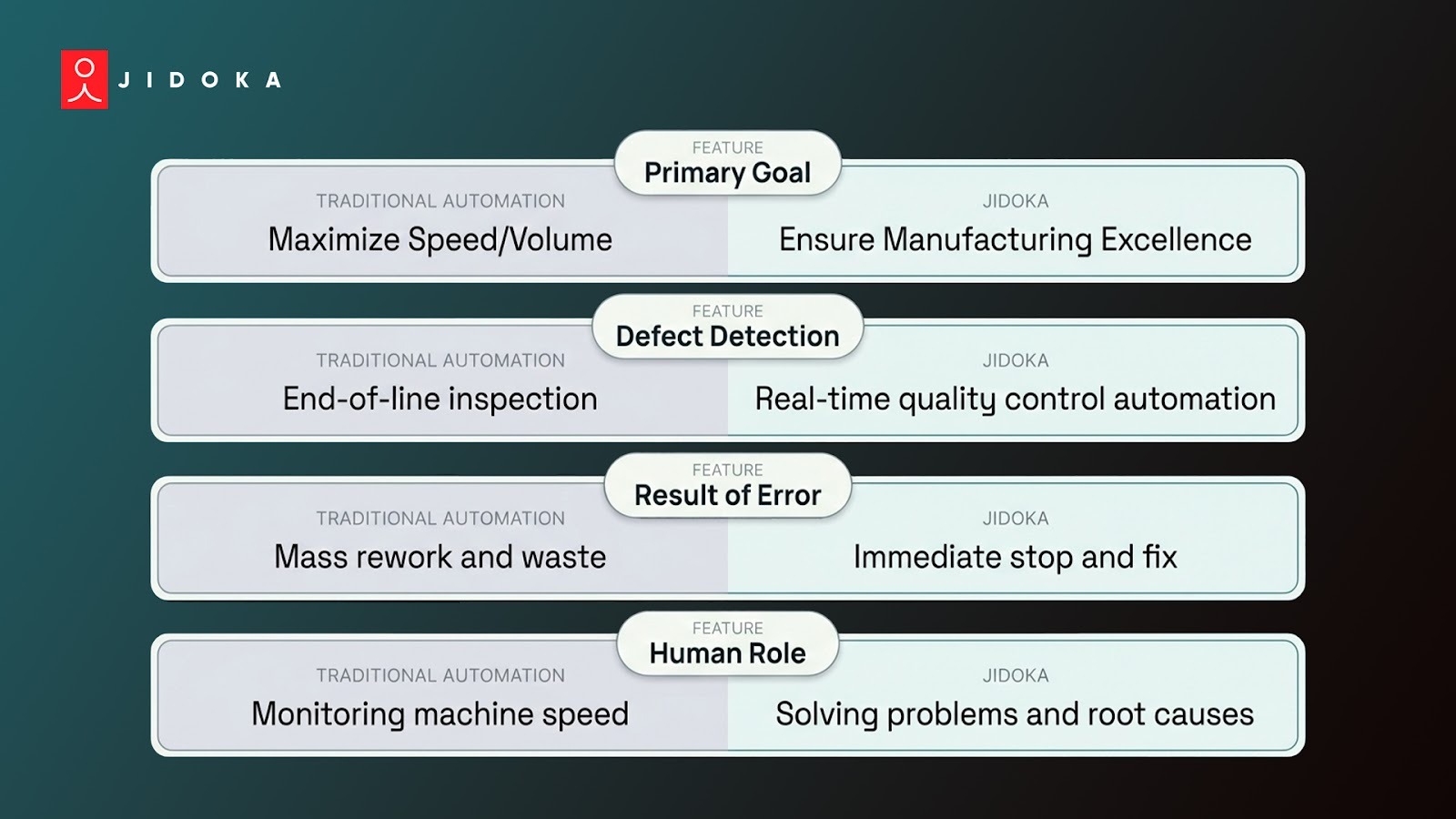
Utilizar este enfoque hace que toda su planta de producción sea más inteligente. Para alcanzar este nivel de eficiencia, necesita un plan claro para su equipo.
Hoja de ruta para la implementación de Jidoka
Configurar un sistema de fabricación Jidoka requiere un plan claro. No puede simplemente comprar una máquina y esperar resultados. Debe cambiar la forma en que su equipo piensa sobre los errores. Comprender el significado de Jidoka le ayuda a guiar a sus trabajadores a través de estos cambios.
Siga estas cuatro fases para lograr la excelencia en la fabricación.
- Fase 1: Cambio cultural: Debe facultar a sus trabajadores para detener la línea. No deben temer represalias por detectar un fallo. Esta apertura es la esencia del significado de Jidoka.
- Fase 2: Añadir detección inteligente: Instale sensores o herramientas de visión por IA. Estos sistemas de detección de defectos actúan como el ojo inteligente de su fábrica. Apoyan el control de calidad de la manufactura esbelta al supervisar cada pieza.
- Fase 3: Instalar Andon: Configure paneles visuales o luces. Esto hace que el significado de Jidoka sea visible para todos en la planta. Mejora la optimización de su línea de producción.
- Fase 4: Estandarizar: Utilice los datos de sus paradas para actualizar sus normas. Realice un análisis de causa raíz para asegurarse de que los errores no vuelvan a ocurrir.
Estas fases garantizan que su calidad se mantenga alta. Al seguir esta hoja de ruta, usted adopta el significado completo de Jidoka.
Hoja de ruta para la implementación de Jidoka de un vistazo
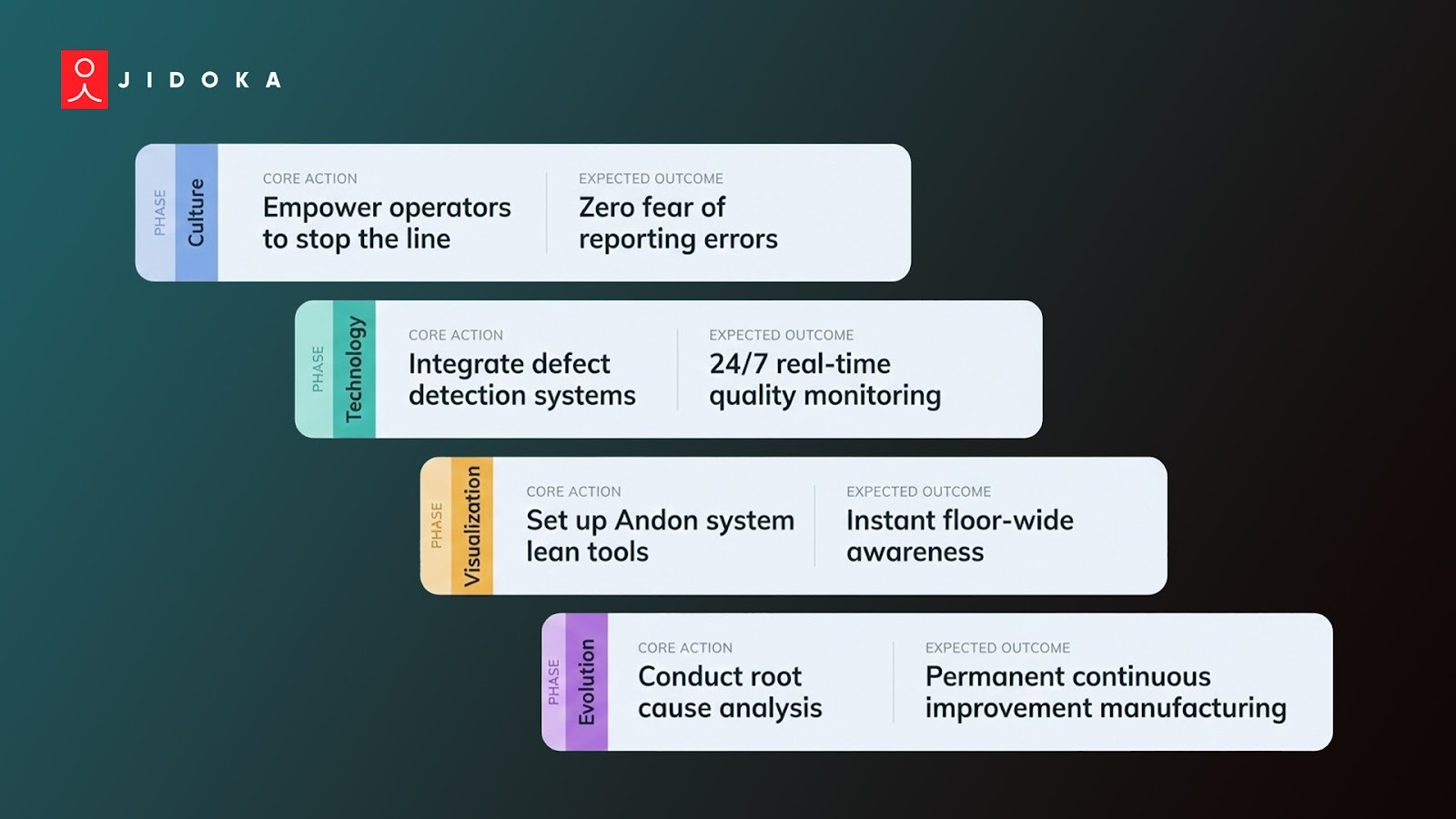
Este proceso le prepara para utilizar herramientas específicas que se encargan del trabajo pesado por usted.
Cómo la tecnología Jidoka automatiza la fase de "detección"
Jidoka Tech construye un sistema de inspección por IA que prospera bajo la presión real de la producción. Su equipo alinea cámaras, iluminación y sincronización de PLC para que el significado de Jidoka funcione en cada turno.
Las plantas que utilizan esta configuración obtienen resultados consistentes incluso a 12,000 piezas por minuto. Este sistema de fabricación Jidoka utiliza dos herramientas potentes para mejorar su flujo:
- KOMPASS (Inspector de alta precisión): Esta herramienta alcanza 99,8 % de precisión en líneas de producción. Analiza fotogramas en menos de 10 ms para detectar pequeñas imperfecciones en metales reflectantes o piezas texturizadas.
- NAGARE (Analista de procesos): Este sistema realiza un seguimiento de cada paso del ensamblaje para señalar piezas faltantes en tiempo real. Refuerza el control de calidad de su fabricación ajustada (lean manufacturing) al reducir el retrabajo hasta en un 35 %.
Ambas herramientas funcionan en unidades locales de borde (edge) para evitar retrasos en la producción. Estos sistemas de detección de defectos llevan el verdadero significado de Jidoka a su planta de producción. Usted obtiene un ojo inteligente que nunca se cansa y nunca pasa por alto un defecto.
Conecte con Jidoka Tech para alcanzar la excelencia en la fabricación.
Conclusión
El significado de Jidoka crea un puente entre la intuición humana y la precisión de las máquinas. Usted evita errores en el origen en lugar de encontrarlos al final. Utilizar un sistema de fabricación Jidoka convierte la inspección en una ventaja competitiva. Usted empodera a su equipo y protege su marca. Este enfoque garantiza que el control de calidad de la fabricación ajustada se mantenga constante.
Jidoka Tech le ayuda a alcanzar su objetivo de excelencia en la fabricación con sistemas de detección de defectos mediante IA. Nuestras herramientas ayudan a su planta de producción a aplicar el significado de Jidoka mediante la precisión en tiempo real.
Contacte con Jidoka Tech hoy mismo para construir su planta de producción más inteligente.
Preguntas frecuentes
1. ¿Cuál es la diferencia entre Jidoka y Just-in-Time (JIT)?
El JIT controla el flujo y los tiempos. El significado de Jidoka se centra en la calidad. La fabricación Just-in-Time mueve las piezas rápidamente, pero un sistema de fabricación Jidoka garantiza que sean perfectas. Añade automatización al control de calidad en su estrategia del Sistema de Producción Toyota para detener los defectos al instante.
2. ¿Puede funcionar Jidoka sin robots?
Sí. El significado de Jidoka también se aplica al trabajo manual. Se utiliza la automatización con un toque humano al dar a los trabajadores la capacidad de detener la línea. Incluso sin robots, el control de calidad de su fabricación ajustada (lean manufacturing) mejora cuando las personas utilizan un sistema Andon para señalar errores.
3. ¿Cuál es la diferencia entre Jidoka y Poka-Yoke?
El sistema a prueba de errores, o poka-yoke, evita que se produzca un fallo. El significado de Jidoka implica sistemas de detección de defectos que detienen la línea si ocurre un error. Ambas herramientas impulsan la excelencia en la fabricación. Una detiene la causa, mientras que la otra detiene el resultado mediante la automatización del control de calidad.
4. ¿Cuál es el ROI de Jidoka?
El significado de Jidoka es ofrecer retornos rápidos mediante la reducción de residuos. La mayoría de las plantas ven resultados en meses. Usted ahorra dinero a través del análisis de causa raíz y menos reparaciones. Un sistema de fabricación Jidoka inteligente reduce los costes de desperdicio y mejora la eficiencia general de su control de calidad en la fabricación ajustada.