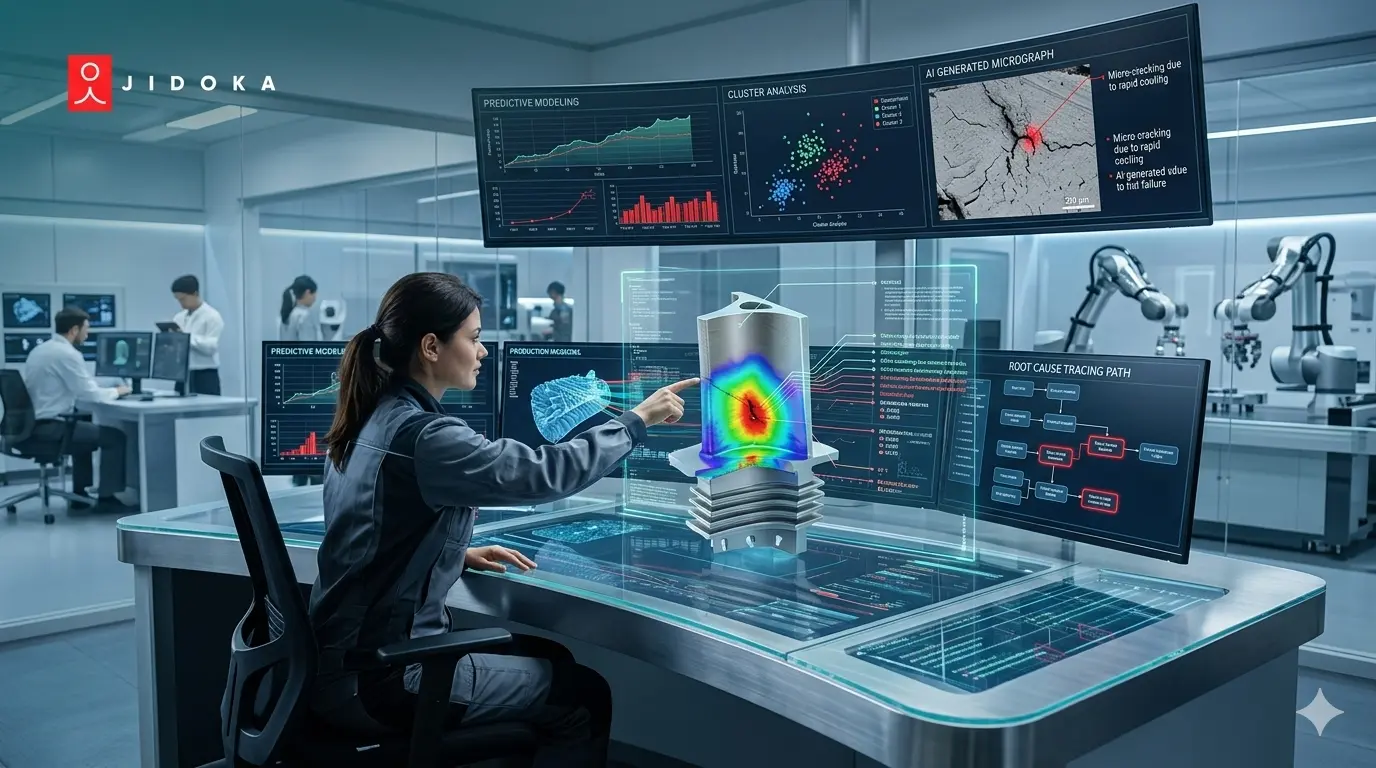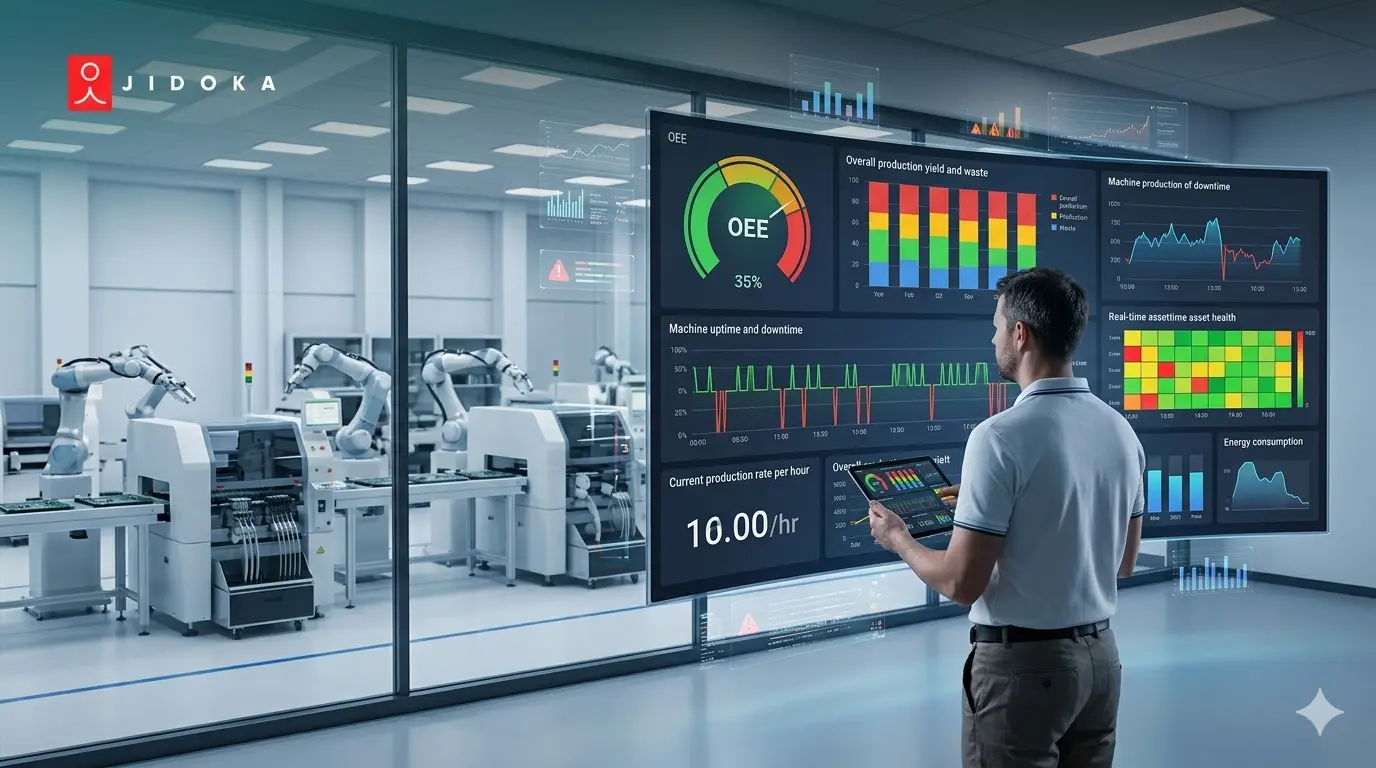
A food and beverage manufacturing plant deployed 120 IIoT sensors across its production lines over 18 months. Vibration, temperature, pressure, and fill-level sensors feed a real-time dashboard monitored by the maintenance team. The quality team continues to use shift-end sampling inspection and manual defect logs. The sensors and the quality system are not connected.
The maintenance team knows when Machine 7 is vibrating. The quality team does not know whether that vibration is causing fill-level rejects, until the end-of-shift count shows 3.2% rejects on a line targeting 0.8%. This guide explains the architecture that closes that gap and where IIOT manufacturing investments actually pay off.
IIoT manufacturing connects sensors, cameras, PLCs, and edge computing devices to generate continuous production data that quality teams can act on in real time. Industrial internet of things manufacturing infrastructure provides the sensor layer, process parameters, and machine state data. When combined with AI vision inspection for defect classification, IIoT becomes the data backbone of a real-time quality monitoring system, not just a maintenance monitoring platform.
What IIoT in Manufacturing Is, and Why Sensor Data Alone Is Not Enough
IIoT manufacturing connects industrial sensors, PLCs, cameras, and edge computing devices on the production floor to collect real-time data on equipment state and process conditions. Unlike consumer IoT (smart devices), industrial internet of things manufacturing infrastructure is designed for deterministic, low-latency data transmission in electrically noisy, temperature-variable, physically demanding factory environments.
The global IIoT market reached $514.39 billion in 2025, with manufacturing remaining the dominant segment driving adoption through smart factories, automation, and real-time analytics (manufacturingleadgeneration.com manufacturing IoT statistics). 72% of large manufacturers (1,000 or more employees) have at least one IIoT pilot or production deployment, but only 25 to 30% have scaled IIoT beyond pilot to enterprise-wide deployment (McKinsey 2025 via MachineCDN State of IIoT 2026).
IIoT vs Consumer IoT: Why Industrial Requirements Are Different
A consumer IoT device (a smart thermostat) can tolerate 200ms latency. An IIOT manufacturing vision reject signal that triggers a PLC-driven ejection mechanism requires deterministic latency under 20ms, otherwise the production line has moved past the ejection point before the command arrives. Iiot sensor factory deployments also operate in environments with electromagnetic interference from motors and welding equipment, temperature ranges from sub-zero cold rooms to 80-degree process ovens, and physical vibration that destroys consumer-grade hardware in weeks.
Industrial protocols (MQTT, OPC-UA), industrial-grade hardware, and edge computing architectures exist specifically because consumer IoT technology cannot meet these requirements. The performance gap between consumer and industrial IoT is not a marketing distinction. It is a physics constraint.
What IIoT Sensors Actually Measure
IIoT sensors measure machine conditions: temperature, vibration, pressure, fill level, current draw, flow rate, and similar parameters. They tell you what the machine is doing. They do not tell you whether the product the machine is making meets specification. A temperature sensor on a sealer tells you the seal head reached 165 degrees. It does not tell you whether the seal bonded correctly on the unit it just processed.
This is the structural gap in sensor-only IIOT manufacturing deployments. The machine condition data and the product quality outcome data are separate streams. The factory with 120 vibration, temperature, and fill-level sensors has comprehensive connected factory devices coverage. Its quality team still does not know whether the readings those sensors produce are correlated with the defects it finds at shift end, because no one connected the two data streams.
Why Sensor Data Alone Cannot Confirm Quality Outcomes
A temperature deviation on a fill head tells the maintenance team that something changed. It does not tell the quality team whether that change produced under-filled units, over-filled units, or no quality deviation at all. The correlation between a specific sensor reading deviation and a specific quality defect type is not visible in sensor data alone. It requires the defect classification data from AI vision inspection on the same timeline.
The industrial iot quality monitoring gap exists because most IIoT deployments are designed by maintenance teams for maintenance use cases, and quality teams are added as afterthoughts. Connecting IIOT manufacturing sensor data to quality decisions requires a deliberate architecture decision, not just more sensors.
IIoT Protocols and Edge Architecture for Quality Monitoring
Two protocols handle the majority of IIOT manufacturing data transmission: MQTT for high-frequency sensor telemetry, and OPC-UA for structured machine-state data exchange with MES and ERP platforms. MQTT and AMQP perform best for edge and fog computing scenarios where latency and bandwidth are constrained (ScienceDirect IIoT Protocols study 2024). Most architectures use both.
MQTT: High-Frequency Sensor Telemetry
MQTT (Message Queuing Telemetry Transport) is a lightweight publish-subscribe protocol designed for high-frequency, low-bandwidth sensor telemetry. In a IIOT manufacturing quality monitoring deployment, MQTT carries temperature, vibration, pressure, and fill-level readings from sensors to an edge broker at update frequencies of 100ms to 1 second.
KOMPASS AI vision inspection events stream via MQTT from the edge device to the same broker, allowing time-synchronized correlation of sensor readings with inspection classification events.
MQTT requires TLS encryption to be secure in IIOT manufacturing environments. The default configuration is plaintext and must be explicitly hardened before deployment in production environments. Most enterprise IIoT platforms handle this at the gateway layer, but it is a required configuration step, not a default one.
OPC-UA: Structured Machine-State Data Exchange
OPC-UA (OPC Unified Architecture) is a platform-independent, secure protocol designed for structured data exchange between PLCs, MES platforms, and analytics systems. It carries machine-state data (run/stop status, cycle count, alarm codes, production lot IDs) on an event-driven or low-frequency poll basis.
OPC-UA supports built-in security and is supported natively by all major PLC vendors, making it the standard protocol for manufacturing iot platform integration with enterprise systems.
NAGARE processes compliance data streams via MQTT or API to the same message broker that receives KOMPASS inspection events and OPC-UA machine state data. This unified stream, time-synchronized at the broker, is what enables IIOT manufacturing correlation analytics: sensor condition, machine state, product inspection result, and process compliance in a single queryable time-series.
Edge vs Cloud: Allocating Processing by Latency Requirement
Edge processing handles latency-sensitive decisions; cloud handles cross-asset workloads and trend analytics (Databricks IoT in Manufacturing). In IIOT manufacturing quality monitoring, the rejection decision (did this unit pass or fail?) must happen at the edge, within the production line's cycle time. The trend analysis (is the defect rate trending toward threshold?) can happen in the cloud, where cross-shift and cross-line data is available.
KOMPASS runs inference at the edge, generating a reject or accept signal within milliseconds, triggering the PLC ejection mechanism without cloud round-trip latency. The structured inspection event data then streams to the cloud analytics platform for Pareto analysis, SPC monitoring, and cross-line correlation with the IIoT sensor data.
Five-Step IIoT Quality Monitoring Deployment Sequence
The most common reason IIOT manufacturing quality monitoring pilots fail to scale is that sensors are installed before the quality question they will answer is defined. A sensor that measures temperature on a sealer that the quality team does not correlate with seal failures generates data no one acts on. Define the quality question first. Install hardware second.
Step 1: Define the Quality Question Before Installing Any Sensor
The quality question must be specific and testable: 'Does temperature deviation on sealer 3 correlate with seal integrity failures on Lot B product?' A vague quality question ('can we improve quality with IIoT?') produces a vague deployment that generates data no one acts on. Every IIOT manufacturing sensor deployment that fails to scale can be traced to a quality question that was too broad to produce a specific alert threshold.
Identify the top three defect types by scrap cost on the target line. For each defect type, identify the process parameter most likely to cause it based on process engineering knowledge. Those parameters are the sensor targets. The quality question is the bridge between the defect data and the sensor data.
Step 2: Deploy KOMPASS and Target Sensors in Parallel
KOMPASS provides the quality outcome data (what defects occurred, when, on which lot). Target sensors provide the process condition data (what parameters were running when the defects occurred). Both streams must be deployed and running simultaneously for the correlation analytics to work.
Deploying sensors without KOMPASS AI vision inspection means the process condition data has no quality outcome data to correlate against. Deploying KOMPASS without the target sensors means the inspection data has no process condition context. The IIOT manufacturing quality use case requires both streams on the same timeline.
Step 3: Validate Protocol Compatibility and Time-Synchronization
Validate that the sensor communication protocol (MQTT or OPC-UA) is compatible with the analytics platform receiving the data. Confirm that NAGARE process monitoring streams process compliance events to the same broker. Time-synchronize all data streams to a common timestamp reference. The correlation analytics work only if a sensor reading at 02:14:03 can be joined to a KOMPASS inspection event at 02:14:03 on the same timeline.
This step is where most IIOT manufacturing deployments stall. Sensor timestamps use local machine time; KOMPASS uses NTP-synchronized system time; the MES uses a different clock source. Without explicit time-synchronization at the broker layer, cross-stream correlation queries return no meaningful results.
Step 4: Run Alert-Only Mode for 30 to 60 Days
Before deploying automated process responses (PLC parameter adjustments, automated line stops), run the factory connected monitoring system in alert-only mode. Validate alert accuracy: what percentage of quality alerts corresponded to actual defect events? What percentage were false positives? Reduce false positive rate to under 10% before deploying automated actions.
Alert-only mode also builds operator trust in the system. Operators who receive accurate, actionable alerts from the IIoT quality system will engage with automated recommendations. Operators whose first experience is a false positive that stops their line will resist the system regardless of subsequent accuracy.
Step 5: Deploy Automated Process Actions
Once alert accuracy is validated, deploy automated process responses: KOMPASS rejection signal triggers PLC ejector, IIoT parameter alert triggers SPC action notification to shift supervisor, defect rate threshold triggers CAPA auto-creation in the quality system. Scale to a second production line using the same deployment template and quality question definition process.
Only 46% of manufacturers have deployed IIoT at the facility level (manufacturingleadgeneration.com). The facilities that move from pilot to facility deployment are those that defined the quality question before installing sensors, validated correlation between sensor and inspection data, and ran alert-only mode before automating responses.
What Real-Time IIoT Quality Monitoring Looks Like in Practice
An IIOT manufacturing quality monitoring system converts the 18-minute window between a machine deviation and a quality impact into an 18-second alert. The sensor detects the process condition change. KOMPASS classifies the quality outcome. The analytics layer correlates them. The alert reaches the supervisor before the shift count reveals the problem.
The 18-Minute Event: From Sensor Signal to Quality Alert
At 02:14:00, Machine 7's vibration sensor on the fill head exceeds the SPC upper control limit. The MQTT broker receives the sensor event and fires an alert to the maintenance dashboard. At 02:14:03, KOMPASS classifies three consecutive fill-level rejects on the same line and streams the inspection events via MQTT. The analytics layer joins the vibration anomaly timestamp and the defect cluster timestamp. At 02:18:00, the shift supervisor receives a correlated alert: 'Machine 7 vibration anomaly correlates with fill-level rejects on Line 4. Defect count: 6 and rising.'
At 02:32:00, maintenance adjusts the fill head. Vibration returns to baseline. KOMPASS confirms zero defects on subsequent units. The event is logged, timestamped, and available as a CAPA evidence record. In the plant without connected IIOT manufacturing and AI vision, the quality team finds out at the 06:00 end-of-shift count: 3.2% reject rate on Line 4. The root cause is identified the following morning.
The Architectural Difference: What Changes and What Does Not
The IIOT manufacturing quality monitoring architecture does not change the manufacturing process. It changes the information available to the people and systems managing that process. Machine 7 vibrated the same way in both scenarios. The sensor was present in both scenarios. The difference was whether the sensor data was connected to the KOMPASS inspection event data in a shared analytics environment.
Jidoka Technologies and IIoT Integration
KOMPASS and NAGARE provide the quality outcome data layer that converts IIOT manufacturing sensor data from condition monitoring into quality prediction. Without classified inspection data from KOMPASS, IIoT sensor readings have no quality outcome to correlate against.
- KOMPASS: AI vision inspection streams defect classification events via MQTT at production speed. Enables time-synchronized correlation with IIoT sensor telemetry. Edge inference at under 20ms for PLC rejection signals.
- NAGARE: Process compliance event streaming via MQTT or API. Adds operator execution data to the sensor and vision data streams.
- Industries: Active across FMCG, automotive, pharmaceuticals, electronics, and general manufacturing.
Conclusion
The FMCG plant with 120 IIoT sensors and a quality team using manual shift-end logs has a connection problem, not a sensor problem. The sensors know about Machine 7's vibration. The quality team does not know about the fill-level rejects it is causing. That gap is an architectural problem.
Connecting KOMPASS inspection data to the IIoT sensor network closes it. See how KOMPASS connects to your manufacturing iot platform for real-time quality monitoring at jidoka-tech.ai.
Frequently Asked Questions
1. What Is the Difference Between MQTT and OPC-UA in IIoT Manufacturing?
MQTT is a lightweight publish-subscribe protocol optimized for high-frequency, low-bandwidth sensor telemetry; OPC-UA is a structured, platform-independent protocol for secure, deterministic machine-state data exchange between PLCs, MES platforms, and analytics systems. Most IIOT manufacturing quality monitoring architectures use both: MQTT for sensor telemetry at the device level, OPC-UA for structured machine data integration with analytics and ERP platforms.
2. Why Do IIoT Quality Monitoring Pilots Fail to Scale in Manufacturing?
The most common reason IIoT quality monitoring pilots fail to scale is that sensor data is collected but never connected to a measurable quality outcome: it feeds a maintenance dashboard, not a quality decision. Quality monitoring requires correlating process condition data (from IIoT sensors) with product quality outcome data (from AI vision inspection). Without that correlation, sensor readings are condition monitoring, not quality prediction, and the pilot cannot demonstrate business value sufficient to justify enterprise rollout.
3. How Does AI Vision Inspection Connect to an IIoT Manufacturing Platform?
AI vision inspection systems like KOMPASS connect to an IIoT manufacturing platform by streaming structured inspection event data (defect classification, timestamp, lot code, station ID) via MQTT or API to the same message broker or data platform that receives sensor telemetry. Time-synchronizing inspection event timestamps with sensor reading timestamps enables the analytics platform to correlate process condition changes (sensor signals) with quality outcome changes (inspection classification) within the same time-series query environment.
4. What Should Manufacturers Prioritize in an IIoT Quality Monitoring Deployment?
Manufacturers should prioritize: defining a specific quality question before installing any sensor, validating protocol compatibility between sensors and the analytics platform, integrating AI vision inspection data alongside sensor data rather than separately, and running alert-only mode for 30 to 60 days before deploying automated process recommendations. The most common IIOT manufacturing quality deployment failure is installing sensors without first defining what quality decision those sensors will inform.
What Is IIoT in Manufacturing and How Is It Different From Consumer IoT?
IIoT in manufacturing connects industrial sensors, cameras, PLCs, and edge computing devices to collect real-time production data for quality, maintenance, and efficiency decisions. Iiot manufacturing differs from consumer IoT in three requirements: latency (under 20ms for production-critical signals vs 200ms tolerance for consumer devices), reliability (deterministic data delivery in electrically noisy environments), and security (industrial hardening against OT network vulnerabilities that consumer devices do not face).