Machine inspection covers five methods: manual gauging, fixture gauging, coordinate measuring machines (CMM), rule-based machine vision, and AI-powered vision. Each suits a different combination of throughput, defect type, tolerance, and budget. Matching the right method to the right constraint is the decision that determines your cost of quality.
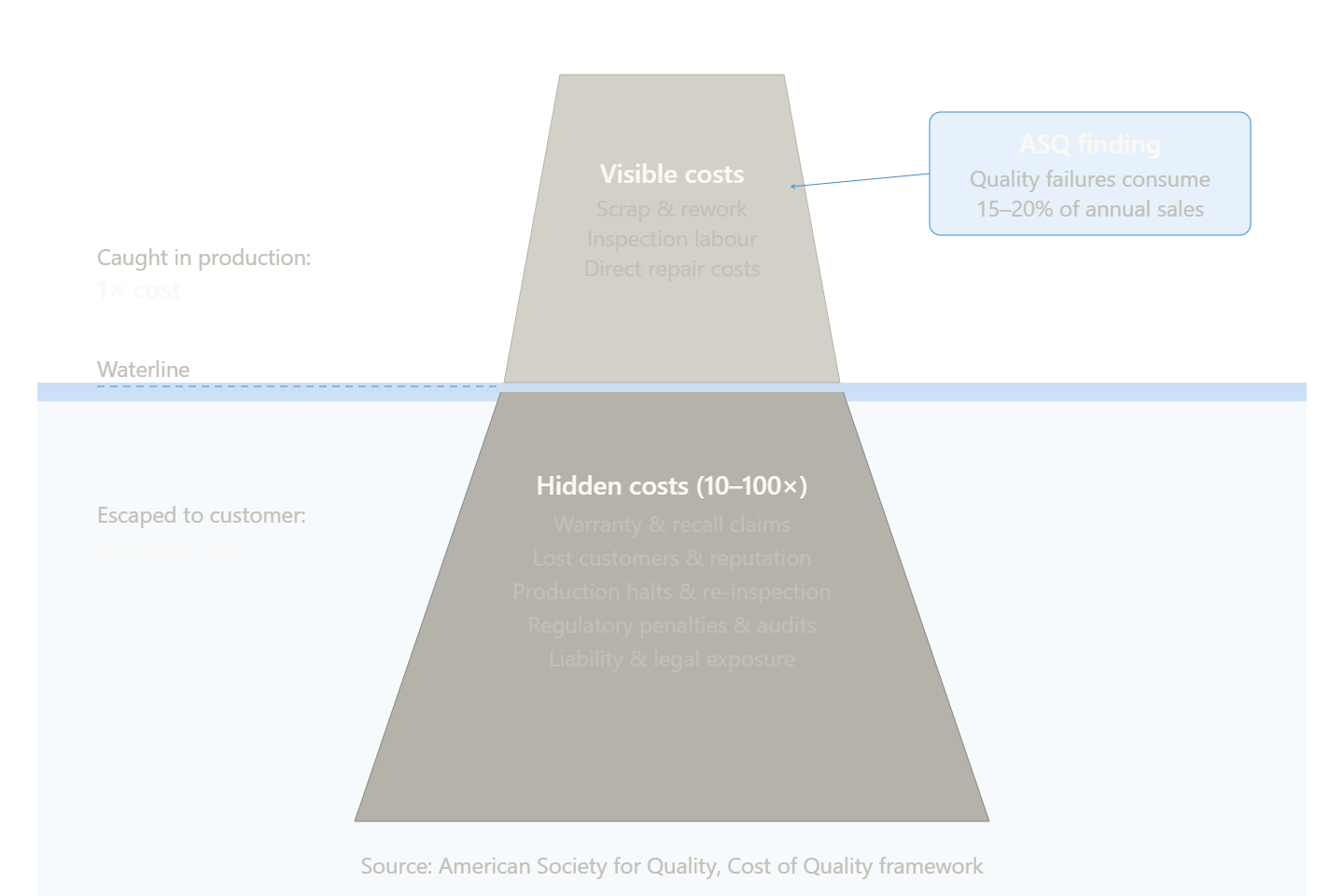
A defect escape that reaches a customer does not arrive alone. It brings warranty claims, production halts, and the kind of audit that ends careers. According to the American Society for Quality's Cost of Quality framework, quality-related failures consume 15 to 20% of annual sales for a typical manufacturer. Catching the same defect during production costs one-tenth of what it costs after it ships, sometimes one-hundredth (American Society for Quality, Cost of Quality).
The problem in most plants is not that machine inspection is absent. It is that the method in use was selected years ago for a production context that no longer exists. A manual gauging station designed for 200 parts per shift is still running on a line that now pushes 2,000. A rule-based vision system programmed for a single SKU is watching a high-mix line and silently misclassifying novel defects. The mismatch is the cost driver.
This guide compares all five machine inspection methods against the three variables that actually determine which one wins: throughput speed, defect type, and tolerance band.
Why The Wrong Inspection Method Costs More Than No Inspection at All
Most plants do not have an inspection problem. They have a method-matching problem. The wrong system running confidently on the wrong line generates more damage than a gap in coverage because it produces false assurance while defects move downstream unchecked.
The financial case for getting this right
Most quality managers think about inspection failure as a missed defect. The more damaging failure is confident misclassification: a system that passes defective parts because it is the wrong tool for the defect type, and does it consistently, invisibly, across every shift.
Human visual inspection misses 20 to 30% of defects under real production conditions, with accuracy degrading 15 to 25% after just two hours of continuous observation. Inter-inspector agreement on defect severity sits at 55 to 70%, meaning identical products receive different quality verdicts depending on which inspector is on shift. Those numbers are a constraint. Every method has one.
The three variables that determine method fit
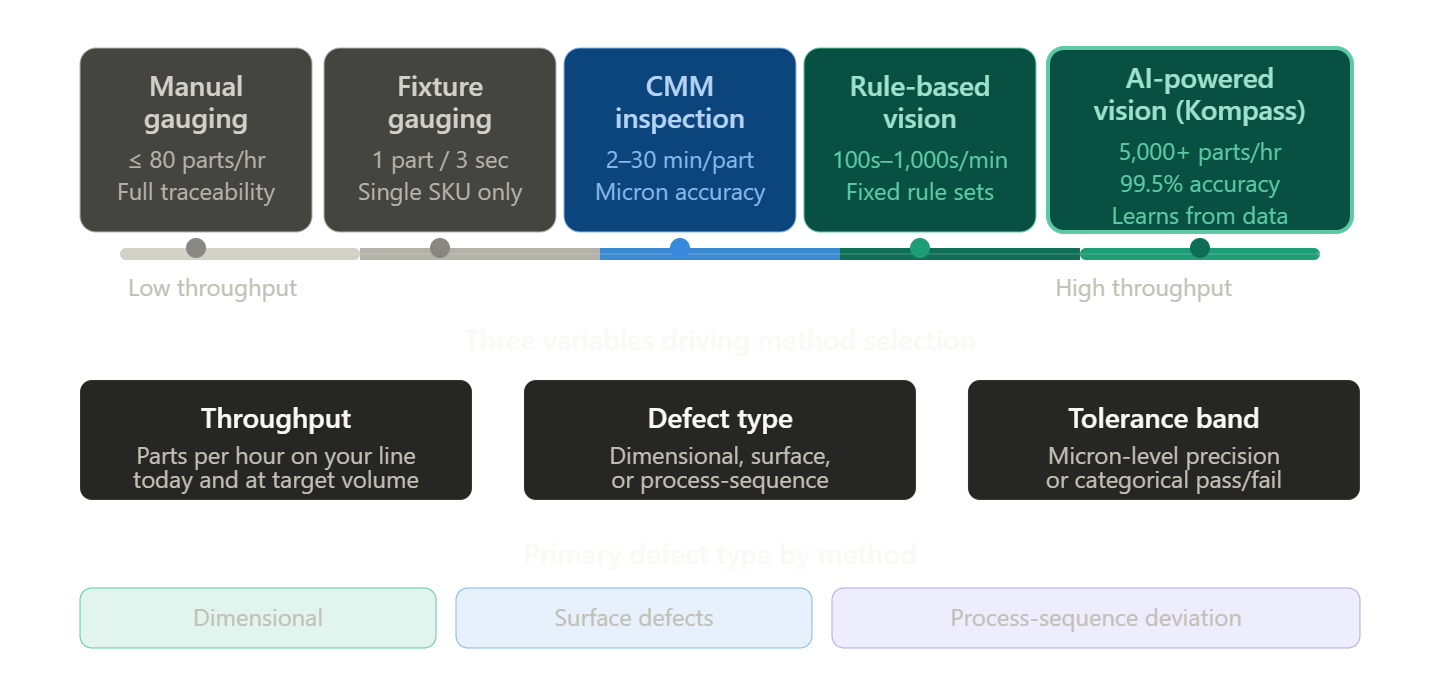
The five methods you need to understand are: manual gauging, fixture gauging, coordinate measuring machines (CMM), rule-based machine vision, and AI-powered automated vision inspection. Three variables determine which class fits your operation:
- Throughput requirement in parts per hour
- Primary defect type: dimensional, surface-level, or process-sequence deviation
- Tolerance band: micron-level accuracy or categorical pass/fail
Manual Gauging: Where Precision Inspection Begins
Manual gauging is the oldest form of machine inspection still in active daily use across manufacturing. Before evaluating whether to replace it, a quality manager needs to know exactly where it holds and where it structurally cannot, because those limits are precise and quantifiable.
What manual gauging actually covers
Manual gauging is the use of hand-held instruments: vernier callipers, micrometers, height gauges, bore gauges, and surface plates, to verify dimensional conformance against a specification. A trained inspector measures a feature, compares it to a drawing tolerance, and records the result. First-article inspection at most contract manufacturers still runs on this method. So does incoming goods verification on components where a measurement certificate is a contractual requirement.
It gets dismissed as outdated. That dismissal is wrong for a meaningful share of plants. High-mix, low-volume manufacturers, aerospace tool rooms, and medical device lines run 100% manual inspection on safety-critical features precisely because it is calibratable, auditable, traceable to an international standard, and requires no programming. No other method matches it on all four simultaneously.
Where manual gauging structurally fails
Cognex's 2025 benchmark places the trained human inspector throughput ceiling at 60 to 80 parts per hour. Fatigue-driven error rates rise after approximately 20 minutes of continuous inspection. There is no automatic data capture by default. Defects are caught, but patterns remain invisible until someone manually compiles gauge records into a trend chart.
The Gage Repeatability and Reproducibility (Gage R&R) threshold is the hard decision criterion. A Gage R&R result above 30% variation is the industry threshold at which a manual machine inspection method is no longer reliably detecting the tolerances being measured. If your process produces that result, the method has disqualified itself.
The hidden cost most quality managers have not calculated
Inspection labour in most factories is tracked by headcount, not by per-part inspection cycle time. Here is a concrete illustration. A line producing 500 parts per shift, running at manual inspection capacity of 60 parts per hour, needs a dedicated headcount of eight inspectors per day just to keep pace. At standard manufacturing labour rates in the US or Europe, that figure reaches well into six figures annually. The "free" manual gauge is rarely free.
Manual gauging works when: volumes are low, part geometry is complex or inaccessible to automated systems, calibration traceability is a regulatory requirement (aerospace, medical devices), or the feature being measured cannot be reached by any camera or probe.
Fixture Gauging: Purpose-Built Speed at The Cost of Flexibility
Fixture gauging occupies a narrow band in the inspection spectrum, but inside that band it outperforms every other method on speed and repeatability. The problem is that the band is getting narrower as product mix increases across most manufacturing sectors.
How fixture gauges work and where they dominate
A fixture gauge is a part-specific, hard-tooled device that checks one or more dimensions simultaneously using go/no-go logic. It eliminates operator variability by constraining measurement to a single pass/fail outcome. A good fixture gauge verifies a part in under three seconds at the end of a machining cell. No software, no camera, no network connection required.
Where it wins: high-volume single-SKU lines with tight dimensional tolerances and stable part geometry. Engine components, fasteners, and connectors are the natural habitat. Automotive Tier 1 suppliers with a stable platform often run fixture gauging for years without any engineering intervention.
The flexibility tax
Any product changeover requires a new fixture, typically with 8 to 16 weeks lead time and significant tooling cost. The method cannot detect surface defects, only the dimensional features it was designed to contact. A reject is a reject, with no defect classification or root cause data attached.
Consider an automotive connector line that introduces three new SKUs to meet an EV manufacturer's updated specification. Under fixture gauging, production stalls for 12 weeks while new physical gauges are designed and machined. The line cannot qualify the new components until the tooling arrives. Under AI-powered vision, the same new SKUs are trained on existing cameras in an afternoon using labelled image examples. The flexibility gap between the two methods is not marginal; it is measured in quarters.
In high-mix environments, fixture gauging amortisation cost per part climbs steeply as SKU count increases. A fixture that makes economic sense at 50,000 identical parts per year looks very different at 5,000 parts across ten variants.
Fixture gauging works when: throughput is high, SKU count is stable, geometry is consistent, and the dimensional features being checked are fully defined by the fixture's contact points.
Coordinate Measuring Machine Inspection: When Dimensional Complexity Demands It
CMM inspection is the reference standard for dimensional accuracy, and it is also one of the most misapplied methods on the floor. Understanding when a CMM earns its place versus when it is simply the most expensive option available is the decision that matters here.
CMM accuracy and its real-world application
A CMM (coordinate measuring machine) is an electromechanical system with a touch or laser probe that records XYZ coordinates and compares them to CAD-defined tolerances. Bridge, gantry, and portable arm configurations suit different part sizes.
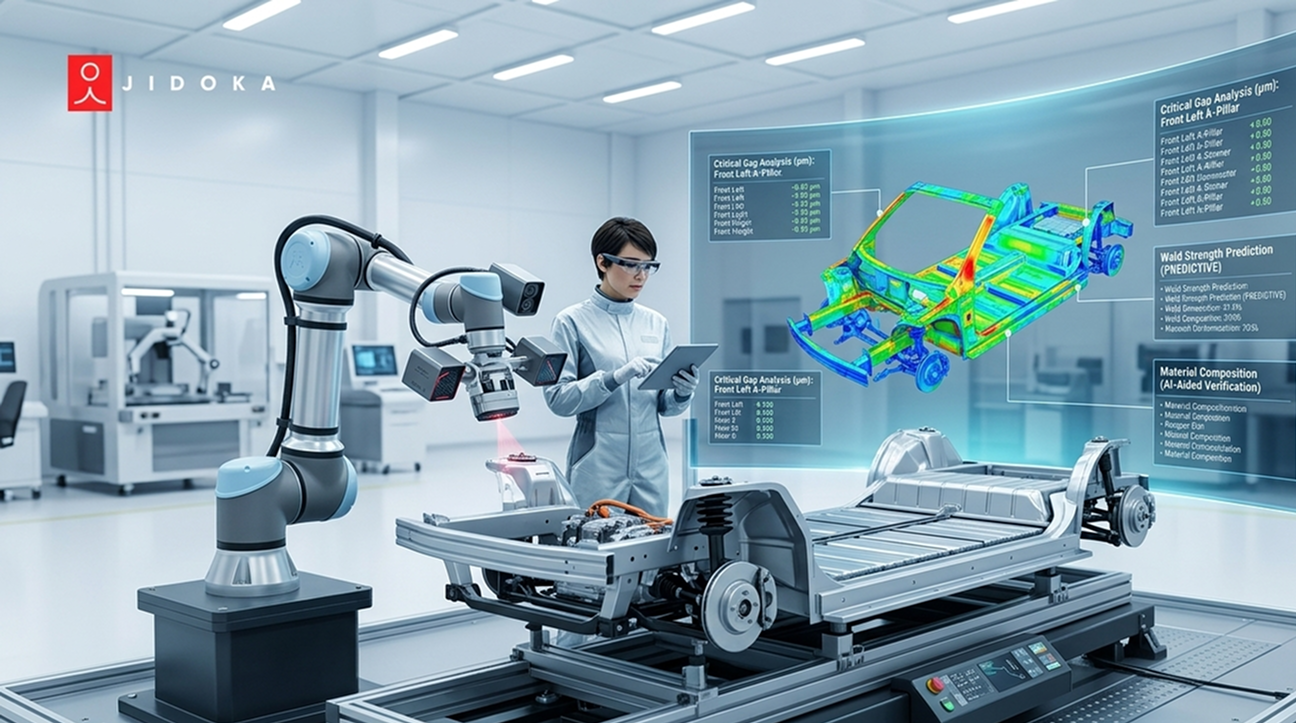
The accuracy advantage is unmatched: CMMs achieve micron-level dimensional accuracy with full GD&T (Geometric Dimensioning and Tolerancing) verification. That makes it the only method capable of certifying complex freeform surfaces, aerospace-class tolerances, and multi-feature relational geometry.
Software platforms like ZEISS INSPECT unify CMM data with optical measurement, enabling quality engineers to run a combined measurement workflow before handing off to a downstream vision system inspection for volume production.
The throughput constraint and environment dependency
CMM cycle times range from 2 to 30-plus minutes per part depending on feature count. That number alone disqualifies CMM from 100% inline use on any production line above minimal volumes. Tooling U-SME's reference on CMM inspection confirms that vision system inspection runs at significantly higher speeds for comparable surface and presence verification tasks.
There is also an environment dependency that vendor pages understate. CMMs require temperature-controlled rooms, typically 20 degrees Celsius plus or minus one degree, along with vibration isolation. Deploying a CMM inline on a noisy production floor introduces measurement uncertainty that invalidates the precision advantage you purchased it for.
When CMM is the right call
- First-article inspection on new tooling or supplier qualification
- Process capability (Cpk) studies for new product introduction
- Incoming goods verification on safety-critical components
- Any application where a traceable dimensional certificate is a contractual or regulatory requirement (ISO 9001, IATF 16949, AS9100)
CMM inspection works when: the application demands certified dimensional accuracy, throughput is low enough for sampling, or the part complexity exceeds what any vision method can measure.
Rule-Based Machine Vision: Reliable at Scale Until The Rules Break
Rule-based machine vision is the method most quality engineers encounter first when they move toward automated vision inspection. It works well under specific conditions and fails in specific, predictable ways. Both sides of that picture deserve equal attention.
How rule-based vision works
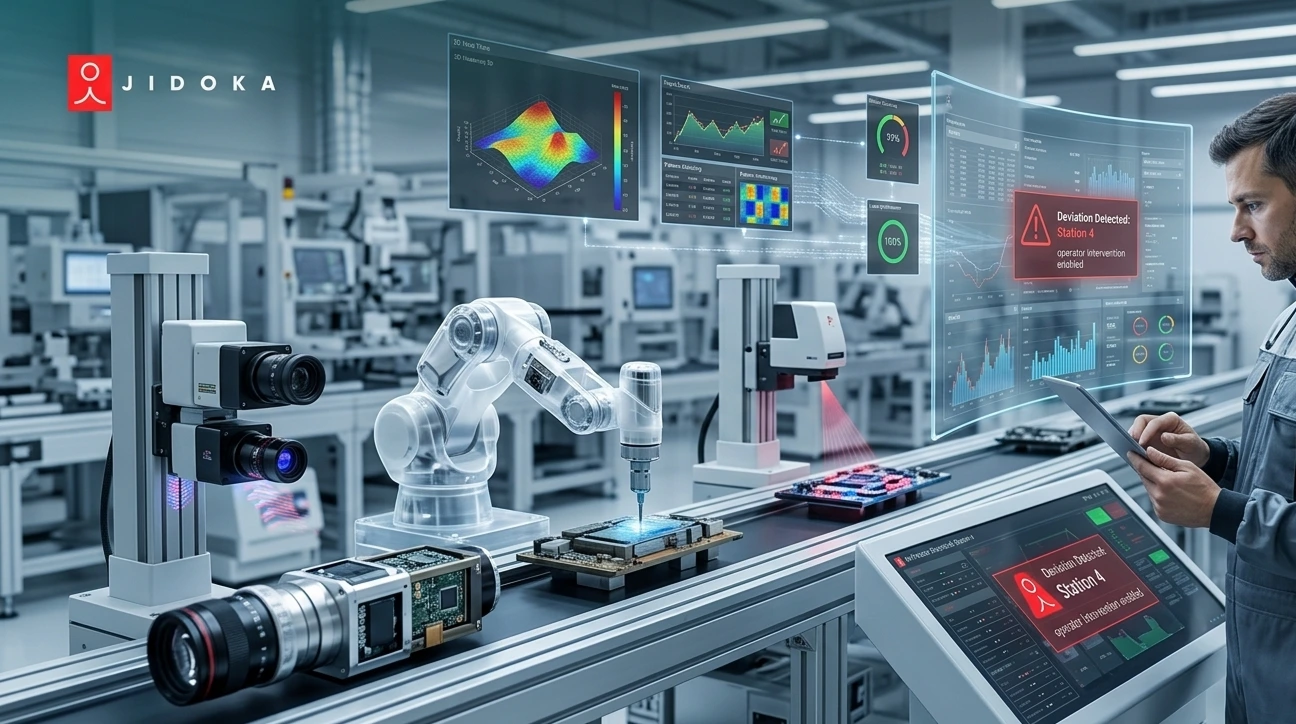
Rule-based machine vision is the dominant automated inspection method in manufacturing today. The method uses cameras and algorithms to check specific features against pre-programmed rules: presence/absence, dimensional measurement, colour match, barcode reading, using blob analysis, edge detection, and template matching. At its best, rule-based vision based quality audit systems operate inline at production speeds, inspecting hundreds to thousands of parts per minute with sub-100ms cycle times.
The machine vision market reflects this adoption: the sector is growing from USD 20.4 billion in 2024 to a projected USD 41.7 billion by 2030 at a 13% compound annual growth rate (Elementary ML, 2025). The majority of deployed systems in that figure are still rule-based.
The four structural failure modes
Rule-based vision fails in four specific ways that vendor pages do not discuss:
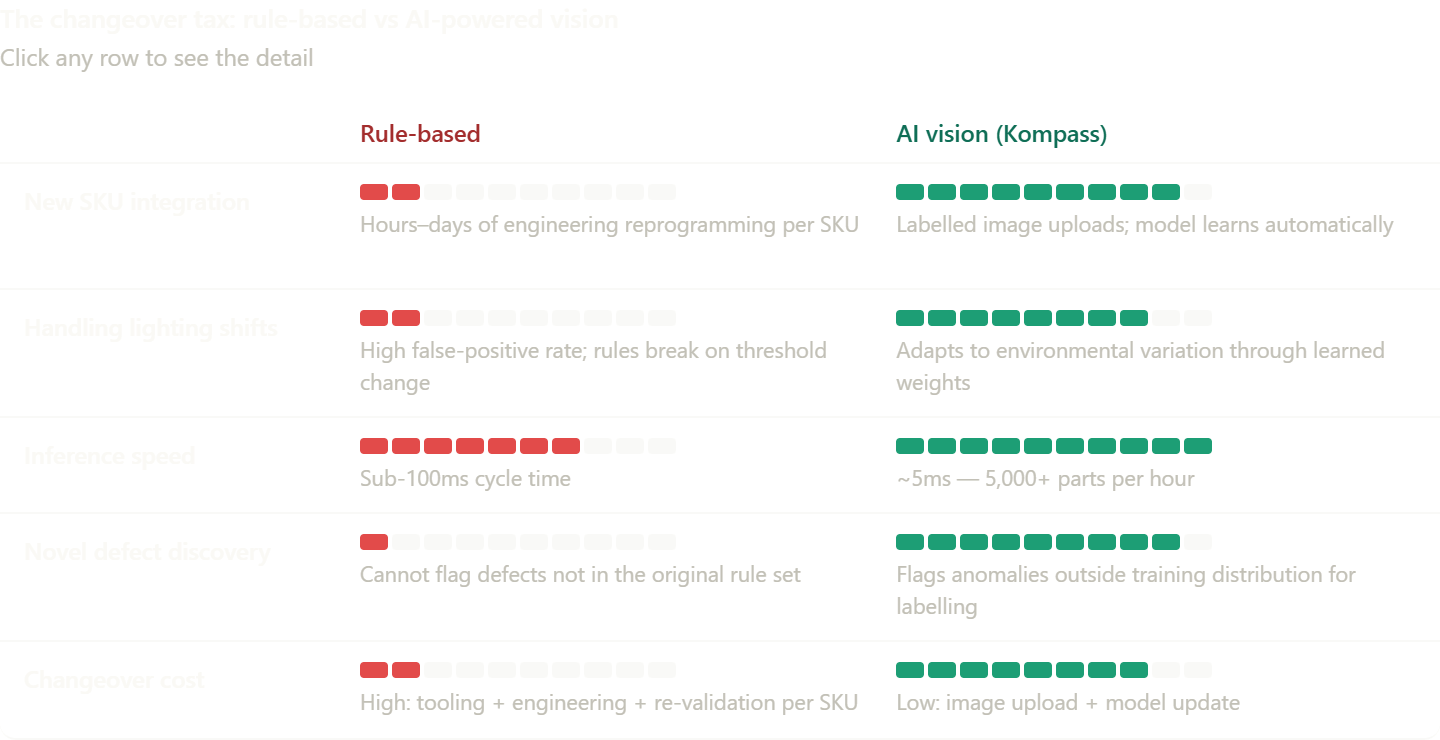
- Novel defect types not in the rule set generate false negatives, silently passing bad parts
- Product changeovers require full reprogramming, often hours to days of engineering time per SKU
- Lighting variation and surface reflection drive false-positive rates invisible in aggregate pass/fail dashboards but eroding line yield in the background
- No learning from experience: every error repeats until a human intervenes and manually updates the rule set
The programming tax
The cost to programme, validate, and maintain rule sets across a high-SKU environment is a real operational cost that does not appear in most vision system ROI calculations. On a 30-SKU line with quarterly product updates, that engineering overhead accumulates into a significant annual cost. Most quality managers are absorbing it without having formally measured it.
"A rule-based vision system is only as good as the defects its programmer anticipated. When the line changes, the rules do not change with it." - Jidoka Technologies
Rule-based machine vision works when: part geometry is stable, SKU count is low and unlikely to change, lighting is controlled and consistent, and defect types are fully defined and documented.
AI-Powered Vision Inspection: What Changes When The System Learns
The shift from rule-based to AI-powered automated vision inspection is not an incremental upgrade. The underlying logic of how the system makes decisions changes entirely, and that change resolves several structural problems that rule-based vision cannot fix regardless of how well it is configured.
The structural difference from rule-based vision
The difference between rule-based and AI-powered vision is not accuracy on a benchmark. It is what happens when the production context changes.
AI-powered automated vision inspection pairs cameras with deep-learning models that learn to classify defect and no-defect states from labelled image data. A novel defect type does not require a programmer to write a new rule. It requires labelled examples for the model to learn from. AI vision inspection systems now achieve 95 to 99% detection accuracy, inspect 10,000-plus parts per hour at sub-100ms inference speed, and maintain identical quality standards across all shifts.
A peer-reviewed survey of more than 50 studies published in the journal Sensors in January 2026 found machine-learning vision reaching defect detection accuracy above 95% in live production environments, with specific configurations achieving 98 to 100%. Compare that to the manual inspector accuracy ceiling of approximately 95% under ideal conditions, which degrades with fatigue.
Rule-based vs. AI: what the code difference looks like
The fastest way to understand why rule-based vision breaks under variation is to look at the logic structure. Here is the contrast:
Rule-based inspection logic (OpenCV / threshold approach):
# Rigid — breaks immediately if lighting shifts or geometry varies
if edge_contrast > 45 and blob_area == 1200:
    return "Pass"
else:
    return "Reject_False_Negative"
    # Any part outside these exact parameters is rejected or passes incorrectly
    # No adaptation. No learning. New SKU = new code.
AI inference logic (deep-learning model):
# Flexible — relies on trained weights, not hard-coded thresholds
confidence, classification = model.predict(image_tensor)
if classification == "defect_scratch" and confidence > 0.95:
    return "Reject"
# The model adapts to lighting shifts through learned feature representations
# New SKU = labelled image examples, not engineering reprogramming
The first block fails as soon as edge contrast shifts from 45 to 46 due to a lighting fixture swap. The second block holds because its decision is based on learned visual patterns across thousands of training images, not a single hard-coded threshold.
The deployment reality vendor pages omit
77% of AI vision implementations are still stuck at prototype or pilot scale (Sensors journal survey, January 2026). The barrier is integration complexity, training data quality, and change management. A plant that has attempted an AI vision deployment and retreated is not evidence the technology does not work. It is evidence the deployment approach failed. Those are different problems.
AI-powered vision works when: throughput exceeds what sampling inspection can safely cover, part mix is high or changing frequently, surface defect detection is the primary requirement, or the line cannot sustain the engineering overhead of rule-based vision maintenance.
Choisir la bonne méthode d'inspection machine : une matrice de décision pour les responsables qualité
Les cinq méthodes ont été abordées individuellement. Cette section les compare en fonction des variables qui déterminent réellement le choix : le débit, le type de défaut, la complexité de la pièce et la plage de tolérance. La matrice ci-dessous est le résultat de cette comparaison.
Les quatre variables d'entrée
Quatre variables déterminent la méthode adaptée à vos opérations :
- Exigence de débit en pièces par heure
- Type de défaut principal: écart dimensionnel, de surface ou de séquence de processus
- Complexité de la pièce et nombre de références (SKU): référence unique, multi-références stable ou mix élevé
- Plage de tolérance: précision dimensionnelle au micron ou validation conforme/non-conforme
Matrice de sélection de la méthode d'inspection Jidoka
Utilisez la matrice de sélection de la méthode d'inspection Jidoka pour faire correspondre votre débit, le type de défaut, la complexité de la pièce et la plage de tolérance à la méthode d'inspection machine appropriée.
Une note sur le coût total d'inspection
La méthode ayant le coût d'investissement le plus faible est rarement celle qui offre le coût d'inspection par pièce le plus bas à grande échelle. Un poste de contrôle manuel, dont la mise en place est gratuite, coûte souvent plus cher par pièce qu'un système de vision par IA pour des volumes supérieurs à 500 pièces par équipe, une fois pris en compte les effectifs d'inspection, les retouches et les coûts de non-qualité. Effectuez le calcul sur un horizon de 12 mois avant d'entamer les discussions d'achat.
Aucun choix n'est définitif. À mesure que le débit augmente et que la complexité des références s'accroît, les paramètres économiques évoluent. Cette matrice constitue le point de départ de votre réflexion interne.
L'angle mort des cinq méthodes : la déviation du processus avant l'apparition du défaut
Un ingénieur qualité ayant étudié les cinq méthodes précédentes remarquera une limite commune : chacune d'elles évalue la pièce une fois le processus terminé. Aucune n'intervient sur le processus lui-même. C'est dans cet intervalle que naît la plupart des défauts évitables.
Ce que l'inspection des pièces ne peut pas détecter
Chaque méthode décrite dans cet article examine le résultat d'un processus. Aucune ne prévient la déviation du processus à l'origine du défaut.
Une étape de serrage oubliée. Une séquence de sous-assemblage sautée. Un mauvais composant prélevé dans le mauvais bac. Ce sont des erreurs de processus. Elles créent des défauts. L'inspection des pièces en aval détecte parfois le défaut. L'erreur de processus qui l'a généré se répète sur la pièce suivante, et ainsi de suite, jusqu'à ce qu'un opérateur remarque l'anomalie ou que le défaut parvienne au client.
Il s'agit d'une limite structurelle de l'inspection des pièces. La seule façon de la surmonter est d'inspecter le processus lui-même.
Comment Nagare comble cette lacune
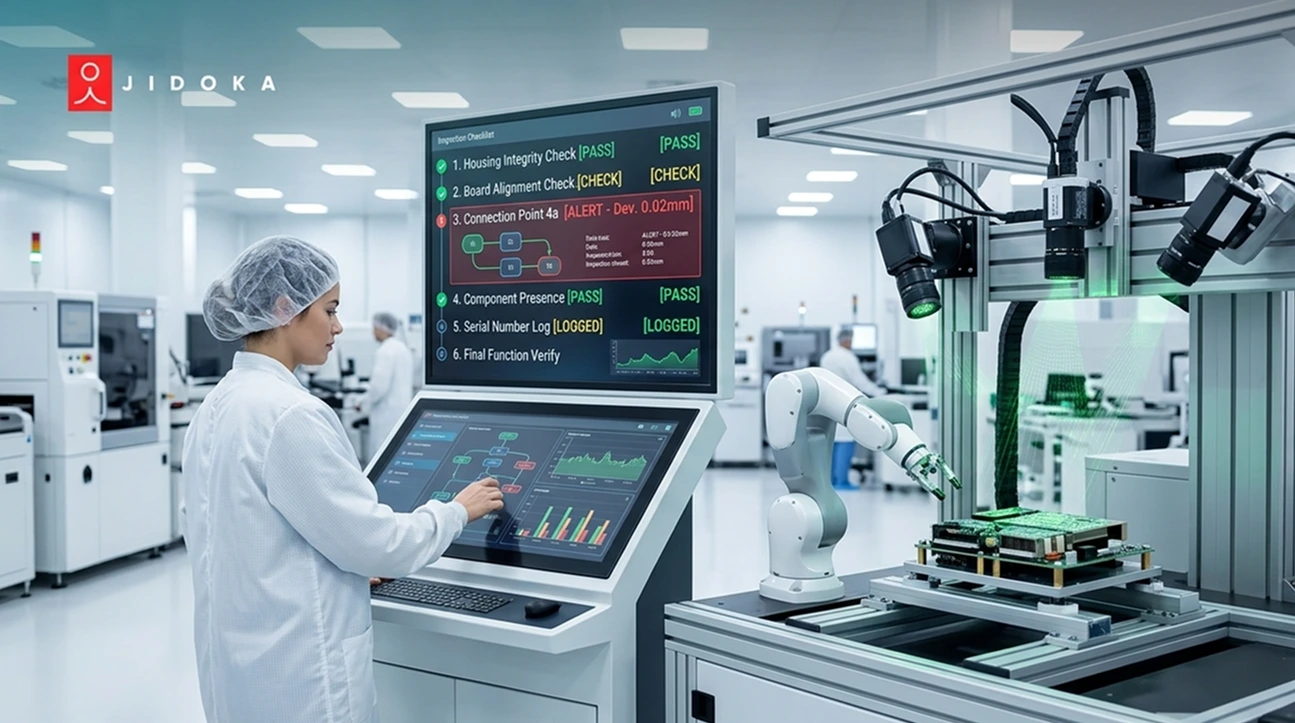
Jidoka Technologies' plateforme de surveillance de la conformité des processus Nagare résout ce problème en transformant les caméras de vidéosurveillance existantes en moniteurs de processus en temps réel grâce à l'IA en périphérie (edge AI). Elle vérifie les étapes d'assemblage et les actions des opérateurs par rapport aux procédures opérationnelles normalisées (SOP) numériques, sans nécessiter de nouvelle infrastructure matérielle. Chaque action sur la ligne est comparée à la norme au moment même où elle se produit.
Fonctionnalités spécifiques de Nagare issues de jidoka-tech.ai :
- Surveillance continue en temps réel par rapport aux SOP numériques
- Détection instantanée des écarts, des pièces manquantes et des mauvais alignements
- Guidage de l'opérateur et blocage des erreurs avant la fin de l'étape
- Traçabilité au niveau du cycle pour l'audit et l'intégration MES
- Traitement par IA en périphérie sur site pour la confidentialité des données et une faible latence
Jidoka rapporte une précision de 99,9 % dans la conformité des processus, une amélioration de 30 % de la conformité, une réduction de 35 % des retouches et une baisse de 25 % des temps d'arrêt sur l'ensemble des installations Nagare actives.
Architecture de confidentialité pour les environnements réglementés et syndiqués
Nagare utilise le suivi de squelette pour surveiller les actions des opérateurs, et non les visages. Le traitement est effectué localement dans l'usine. Aucune vidéo ne quitte le site. Pour les usines opérant sous le RGPD, la loi indienne PDPB ou des accords syndicaux couvrant la surveillance, cette distinction est ce qui permet d'obtenir l'adhésion des opérateurs.
« Chaque méthode d'inspection évalue la pièce. Nagare évalue le processus qui l'a créée. Ce n'est pas un perfectionnement de l'inspection. C'est une capacité totalement différente. » - Jidoka Technologies
Si votre ligne découvre encore des erreurs de processus une fois la pièce fabriquée, Nagare comble cette lacune. Demandez une démonstration de 30 minutes de Nagare chez jidoka-tech.
Conclusion : adapter votre méthode d'inspection à vos contraintes réelles
Quatre-vingts pour cent des défauts de qualité en production peuvent être évités en déployant la méthode d'inspection adaptée au bon stade du processus. Le problème n'est pas l'accès à la technologie, mais le fait que la plupart des usines utilisent des méthodes choisies pour un contexte de production qui n'existe plus.
Le contrôle manuel, les calibres, les MMT, les systèmes de vision basés sur des règles et l'inspection par IA ont tous leur utilité. La question est de savoir si votre méthode actuelle est adaptée à votre débit, au type de défaut et à vos tolérances.
Si la matrice de sélection de méthode d'inspection Jidoka ci-dessus a classé votre opération dans la catégorie du suivi de processus par IA, l'étape suivante est une démonstration de 30 minutes de Nagare. Découvrez comment l'IA en périphérie transforme vos caméras existantes en gardiens de processus en temps réel sur jidoka-tech.ai/products/nagare.
Questions fréquentes
1. Quelle est la différence entre l'inspection machine et le contrôle qualité ?
L'inspection machine consiste à mesurer ou examiner une pièce ou un processus pour déterminer s'il est conforme aux spécifications. Le contrôle qualité est le système de gestion global qui régit l'utilisation des données d'inspection pour accepter, rejeter ou retravailler la production. L'inspection génère les données ; le contrôle qualité définit les mesures à prendre. Une usine peut avoir une inspection rigoureuse et un mauvais contrôle qualité, ou inversement.
2. Quand l'inspection visuelle automatisée surpasse-t-elle une MMT ?
L'inspection visuelle automatisée surpasse la MMT lorsque le débit dépasse la capacité d'échantillonnage de la MMT ou lorsqu'une inspection en ligne à 100 % est requise. Les systèmes de vision inspectent des milliers de pièces par heure ; une MMT traitant le même volume nécessiterait soit une prise de risque importante par échantillonnage, soit un nombre prohibitif de machines. La MMT reste le meilleur choix pour la vérification complexe GD&T sur des pièces à haute valeur ajoutée où un certificat dimensionnel traçable est une exigence contractuelle.
3. Qu'est-ce qu'un audit qualité par vision et comment fonctionne-t-il ?
Un audit qualité par vision utilise des caméras et un logiciel de traitement d'image pour vérifier la conformité d'un produit ou d'un processus à un point de contrôle défini. Le système capture une image, l'analyse par rapport à une référence enregistrée ou à un modèle entraîné, et classe le résultat comme conforme ou non conforme. Les systèmes basés sur l'IA enregistrent en outre chaque image d'inspection, permettant une analyse rétrospective des défauts et une détection des tendances que les systèmes basés sur des règles ne peuvent offrir.
4. Quel est l'impact de l'inspection visuelle automatisée sur les effectifs d'inspecteurs manuels ?
L'inspection visuelle automatisée ne rend pas le personnel qualité inutile ; elle transforme la nature de son travail. Les inspecteurs passent d'une observation répétitive de type « conforme/non conforme » à l'analyse des tendances de défauts, au calibrage des systèmes et à la gestion des escalades. Les lignes équipées de vision par IA nécessitent toujours une supervision humaine pour les nouveaux types de défauts, les classifications limites et la gestion des exceptions. La réduction des heures d'inspection manuelle est réelle, mais réorienter ce temps vers des tâches qualité à plus forte valeur ajoutée constitue une approche plus pertinente pour justifier la mise en œuvre en interne.
5. Quel est le multiplicateur de coût de 10 à 100 fois pour les défaillances externes ?
Le cadre du « Coût de la qualité » de l'American Society for Quality indique que les coûts liés aux défaillances externes sont 10 à 100 fois plus élevés que le coût de détection du même défaut pendant la production (ASQ, Coût de la qualité). Ce multiplicateur varie selon le secteur et le type de défaut. Les rappels dans l'industrie automobile se situent dans la fourchette haute, tandis que les défauts sur les biens de consommation se situent plus bas. Ce chiffre constitue l'ancrage financier de tout dossier d'investissement interne en matière d'inspection.
6. Que vérifie réellement un contrôle visuel en milieu industriel ?
Un contrôle visuel en milieu industriel vérifie tout attribut pouvant être évalué par l'examen de l'aspect de la pièce : défauts de surface, uniformité des couleurs, exactitude de l'étiquetage, présence de composants, contrôle dimensionnel global et intégrité de l'assemblage. Ce terme englobe à la fois les contrôles manuels effectués par les opérateurs et les systèmes automatisés par caméra. La distinction opérationnelle importante est de savoir si le contrôle est enregistré, cohérent d'une équipe à l'autre et capable de détecter le type de défaut spécifique à l'origine de vos non-conformités.
7. L'inspection visuelle par IA peut-elle remplacer entièrement une MMT ?
Pas pour toutes les applications. La vision par IA atteint une précision de détection des défauts de 98 à 100 % pour les tâches de contrôle visuel de surface et de présence/absence (journal Sensors, janvier 2026), mais elle ne remplace pas la métrologie dimensionnelle par MMT pour les caractéristiques critiques liées à la sécurité et aux tolérances serrées, où un certificat de mesure traçable est une exigence contractuelle. La réponse pratique pour la plupart des fabricants est une architecture hybride : la vision par IA pour un contrôle en ligne à 100 % et la MMT pour le premier article, la capabilité des processus et la certification dimensionnelle requise par contrat.