Fabrieken schakelen vaak tussen spoedmodus en downtime. Teams van een week maken overuren. De volgende week staan de machines stil. Dat patroon zorgt voor verspilling, stress en gemiste leverdata.
Heijunka in Lean Manufacturing lost dit probleem op door een stabiel productieritme te creëren dat past bij de werkelijke vraag van de klant. Het vervangt brandbestrijding op het laatste moment door geplande flow. In plaats van te reageren op elke orderpiek, past Heijunka bij Lean Manufacturing een level load-productie toe, zodat het werk dag na dag voorspelbaar blijft.
Je krijgt vlottere planningen, minder voorraad en duidelijkere prioriteiten op de werkvloer. Deze handleiding laat zien hoe een vraaggestuurd plan de dagelijkse activiteiten weer onder controle brengt.
De twee soorten nivellering (Heijunka)
Heijunka in lean manufacturing werkt door de productie op twee duidelijke manieren te beheersen. Eén methode stabiliseert hoeveel je produceert. De andere bepaalt welke mix van producten door de lijn beweegt. Samen ondersteunen deze methoden een herhaalbare strategie voor vraagnivellering die de dagelijkse chaos uit de planning verwijdert.
1. Nivellering op volume
De spreidingen voor volumenivellering werken gelijkmatig over de beschikbare productiedagen. In plaats van aan het einde van de week grote hoeveelheden te produceren, stelt Heijunka in lean manufacturing een vast dagdoel op basis van de gemiddelde vraag. Als klanten 500 eenheden per week nodig hebben, produceert de lijn 100 eenheden per dag.
Deze aanpak ondersteunt de productie met een vlakke belasting en vermindert de belasting van mensen en apparatuur.
Belangrijkste praktijken:
- Bereken de dagelijkse vraag met behulp van een bestelgeschiedenis van meerdere weken
- Koppel de output aan de beschikbare tijd met behulp van de berekening van de takttijd
- Houd de productie stabiel, zelfs als de dagelijkse bestellingen fluctueren
Door de productie te stabiliseren, vermindert Heijunka in lean manufacturing overuren, beperkt het overtollige voorraad en verbetert de doorlooptijd over de hele linie.
2. Nivellering per type of mix
Mix leveling richt zich op het sequencen van verschillende producten via hetzelfde proces in kleine, herhaalbare patronen. Bij traditionele batching wordt één product gedurende lange perioden gebruikt. Heijunka in lean manufacturing is van toepassing productie van gemengde modellen dus de productvariëteit stroomt dagelijks.
Deze methode verbetert de productie, soepeler, ondersteunt de voorraadvermindering, de productie en vermindert het risico dat verbonden is aan grote batches. Succes hangt af van een kortere omsteltijd, kwaliteitsstandaardisatie en een constante aanvoer van materiaal.
Heijunka in lean manufacturing werkt het beste wanneer zowel volume- als mixnivellering samenwerken. Zodra de productie op niveau is, is de volgende stap het omzetten van dat plan in duidelijke visuele instructies met behulp van de Heijunka Box.
Het gereedschap: de Heijunka Box
Zodra Heijunka in Lean Manufacturing bepaalt wat er moet worden geproduceerd en in welke volgorde, moet het plan een duidelijke manier hebben om de werkvloer te bereiken. De Heijunka Box vult dat gat.
Het zet een genivelleerd plan om in eenvoudige visuele instructies die teams kunnen volgen zonder vergaderingen of gissingen. Deze tool ondersteunt de productie met niveaubelasting door het dagelijkse werk zichtbaar en getimed te maken.
A) Wat de Heijunka Box is
Een Heijunka Box is een visueel planningsbord dat wordt gebruikt om in een gestaag tempo werk vrij te geven. Het geeft weer hoe Heijunka in lean manufacturing planningsbeslissingen vertaalt in actie. Elk slot laat zien wat je moet maken en wanneer je het moet maken, op basis van een vast ritme dat is gekoppeld aan de vraag van de klant.
B) Hoe het in de praktijk werkt
Veel voorkomende elementen zijn onder meer:
- Horizontale rijen die productsoorten of -families vertegenwoordigen
- Verticale kolommen die tijdsintervallen tijdens de shift weergeven
- Kaarten die het exacte werk aangeven om vrij te geven
Elke kaart geeft de berekening van de takttijd weer, zodat de productie op één lijn blijft met de vraag. Teams werken alleen als er een slot open is, wat op pull gebaseerde productiesystemen ondersteunt en overproductie beperkt.
C) Waarom het belangrijk is
De Heijunka Box legt problemen vroegtijdig bloot. Gemiste slots duiden op vertragingen. Lege sleuven duiden op onbalans. Deze zichtbaarheid helpt bij het balanceren van de werklast en het verminderen van de productievariabiliteit voordat de problemen toenemen.
Een tabel voor de implementatie van Heijunka:
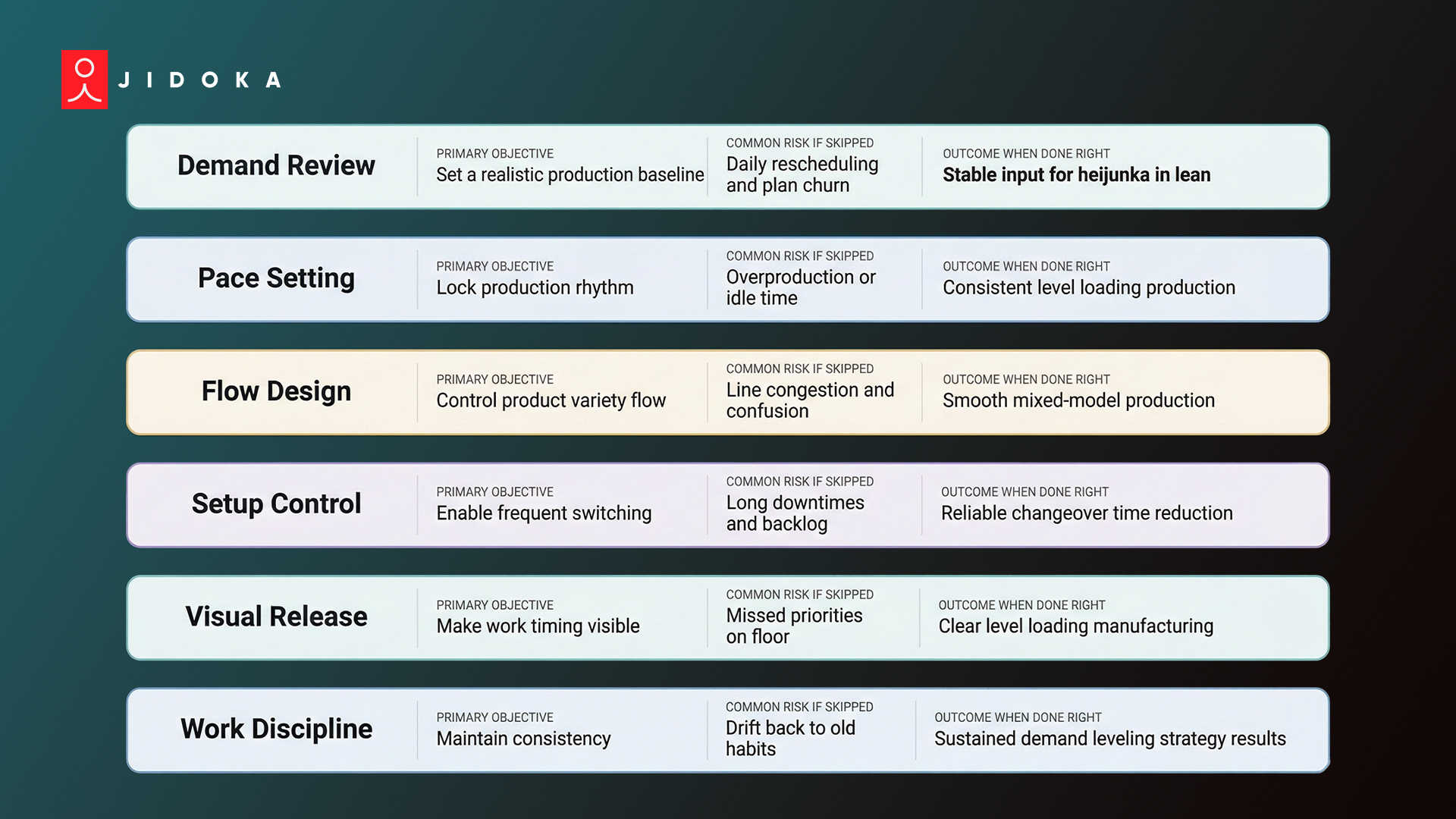
Vervolgens zul je zien hoe je van theorie naar actie kunt gaan met een duidelijk implementatieradmap voor heijunka in lean.
Routekaart voor de implementatie (6 stappen in Heijunka)
Het uitrollen van Heijunka in lean manufacturing werkt het beste wanneer elke stap voortbouwt op de laatste. Teams falen vaak door meteen over te schakelen op planningstools zonder de basisbeginselen vast te leggen. Deze routekaart houdt de inspanningen praktisch en gefundeerd, zodat de productie onder de dagelijkse druk op peil blijft.
Stap 1. Analyseer de vraag
Begin met de werkelijke bestelgeschiedenis, niet met voorspellingen. Kijk over meerdere weken of maanden om de gemiddelde vraag te identificeren die zich herhaalt. Dagelijkse pieken zouden niet de drijfveer moeten zijn voor het plan. Deze stap verankert de strategie voor vraagnivellering en voorkomt voortdurende herschikkingen.
Stap 2. Bereken de takt-tijd
De takttijd bepaalt hoe vaak een voltooide eenheid de lijn moet verlaten. Het houdt de output gekoppeld aan de vraag van de klant in plaats van aan interne doelstellingen.
Het gebruik van takttijdberekening helpt teams:
- Stel een realistisch productietempo in
- Knelpunten vroegtijdig opsporen
- Voorkom overproductie tijdens langzame periodes.
De takttijd wordt het referentiepunt voor alle planningsbeslissingen.
Stap 3. Bepaal de productmix
Wanneer meerdere producten een lijn delen, is de volgorde belangrijk. Heijunka in lean manufacturing vraagt om een eenvoudige, herhaalbare bestelling die de vraagpatronen weerspiegelt.
Goede praktijken zijn onder meer:
- Te beginnen met stabiele producten met een hoog volume
- Veranderingen in de mix voorspelbaar houden
- Het vermijden van frequente lastminute-swaps
Dit ondersteunt de productie van gemengde modellen zonder de flow te verstoren.
Stap 4. Verkort de omsteltijd
Veelvuldig schakelen mislukt zonder snelle instellingen. Door de verkorting van de omsteltijd worden vertragingen verwijderd die in strijd zijn met het genivelleerde plan. Voorbereiding voor onderbrekingen, vaste instellingen en duidelijke installatiestappen maken het schakelen betrouwbaar. Zonder deze stap kan Heijunka in lean manufacturing geen stand houden.
Stap 5. Bouw de Heijunka Box
De Heijunka Box zet het plan om in zichtbare actie. Plaats het bij het pacemakerproces en verdeel de shift in tijdvakken op basis van takt. Dit visuele systeem zorgt ervoor dat de productie van niveaubelasting duidelijk en gemakkelijk te volgen is.
Stap 6. Werk standaardiseren
Standaardwerk houdt het systeem stabiel. Exploitanten moeten dezelfde stappen volgen voor normale productie, omschakelingen en kwaliteitscontroles.
Sterke standaarden ondersteunen het in evenwicht brengen van de werklast, beperken variaties en zorgen voor een gestage verbetering van de doorlooptijd.
Nu het proces is voltooid, wordt in het volgende deel uitgelegd hoe Heijunka in lean manufacturing operationele en financiële voordelen op lange termijn oplevert.
De strategische voordelen van Heijunka
Wanneer Heijunka in lean manufacturing werkt zoals bedoeld, verlopen de activiteiten in een vast ritme. De voordelen komen voort uit consistentie, niet uit snelheid. Door productie met niveaubelasting toe te passen, verminderen teams afval dat zich verschuilt in ongelijke planningen.
1. Lagere voorraadniveaus
Bij batchproductie wordt overtollig materiaal naar de opslag gebracht. Heijunka in lean manufacturing beperkt dit door werk vrij te geven in kleine, regelmatige hoeveelheden. Het onderhanden werk daalt, de afgewerkte goederen stapelen zich niet meer op en het materiaal wordt sneller door elke stap verplaatst. Deze aanpak ondersteunt rechtstreeks productievermindering van de voorraad en maakt doorstromingsproblemen eerder zichtbaar.
2. Stabielere signalen van de toeleveringsketen
Instabiele planningen sturen gemengde berichten naar leveranciers. Regelmatige wijzigingen leiden tot versnelling, tekorten en premium vracht. Met heijunka in lean blijven de bestelpatronen stabiel. Leveranciers plannen hun capaciteit met vertrouwen, wat de synchronisatie van de toeleveringsketen versterkt en de ruis in het hele netwerk vermindert.
3. Minder overbelasting van mensen en apparatuur
Productiepieken zorgen ervoor dat teams overuren maken, waardoor ze dagen later moeten wachten. Heijunka in lean manufacturing vereenvoudigt de werkdruk, zodat personeel, machines en onderhoud een voorspelbaar tempo volgen. Dit ondersteunt het in evenwicht brengen van de werklast en verlaagt de kwaliteitsrisico's die gepaard gaan met overhaasten.
4. Kortere en betrouwbaardere levertijden
Een constante stroom verkort de wachttijd tussen processen. Door de opbouw van wachtrijen te beperken, zorgt Heijunka in Lean Manufacturing voor een echte verbetering van de doorlooptijd, zoals klanten merken. Bestellingen worden vaker op tijd verzonden.
Vervolgens zult u zien hoe digitale systemen deze aanpak actualiseren en ervoor zorgen dat Heijunka gestroomlijnd blijft produceren en reageert wanneer de omstandigheden veranderen.
Hoe Jidoka Tech Heijunka moderniseert
Bij Lean Manufacturing is Heijunka afhankelijk van nauwkeurige planningen tijdens de werkelijke productieomstandigheden. Fysieke kaarten falen wanneer machines traag worden, er defecten optreden of de stroom halverwege de shift wordt onderbroken. Als dat gebeurt, verliest de productie bij een gelijkmatige belasting aan geloofwaardigheid op de werkvloer.
JMidoka Tech moderniseert de uitvoering door genivelleerde plannen rechtstreeks te koppelen aan live lijngegevens. Hun systemen stemmen camera's, verlichting, PLC-timing en edge-units op elkaar af, zodat de planningen tijdens alle ploegen betrouwbaar blijven. Fabrieken rapporteren stabiele prestaties, zelfs bij extreme snelheden, waardoor de strategie voor het nivelleren van de vraag intact blijft.
KOMPAS ondersteunt kwaliteitsstabiliteit:
- Inspecteert elk onderdeel in milliseconden
- Behoudt meer dan Nauwkeurigheid van 99,8 procent op live-lijnen
- Leert nieuwe varianten met minder samples
NAGARE beschermt de stroomintegriteit:
- Volgt elke assemblagestap via bestaande camera's
- Markeert ontbrekende onderdelen of verkeerde sequenties in realtime
- Voorkomt herbewerking die de productie verstoort, waardoor lean wordt gladgestreken
De Jidoka-systemen draaien lokaal op edge-eenheden en zorgen ervoor dat Heijunka in een gestroomlijnde productie zonder vertragingen reageert.
Conclusie
Onregelmatige planningen dwingen teams tot voortdurende brandbestrijding. In de loop van de tijd neemt de voorraad toe en verdwijnen er kwaliteitsproblemen wanneer de lijnen zich haasten om zich te herstellen. Na verloop van tijd verdwijnt het vertrouwen in het productieplan.
Gemiste leveringen hebben klanten van streek gemaakt. Versnellen verhoogt de kosten. Kleine problemen veranderen in dagelijkse verstoringen die de focus en marges aantasten.
Heijunka in lean manufacturing herstelt de controle door middel van een gestage flow. In combinatie met Jidoka Tech, gelijke abonnementen blijven afgestemd op de levensomstandigheden, de kwaliteit blijft consistent en de productie blijft voorspelbaar, zelfs onder druk.
Maak verbinding met Jidoka Tech om te zien hoe realtime zichtbaarheid en inspectie ervoor zorgen dat Heijunka in lean manufacturing betrouwbaar blijft werken op live productielijnen.
Veelgestelde vragen
1. Wat is Heijunka in lean manufacturing en waarom wordt het gebruikt?
Bij Lean Manufacturing past Heijunka het productievolume en de mix aan om aan de gemiddelde vraag te voldoen. Het ondersteunt de productie bij niveaubelasting, vermindert planningsschommelingen en verbetert de doorstroming. Teams gebruiken het om variabiliteit te beheersen, overtollige voorraad te beperken en voorspelbare output te creëren zonder voortdurend opnieuw te plannen.
2. Hoe ondersteunt Heijunka in lean manufacturing een strategie voor vraagnivellering?
Een strategie voor vraagnivellering zorgt voor een soepele productie op basis van langetermijngemiddelden. Heijunka in lean manufacturing past dit toe door dagelijkse productiedoelstellingen vast te stellen en het werk consistent te sequencen. Deze aanpak vermindert de reactie op kortstondige orderruis en stabiliseert stroomopwaartse en stroomafwaartse processen.
3. Is Heijunka in lean manufacturing geschikt voor gemengde of grootschalige productie?
Ja. Heijunka in lean manufacturing ondersteunt productie van gemengde modellen wanneer de processen stabiel zijn. Snelle instellingen, verkorting van de omsteltijd en duidelijke volgorde zorgen ervoor dat meerdere producten dagelijks kunnen worden verwerkt. Zonder deze basisbeginselen zorgt afwisseling voor meer verstoring in plaats van voor flexibiliteit.
4. Hoe past de berekening van de takttijd in heijunka in lean?
De berekening van de Takttijd bepaalt het tempo dat nodig is om aan de vraag te voldoen. Heijunka in lean manufacturing gebruikt takt om de release-intervallen en de grootte van de werksleuven in te stellen. Dit koppelt de vraag van de klant rechtstreeks aan het productieritme en ondersteunt een soepele productie.
5. Wat gebeurt er als Heijunka in lean manufacturing niet correct wordt toegepast?
Een slechte toepassing leidt tot gebroken planningen, te veel werk in uitvoering en ongelijke werkdruk. Zonder nivellerende productie en standaardwerk wordt Heijunka in lean manufacturing slechts een planningsoefening. De resultaten zijn onder meer gemiste leveringen, hogere kosten en onstabiele levertijden.