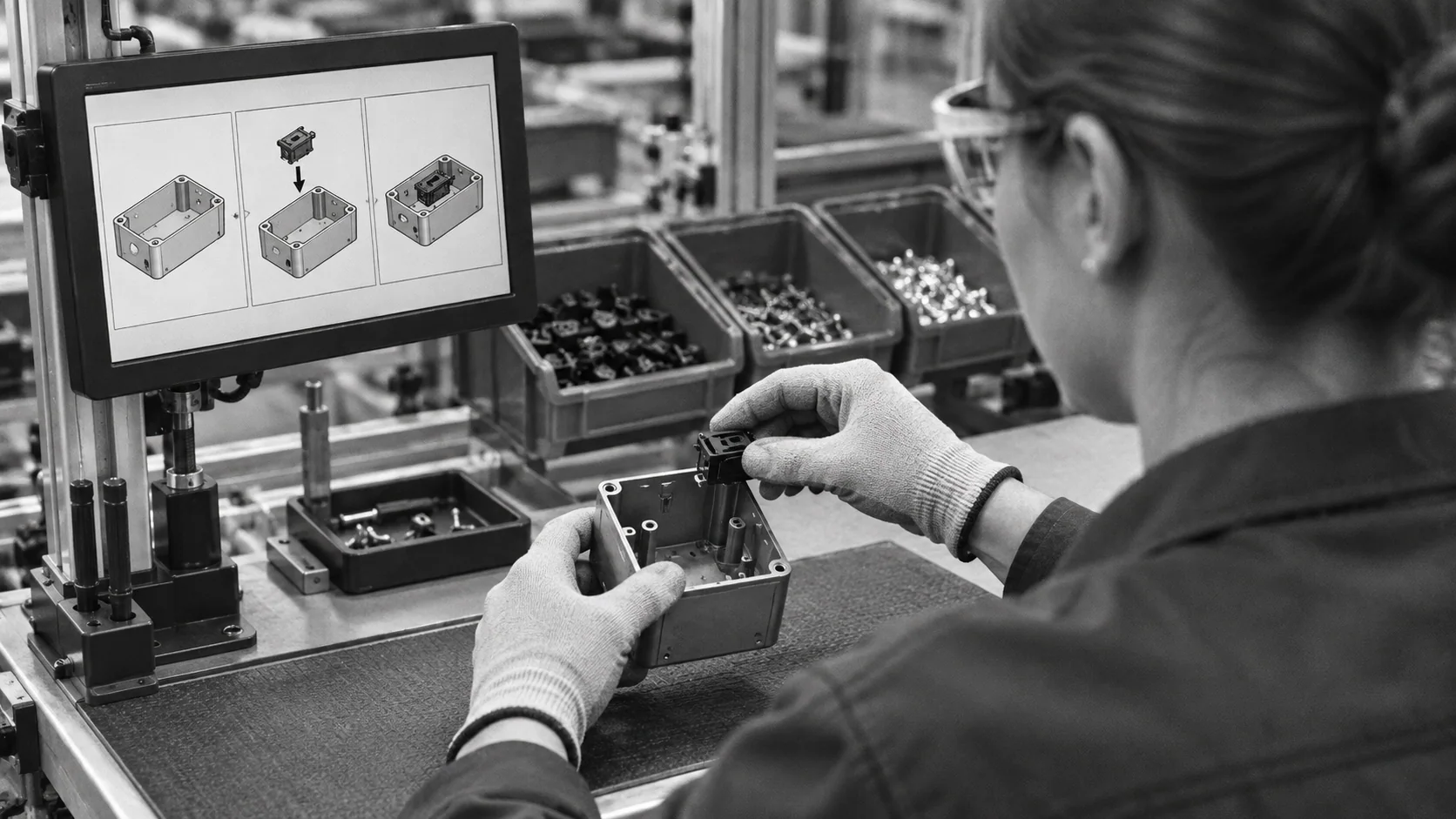
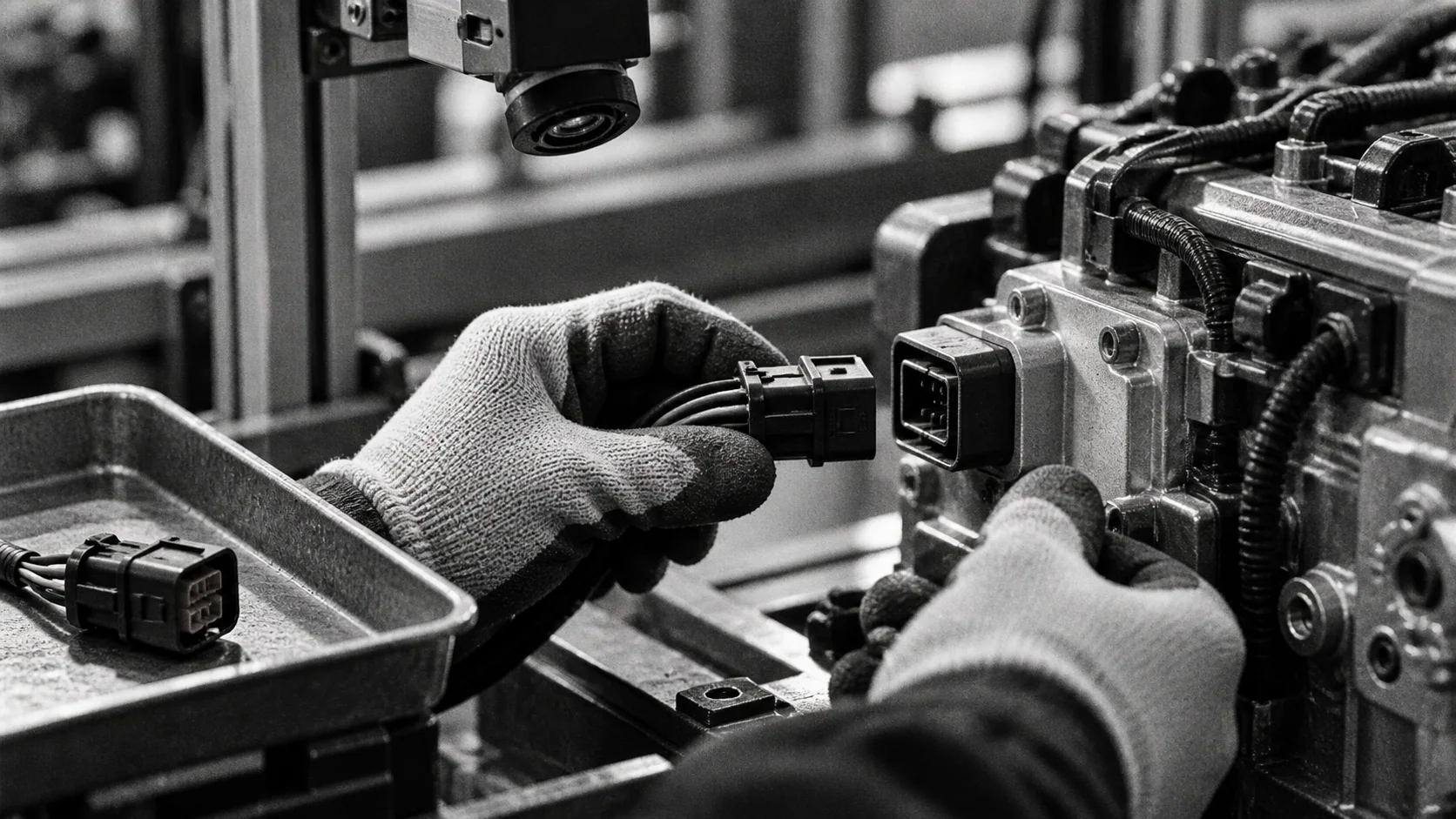
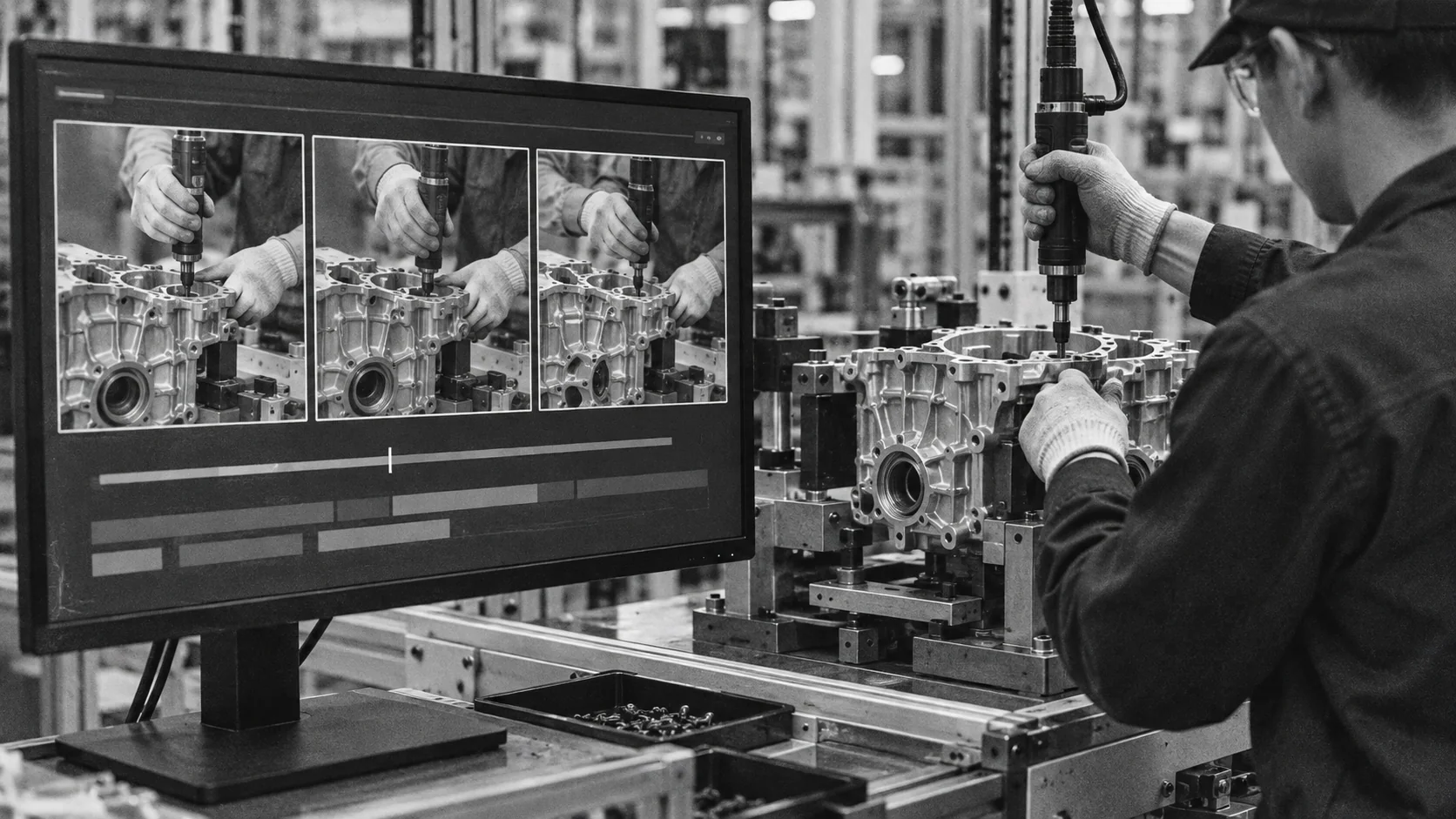
- Step-by-step digital work instructions, displayed at the point of work
- Confirms each step is completed in sequence, automatically
- Handles multiple product variants without reprogramming the line
- Brings day-one hires to standard work, fast
Digital Work Instruction & Poka-Yoke AI for Error-Free Assembly
NAGARE AI puts step-by-step instructions at every station and verifies each step through the cameras you already have — no missed steps and sequences, no finding out at end-of-line, first-time right on every shift.
Toonaangevend in de sector voor foutloze productie


Handmatige kwaliteitscontrole schaadt uw reputatie en bedrijfsresultaten
Unverified Assembly Steps are a Recall Waiting to Happen.
A missed screw or a skipped step costs a little at the station, more at end-of-line testing, and a fortune in the field. Without verification at every step, each unit that ships is a bet that nobody missed anything.
Steps Slip Through
Paper Can’t Keep Up
New Hires Learn the Hard Way
Work Instructions and Error-Proofing, Built Into the Line You Already Have
NAGARE verifies every step through the cameras already at your station — guiding the operator, confirming the step was done right, and stopping errors before they leave the station. It’s privacy-first by design: no facial recognition, no identity tracking, only the part and the process.
Guide Every Step at the Station
Stop Errors Before They Escape
- Watches assembly actions in real time, at every monitored station
- Flags the wrong part, wrong tool, or wrong action in the moment
- Enables correction at the station, not after end-of-line testing
- Cuts the cost of poor quality before it compounds
Turn Every Cycle Into Improvement Data
- Cycle-level video traceability for every unit built
- Time-and-motion data from every cycle, not a sampled study
- Reduces supervision load with intelligent monitoring
- Bescherm de privacy van werknemers overal
.avif)
Guide Every Step at the Station
- Step-by-step digital work instructions, displayed at the point of work
- Confirms each step is completed in sequence, automatically
- Handles multiple product variants without reprogramming the line
- Brings day-one hires to standard work, fast


Stop Errors Before They Escape
- Watches assembly actions in real time, at every monitored station
- Flags the wrong part, wrong tool, or wrong action in the moment
- Enables correction at the station, not after end-of-line testing
- Cuts the cost of poor quality before it compounds
Turn Every Cycle Into Improvement Data
- Cycle-level video traceability for every unit built
- Time-and-motion data from every cycle, not a sampled study
- Reduces supervision load with intelligent monitoring
- Bescherm de privacy van werknemers overal
.avif)
Work Instruction & Poka-Yoke Applications We Error-Proof
See it running on your line
Tell our engineers where errors bite today and they will walk you through implementation, timelines and cost for your line.
Learn More - Talk to our expertSee it running on your line
Tell our engineers your build sequence and they will walk you through implementation, timelines and cost for your line.
Learn More - Talk to our expertSee it running on your line
Tell our engineers your torque-critical steps and they will walk you through implementation, timelines and cost for your line.
Learn More - Talk to our expertSee it running on your line
Tell our engineers about your manual stations and they will walk you through implementation, timelines and cost for your line.
Learn More - Talk to our expertSee it running on your line
Tell our engineers which steps get missed and they will walk you through implementation, timelines and cost for your line.
Learn More - Talk to our expertLive on Your Line, Not in a Six-Month Pilot
Operator guidance runs on the cameras you already have at your stations. No pilot line, no new hardware to install. We have mapped this deployment before, which is what makes it fast now.
We walk your stations, confirm camera coverage, and scope the steps and variants for verification.
The model trains on your actual steps, parts, and variants, not a generic action library.
Guidance runs alongside your current process first, then is confirmed accurate before it goes live on your line.
Bring your highest-scrap station and your trickiest variant. We will scope a pilot on your line.
Comparison
What Changes When You Add NAGARE
When errors are caught
At assembly or at the customer
End-of-line, after the errors
During the step, in real time
What it sees
Whatever the checker notices
Components, fixed positions only
Components + operator actions
New line or new variant setup
Retraining, weeks
Reprogramming, weeks
New variants configured in minutes
Hardware
Hand tools and checklists
Fixtures, jigs, proprietary sensors
Runs on your existing cameras
Traceability
Paper logs, if kept
Pass/fail report per unit
Video-backed record for every unit
First-Time-Right
Hope
Inspection after the fact
Right the first time, every shift
See Computer Vision for Error-Free Assembly in Action
Discover how industry leaders build right the first time with Jidoka’s AI vision systems.


Inspectie van gelabelde flessen met AI-Vision-systeem en modulaire hardware:
- Volledige automatisering van de etiketinspectie bij meer dan 300 flessen per minuut
- Verwaarborgt correcte tekst, oriëntatie en labelkwaliteit
- Geautomatiseerde eindlijnkwaliteitscontrole en waarborgt consistente normen
Veelgestelde vragen
What is poka-yoke in manufacturing?
Poka-yoke is Japanese for mistake-proofing: designing a process so an error either cannot happen or is caught the moment it does, before it becomes a defect. The concept was developed by Shigeo Shingo within the Toyota Production System. Vision AI applies the same principle without physical jigs or fixtures, using cameras to verify each step as it happens. The thinking behind it: human error is inevitable, so fix the system, not the worker.
What is the difference between jidoka and poka-yoke?
Both come from the Toyota Production System. Poka-yoke prevents mistakes at the source; jidoka stops the process automatically when an abnormality is detected, so defects never move downstream. NAGARE does both jobs on one camera feed: it guides the operator to prevent the error, and raises the alert that stops it from escaping when something drifts.
How are AI digital work instructions better than paper instructions?
Paper instructions go out of date, live in binders nobody opens, and cannot confirm anything was actually done. Digital work instructions display the right step at the right moment, track completion automatically from the camera feed, update centrally across every station, and switch between product variants in minutes.
Can machine vision confirm steps without operator input?
Yes. The camera confirms each step automatically as it is performed, so operators never stop to tap a tablet or press a confirm button. Both hands stay on the work, and the verification record builds itself in the background. No tablet at every station, no wearables, the cameras you already have do the verifying.
What are examples of AI-powered poka-yoke on assembly lines?
Common applications include real-time poka-yoke error prevention, guided assembly sequencing, torque-step confirmation, manual-station error-proofing, and missed-step alerting, all running on standard cameras over the stations.
How does AI poka-yoke improve productivity and ROI?
The cost of poor quality typically runs 15 to 20% of sales revenue (ASQ), and human error drives 23% of unplanned manufacturing downtime (Vanson Bourne). Correcting errors at the station, before they escape, attacks both numbers: Jidoka deployments have delivered $140k savings in inspection and COPQ, 25% higher productivity, and 30% reduction in downtime, with new operators reaching standard work faster through guided steps.