.webp)
You walked out of that vendor demo with a strong impression and a weak business case. The system caught defects the line inspector missed, the vendor slide said 99% accuracy, and then your engineering lead asked the question that stopped the meeting: which architecture produces that number, and at what production speed? You did not have the answer. Neither did the vendor's sales deck.
This article gives you the answers. By the end, you will have the technical vocabulary to evaluate any benchmark claim, a structured cost model to populate for your own facility, and a six-criterion checklist to use in your next RFQ meeting.
AI vision quality inspection systems use CNN-based architectures (most commonly YOLO variants for high-speed lines and ResNet for precision defect classification) achieving 95-99% accuracy in production deployments. Pilot costs typically run $50,000-$250,000. Enterprise rollouts reach $500,000-$2 million. Most facilities hit ROI within 9-18 months.
What AI Vision Quality Inspection Actually Is (And What It Is Not)
AI vision quality inspection means a trained neural network inspection learns to classify images of acceptable and defective parts from labelled training data, then applies that learned model at inference speed on the production line. It is not a rule set. A human programmer does not tell it what a scratch looks like. The model learns the visual decision boundary from data.
That distinction matters more than most vendors acknowledge. Traditional machine vision works from geometric rules: presence or absence of a feature, a dimensional measurement, a colour threshold against a predefined mask. It fails reliably when defect appearance varies, because the rule that catches one variant misses another. Computer vision for quality control has no such ceiling. The model generalises across defect variation because that variation was baked into its training distribution.
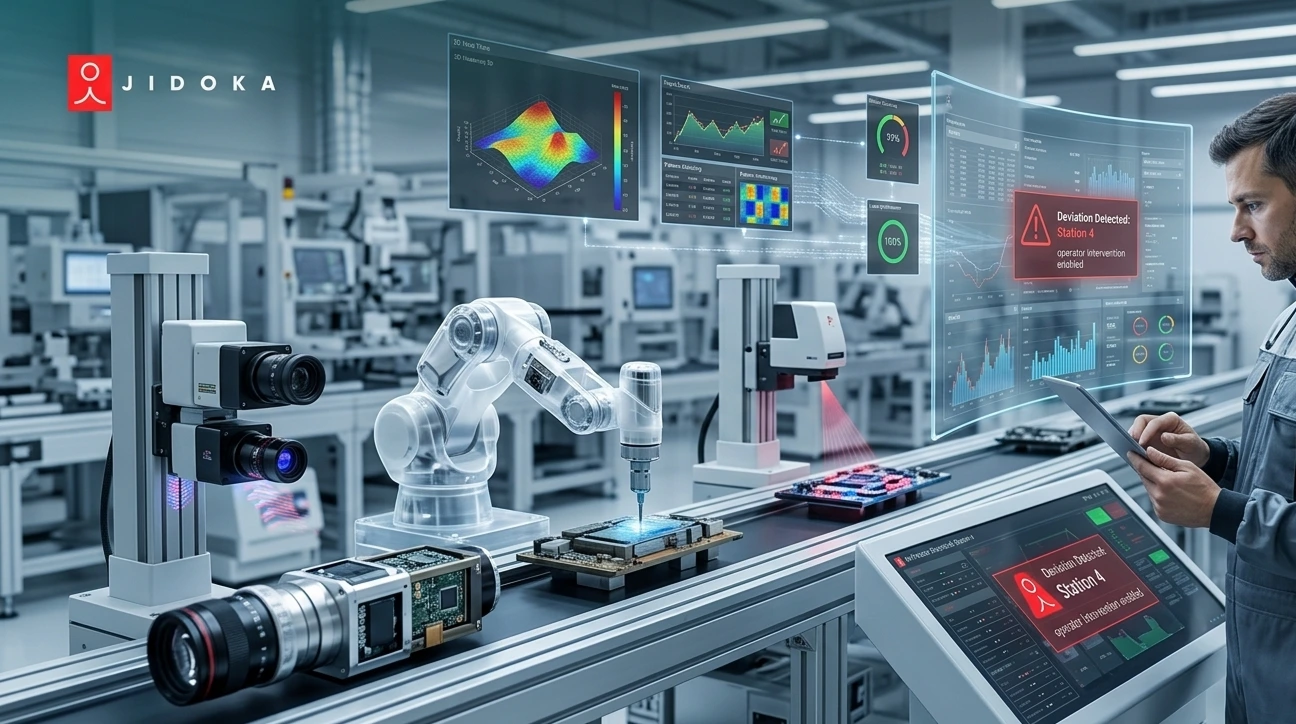
Three deployment modes determine the architecture conversation with any vendor. Edge-only runs the model on a GPU or NPU directly at the camera station, with no cloud dependency. Edge-to-cloud hybrid processes real-time inspection decisions at the edge, then streams defect images and metadata to the cloud for model retraining and performance monitoring. Cloud-dependent routes inference to a cloud API and is not appropriate for production lines with cycle times below 500ms. The architecture choice determines your latency ceiling, your data sovereignty posture, and your accuracy floor under production conditions.
PCB solder inspection on electronics assembly lines has the deepest documented deployment history for CNN-based AI vision quality inspection. If your facility runs a defect type with limited published deployment data, that changes your training data requirements and your accuracy expectations in the early production phase.
“AI vision inspection is not machine vision with a better camera. It is a learned model that generalises across defect variation, the same way a trained human eye does, but at production speed and without fatigue.” - Source: Jidoka Technologies
The Three Neural Network Architectures Used in Production Inspection
Architecture selection is the decision your vendor will try to make for you. Your job is to understand it well enough to ask the right follow-up questions. See the Jidoka Architecture Selection Matrix below for a printable reference before your next vendor meeting.
CNN / ResNet variants
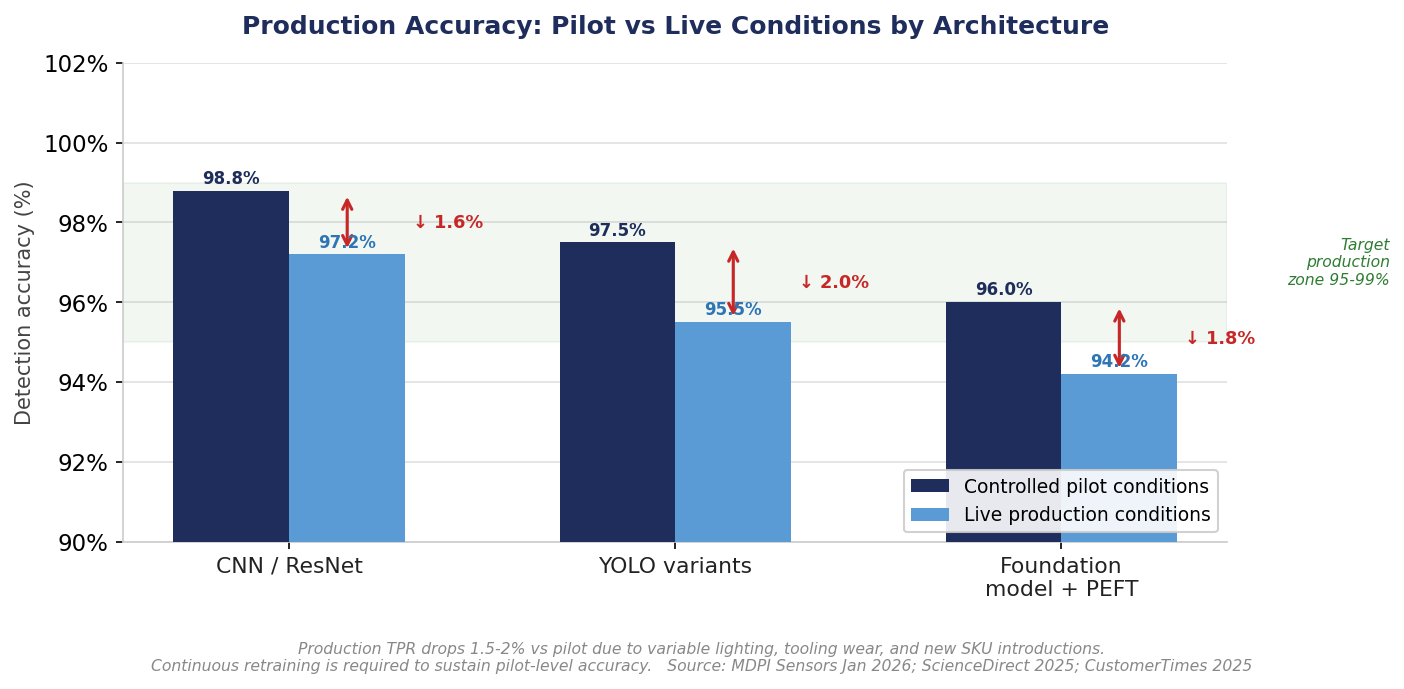
ResNet-50 and ResNet-101 handle classification-heavy tasks: defect type identification, pass/fail binaries on complex surface patterns, anything where distinguishing a crack from a scratch matters more than inspection speed. Documented accuracy in manufacturing environments reaches 97-99.9%. ICAISM 2025 benchmarks place ResNet-50 at 97.2% on building materials under production conditions (ICAISM 2025, ACM DL). A custom CNN on casting products documented 99.86% accuracy in MDPI Smart Manufacturing research. These architectures work best when cycle time exceeds 500ms and labelled training data is plentiful.
YOLO variants
Deep learning quality inspection in high-speed automotive and electronics lines runs on YOLO. YOLOv8 is the current production standard for lines requiring sub-100ms inference, processing the full image in a single pass without the two-stage pipeline ResNet architectures use. Ultralytics released YOLO26 in September 2025, removing the Non-Maximum Suppression (NMS) post-processing bottleneck and improving edge latency by approximately 20% on NPU targets. Practical accuracy on high-speed lines: 95-98% (ScienceDirect, YOLOv8 assembly line study, 2025).
Foundation model fine-tuning
Emerging in PCB and semiconductor inspection, where labelled defect data is often scarce. CLIP-ViT with Low-Rank Adaptation (LoRA) fine-tuning achieves competitive detection accuracy with significantly fewer labelled samples than training from scratch (PMC, November 2025, PCB defect inspection study). This approach remains predominantly pilot-scale in 2026 and should not serve as the production backbone for a facility that cannot support ongoing model maintenance overhead.
Model selection guide
If cycle time runs below 200ms, start with YOLO. If defect classification accuracy is the primary KPI and cycle time exceeds 500ms, use ResNet. If labelled defect data is scarce (fewer than 500 examples per defect class), evaluate PEFT fine-tuning of a foundation model before committing to training from scratch.
INT8 quantisation compresses models for edge-deployed CNN inspection. It reduces model size by 4x with less than 2% accuracy loss. An NVIDIA Jetson Orin NX running YOLOv8 at INT8 processes 240 frames per second under 15 watts (NVIDIA, 2026). That is your hardware benchmark for a single-station edge deployment.
What Accuracy Benchmarks Actually Mean in Production (And What They Do Not Tell You)
Every vendor shows 99% accuracy. Almost none tells you what that number means, under what conditions they measured it, or what it costs when the number drops to 96% on your line.
True Positive Rate (TPR) is what vendors quote: the percentage of actual defects the system catches. False Positive Rate (FPR) determines your scrap cost: how often the system rejects a good product. False Negative Rate (FNR) drives warranty and recall exposure: defects that escape the line. Inference Speed is cycle-time compatibility. Generalisation Accuracy tells you how performance holds when a new part variant enters production without retraining. Vision AI quality benchmarks that only report TPR are telling you one-fifth of the story.
AI vision quality inspection systems in controlled pilot environments routinely achieve 98-99% TPR with FPR below 2%. Under production conditions, variable lighting, tooling wear, and new SKU introductions pull TPR down to 95-97% and push FPR up, unless continuous retraining is in place. An MDPI Sensors study (January 2026) on ML-powered vision for robotic inspection found that 77% of implementations remain at pilot scale, revealing systematic deployment barriers as much as any cost concern.
Training data volume is a direct driver of that gap. A model trained on 500 labelled examples of a defect class performs measurably worse than one trained on 5,000. Synthetic data generation is closing this gap for facilities with limited real defect samples; a March 2026 Springer Nature study on semiconductor wafer inspection validated synthetic augmentation as an accuracy-preserving approach. The industry baseline, when conditions are right, is 98-99% computer vision manufacturing accuracy with 50-70% labour savings (CustomerTimes AI Automation in Manufacturing 2025 Report).
The Production Accuracy Audit: five questions to ask before accepting a benchmark
Any vendor benchmark should survive these five questions before you take it into a board presentation.
- What was the training set size for the defect classes you are quoting?
- Was the benchmark run on held-out production data or on the training validation set?
- What is the false reject rate at that accuracy level?
- How does accuracy change when a new part variant is introduced without retraining?
- Was the benchmark run at the target inference speed, or offline?
A vendor who cannot answer questions 2, 3, and 5 with specific numbers has not run a production-grade evaluation. That is the signal you need before committing the procurement budget.
Deployment Architecture: Edge, Cloud, And Hybrid Explained
Your production IT team will ask this question before procurement reaches pricing. Answer it in the RFQ, not after.
Edge-only
The model runs on a GPU or NPU at the camera station. NVIDIA Jetson Orin NX, Intel Arc, and AMD Ryzen AI are the common hardware targets. Inference latency sits below 50ms at full line speed. All data stays on-premises, the non-negotiable requirement for pharmaceutical Good Manufacturing Practice (GMP) compliance and automotive Original Equipment Manufacturer (OEM) data agreements.
The operational limitation: model updates require a manual push or an Over-The-Air (OTA) pipeline. If your line introduces new part variants frequently, factor that maintenance load into your total cost of ownership.
Edge-to-cloud hybrid
Edge handles real-time inference; defect images and metadata stream to cloud for model retraining and performance monitoring. This enables continuous model improvement without production downtime. Bandwidth requirement: 2-5 Mbps per camera at 30fps.
Computer vision manufacturing accuracy improves over time with hybrid deployment because the retraining pipeline feeds production data back into the model automatically. Jidoka's Nagare uses this architecture, processing real-time verification on-premises via existing camera infrastructure, while keeping inference data from leaving the facility.
Cloud-dependent
Inference routes to a cloud API. Not appropriate for production lines with cycle times below 500ms. Where it fits: offline batch inspection, audit sampling, and quality analytics on non-time-critical workflows. Upfront cost is the lowest of the three; ongoing API spend at scale is the highest.
Hardware cost benchmarks by tier
- Entry (single-camera, single-station, edge GPU): $15,000-$40,000
- Mid-tier (multi-camera line, edge cluster): $50,000-$150,000
- Enterprise (multi-line, full facility, MES integration): $300,000-$1,000,000+
Integration checklist
- PLC/SCADA interface: OPC-UA or MQTT protocol
- Manufacturing Execution System (MES) quality record push
- Camera trigger synchronisation with line PLC
- Lighting controller integration
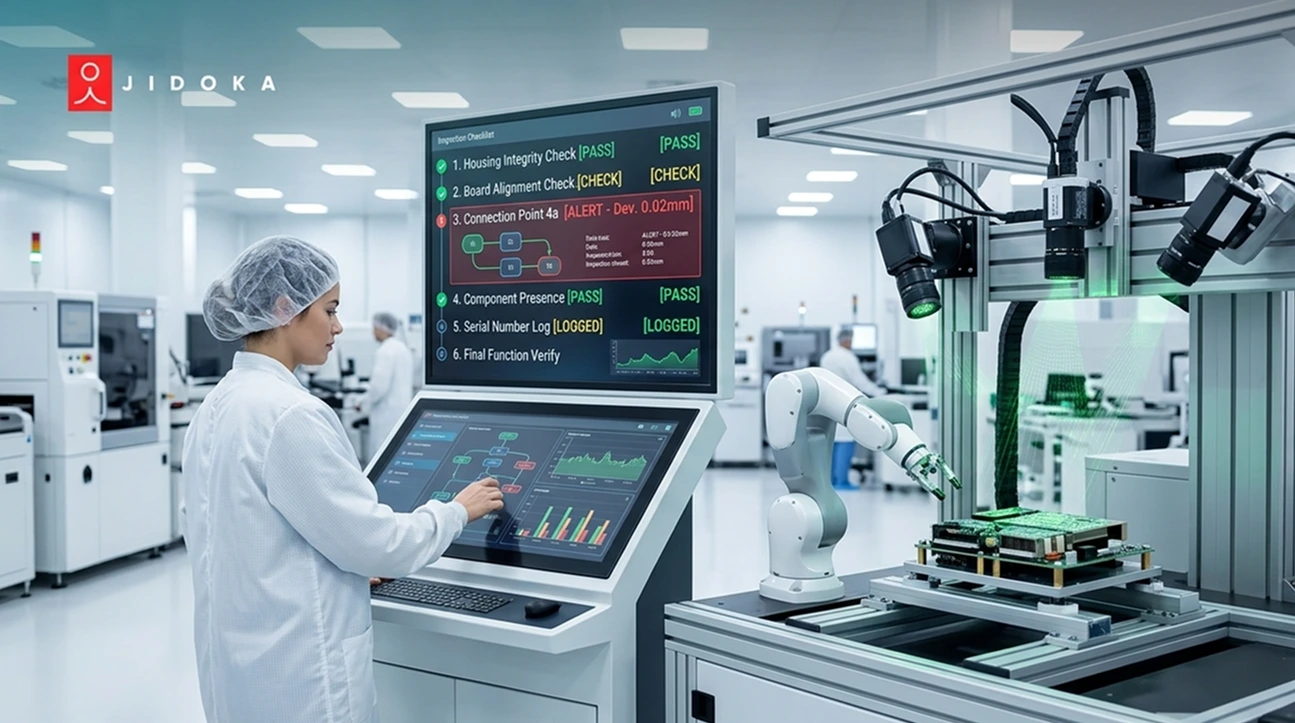
- Reject mechanism trigger: tower lamp, pneumatic gate, or robotic arm
“Nagare is a low-capex, plug-and-play solution that works with your current cameras, no additional hardware required, and typically achieves ROI within a year by optimising workflows and reducing supervision and rework.” - Jidoka Technologies
Deployment Cost Model And ROI Calculation Framework
A technology decision at this scale needs a number the board can challenge. This is how you build it.
The baseline: cost of doing nothing
The average manufacturer loses 20% of total revenue to scrap, rework, warranty claims, and inspection overhead. For a plant generating $10 million annually, that is $2 million gone before a single AI system is considered. That is your COPQ (Cost of Poor Quality) baseline. Your AI vision quality inspection deployment does not need to eliminate all of it; it needs to recover more than it costs to deploy.
Three-part deployment cost structure
- Hardware acquisition (cameras, lighting, edge compute, mounting): typically 50-60% of total project cost
- Software licensing for SaaS platforms: $15,000-$80,000 annually, with higher rates for custom model training subscriptions
- Integration and commissioning: typically 15-30% of hardware cost, depending on PLC complexity and number of existing systems requiring interface
ROI calculation inputs
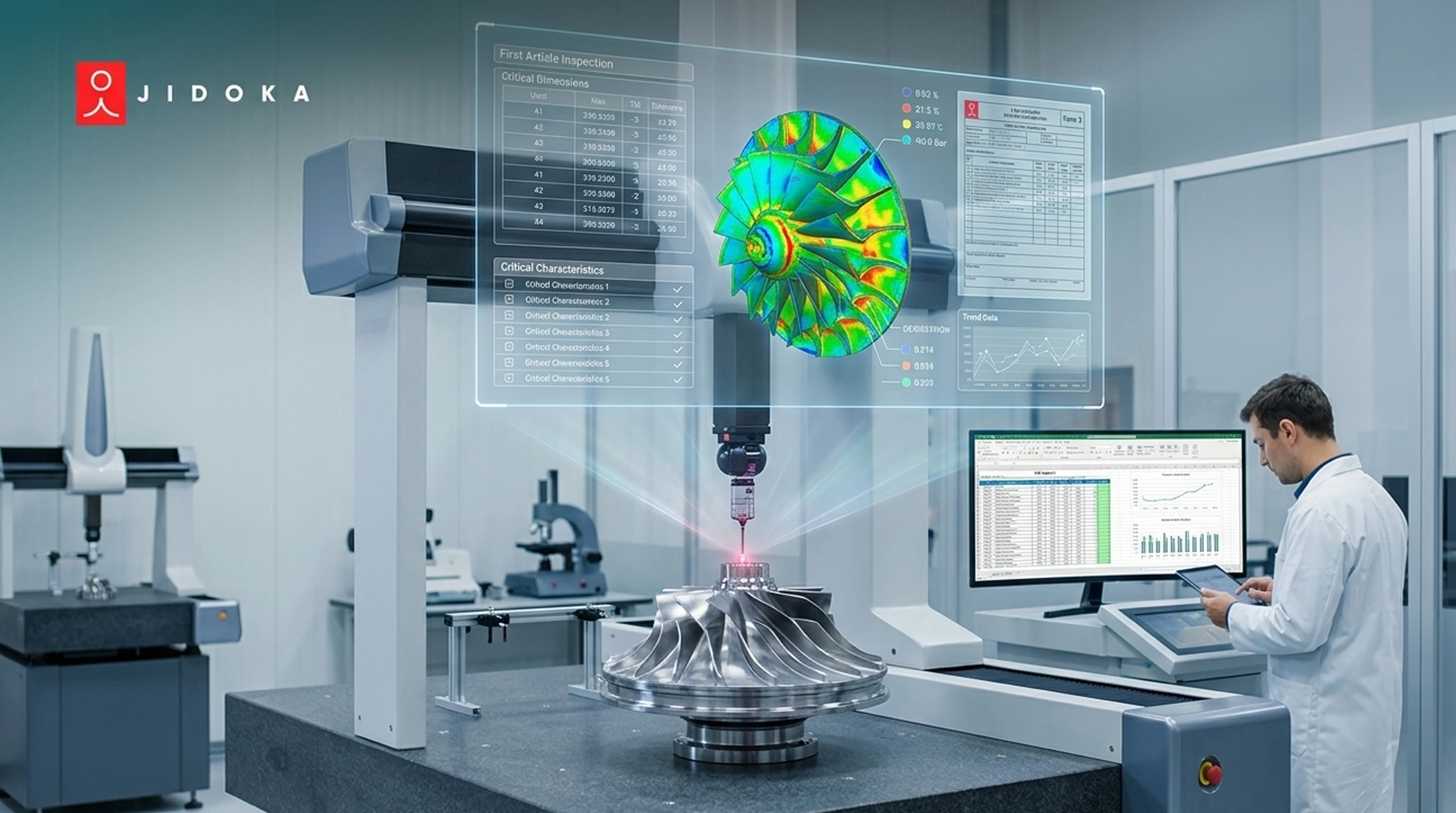
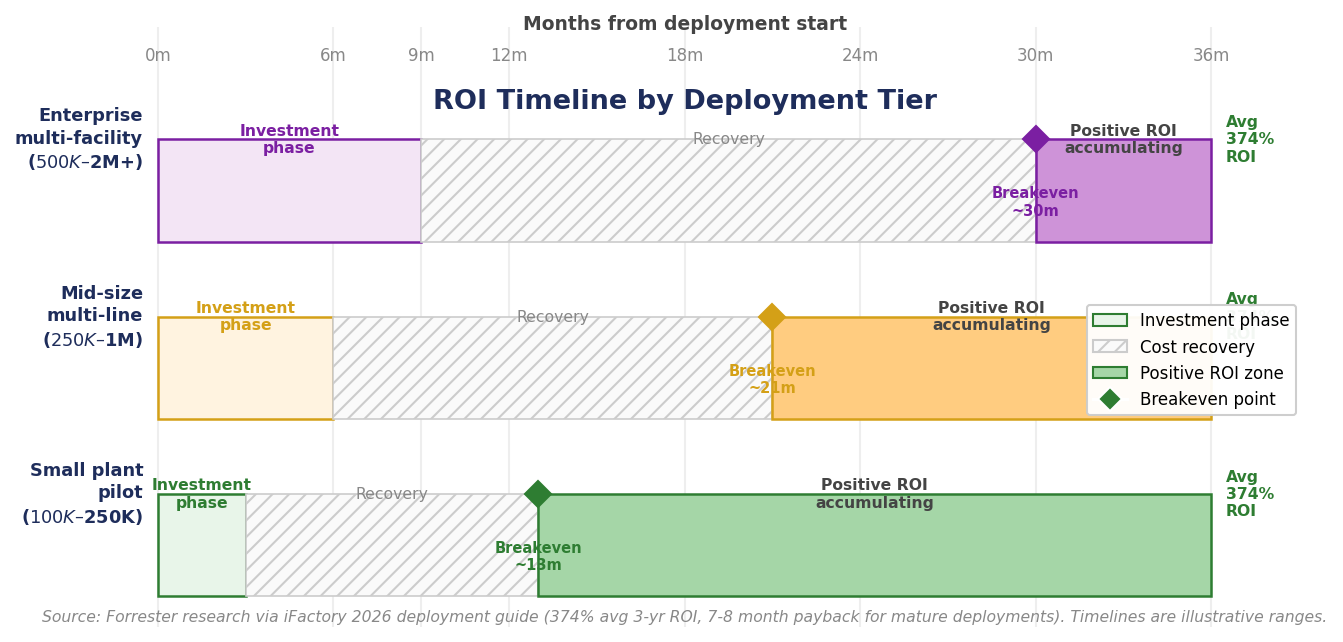
Annual defect escape cost (warranty claims, recalls, rework) plus annual inspection labour cost plus false reject cost (scrap rate at current FPR), minus projected values at target accuracy. Forrester research, as cited in iFactory's 2026 deployment guide, shows 374% average three-year ROI with 7-8 month payback for mature deployments. Optimised high-volume deployments generate $200,000-$500,000 in annual savings per production line through 50-70% labour savings (CustomerTimes 2025, smartdev.com 2025).
Jidoka deployment pathway
Facilities with existing CCTV coverage can deploy Jidoka's Nagare with zero camera hardware cost, using existing camera feeds as the input source. Nagare deploys with minimal production downtime.
Jidoka's Kompass delivers 98% accuracy at 4,200 parts per minute in packaging applications and 99% defect detection with 20% rework reduction in electronics assembly.
These figures represent documented first-party outcomes from Jidoka production deployments, not market averages. Use the conservative scenario when building your internal business case.
Payback period by facility size
- Small plant pilot ($100,000-$250,000 investment): 12-18 months
- Mid-size facility multi-line ($500,000-$1,000,000): 18-24 months
- Enterprise multi-facility: 24-36 months, with compounding model improvement as production data accumulates
What a Vendor Selection Process Should Look Like (A Practitioner’s Checklist)
Most vendor evaluations end with a demo. That is backwards. A demo proves a system works under vendor-controlled conditions. The questions below prove it can work under yours.
The Vision AI Vendor Readiness Assessment is a six-criterion framework for separating production-ready platforms from demo-only solutions. Apply it before any RFQ meeting.
The Vision AI Vendor Readiness Assessment: six criteria:
Criterion 1: Production reference customers
Can the vendor name a customer (not anonymised) running the same defect type at your line speed for more than 12 months? References from a different industry or defect class do not transfer. An automotive-grade benchmark does not tell you how the system handles pharmaceutical label inspection.
Criterion 2: Retraining infrastructure
How does the model update when a new part variant enters production? What is the turnaround time, and does the update require on-site vendor presence? Get the answers in writing before signing. Vendors who cannot quantify their retraining turnaround time have not run enough production deployments to know it.
Criterion 3: False reject rate at production accuracy
Request FPR at the quoted TPR, on production data, not the validation set. FPR above 3% creates scrap cost that often exceeds the cost of the manual inspection process the system replaces. A vendor comfortable with 3% or higher FPR has a demo-grade product.
Criterion 4: MES/PLC integration method
Does the vendor support OPC-UA, MQTT, or PROFINET? Custom integration adds 30-50% to commissioning cost. Jidoka's systems integrate directly with PLC and MES, triggering tower lamps or line stops without custom middleware.
Criterion 5: Edge vs cloud and data sovereignty
Where is inference data stored? For automotive OEM and pharmaceutical GMP facilities, cloud-routed inference data may violate data agreements. Nagare processes all inference data on-premises by design.
Criterion 6: Deployment timeline with pilot gate
A credible vendor proposes a 2-4 month pilot scoped to a single station with defined acceptance criteria before a full-line commitment. Vendors who push for full-line contracts before a pilot have not earned the right to your production data. Walk away from any proposal that skips the pilot gate before full-line commitment.
Final Thoughts
The gap between 95% and 99% accuracy is not a footnote in a vendor comparison deck. It is the difference between a system that pays for itself in nine months and one that creates a new category of scrap.
The questions in this article require the same rigour you apply to any capital equipment decision: ask for production data, not demo conditions; ask for false reject rates, not headline accuracy; ask for a pilot gate before a full-line commitment.
Jidoka Technologies builds AI vision quality inspection and process adherence systems that answer all six criteria in the Vision AI Vendor Readiness Assessment: Kompass for automated defect detection at 99%+ accuracy, Nagare for edge-deployed process monitoring that works with your existing cameras. See how Nagare fits your line: book a deployment assessment.
Frequently Asked Questions
1. What accuracy can AI vision inspection systems realistically achieve?
Mature AI vision inspection deployments achieve 95-99% detection accuracy under production conditions. The range depends on architecture (YOLO for high-speed lines, ResNet for precision classification), training data volume, and defect type complexity. Controlled pilot environments often show 99%+; production performance with variable lighting and new part introductions typically stabilises at 95-97% without continuous retraining.
2. How long does it take to deploy a computer vision quality inspection system?
A single-station pilot deployment typically takes 2-4 months from camera installation to production sign-off. Full-line enterprise rollouts run 12-24 months depending on inspection station count, MES integration complexity, and model training time. Low-capex solutions using existing CCTV infrastructure, such as Jidoka's Nagare, significantly compress hardware procurement timelines.
3. What is the Production Accuracy Audit for AI vision inspection?
The Production Accuracy Audit is a five-question framework for evaluating any AI vision vendor's benchmark claim against production-grade standards. The five questions cover training set size, benchmark data source (production vs validation set), false reject rate at quoted accuracy, accuracy degradation on new part variants, and whether the benchmark was run at target inference speed. Vendors who cannot answer all five with specific numbers are quoting demo-condition figures.
4. What is the Vision AI Vendor Readiness Assessment?
The Vision AI Vendor Readiness Assessment is a six-criterion framework for separating production-ready AI vision vendors from demo-only platforms. The six criteria are: production reference customers, retraining infrastructure, false reject rate at production accuracy, MES/PLC integration method, edge vs cloud data sovereignty, and a defined pilot gate before full-line commitment.
5. How much does AI vision quality inspection cost to deploy?
Deployment cost ranges from $50,000-$250,000 for a single-line pilot to $500,000-$2,000,000 for enterprise multi-line rollouts. Hardware (cameras, edge compute, lighting) typically represents 50-60% of total cost; software and integration account for the remainder. Solutions using existing camera infrastructure reduce hardware costs significantly. Most deployments achieve ROI within 9-18 months through labour savings and defect escape reduction.
6. What is the difference between YOLO and ResNet for inspection applications?
YOLO is optimised for speed: it processes full images in a single pass, making it the default for production lines with cycle times under 200ms. ResNet is optimised for classification accuracy; its residual architecture supports deeper feature extraction, better suited for complex defect type discrimination at cycle times above 500ms. Most production systems use YOLO for real-time inspection and ResNet for offline defect classification.
7. Can AI vision inspection work without replacing existing cameras?
Yes. Platforms designed for existing infrastructure deploy edge AI models onto existing CCTV or line cameras without hardware replacement. Jidoka's Nagare is designed as a plug-and-play solution that converts existing camera feeds into intelligent process monitoring. The constraint is camera resolution and frame rate; systems requiring sub-100ms inference at high resolution may need a GPU module at the camera station even if the camera itself is retained.