Tier 1 manufacturing execution system platforms cost $1M to $3M per plant to implement, with deployment timelines running 18 to 36 months. For a mid-market manufacturer running one or two plants, that is not a technology decision. It is a multi-year capital commitment with significant organisational risk.
The real question for most 200 to 2,000-employee manufacturers evaluating MES software alternatives is not whether full MES is better. It is whether full MES is the right tool for the operational problem you actually need to solve today. This guide gives you the decision framework to answer that question with numbers, not vendor preference.
Full MES platforms are built for enterprise manufacturers with complex compliance requirements, multi-product scheduling, and large dedicated IT teams. AI process monitoring platforms are built for mid-market manufacturers who need real-time process adherence, OEE visibility, and quality control without the cost or timeline of a full MES deployment. Choosing between them depends on your compliance requirements, integration needs, and time-to-ROI target.
What a Manufacturing Execution System Actually Does (and Does Not Do)
Before comparing MES software alternatives, the mid-market buyer needs an accurate picture of what MES covers and where it was not designed to operate. Most MES misconceptions lead to either over-investment or under-investment for the actual operational problem at hand.
A manufacturing execution system is one of the most evaluated MES software alternatives for mid-market plants. It is a plant-level software layer that sits between ERP and the production floor. At its core, MES handles work order management, production scheduling, quality management, traceability, labour tracking, and ERP integration.
These are the functions that make MES essential for pharmaceutical manufacturers managing lot genealogy under FDA 21 CFR Part 11, or automotive Tier 1 suppliers managing IATF 16949 compliance documentation.
1. Where MES Delivers Its Strongest Value
MES delivers the highest return in regulated industries where documentation is legally required, not operationally optional. Pharmaceutical manufacturers need batch record traceability that links every material and operator action to a specific lot.
Aerospace manufacturers need AS9100 conformance documentation tied to each work order. Multi-site enterprise operations need centralised production scheduling across facilities with different product mixes. For those use cases, MES is not an alternative to evaluate. It is a requirement.
2. The Tier 1 Deployment Reality for Mid-Market Buyers
Tier 1 enterprise MES platforms including Siemens Opcenter and Rockwell FactoryTalk are engineered for that enterprise context. The deployment reality for a mid-market buyer evaluating MES software alternatives reflects that complexity.
TeepTrak's 2026 US MES Buyer's Guide documents total cost of ownership of $1M to $3M per plant over a three-year period, with 18 to 36 month implementation timelines. Those timelines assume three to five internal IT staff dedicated to the implementation during that window.
“Tier 1 enterprise MES platforms carry a total cost of ownership of $1M to $3M per plant, with implementation timelines of 18 to 36 months. For most mid-market manufacturers, that timeline eliminates them from consideration for current-year operational problems.”
3. Tier 2 Mid-Market MES Options
Tier 2 mid-market platforms including iFactory and Tulip reduce both the cost and complexity significantly. iFactory's 2026 MES comparison data puts three-year TCO for mid-market platforms at $180K to $420K, with deployment timelines of 6 to 10 weeks. These platforms cover OEE dashboards, quality reporting, and digital work instructions without the integration complexity of a Tier 1 deployment.
4. The Core MES Limitation for Real-Time Adherence Use Cases
The functional boundary that matters most to any buyer comparing MES software alternatives defines where MES ends and AI process monitoring begins is the difference between logging what happened and verifying what is happening now. MES tracks whether a work order was opened, steps were recorded, and output was logged.
It does not watch whether the operator performed each step correctly during the cycle. A work order can be closed successfully in MES while the actual assembly contains a deviation that will not surface until end-of-line inspection finds the defective unit. That gap is structural, not a configuration problem.
What AI Process Monitoring Does That MES Does Not
AI process monitoring is not a cheaper version of MES. It is a different capability layer that addresses the real-time adherence gap MES was never designed to fill. This section maps the five specific functions that fall outside the MES module set.
When buyers compare MES software alternatives, the ai process intelligence platform category emerges as the solution to a specific operational gap: manufacturers needed to know whether the right process was happening right now, at each station, on each cycle, without waiting for an end-of-shift quality report or a work order closure event. That is a different problem from what MES solves.
1. Real-Time SOP Step Verification
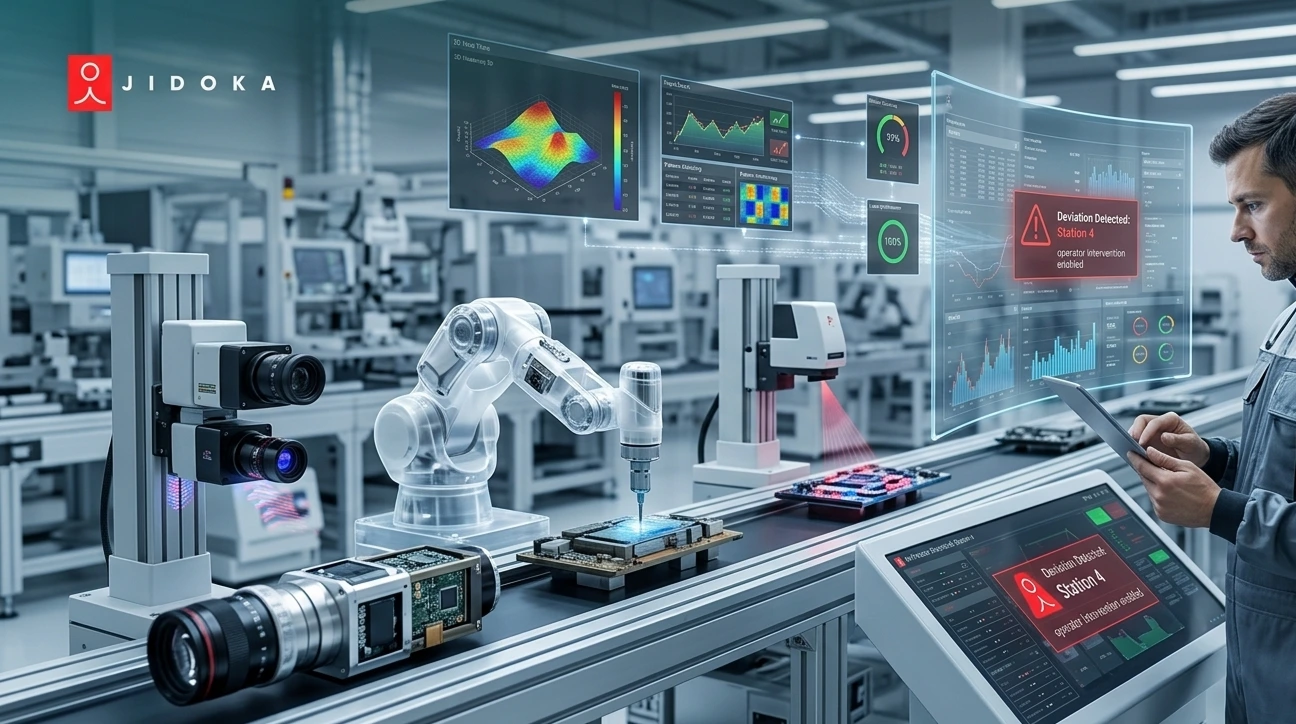
AI vision monitors whether each operator step is performed correctly at the point of production, not whether a work order record was opened and closed. A camera watching an assembly station compares the operator's actions against the digital SOP in real time.
When a step is missed or performed out of sequence, an alert fires at the station in under 10ms. The operator self-corrects before the part moves to the next station. No MES module provides this capability because MES operates on work order records, not camera inference.
2. 100% Inspection Coverage Per Cycle
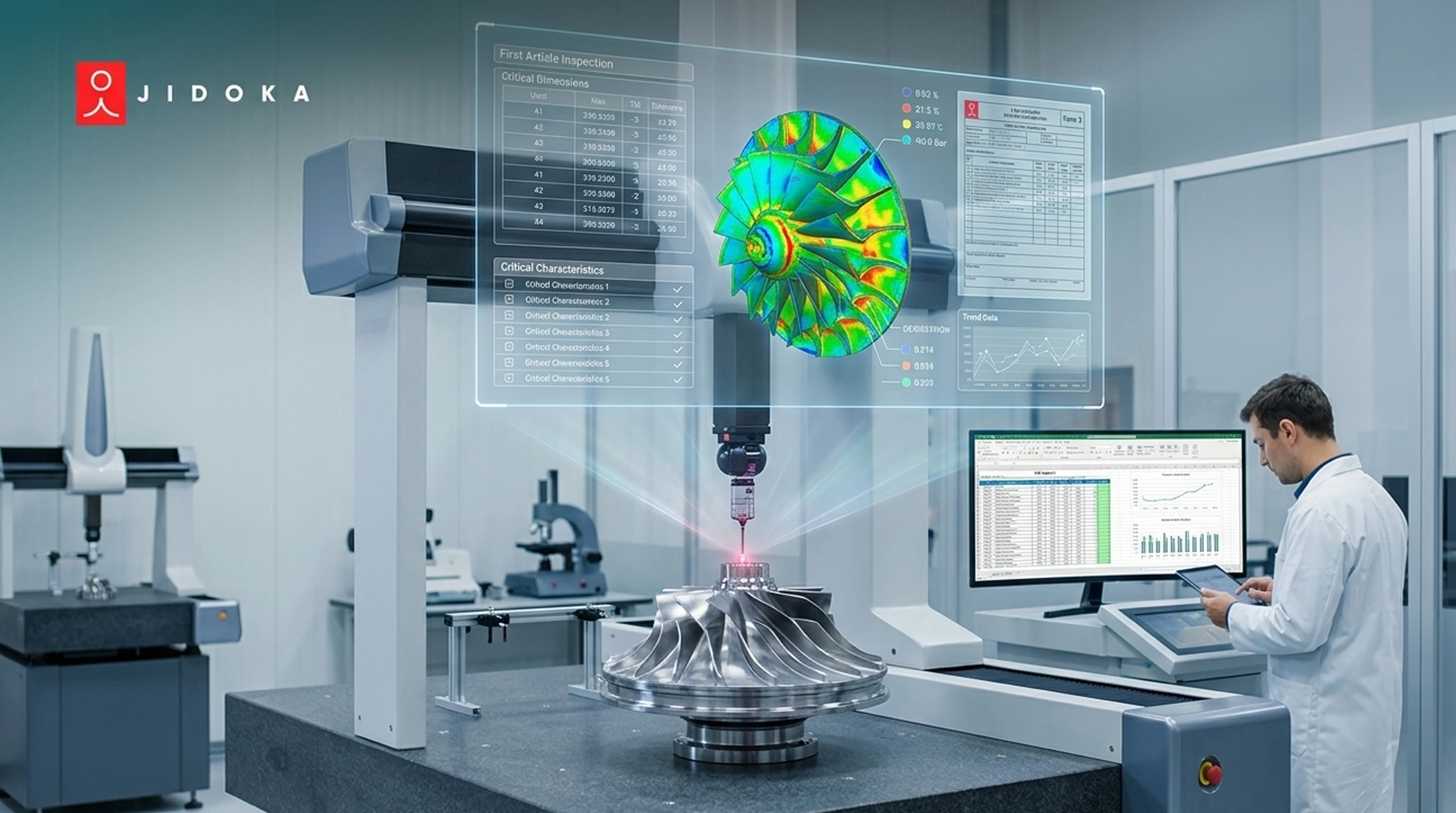
MES quality modules log results from sampled gate checks. A quality record in MES reflects what an inspector found during a timed visit, applied to the lot through statistical sampling. AI vision inspection checks every unit, every cycle.
Jidoka's Kompass system achieves 99.8% inspection accuracy at up to 12,000 parts per minute. The quality OEE score in a Kompass deployment reflects what happened on every cycle, not on the 5% sample that happened to be inspected.
3. Deployment on Existing Camera Infrastructure
AI monitoring platforms deploy on cameras already installed on the production line. Nagare by Jidoka Technologies uses existing CCTV infrastructure with no additional hardware requirement.
MES deployments require new integration points between MES servers, PLCs, and operator terminals at each station. The infrastructure gap between the two deployment paths is measured in months and hundreds of thousands of dollars for a full facility rollout.
4. Sub-10ms Operator Deviation Alerts
MES work order systems operate on minutes-to-hours response cycles. A deviation logged in MES appears in a shift summary or a quality report. A deviation detected by AI process monitoring triggers a station alert in under 10ms.
For rework prevention, the response time difference is the difference between catching the deviation on the unit and catching it 40 units downstream at the inspection gate.
5. No-Code Process Monitoring Configuration
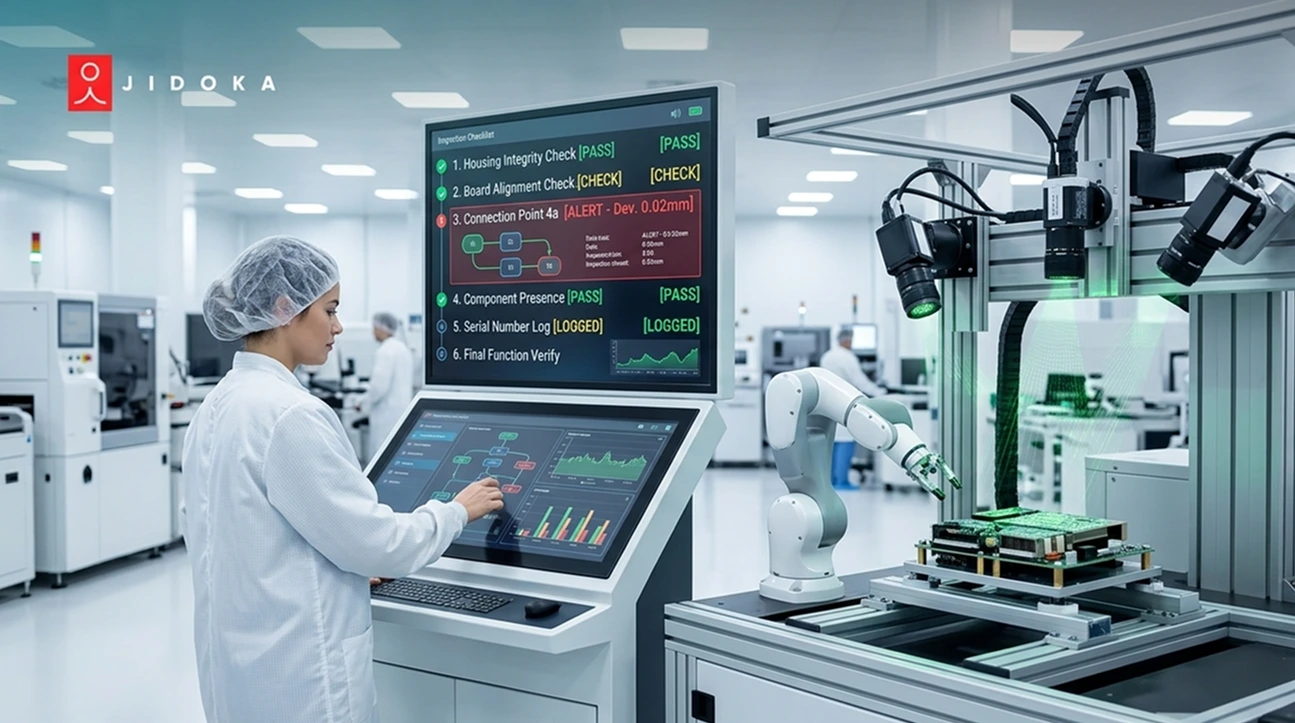
When evaluating MES software alternatives for no-code deployment, lightweight MES platform options like Nagare configure visual SOPs without IT development resources. A quality engineer uploads the SOP, maps it to the camera feed, and runs a calibration cycle.
No system integration project, no IT team requirement, no six-month configuration phase. MES configuration for a new product line requires system integration expertise, often involving the MES vendor's professional services team and weeks of parameter setup.
Named Framework: MES Capability Gap Map (3-Zone Framework)
Use this three-zone model to determine which tool owns which function before evaluating any vendor. Zone 1: MES is clearly the right tool. Zone 2: either works, both can deliver. Zone 3: AI monitoring is clearly the right tool.
- Zone 1 (MES-only): Pharmaceutical lot genealogy, regulatory compliance documentation, IATF 16949 audit trails, multi-site ERP-level scheduling, serialisation and batch traceability
- Zone 2 (either works): OEE dashboards, shift-level quality reporting, downtime classification, labour tracking, production count reporting
- Zone 3 (AI monitoring-only): Real-time SOP step verification on every cycle, operator deviation alerts under 10ms, vision-based 100% inspection, no-code SOP configuration, existing camera deployment
The Mid-Market Decision Framework: When to Choose Full MES vs AI Monitoring
This is the section the mid-market plant manager or CIO brings to the board conversation. The Fit Matrix and decision tree below provide a structured MES software alternatives evaluation based on your actual operational requirements, not a vendor's preference.
The production monitoring software comparison question has three conditional answers, not one absolute one. Full MES, AI process monitoring, and a combined deployment each serve a legitimate use case. The decision criterion is the nature of your operational problem, not the capabilities of the technology in isolation.
Choose Full MES If
- You operate in a regulated industry where compliance documentation is legally required: pharmaceutical, aerospace, medical devices, or IATF 16949 automotive
- You run multi-site operations that require centralised production scheduling across facilities with different product mixes
- You have a dedicated IT implementation team and an 18-month deployment runway in your current capital plan
- Your primary operational pain is lot genealogy, batch traceability, or ERP-level production visibility across multiple plants
Choose AI Process Monitoring If
- You need measurable improvement in SOP adherence, rework reduction, or quality OEE within 8 weeks, not 18 months
- You do not have IT resources available for a multi-month MES configuration project
- Your existing cameras can serve as the monitoring infrastructure, eliminating hardware procurement from the deployment path
- Your primary operational pain is operator process deviation, end-of-line defect clusters, or micro-stop performance loss that manual gate checks do not capture
Choose Both If
- You have MES for scheduling, compliance documentation, and ERP integration and want to add the real-time adherence layer MES does not provide
- You are a Tier 1 automotive or pharmaceutical manufacturer with a full MES deployment that still has a rework problem, because the rework is happening between MES logging events, not within them
- You want to deploy AI monitoring on a single line first to generate ROI data before committing to a full MES rollout
Total Cost of Ownership Comparison: MES vs AI Monitoring for a Single Mid-Market Plant
BoFU decisions require numbers. This section provides the three-year TCO range for each path, with time-to-first-value and payback benchmarks sourced from published 2026 industry data, so you can build an internal business case with cited figures.
The smart MES alternative and MES software alternatives question always comes down to total cost of ownership rather than licence fee alone. For a mid-market manufacturer evaluating the production monitoring software comparison, the hidden costs of MES, specifically the IT resource requirement during deployment, often make the real TCO significantly higher than the software contract value.
1. Tier 1 Enterprise MES
Siemens Opcenter and Rockwell FactoryTalk represent the full-capability enterprise MES tier. Three-year TCO for a single plant runs $1M to $3M, encompassing software licensing, professional services for implementation, internal IT resource cost during the 18 to 36 month deployment, and integration development for PLCs and ERP.
Payback period at this investment level typically runs 24 to 36 months. The business case works at scale, in regulated industries where compliance documentation carries a direct legal cost of non-compliance. For a 500-person manufacturer with one plant and no pharmaceutical compliance requirement, the ROI maths rarely closes.
2. Tier 2 Mid-Market MES
iFactory, Tulip, and HYDRA-X bring the deployment timeline and cost structure into mid-market range. iFactory's 2026 MES comparison data puts three-year TCO at $180K to $420K for a single facility, with 6 to 10 week deployment timelines assuming one to two internal IT staff during setup. Payback period for Tier 2 mid-market MES runs 12 to 18 months.
These platforms cover the Zone 2 functions from the MES Capability Gap Map: OEE dashboards, digital work instructions, and shift-level quality reporting. They do not close the Zone 3 real-time adherence gap.
3. AI Process Monitoring
Nagare by Jidoka Technologies deploys on existing camera infrastructure without new hardware procurement. The deployment path eliminates the hardware and IT integration cost components that represent the majority of MES implementation spend. Contact Jidoka for a plant-specific deployment audit; cost structure varies by line count, camera coverage, and ERP integration requirements.
“Nagare deploys on existing cameras without new hardware, with no IT team requirement, typically completing a single-line deployment in under two weeks.” - Jidoka Technologies.
The AI vision inspection benchmark provides the clearest ROI comparison point available for mid-market buyers. iFactory's 2026 AI vision deployment data documents 374% average three-year ROI with a 7 to 8 month payback period for AI vision inspection deployments.
For a mid-market manufacturer evaluating MES software alternatives, that payback period compares directly against the 24 to 36 months a Tier 1 MES requires.
4. Hidden Cost: IT Resource Requirement During MES Deployment
The cost category most frequently underestimated in MES evaluations is the internal IT resource requirement during deployment. TeepTrak's 2026 data indicates Tier 1 MES implementations require three to five internal IT staff dedicated to the project during the deployment window.
At a blended IT resource cost of $120K to $180K per person per year, a 24-month Tier 1 MES implementation carries $720K to $2.16M in internal IT resource cost alone, before a single software invoice is paid. This cost is absent from the AI monitoring deployment path because Nagare requires no IT team for deployment.
The Right Tool Is the One That Solves Your Actual Problem
Full MES is the right choice among MES software alternatives for some manufacturers. It is not the right answer for a 500-person plant that needs to know whether assembly operators are following the correct bolt torque sequence on every cycle, in real time, not in a work order log from this morning. For that problem, AI process monitoring is faster, cheaper, and more directly actionable than any production monitoring software comparison will suggest MES can be.
The question is not which technology is theoretically superior. The question is which technology solves your specific operational problem within your budget and your timeline. If your problem is SOP adherence, real-time quality monitoring, and OEE visibility without an 18-month IT project, request a Jidoka Technologies Nagare deployment audit. If your problem is pharmaceutical compliance documentation or multi-site ERP integration, evaluate Tier 2 **MES software alternatives** alongside it.
Frequently Asked Questions
1. What Is an MES Software Alternative for Mid-Market Manufacturers?
Mid-market manufacturers have three main alternatives to Tier 1 enterprise MES platforms: Tier 2 mid-market MES tools like Tulip and iFactory, standalone OEE platforms like TeepTrak and Tractian, and AI process monitoring platforms like Nagare by Jidoka Technologies. The right choice depends on whether the primary need is compliance documentation, OEE visibility, or real-time process adherence monitoring.
2. How Much Does Manufacturing MES Software Cost?
Tier 1 enterprise MES platforms (Siemens Opcenter, Rockwell FactoryTalk) are the most expensive among MES software alternatives, costing $1M to $3M per plant over a three-year period including implementation, per TeepTrak's 2026 US MES Buyer's Guide. Tier 2 mid-market platforms (iFactory, Tulip) run $180K to $420K over three years. AI process monitoring platforms deployed on existing cameras have lower entry costs. Contact Jidoka Technologies for a plant-specific estimate.
3. Can AI Process Monitoring Replace MES?
Among MES software alternatives, AI process monitoring cannot replace full MES for compliance documentation, lot genealogy, or complex multi-site scheduling. It can replace or complement MES for real-time SOP adherence monitoring, quality OEE tracking, and operator deviation alerting, often at a fraction of the cost and in a fraction of the time. Many manufacturers use both tools in combination: MES for compliance and scheduling, AI monitoring for the real-time adherence layer.
4. How Long Does It Take to Implement AI Process Monitoring vs MES?
Tier 1 MES takes 18 to 36 months to deploy. Tier 2 MES takes 6 to 10 weeks. AI process monitoring platforms like Nagare deploy on existing cameras and complete single-line deployments in days to two weeks, with no IT team requirement. For manufacturers who need measurable results within the current quarter, AI monitoring is consistently the faster path to first value.