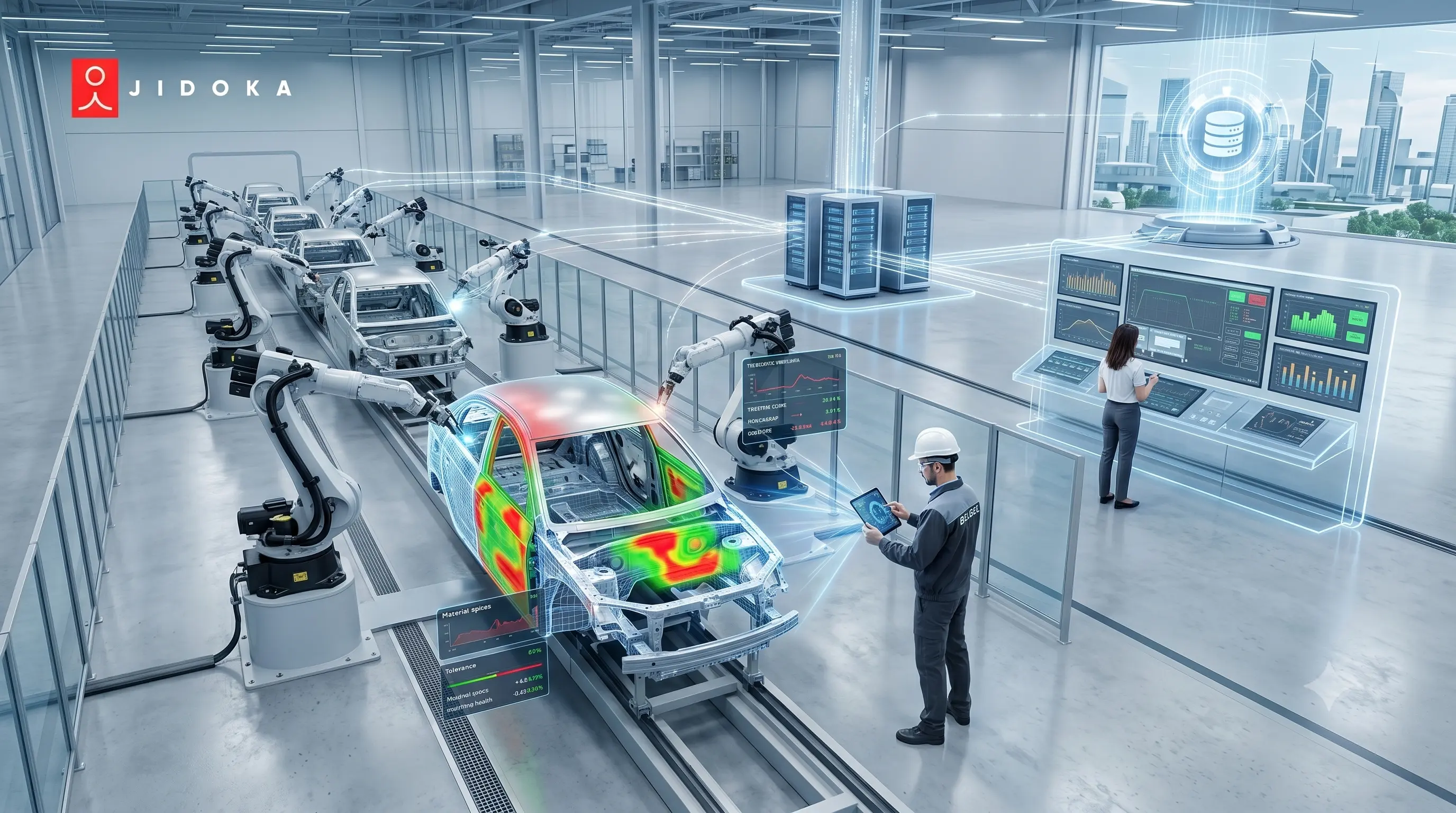
Most plant quality managers can describe their TQM program in precise detail: the documented procedures, the audit schedule, the corrective-action tracker, the quarterly review. They can also describe the recurring defect that survived every one of those mechanisms. The program is real. The problem is still there.
The gap is not in the principles. Total quality management's core ideas, build quality in at the source, give every employee ownership of the process, improve continuously on data, are as sound in 2026 as they were when W. Edwards Deming carried them to Japanese industry seventy years ago. The gap is verification: no plant has ever had a practical way to confirm, in real time, that a defined process was executed correctly at every station, on every shift.
Manufacturers lose roughly 20 to 30% of annual productivity to process inefficiencies, per McKinsey Global Institute estimates. [VERIFY exact current figure from jidoka-tech.ai before publish.] Most of that loss originates not in flawed processes but in inconsistent execution of processes that are perfectly sound on paper. That is the problem this article addresses.
Total quality management is a company-wide approach to building quality into every process rather than inspecting it in at the end. It rests on eight principles, from customer focus to continuous improvement. Its results have always been limited by one thing: no plant could verify, in real time, that processes were followed as defined.
What total quality management means on a factory floor
Total quality management (TQM) is a system where quality is owned by everyone in the organisation and built in at the source, not delegated to a final inspection gate. It treats every process, from component handling to assembly sequence to packaging, as a quality event, not just the dimensional check at the end of the line.
The distinction from adjacent systems matters. Quality control catches defects after they occur. Quality assurance prevents them through process design. Total quality management is the umbrella over both: a philosophy that makes quality the objective of the whole organisation rather than the responsibility of a dedicated function.
The shift in cost structure is the practical case for TQM. Statistical process control (SPC), one of TQM's core measurement tools, consistently delivers 20 to 40% defect reductions compared to inspection-led approaches (Oxmaint, 2026). That reduction is not because SPC catches more defects; it is because prevention is cheaper than detection at every stage of the value chain.
Three companies are most associated with mature TQM at scale: Toyota, whose production system embedded TQM principles before the term was formalised; Ford, which adopted Deming's methods in the early 1980s as a direct response to quality-driven market share loss; and Philips Semiconductor, whose TQM programme became a reference case for high-complexity manufacturing.
The eight principles of total quality management, and where each one breaks
Every competitor page lists the eight principles. None of them explain the specific failure mode that happens when each principle exists only as a document. The table below does both.
Two of these failure modes carry disproportionate cost. The process-centred approach failure is the one most plants understand: the process is only as good as its execution, and most plants define the process in a document nobody watches being followed. The fact-based decision making failure is subtler but more expensive: most quality decisions still rest on sampled, after-the-fact data, not on a continuous record of what happened at each station during each shift.
ISO 9001:2015 formalises a related set of seven quality management principles (ISO). The overlap is substantial, and certification to ISO 9001 is often treated as evidence of TQM maturity. It is evidence of documented intent. The execution gap is separate.
Where TQM came from: Deming, Juran, and the jidoka principle
The intellectual foundation of total quality management starts at Bell Labs in the 1920s. Walter Shewhart developed statistical methods for understanding process variation and published the landmark text on economic control of manufactured product in 1931. His PDCA cycle, Plan-Do-Check-Act, became the spine of every continuous improvement methodology that followed.
W. Edwards Deming studied under Shewhart and carried statistical quality methods to Japanese industry after the Second World War. His 14 Points for Management, delivered to Japanese engineers and executives in the early 1950s, formed the blueprint for what would later be called TQM. Joseph Juran arrived in Japan in 1954, adding a structured approach to quality planning and the now-standard understanding that quality is a management responsibility, not an inspection function (Shoplogix; SixSigma.us).
From that same post-war industrial moment came jidoka, the Toyota Production System pillar translated as autonomation: automation with a human touch. In its original form, jidoka meant that a machine stops itself the moment it detects an abnormality, preventing a defect from being passed to the next station. A human then addresses the root cause rather than letting production continue around a known problem.
The link between jidoka and TQM is direct: both rest on the idea that quality must be built in at the source, and that a defect should stop at the station that created it, not travel downstream where the cost of correction multiplies. Deming's central teaching, cease dependence on inspection to achieve quality, is the same idea stated as a management principle. Jidoka is the same idea embedded in machine behaviour.
"Jidoka was never about removing people from quality. It was about making sure a defect stops at the station that created it, not three stations later." — Sekar Udayamurthy, Founder and CEO, Jidoka Technologies
How to implement total quality management without stalling
Most TQM programs stall not because the principles are wrong but because the implementation sequence is. The typical failure: launch with training, produce documentation, run the first audit, find the first gap, and then discover that the corrective-action system has no connection to what actually happens at the station tomorrow morning.
A sequence that avoids this follows five steps, in order:
- Secure visible leadership commitment. TQM requires production managers to accept that stopping the line for a quality issue is correct behaviour, not a schedule failure. That norm cannot be set by a quality department; it must come from plant leadership explicitly.
- Define and document core processes. A process that exists in someone's head is not a TQM process. Each step must be written, sequenced, and accessible to the operator performing it.
- Train operators on both the why and the how. Operators who understand why a step matters in quality terms follow it more reliably under production pressure than operators who were told to follow it.
- Instrument the process for data. A continual improvement loop, the Plan-Do-Check-Act (PDCA) cycle, requires data. What gets measured is what gets improved.
- Run the PDCA loop continuously. The improvement cycle has no endpoint. Each completed cycle feeds the next.
Full TQM implementation typically takes two to three years, with measurable progress appearing within the first 6 to 12 months when objectives and improvement processes are clearly defined (monday.com, 2026). The pace depends less on documentation and more on whether the plant can sustain adherence to the standards it sets. That is where most programs hit the ceiling.
The most common reason programs stall after initial progress: the documented standard and the executed reality drift apart. Operators adapt to production pressure, shortcuts become habits, and audits catch the drift weeks after it started. By then, the corrective action addresses the symptom, not the drift.
The Jidoka TQM Digitization Ladder
A maturity model for how manufacturing plants move from documented processes to continuously verified ones.
The measurement gap: why TQM results plateau
Every TQM principle ultimately depends on people executing a defined process correctly, every cycle, on every shift. That is not a critique; it is the design. The problem is that traditional quality tools were built to measure what a process produces, not to verify that the process was followed as defined.
Sampling and audits leave a structural blind spot. An audit confirms that the process worked correctly when the auditor was watching. Statistical process control tracks dimensional or parametric output, not the sequence of steps that produced it. Both methods confirm quality at the moments they check; neither confirms quality between checks. For a plant running two shifts and producing hundreds of units per hour, that gap is most of the production run.
The cost-of-poor-quality (COPQ) consequence is specific. Defects that originate from missed or out-of-sequence process steps often have no measurable output variable for SPC to catch. A torque step performed correctly but out of sequence, a pre-treatment step skipped under time pressure, a part installed correctly at final assembly that was mishandled in an earlier stage: these produce units that pass dimensional inspection and fail in the field.
The field failure is three to ten times more expensive than a line catch, and a line catch is three to ten times more expensive than a prevention at the station. The cost arithmetic of quality has always pointed to prevention. The measurement gap is why prevention has been harder to achieve than the TQM literature suggests.
"Most quality programs measure the product after the fact. The expensive failures hide in the steps no one was watching." — Sekar Udayamurthy, Founder and CEO, Jidoka Technologies
The AI-driven evolution of total quality management
AI does not replace TQM's eight principles. It makes the process-centred and fact-based principles continuously true rather than periodically checked. The gap between what TQM requires and what plants could previously verify is a technology gap, and it is now closeable.
Nagare by Jidoka Technologies is an edge-AI process monitoring system that watches each production step against the digital standard operating procedure (SOP) in real time. It runs on-premise, uses existing cameras, and detects deviations, missing parts, misalignments, and out-of-sequence steps as they happen (jidoka-tech.ai/products/nagare). No cloud dependency, no new hardware infrastructure beyond the cameras already present on most modern lines.
The TQM loop that Nagare closes works as follows: the defined process is encoded as a digital SOP. Nagare monitors each step against that standard continuously, every cycle. When a deviation occurs, the operator is guided to correct it before the part moves. The system can block progression past an incorrect step. Every cycle's adherence data feeds back into the manufacturing execution system (MES) and quality management systems, giving the continual improvement engine a complete picture rather than a sampled one.
Process adherence improvements of ~30% and rework reductions of ~35% reported across Nagare deployments.
The conceptual close matters as much as the operational one. Nagare is jidoka realised digitally: a defect stops at the station that created it, caught by a system that watches every step rather than waiting for an auditor to find the drift. What Shewhart, Deming, and the engineers at Toyota described as the ideal, quality built in at the source, is now an engineering problem rather than a management aspiration.
Frequently asked questions
What is total quality management in simple terms?
Total quality management is a company-wide way of working where quality is built into every process rather than inspected in at the end. It rests on eight principles, including customer focus, employee involvement, and continual improvement, and aims to shift cost away from rework and toward prevention so defects are stopped at their source.
What are the eight principles of total quality management?
The eight principles are customer focus, total employee involvement, a process-centred approach, an integrated system, a strategic and systematic approach, continual improvement, fact-based decision making, and communication. Together they move a plant from catching defects to preventing them, but each principle only works when the underlying process is actually executed as defined.
How long does it take to implement TQM in a factory?
Full total quality management implementation typically takes two to three years, with measurable progress appearing within the first 6 to 12 months when objectives and improvement processes are clearly defined (monday.com, 2026). The pace depends less on documentation and more on whether the plant can sustain adherence to the standards it sets.
How is AI changing total quality management?
AI closes the verification gap that has always limited TQM. Edge-AI process monitoring watches each production step against the digital standard in real time, catching skipped or out-of-sequence actions that sampling and audits miss. This makes the process-centred and fact-based principles of TQM continuously enforced rather than periodically checked.
Is total quality management still relevant in 2026?
Yes. The principles of total quality management remain the foundation of modern manufacturing quality, and IATF 16949 and ISO 9001 still rest on them. What has changed is enforcement: technology can now verify process adherence continuously, which makes the original promise of TQM, quality built in at the source, achievable in practice rather than only on paper.
From a program on paper to quality you can see
The recurring defect that survives every audit is not surviving because the TQM principles are wrong. It is surviving because it lives in a step no one was watching, somewhere between the last check and the next one. Quality programs have managed this gap with audits and sampling for sixty years because continuous verification was not a viable option. It is now.
TQM's principles were never the problem. The missing piece was the ability to verify adherence continuously, every cycle, on every shift. That piece exists.
"The principles never changed. What changed is that you can finally watch them being followed." — Jidoka Technologies
See process adherence monitoring on a live line. Book a demo at jidoka-tech.ai to see how Nagare closes the verification gap in your plant.