.jpg)
60% of companies use some form of worker monitoring software, but on the manufacturing shop floor, the term means something entirely different from what office monitoring tools track. Monitoring whether a remote marketer spends six hours in Chrome is a different problem from monitoring whether an assembly operator completed the correct bolt torque sequence before the next station received the part.
The tools, the metrics, the legal constraints, and the ethical lines are not shared between office and shop floor contexts. By the end of this guide, you will know which operator metrics are worth collecting, which legal frameworks apply, where the ethical boundary sits in 2026, and which tool categories produce measurable productivity improvement on the factory floor.
Worker monitoring software for manufacturing tracks operator process compliance, cycle time adherence, SOP step completion, and safety posture, not screen time or keystrokes. The measurable metrics are specific to physical production work. The ethical boundary is that monitoring should improve operator capability and prevent injury, not create a surveillance culture that drives turnover.
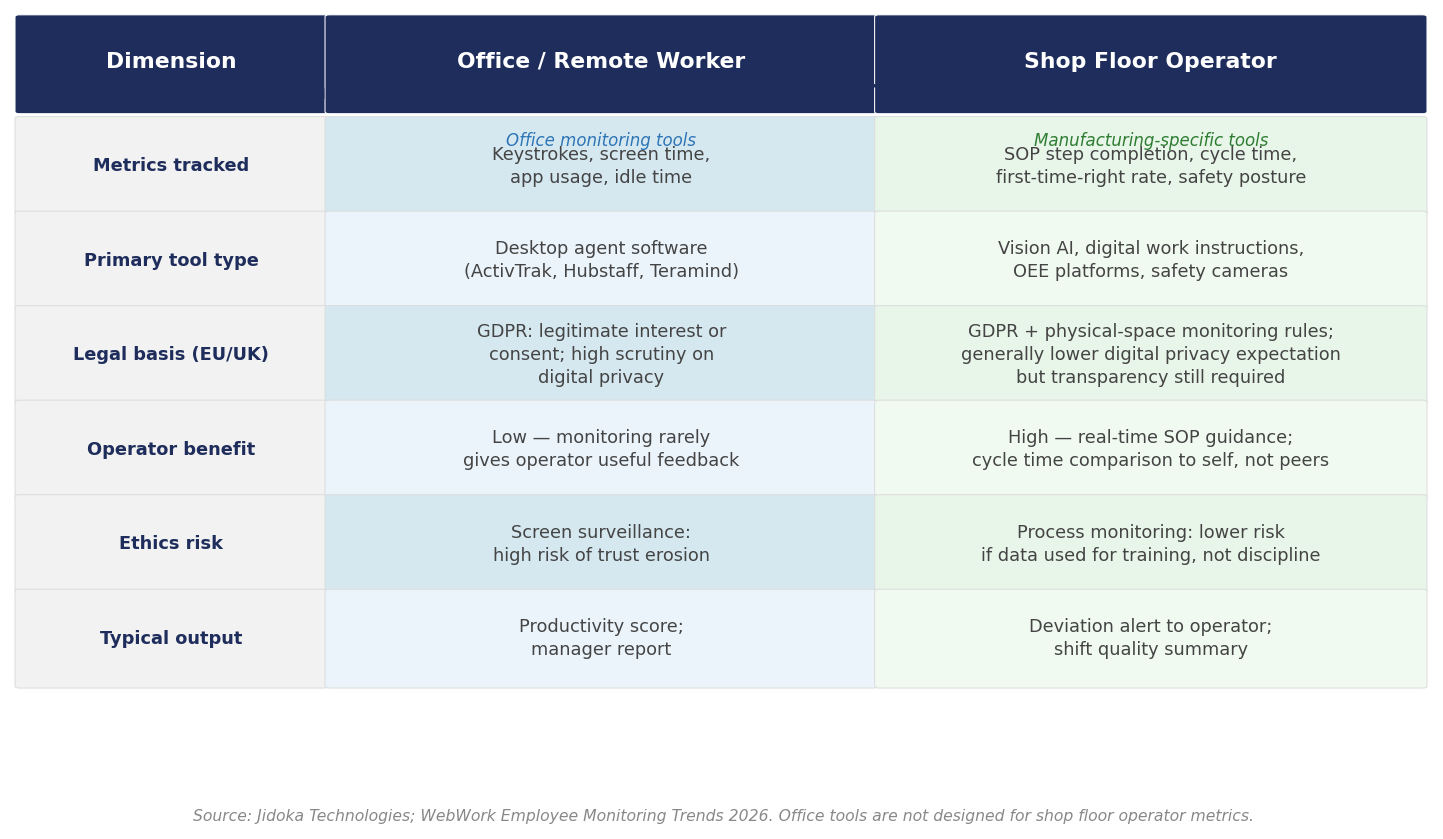
Figure 1: Key differences between office worker monitoring and shop floor operator monitoring across metrics, tools, legal context, and operator benefit.
What Is Actually Measurable in a Manufacturing Shop Floor Context
Shop floor operator monitoring requires a completely different metric set from office tools. This section defines the six metrics that generate genuine production value and separates them from the data points that serve management curiosity more than operational improvement.
The instinct to import office monitoring metrics onto the factory floor produces numbers that feel like management activity but drive no production outcome. Worker monitoring software built for remote workers tracks screen time and application usage. Neither metric exists on a shop floor. The metrics that do exist are specific to physical production work, and each one connects to either a quality result or a safety outcome.
Six Metrics That Generate Genuine Value on the Shop Floor
1. SOP step completion: tracks whether every required assembly step was performed in the correct sequence. Any worker monitoring software worth deploying on the shop floor measures this. A missed torque check or skipped verification step does not appear in a production count. It appears 40 units later when the defect surfaces at the next inspection gate. SOP completion rate, measured at the station level, is the most direct predictor of first-time-right rate in complex assembly work.
2. Cycle time adherence: measures whether the operator completes tasks within the standard time window. Consistent overruns at a specific station indicate either a training gap, a tooling problem, or a process issue. Consistent underruns may indicate a step is being skipped. Either pattern is actionable. Worker productivity tracking at the cycle level gives the shift supervisor a live picture of where the line is losing time and why.
3. Process deviation frequency: counts how often an operator skips, reorders, or modifies a prescribed step. This metric has a direct relationship to both quality output and safety exposure. Facilities that measure process deviation frequency at the station level consistently find that 20% of operators account for 80% of deviation events, and the pattern almost always points to a training gap rather than an attitude problem.
4. First-time-right rate: the percentage of an operator's output that passes the next inspection gate without rework. This is the quality metric that matters most to the business case for operator monitoring. It connects individual operator performance to downstream production cost in a direct, auditable way.
5. Safety posture: covers PPE usage compliance and operator movement near defined hazard zones. Camera-based AI can now detect PPE absence and proximity violations in real time, alerting supervisors before an incident occurs rather than after. This is the one monitoring metric category where the employer's duty of care justifies continuous monitoring without the more detailed ethical scrutiny that process compliance monitoring warrants.
The metric category to avoid: individual speed rankings that compare operators against each other without controlling for task difficulty, product complexity, or training stage. A new operator on a complex sub-assembly is not a fair comparison point for a three-year veteran on a simpler station. Metrics that produce unfair comparisons drive turnover without producing any quality improvement.
Named Framework: Manufacturing Operator Monitoring Scope Filter
Before collecting any monitoring metric, apply this three-question test. A metric that fails all three questions should not be collected.
- Does this metric measure process adherence or personal surveillance? If the metric tracks what the operator does with production equipment and materials, it measures process adherence. If it tracks personal behaviour with no production connection, it is surveillance. Collect the first. Do not collect the second.
- Does the operator benefit from knowing this metric about themselves? If the operator can see this data and use it to self-correct or request training, it passes. If the data only benefits management and gives the operator no actionable information about their own work, justify or redesign the metric before collecting it.
- Does it directly connect to a safety or quality outcome? If you cannot draw a direct line from the metric to a specific safety risk or a specific quality result, the metric is collecting data without operational purpose. Remove it from the monitoring plan.
The Legal Framework for Monitoring Shop Floor Workers in 2026
Legal compliance for worker monitoring software on the shop floor is not optional and is not the same as the framework for remote-worker digital surveillance. This section covers the key requirements across the EU, UK, and Indian markets where Jidoka Technologies operates, without giving legal advice.
Across every jurisdiction that matters for mid-size manufacturing in 2026, the baseline legal requirement for worker monitoring software and workforce productivity manufacturing monitoring is the same: workers must be informed of what is monitored, why, and how the data is used. The specific legal instrument varies. The transparency requirement does not.
1. GDPR (EU and UK)
Under GDPR, monitoring of workers requires a legitimate legal basis. For shop floor monitoring, the most commonly relied-upon basis is legitimate interest (Article 6(1)(f)), which requires a balancing test: the employer's interest in production safety and quality must outweigh the worker's privacy interest.
Physical process monitoring on a production line typically passes this test when the monitoring is disclosed, limited to production-relevant data, and used only for the stated purpose.
Data minimisation applies: collect only what is necessary for the stated quality or safety purpose. If you can achieve the monitoring objective with aggregate shift-level data, collecting individual real-time data requires additional justification. Workers have the right to access their own performance data under GDPR Article 15. A monitoring system that denies operators access to their own records is non-compliant.
2. India's DPDP Act 2023
India's Digital Personal Data Protection Act 2023 applies to employee monitoring in manufacturing facilities. Monitoring that collects digital personal data (including camera footage that identifies individuals) requires either consent or a legitimate purpose.
Employment context does not automatically provide consent. The Act requires that the purpose of data collection be communicated clearly and that data not be used beyond that stated purpose. Jidoka Technologies' manufacturing clients in India should confirm their monitoring disclosure language with legal counsel before deployment.
3. Physical Monitoring vs Digital Monitoring
Most jurisdictions apply different legal thresholds to physical-space monitoring (cameras, sensors) and digital monitoring (screen recording, application tracking). Shop floor monitoring is predominantly physical. Courts and regulators generally apply a lower privacy expectation to an employer monitoring a production line than to an employer reading an employee's digital communications.
This does not mean physical monitoring requires no legal basis. The legitimate-interest justification is easier to establish when the monitoring is tied to a specific production safety or quality outcome.
“Organisations that implement transparent worker monitoring policies report significantly higher employee acceptance rates and lower monitoring-related turnover compared to those that deploy monitoring without disclosure.”
The practical recommendation across all three jurisdictions: include the monitoring scope in the employment contract or staff handbook before deployment begins. Provide workers with access to their own performance data on request. Use monitoring data only for the purpose stated in the disclosure. A system that is transparent at deployment and operationally limited to the stated purpose has the strongest legal position under every framework covered here.
The Ethical Boundary Line: Monitoring for Capability Versus Monitoring for Control
The legal minimum and the ethical standard are not the same thing. This section draws the line between monitoring that builds operator capability and monitoring that functions as management control, and explains why the distinction has direct consequences for retention and output quality.
60% of companies with remote workers currently use some form of worker monitoring software (WebWork, 2026). On the manufacturing shop floor, operators have a heightened expectation of physical-space dignity that most remote knowledge workers do not.
They work with their hands, at a fixed station, in a shared physical space. A monitoring system that feels like surveillance in that context produces a different psychological response than one a marketer experiences with screen-time software.
The ethical distinction is not about whether to monitor. It is about what happens to the data after it is collected.
A) Monitoring for Capability
Capability-focused monitoring uses performance data to identify training needs, spot fatigue-related process drift before it becomes a quality problem, and inform Kaizen events with specific operational data. The operator benefits from the data directly: they receive real-time feedback on their own work, can request coaching based on their own deviation patterns, and can see their first-time-right rate improve as training takes effect.
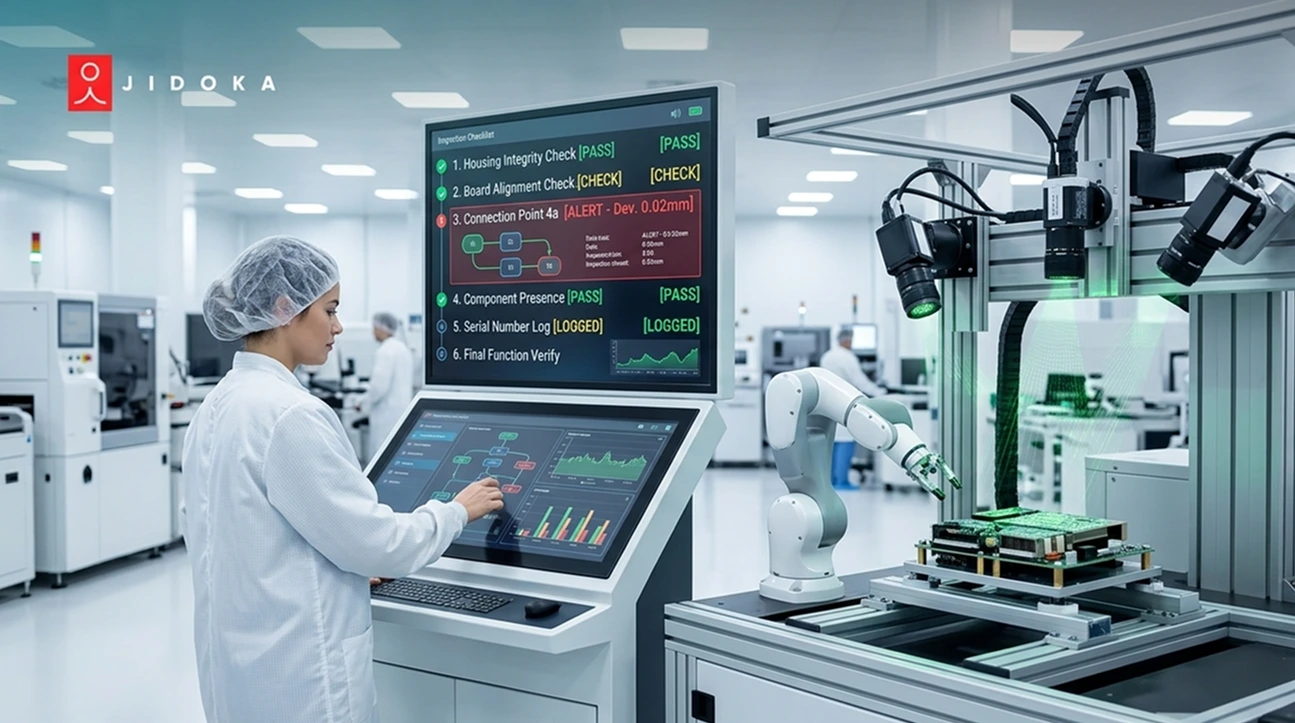
Nagare by Jidoka Technologies operates in this model. When Nagare detects an SOP deviation, the alert fires at the operator's station in real time, giving the operator the opportunity to self-correct before the part moves to the next station. The data is used to improve operator performance, not to build a disciplinary record. In documented Jidoka deployments, this approach cuts rework by 35% because it addresses the deviation at the point of occurrence rather than at the end-of-line inspection gate.
B) Monitoring for Control
Control-focused monitoring uses performance data asymmetrically: management sees the data, the operator does not. Individual speed rankings compare workers against each other without controlling for task complexity, machine condition, or training stage. Anomalies trigger manager review rather than operator self-correction. The operator bears the risk of the data. Management holds the benefit.
The operational consequence of control-model monitoring is well-documented: increased turnover, decreased engagement, and reduced willingness to flag problems. An operator who knows that a deviation will trigger a disciplinary conversation rather than a coaching one does not report near-misses. Near-misses that go unreported become incidents.
The practical boundary: aggregate, anonymised performance data by shift or line is an operational tool. Individual real-time surveillance for punitive purposes is a management control mechanism with no net quality benefit and a measurable turnover cost.
“Worker monitoring on the shop floor should tell an operator what they can correct right now, not what a manager will use against them next week.” - Jidoka Technologies.
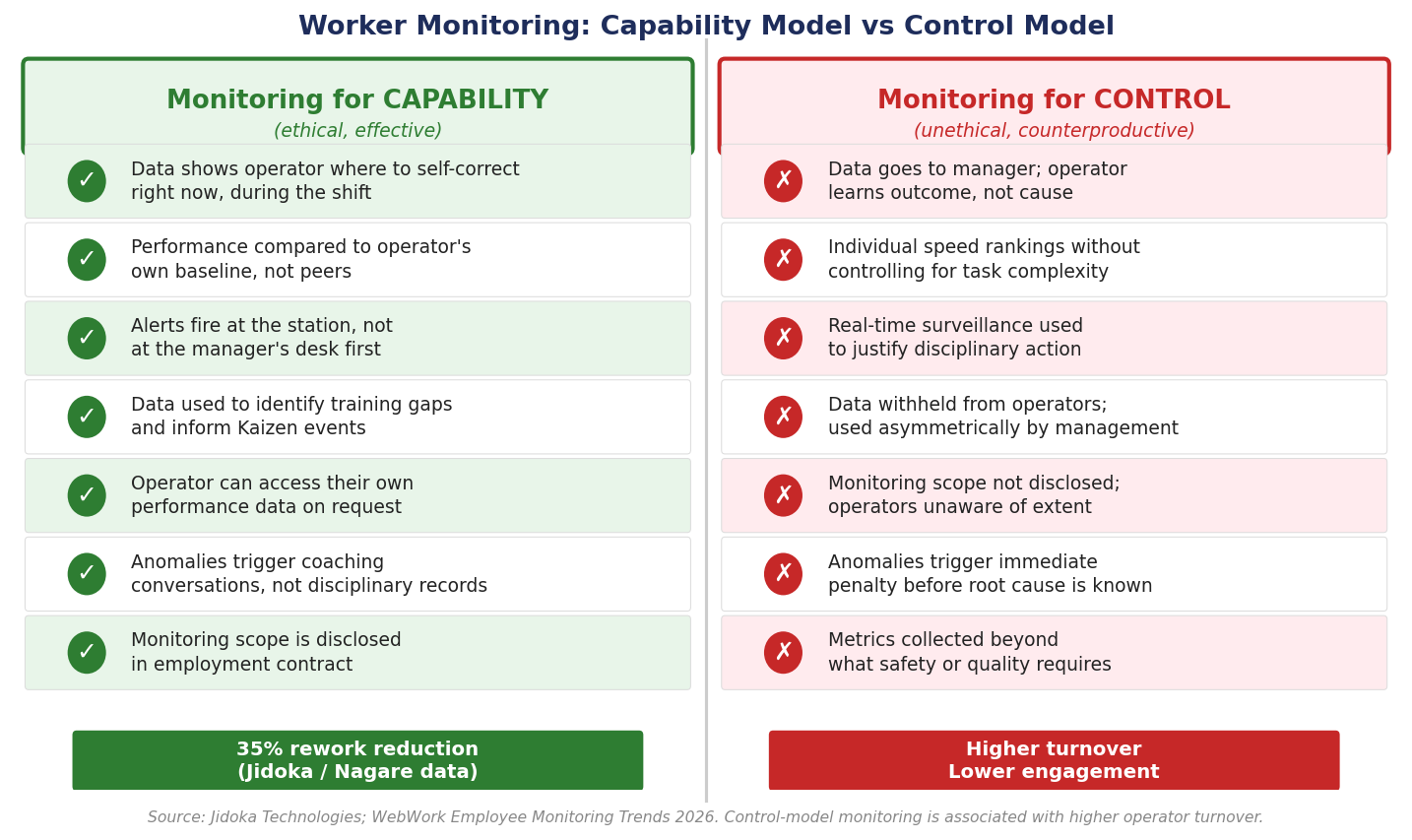
Figure 2: Capability model vs control model monitoring. The capability approach is associated with a 35% rework reduction and higher operator engagement. The control approach drives turnover without measurable quality gain.
What Works: The Tools and Approaches That Improve Operator Productivity in Manufacturing
Four tool categories have proven track records for shop floor worker productivity tracking. This section names each category, its specific use case on the production floor, and a concrete example, without recommending 15 platforms that cover the same use case.
1. Vision AI Process Compliance Monitoring
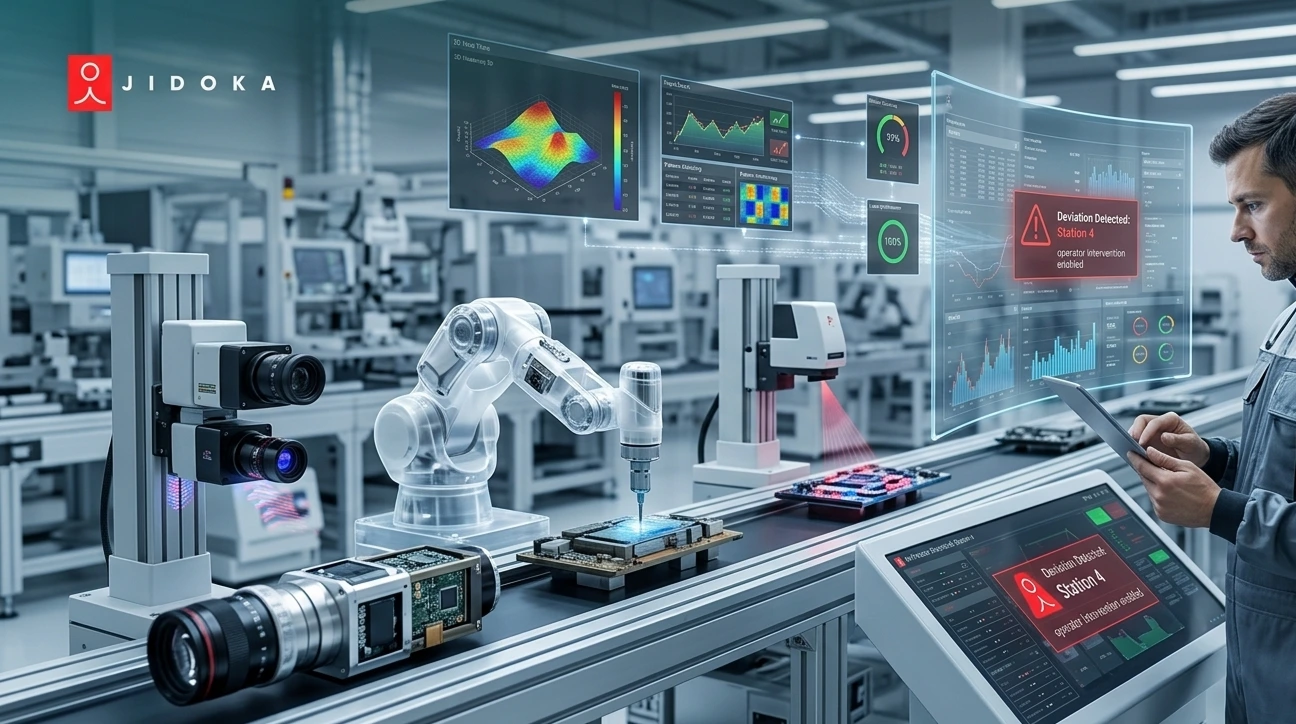
Vision AI platforms are the most capable form of worker monitoring software for the shop floor use case. They verify SOP step completion against digital work instructions in real time, using existing cameras without hardware additions. Nagare by Jidoka Technologies is the primary example for the manufacturing SOP compliance use case.
Nagare monitors 100% of assembly steps at each station, compares what the camera observes against the digital SOP, and fires a real-time alert to the operator when a deviation is detected. The alert is at the station, not at the manager's desk.
“Nagare monitors 100% of assembly steps, providing real-time operator guidance that cuts rework by 35% without increasing supervisory headcount.” - Jidoka Technologies.
2. Cycle Time Analytics and OEE Platforms
Cycle time analytics aggregate performance data by shift and by line, surfacing systematic throughput losses without requiring individual-level surveillance. Platforms like Tractian and MachineCDN provide OEE-level cycle time tracking that gives operations managers the shift-level picture they need without drilling into individual operator records in a way that triggers the control-model ethical problems described above.
Use these platforms for line-level performance analysis and shift-to-shift trending. Reserve station-level data for coaching conversations, not manager reports.
3. Digital Work Instruction Platforms
Digital work instruction platforms serve dual purpose: they guide operators through complex assembly sequences in real time and log step completion as a quality record simultaneously. Tulip, Dozuki, and VKS are the three platforms most widely deployed in mid-size discrete manufacturing.
Each provides step-by-step digital SOPs that the operator follows on a tablet or station screen. Each logs which steps were completed and when. The manufacturing operator training software use case is built into the platform: new operators follow the same verified sequence as experienced ones, reducing the training ramp period and the deviation risk during that period.
4. Safety Monitoring Using Computer Vision
Computer vision systems that detect PPE absence, unsafe posture near machinery, and proximity violations near defined hazard zones represent the worker monitoring software category with the clearest ethical justification. The employer's duty of care under health and safety law in every jurisdiction covered here creates a legitimate basis for continuous safety monitoring that is harder to establish for process compliance monitoring alone. Camera-based operator compliance monitoring for safety purposes alerts supervisors before an incident occurs. This is the monitoring category that most directly saves lives and reduces liability.
The four tool categories map to different use cases and different levels of operator benefit. Vision AI process compliance and digital work instructions produce the highest direct operator benefit. Cycle time analytics and safety monitoring produce higher supervisor and facility benefit. A well-designed labor efficiency monitoring programme uses all four, with the operator-facing tools receiving more prominent disclosure and the supervisor-facing tools scoped to aggregate rather than individual data.
The Monitoring Model That Produces Results Is the One Operators Actually Trust
The manufacturers getting the most out of worker monitoring software on the shop floor are not the ones watching their operators most closely. They are the ones giving operators the most useful real-time information about their own work. Process compliance, cycle time adherence, first-time-right rate: these are metrics that help operators do their jobs correctly, not metrics designed to catch them doing their jobs wrong.
Nagare by Jidoka Technologies is built for that model. It monitors 100% of assembly steps and gives operators real-time guidance at the station, not a retrospective score in a manager's dashboard. If your current approach to **worker productivity tracking** is producing more tension than improvement, request a Jidoka deployment audit to see a different approach in action.
Frequently Asked Questions
1. Is It Legal to Monitor Workers in Manufacturing?
Yes, in most jurisdictions, but with conditions. Worker monitoring software in manufacturing must be disclosed to workers, limited to the purpose stated, and comply with applicable data protection law. In the EU and UK, GDPR applies. In India, the DPDP Act 2023 governs employee data. Workers in physical workplaces generally have fewer digital privacy expectations than remote workers, but physical monitoring still requires transparency and a legitimate purpose.
2. What Metrics Should Manufacturing Worker Monitoring Track?
The most actionable metrics for any worker monitoring software on the shop floor are SOP step completion rate, cycle time adherence, first-time-right rate, and process deviation frequency. Metrics that provide genuine operational value to both employer and operator include safety posture compliance and training gap identification. Avoid individual speed rankings without contextual controls for task complexity and training stage.
3. Does Worker Monitoring Software Reduce Productivity in Manufacturing?
Poorly implemented worker monitoring software that feels like surveillance increases turnover and reduces engagement, which reduces productivity. Well-implemented monitoring that gives operators real-time feedback on their own performance, and that is used to inform training rather than discipline, is associated with improved first-time-right rates and reduced rework. The implementation model determines the outcome, not the monitoring itself.
4. What Is the Difference Between Operator Monitoring and Surveillance?
Operator monitoring tracks process adherence and capability development. The operator benefits from the data and can act on it immediately. Surveillance tracks individual behaviour for management control. The operator bears the risk and receives no benefit. The distinction matters for legal compliance under GDPR and DPDP, for ethical practice, and for retention outcomes. The tool category is less important than how the data is used after collection.