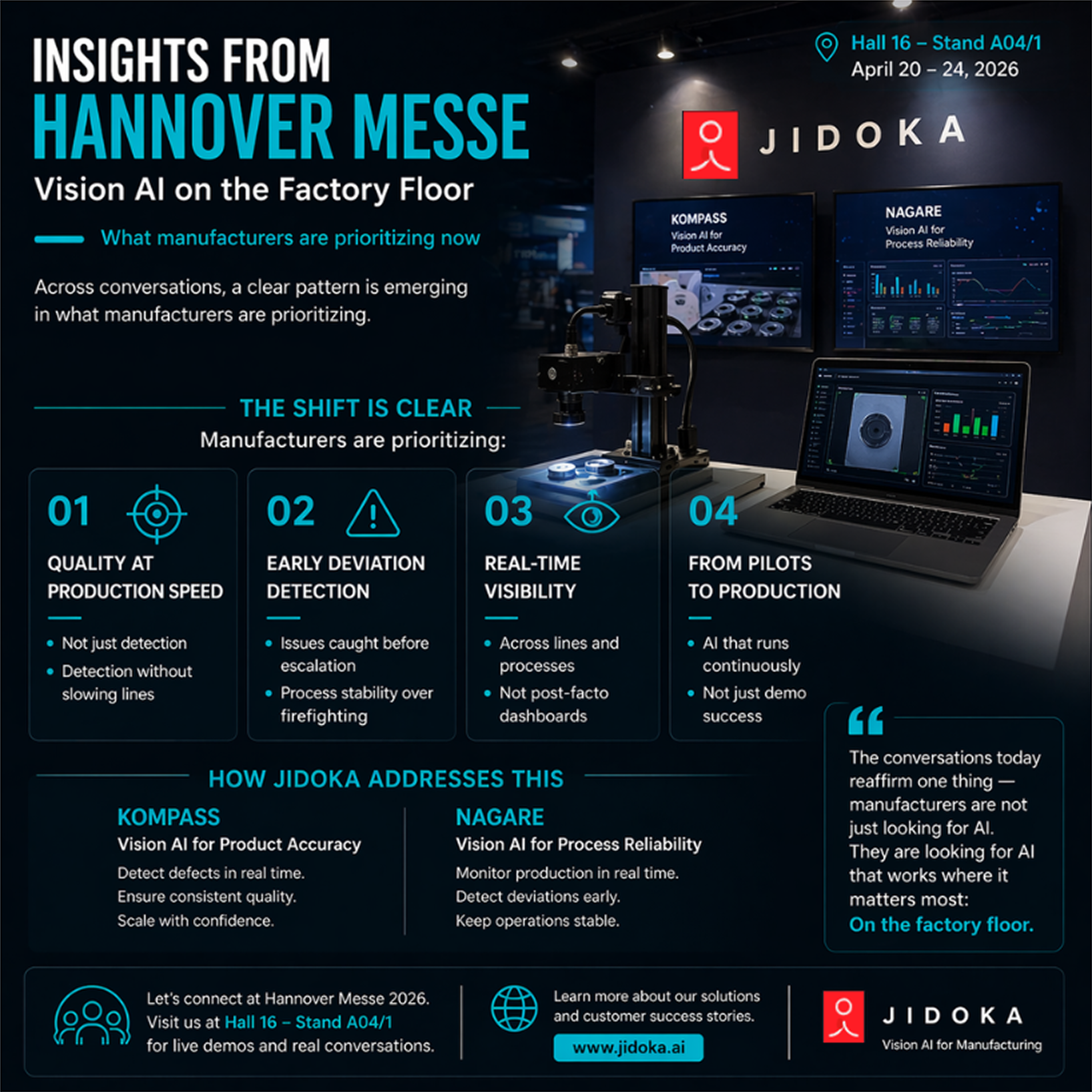

We represented Jidoka Technologies at Hannover Messe 2026, one of the largest industrial automation exhibitions globally, connecting with manufacturers, system integrators, and industrial AI buyers across four regions: Germany, Rest of Europe, North America, and Central Americas.
Our presence gave us direct access to real buyer conversations. What we heard was consistent across every region: the industrial AI market has moved past evaluation mode. Buyers are now shortlisting deployment-ready vendors, and the questions they ask reflect that shift entirely.
1. The Demand is Global, and the Priorities Are Aligned
Visitors at Hannover Messe came from a wide geographic spread. Despite different regulatory environments and operational contexts, the underlying priorities were strikingly aligned:
- Scalability and measurable ROI
- Process reliability and compliance across multiple plant locations
- Production-ready AI that performs on the actual shopfloor, not in a demo environment
This alignment confirmed something we already suspected: the problems we have solved in India's manufacturing sector translate directly to what global buyers are dealing with. Our cross-vertical track record in Indian manufacturing carried real weight in these conversations.
2. Buyers Are Done With AI Demos
The clearest signal from Hannover Messe 2026 was that model demonstrations no longer move buyers. People are not impressed by capability showcasing. We heard the same three questions across nearly every conversation on the floor:
- "How fast can this deploy?"
- "How does it integrate with my line?"
- "What happens when conditions change?"
These questions are not about AI potential. They are about production-readiness. Organizations attending Hannover Messe in 2026 are not exploring AI vision concepts. They are selecting partners who can deliver on a live production line.
3. Vision AI Has Moved from Inspection to Decision-Making
The conversations generating the most serious interest were not about defect detection alone. Buyers are now focused on what the system does after it detects a problem:
- Closed-loop actions: stopping a line, triggering rework automatically
- Operator guidance at the exact point of failure
- Real-time integration with MES and PLC systems
We saw strong demand from buyers who want vision AI embedded into their existing production infrastructure, not deployed as a standalone monitoring layer. This validates the direction we have been building toward: vision AI as an active control layer that feeds directly into production decisions.
4. Data Ownership and On-Prem Deployment Are Baseline Requirements
EU and North American visitors were consistent on this. Two concerns came up across multiple independent conversations:
- A clear preference for on-prem deployment over cloud-based architectures
- Serious concerns around data privacy and intellectual property leakage
For manufacturers running proprietary processes or operating in regulated sectors, transferring production data to an external cloud platform is not a trade-off they are prepared to make. On-prem control is not being treated as a premium configuration. It is a minimum requirement for vendor consideration.
5. Pilot Fatigue is Reshaping Vendor Evaluation
We heard the phrase "pilot fatigue" from multiple buyers across the floor. The frustration was specific and consistent: too many PoCs involving camera setups and AI tools that performed in controlled conditions but never reached production scale.
The common failure points cited were:
- Vendors whose systems could not survive real operational variability
- No clear path from pilot to full-line deployment
- Extended trial cycles with no commercial outcome
This fatigue is creating a direct opening for vendors who can prove production-scale reliability before the pilot conversation even starts. Buyers are now asking for deployment references before agreeing to a proof of concept.
What We Took Away
Across all conversations and buyer interactions at Hannover Messe 2026, five things became clear:
- The market is ready, but still skeptical. Buyers are willing to invest, but they need demonstrated proof across production environments, not case-study PDFs.
- Our India manufacturing track record resonates internationally. Success stories across industry verticals in India map directly onto the challenges global manufacturers are trying to solve.
- Deployment speed and reliability outweigh model accuracy. The conversations we won were centered on how fast we deploy and how reliably the system holds up, not on benchmark performance scores.
- Buyers are shifting toward platform and system ownership. Point solutions are losing ground. Organizations want the ability to expand a single platform across facilities and production lines.
- Global players want partners, not vendors. The most substantive conversations were with organizations looking for long-term technology relationships, not transactional software purchases.
Where We Go From Here
Hannover Messe 2026 gave us a clear picture of where the global industrial AI market stands today. The differentiators are no longer about AI model sophistication. They are about deployment credibility, integration depth, and data control.
We left Hannover with validated positioning, active regional interest, and a confirmed signal that what we have built for Indian manufacturing is directly applicable to global production environments. The work now is converting those conversations into live deployments, and the demand signals we observed make a strong case for accelerating that effort.

%20(1).svg)


