Les problèmes de qualité dans votre usine ne sont pas le fruit du hasard. Ils sont traçables. Selon l'American Society for Quality (ASQ), une mauvaise qualité vous coûte jusqu'à 20 % du chiffre d'affaires. Certaines plantes perdent 40 % des coûts d'exploitation. Un mauvais automobile les coûts des lots sont supérieurs 280 000$ dans les retouches et les offres perdues.
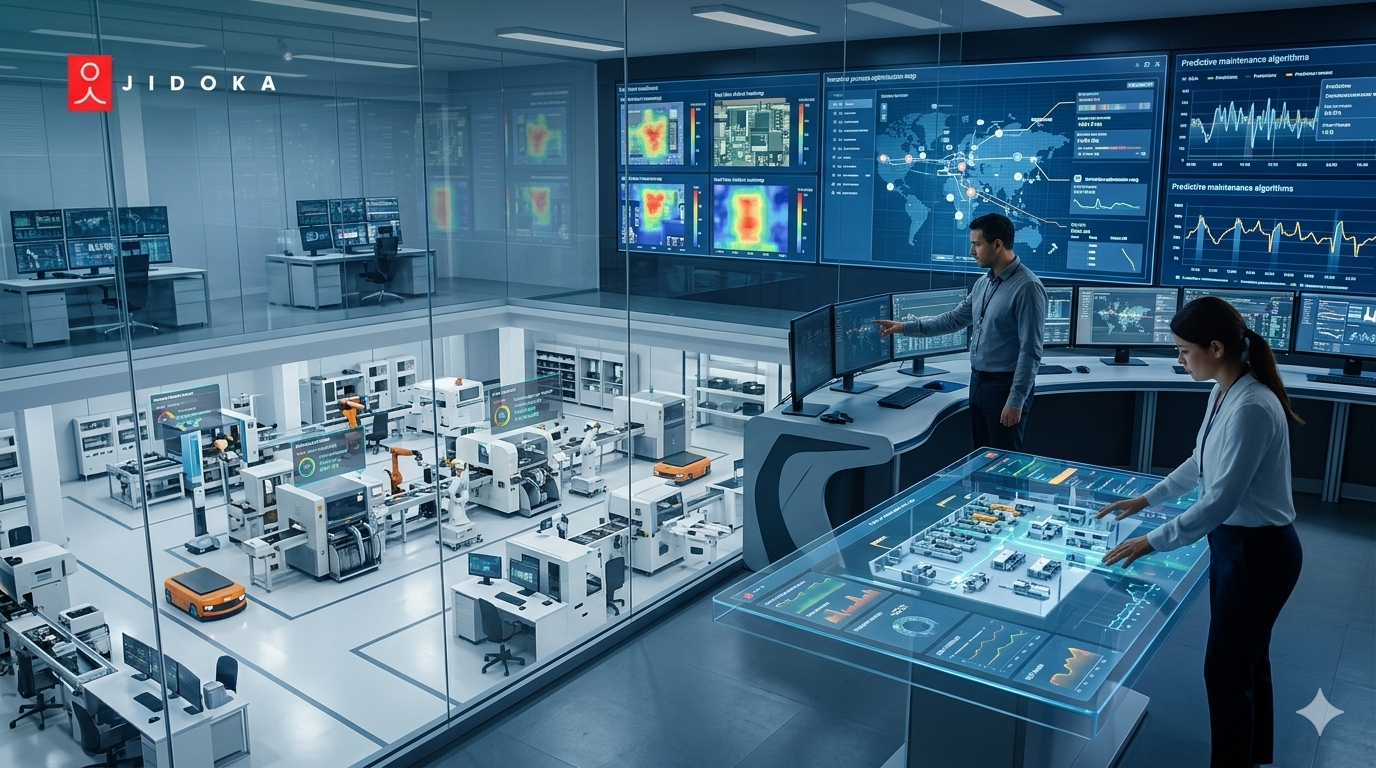
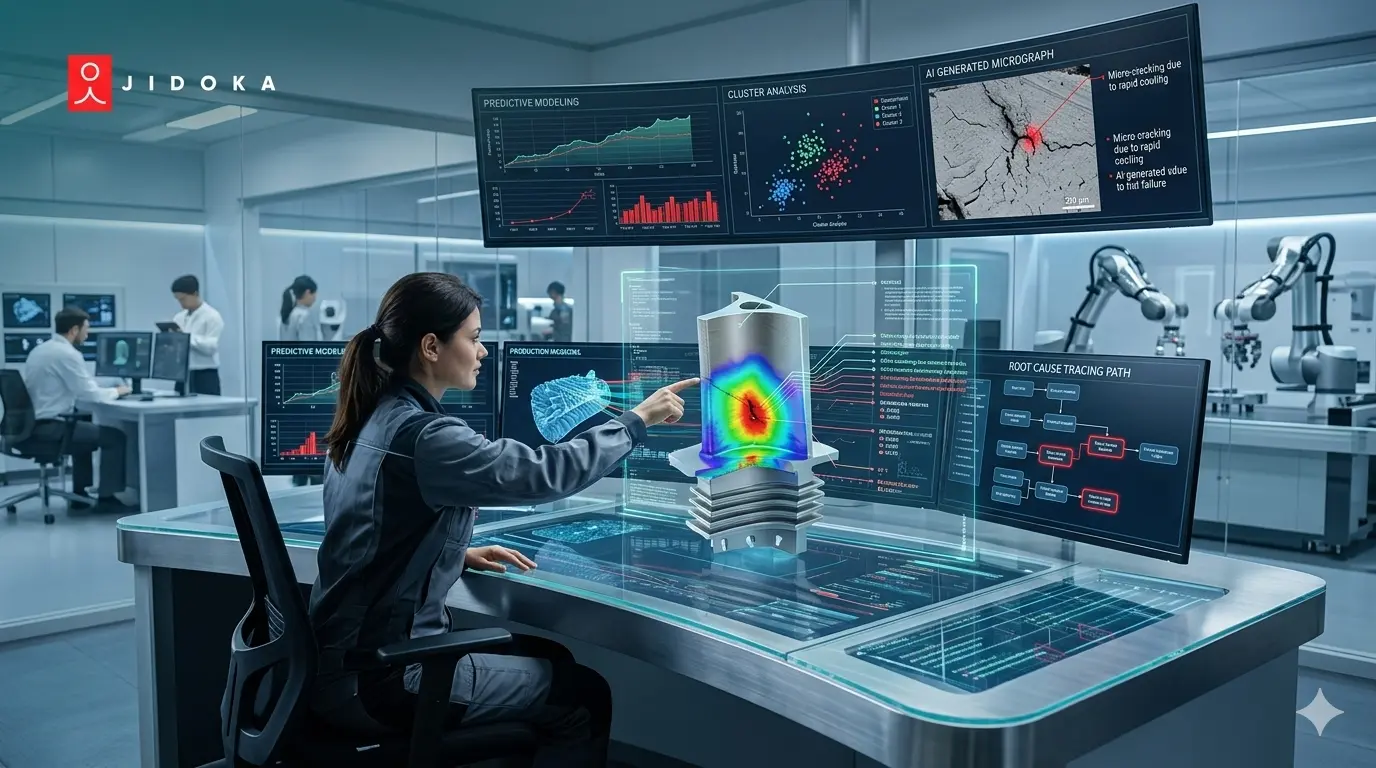
L'analyse des causes profondes permet de stopper ces fuites. Les outils d'IA accélèrent l'analyse des causes profondes dans le secteur de la fabrication en détectant rapidement les problèmes. Nous expliquons les méthodes d'analyse des causes profondes, comme la méthode des 5 pourquoi. Utilisez l'analyse des causes premières pour prévenir les défauts. Commencez à corriger votre ligne dès aujourd'hui.
Qu'est-ce que l'analyse des causes profondes ? (Définition + concept de base)
Comprendre la source d'un problème permet d'économiser du temps et de l'argent. Si vous ne corrigez que le problème visible, vous gaspillez des ressources dans un cycle d'échecs répétés. Cette section explique en quoi consiste réellement l'analyse des causes profondes et explique pourquoi vous devez regarder au-delà de la surface.
1. Définition de l'analyse des causes profondes
L'analyse des causes profondes est un moyen systématique de découvrir pourquoi une ligne de production est tombée en panne ou pourquoi une pièce est mal sortie. Il met l'accent sur l'origine du problème plutôt que sur son résultat immédiat. Lorsque vous effectuez une analyse des causes premières dans le secteur de la fabrication, vous passez des réparations réactives à la prévention permanente des défauts.
Points clés à retenir à propos de l'analyse des causes profondes :
- Il s'agit d'un élément essentiel de l'amélioration continue de la fabrication.
- Cela nécessite des données plutôt que des suppositions.
- Il fonctionne dans des cadres tels que Lean et Six Sigma.
- Cela empêche la même erreur de se produire deux fois.
2. Symptômes et causes profondes : pourquoi la différence est importante
Traquer les symptômes est un piège. Si une machine vibre et que vous serrez simplement un boulon, cela signifie que vous n'avez pas réparé le roulement usé à l'origine du tremblement. Vous devez mener une enquête sur les défauts de qualité pour trouver le véritable coupable. Sans une analyse approfondie des défaillances, vous ne faites que corriger des failles.
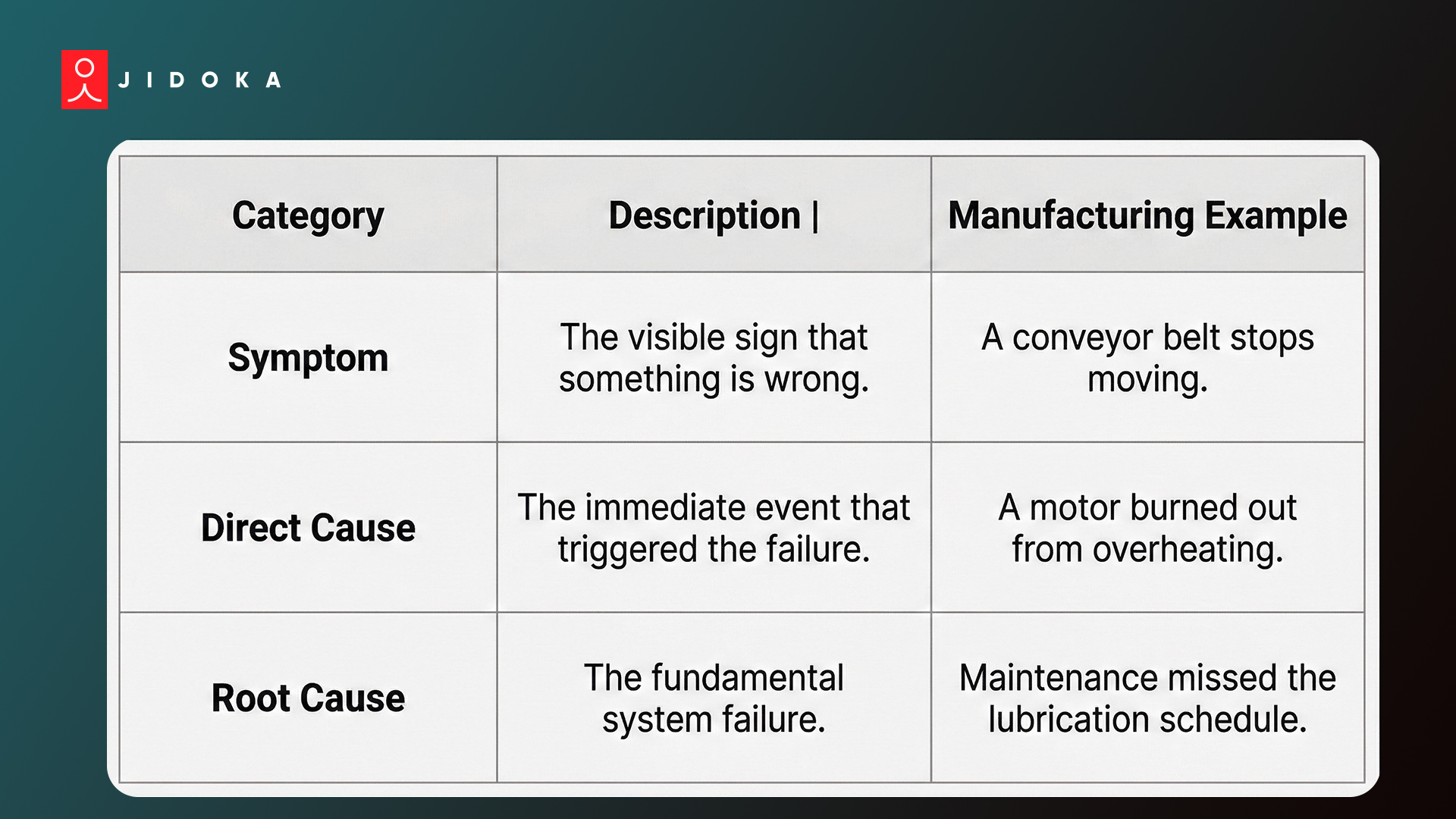
La séparation de ces niveaux garantit que votre action corrective fonctionne réellement. Une fois que vous savez ce que vous recherchez, vous pouvez utiliser des méthodes d'analyse des causes profondes spécifiques pour approfondir vos recherches.
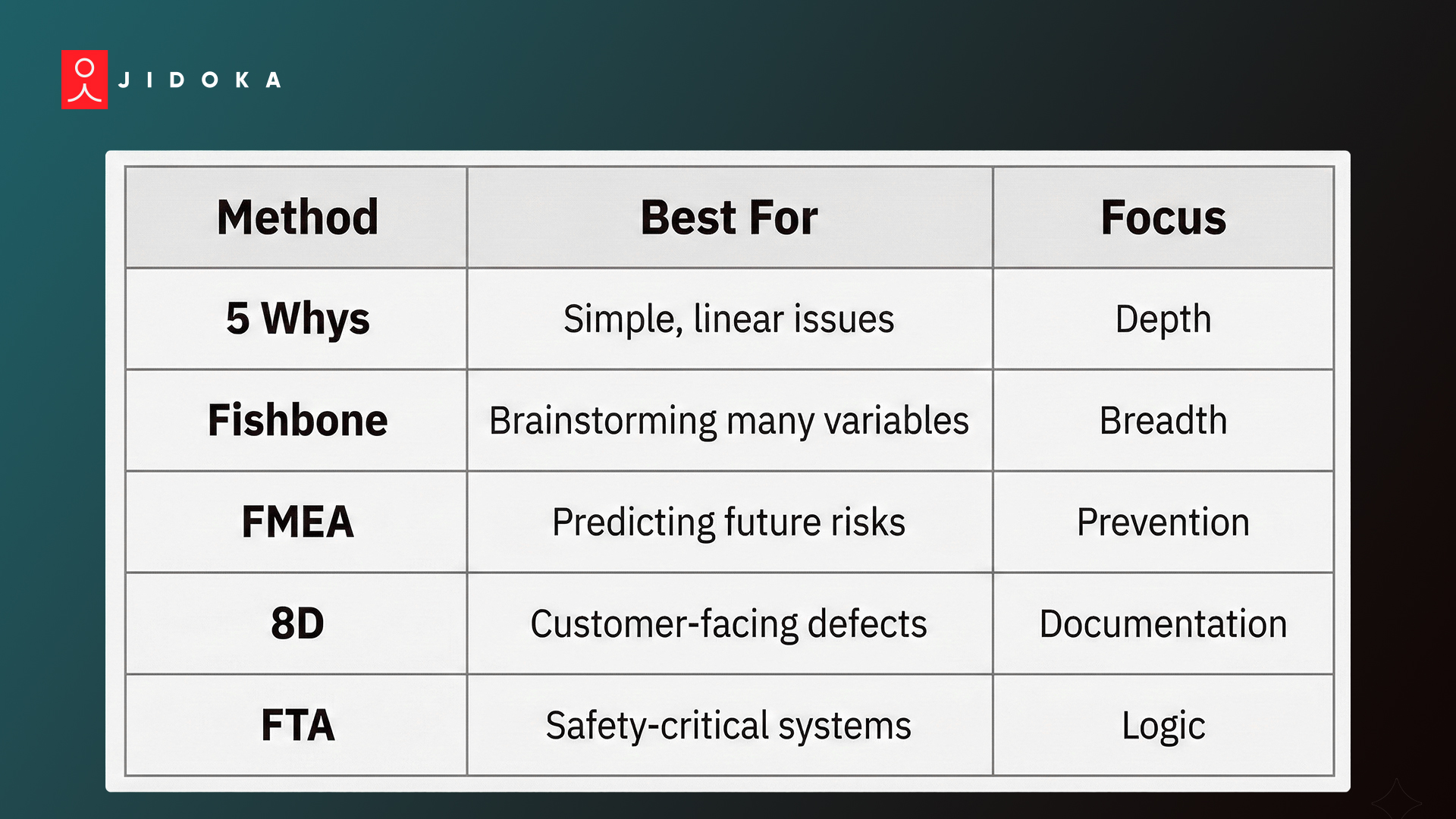
Le choix de l'outil adapté à la tâche est la partie la plus importante d'une enquête sur les défauts de qualité. Certains problèmes sont simples, tandis que d'autres impliquent de nombreuses variables différentes. L'utilisation de ces méthodes d'analyse des causes profondes aide votre équipe à rester organisée et à trouver des informations.
Méthodes d'analyse des causes fondamentales utilisées dans la fabrication
1. 5 Pourquoi utiliser la méthode
Le Méthode 5 pourquoi est le moyen le plus simple d'aller au fond des choses. Vous commencez par le défaut et vous demandez « pourquoi » jusqu'à ce que vous atteigniez la source. Il fonctionne mieux pour les problèmes linéaires, tels que la défaillance d'une seule pièce de la machine.
- Exemple : Une pièce présente une rayure. Pourquoi ? Le bras du robot a glissé. Pourquoi ? Un joint d'étanchéité a laissé échapper de l'huile sur la pince. Pourquoi ? Le sceau était vieux. Pourquoi ? Il ne figurait pas sur la liste des remplaçants. Cause principale : la liste de maintenance était incomplète.
2. Schéma en arête de poisson (Ishikawa)
Un diagramme en arête de poisson est utile lorsque vous avez de nombreuses causes potentielles. Il organise les idées en six catégories : machine, méthode, matériau, main-d'œuvre, mesure et environnement. Cela vous donne une vue d'ensemble de votre processus.
3. FMEA (analyse des modes de défaillance et des effets)
La fabrication FMEA est un outil proactif. Vous l'utilisez pour détecter les défaillances potentielles avant qu'elles ne se produisent. Vous classez les risques en fonction de leur gravité, de leur fréquence et de leur facilité à les détecter. Cela est essentiel pour la prévention des défauts dans les secteurs à enjeux élevés tels que l'automobile ou technologie médicale.
4. Résolution de problèmes 8D
La résolution de problèmes 8D est un processus formel en huit étapes. Il s'agit de la référence absolue en matière de traitement des plaintes des clients. Cela vous permet non seulement de réparer la pièce, mais également de prouver que votre action corrective durera dans le temps.
5. Analyse de l'arbre de défaillances (FTA)
Utilisez l'analyse de l'arbre des défaillances pour les problèmes de sécurité. Il utilise la logique pour montrer comment différentes petites défaillances peuvent se combiner pour provoquer un accident majeur. Il trace « l'arbre » des événements afin que vous puissiez voir tous les chemins possibles menant à une défaillance.
Exemples d'analyse des causes profondes dans le secteur de la fabrication
Des histoires réelles montrent comment ces outils fonctionnent. Voyant analyse des causes profondes in action vous aide à l'appliquer à votre propre atelier. Ces cas prouvent que l'analyse des causes profondes dans le secteur de la fabrication permet d'économiser de l'argent.
Exemple #1. Composants de freins défectueux (automobiles)
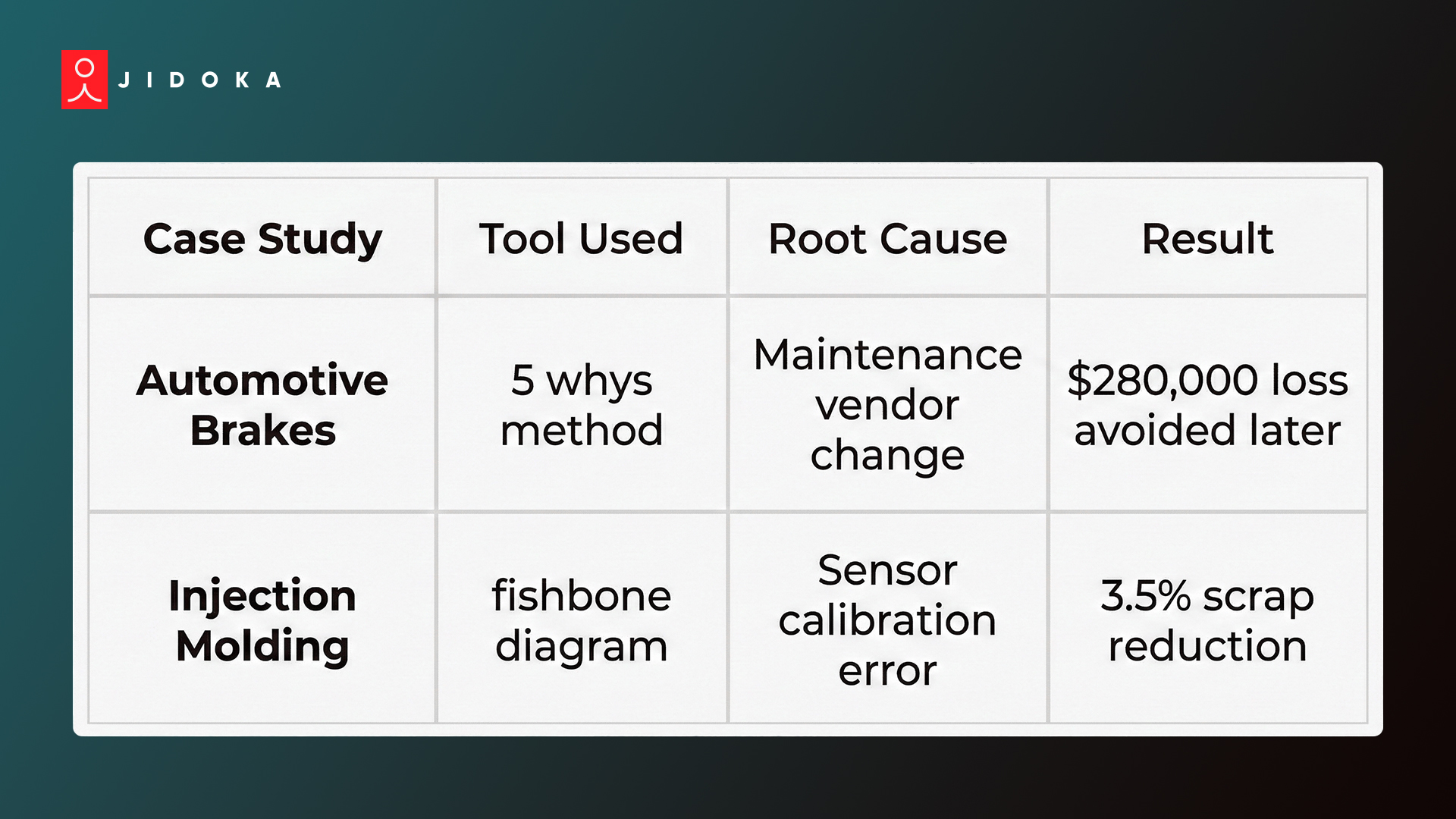
Une usine automobile a produit un lot de freins défectueux. Le défaut est parvenu à l'acheteur. Cette erreur a coûté plus de 280 000$. L'équipe a utilisé la méthode des 5 raisons pour identifier le problème.
Ils ont découvert qu'un fournisseur de maintenance avait changé. Personne n'a mis à jour le calendrier d'étalonnage de la machine. Leurs mesures correctives comprenaient des alertes logicielles automatisées. Ce prévention des défauts move a stoppé l'erreur.
Exemple #2. Défauts récurrents dans le moulage par injection
Une entreprise de plasturgie a enregistré un taux de défauts de 4 %. Ils ont utilisé un diagramme en arête de poisson pour vérifier chaque variable. Ils ont découvert qu'un capteur de température avait été mal calibré après un changement de moule. Il n'existait aucune procédure normalisée pour vérifier les capteurs lors des échanges.
Ils ont mené une enquête sur les défauts de qualité et ont rédigé un nouveau processus. La ferraille est tombée à 0,5 %. Dans la pratique, il s'agit d'une fabrication en amélioration continue.
Principaux points à retenir des exemples de fabrication :
- Utilisez les données pour étayer vos réclamations.
- Vérifiez régulièrement vos calendriers de maintenance.
- De petites erreurs dans SOP entraîner de gros coûts
Pour découvrir la vérité grâce à l'analyse des causes profondes, il faut un processus clair. Nous pouvons maintenant examiner les étapes spécifiques à suivre pour mener votre propre enquête.
Comment effectuer une analyse des causes premières étape par étape
Mener une enquête sur un défaut de qualité ne doit pas être un jeu de devinettes. Vous avez besoin d'un chemin à suivre pour ne manquer aucun détail. Ce processus en quatre étapes vous permet d'appliquer une analyse des causes profondes à tout problème de production auquel vous êtes confronté.
Étape #1. Définir le problème lié aux données
On ne peut pas régler un vague problème. Commencez par recueillir des informations concrètes sur l'échec.
- Utilisez l'approche « 5W1H » : qui, quoi, où, quand, pourquoi et comment.
- Collectez des chiffres spécifiques, tels que « Le rendement de la partie B a chuté de 12 % sur la ligne 4 ».
- Évitez les suppositions ; utilisez uniquement des données vérifiées provenant de votre atelier.
Étape #2. Contenir le problème
Empêchez le problème de se propager à vos clients. Il s'agit d'un bouclier temporaire pendant que vous travaillez sur le vrai correctif.
- Mettez immédiatement en quarantaine toutes les parties suspectes.
- Vérifiez votre inventaire actuel pour détecter d'éventuels défauts similaires.
- Ajoutez une vérification manuelle temporaire en fin de ligne si nécessaire.
Étape #3. Identifier et vérifier la cause première
Utilisez les méthodes d'analyse des causes profondes que vous avez choisies pour trouver la source. Une fois que vous pensez l'avoir, vous devez le prouver.
- Appliquez la méthode des 5 pourquoi ou un diagramme en arête de poisson en fonction de la complexité.
- Testez votre théorie : si vous « désactivez » la cause, le défaut disparaît-il ?
- Recherchez les données de l'analyse des défaillances pour confirmer que vos résultats correspondent aux preuves physiques.
Étape #4. Mettre en œuvre des actions correctives et préventives (CAPA)
Maintenant, réglez le problème pour de bon. Cette étape vous permet d'atteindre l'objectif de prévention des défauts.
- Exécutez une action corrective pour corriger le lot ou la machine en cours.
- Créez un plan de prévention, comme la mise à jour d'une SOP ou l'ajout d'une Fabrication FMEA chèque.
- Surveillez vos indicateurs de performance clés pendant au moins trois cycles de production afin de garantir la pérennité du correctif.
En suivant ces étapes, votre équipe peut se concentrer sur les faits plutôt que sur les opinions.
Comment Jidoka Tech soutient l'analyse des causes profondes grâce à la détection des défauts en temps réel
L'analyse traditionnelle des causes premières permet de détecter les erreurs une fois qu'elles se sont produites. Le système d'inspection par IA de Jidoka Tech les attrape instantanément. Notre équipe intègre caméras et unités périphériques pour traiter plus de 12 000 pièces par minute.
Nos données en temps réel simplifient toute enquête sur les défauts de qualité.
Capacités technologiques de Jidoka :
- Inspecteur de haute précision KOMPASS: Offre une précision de plus de 99,8 % et passe en revue les images en moins de 10 ms. Il maîtrise les nouvelles variantes avec 70 % d'échantillons en moins.
- Analyste des processus NAGARE: Suit chaque étape de l'assemblage pour signaler les pièces manquantes ou les séquences erronées. Il permet de réduire les retouches jusqu'à 35 %.
- Informatique de périphérie : Exécute localement le système de détection des défauts entièrement automatisé pour éliminer les retards.
L'utilisation de ces outils permet d'automatiser la prévention des défauts. Vous obtenez les preuves nécessaires à l'analyse des défaillances sans conjectures manuelles.
Conclusion
L'analyse des causes profondes est le seul moyen de mettre fin aux défauts de fabrication récurrents. Si vous l'ignorez, vous êtes confronté au stress constant de rechercher les symptômes alors que vos profits disparaissent. Le fait de ne pas procéder à une analyse approfondie des défaillances entraîne des résultats catastrophiques : rappels massifs, poursuites judiciaires et perte de confiance des clients. Une erreur non détectée peut entraîner la faillite d'une installation.
Il ne faut pas attendre qu'une catastrophe se produise. Technologie Jidoka fournit les données dont vous avez besoin pour prévenir les défauts grâce à l'IA en temps réel. Nous identifions le « pourquoi » instantanément, protégeant ainsi votre réputation et vos résultats
Connectons-nous à Jidoka et réservez une démonstration pour découvrir comment l'analyse des causes profondes pilotée par l'IA transforme votre chaîne de production.
FAQs
1. Qu'est-ce que l'analyse des causes profondes dans le secteur manufacturier ?
L'analyse des causes profondes est un processus systématique visant à déterminer pourquoi un défaut s'est produit. Il met l'accent sur l'origine plutôt que sur le symptôme. En effectuant une enquête sur les défauts de qualité, vous garantissez la prévention des défauts et vous empêchez les pertes récurrentes dans le cadre de l'amélioration continue de la fabrication.
2. Quelles sont les méthodes d'analyse des causes profondes les plus courantes ?
Les principales méthodes d'analyse des causes profondes incluent la méthode des 5 pourquoi, le diagramme en arête de poisson et la fabrication du FMEA. Pour les problèmes rencontrés par les clients, Résolution de problèmes 8D est le meilleur. Pour les défaillances de sécurité complexes, l'analyse de l'arbre des défaillances vous permet de réaliser une analyse approfondie des défaillances.
3. Comment l'analyse des causes profondes permet-elle de réduire les coûts de fabrication ?
RCA réduit ses coûts en éliminant le besoin de retouches constantes. Il évite les demandes de garantie coûteuses et protège vos revenus de vente. L'utilisation de l'analyse des causes profondes dans le secteur de la fabrication vous permet de passer des réparations réactives coûteuses à des mesures correctives permanentes et à la prévention des défauts à long terme.
4. Quand un fabricant doit-il utiliser le FMEA plutôt que 5 pourquoi ?
Utilisez la fabrication FMEA de manière proactive pour prévoir les risques lors du lancement de nouveaux produits. Utilisez la méthode des 5 pourquoi de manière réactive pour les problèmes simples à cause unique. La combinaison de ces méthodes d'analyse des causes profondes garantit que votre enquête sur les défauts de qualité couvre à la fois les risques potentiels et les défaillances réelles.
5. Comment l'inspection par IA contribue-t-elle à l'analyse des causes profondes ?
Un système automatique de détection des défauts fournit des données en temps réel pour l'analyse de vos défaillances. Les outils d'IA de Jidoka Tech identifient exactement où une séquence a échoué. Ces preuves traçables accélèrent l'analyse des causes profondes, ce qui permet de prendre des mesures correctives instantanées sans conjectures manuelles.