
The global warehouse management system market hit $6.78 billion in 2026. This growth happens because companies need better warehouse management to handle high e-commerce demands.
Recent data shows that 62% of facility leaders still struggle with inventory control. Poor warehouse management hurts your order fulfillment accuracy and wastes money.
Modern managers use autonomous mobile robots and smart WMS software to fix these gaps. You can improve efficiency by automating your daily tasks. This guide shows you how to run a better facility right now.
What Is Warehouse Management and Why the Definition Has Expanded in 2026
Warehouse management means more than just moving boxes in 2026. It is the control center for your entire supply chain. Today, successful warehouse management connects your physical inventory to digital data in real-time.
This helps you track every item through RFID tracking and automated sensors. You get a clear picture of what is happening on your floor every second.
A) The Core Functions Warehouse Management Controls
Modern warehouse management handles several vital tasks at once:
- Inventory visibility: You see exactly what you have and where it is located.
- Labor management system: You assign the right tasks to the right workers to stop wasted time.
- The put-away process: You move items from the dock to the best shelf location quickly.
- Returns management: You process customer returns fast to get items back into stock.
Warehouse Management System (WMS) vs. Manual Operations (The Real Performance Gap)
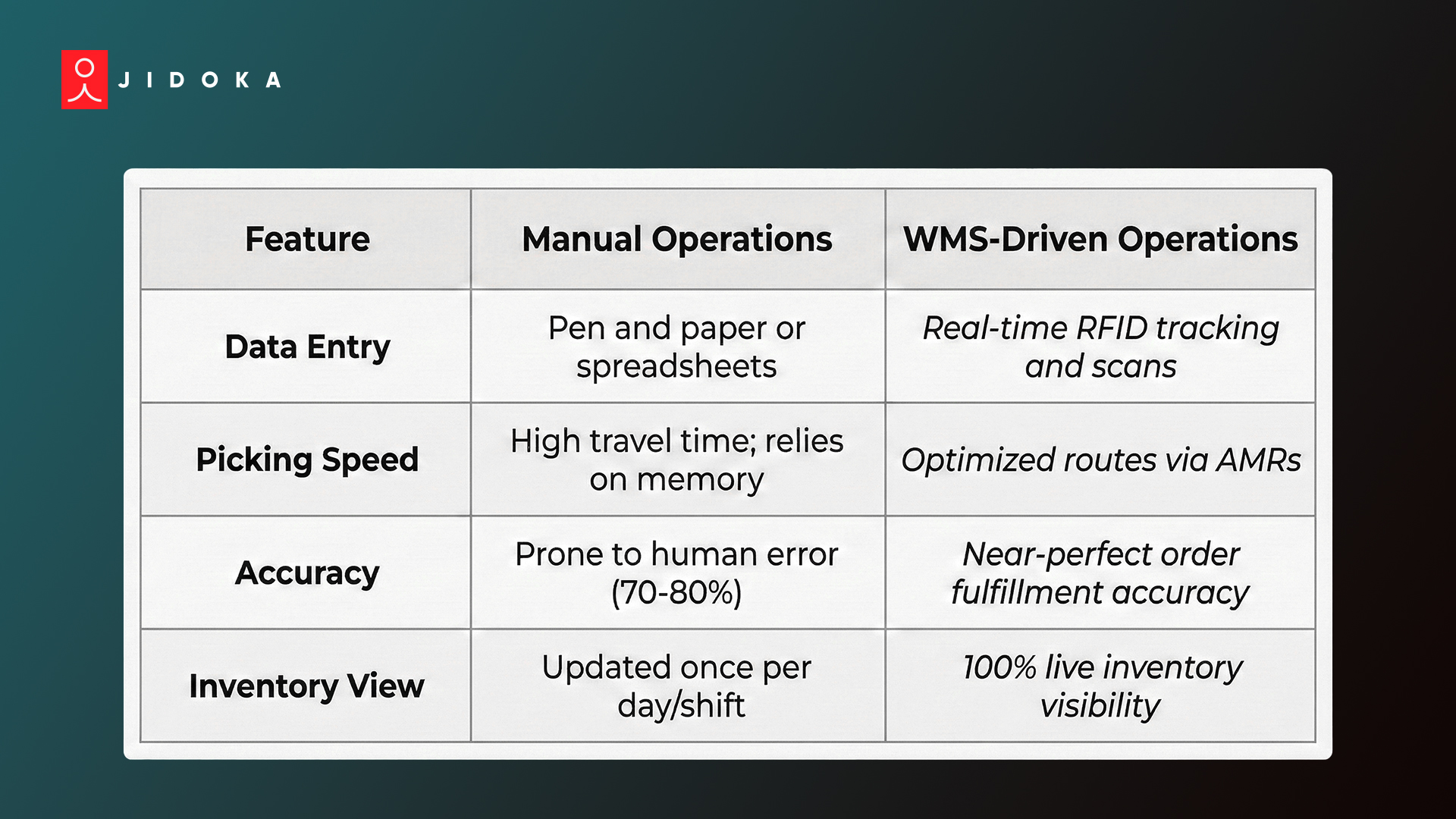
Manual warehouse operations management relies on paper and memory, which causes mistakes. A digital warehouse management system removes the guesswork. You see a massive difference in speed when you switch from spreadsheets to WMS software.
Automated systems give your team clear instructions, so they don't wander around looking for items. This switch improves your order fulfillment accuracy by up to 30% almost immediately.
Efficient warehouse management sets the foundation for every other part of your business. Now, let's look at the four specific operations that drive your daily success.
The Four Core Warehouse Operations Every WMS Must Manage
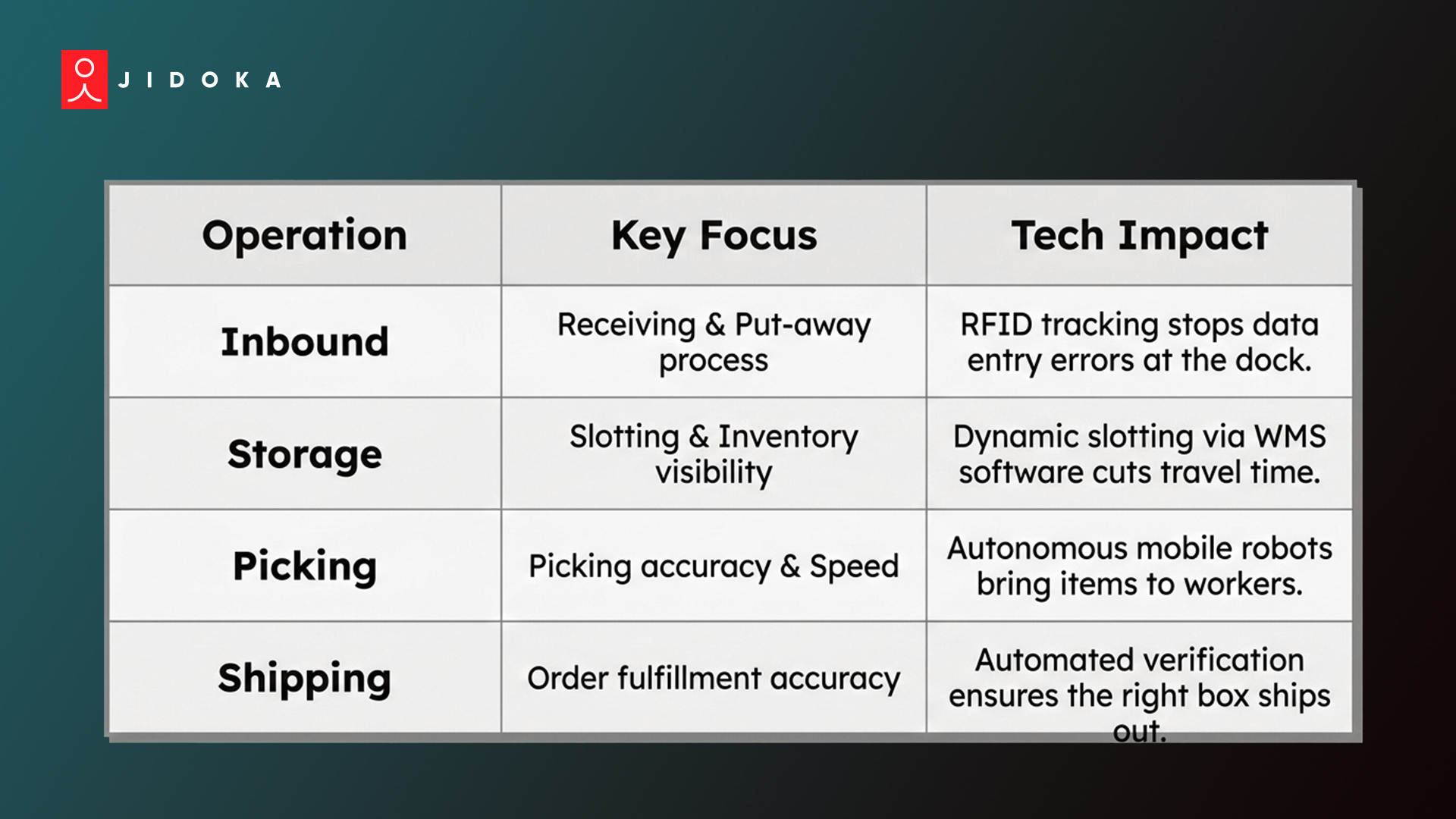
Strong warehouse management relies on four specific stages. When you use a warehouse management system, you turn these stages into a high-speed engine. You stop guessing where items are and start moving them with precision.
1. Inbound Operations: Receiving, Inspection, and Put-Away
Your warehouse operations management starts the moment a truck hits the dock. If you make a mistake here, it breaks your data for the rest of the month. Use RFID tracking to scan entire pallets instantly instead of counting items by hand.
- Receiving: Your WMS software checks inbound goods against your purchase orders.
- The put-away process: The system tells your team exactly where to store items based on how fast they sell.
- Cross-docking: Move urgent items from the receiving dock directly to the shipping dock to skip storage time.
2. Inventory Storage and Slotting: Using Every Inch of Space
Most facilities waste 30% of their space because of poor warehouse management. You need to keep your fastest-selling items near the front. This is called slotting. Good warehouse operations management uses dynamic slotting to change item locations as demand shifts. This reduces the distance your team travels and keeps your inventory visibility high.
3. Order Picking: The Heart of Fulfillment
Picking is your most expensive task. It takes up over half of your labor costs. To fix this, high-performing facilities use autonomous mobile robots to bring items to workers. This improves your picking accuracy and stops workers from walking miles every shift.
4. Shipping and Quality Checks
The final step of warehouse management is getting the box out the door. You must verify that the right items are in the right box. This keeps your order fulfillment accuracy high and your customers happy. Your warehouse management system prints shipping labels and schedules carriers automatically.
Quick Glance: Four Core Warehouse Operations
Running these operations smoothly is hard when you face outside pressure. Next, we will look at the specific challenges that make warehouse management difficult in 2026.
The Biggest Warehouse Management Challenges in 2026 (Specific, Data-Backed, Not Generic)
Running a facility today means facing a few tough realities that didn't exist a decade ago. You deal with faster delivery demands and smaller, more frequent orders.
These shifts put massive pressure on your warehouse management strategies and your ability to stay profitable.
1. Inventory Accuracy — Why 62% of Warehouse Leaders Still Can't Get It Right
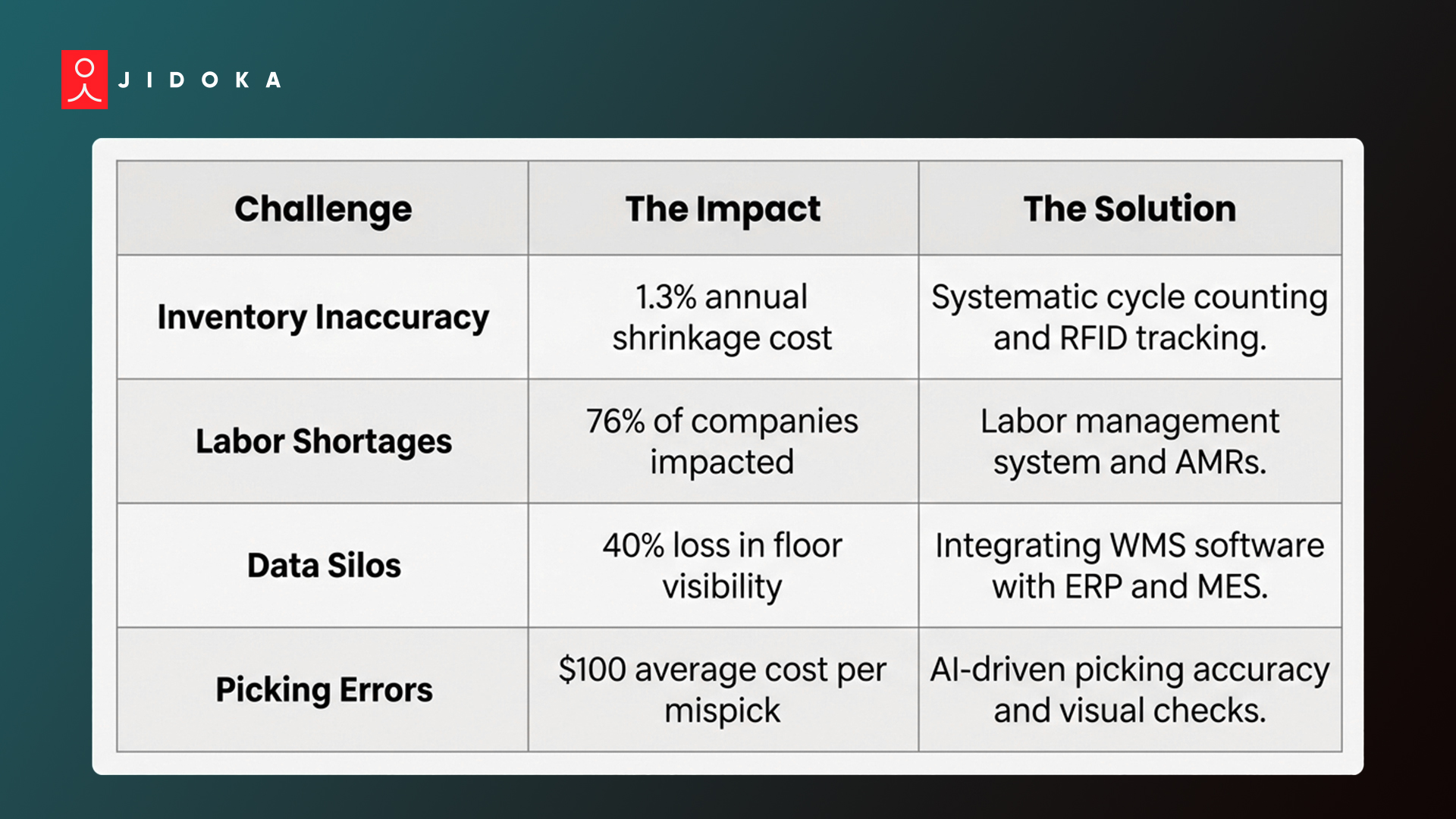
Most facilities struggle with inventory shrinkage, which costs the industry about 1.3% of total stock value every year. This happens because of manual entry lags and counting errors. When your digital records don't match the physical boxes on your shelves, your order fulfillment accuracy drops.
To fix this, high-performing teams use RFID tracking and systematic cycle counting to catch errors before they grow. Replacing an annual count with a weekly cycle counting schedule keeps your inventory visibility near 100%.
2. Labor Shortages — A Structural Problem, Not a Seasonal Hiring Gap
You likely see a high turnover rate, which averages around 36% annually for warehouse staff. Every time a worker leaves, you spend more on training and lose productivity.
Smart warehouse operations management focuses on using a labor management system to make the work easier. By using autonomous mobile robots to handle heavy lifting, you reduce worker fatigue and keep your team longer.
3. Technology Integration — When WMS software Doesn't Talk to Other Systems
Data silos can lower your operational visibility by as much as 40%. This happens when your warehouse management system does not share data with your ERP or shipping software. If these tools don't communicate, you make decisions based on old information.
You need an integrated warehouse management setup where your WMS software sends live updates to every other department. This connection ensures your put-away process and cross-docking tasks happen without a hitch.
Quick Glance: Biggest Warehouse Management Challenges in 2026
Addressing these challenges is the first step toward building a more resilient facility. One way to bridge these gaps is by using advanced visual tools to monitor your floor.
How Jidoka Tech Handles Warehouse Inspection Across High-Volume Lines
Standard warehouse management tracks item movement, but Jidoka Tech ensures every move is perfect. Our AI inspection system handles the pressure of 300 million inspections daily, closing the gap in order fulfillment accuracy.
- KOMPASS: Delivers 99.8%+ accuracy on live lines, reviewing frames in under 10 ms to catch defects instantly.
- NAGARE: Analyzes 100% of assembly steps through your existing cameras to flag wrong sequences and cut rework by 35%.
By running on local edge units, Jidoka provides an intelligent inspection solution that keeps your warehouse operations management fast and error-free.
Book a demo with Jidoka today to see how automated inspection improves your warehouse management and order fulfillment accuracy.
Conclusion
Warehouse management is the backbone of your supply chain, yet 62% of leaders struggle with inventory control. When your warehouse operations management fails, you face constant stockouts and shipping errors.
These failures lead to lost contracts and a damaged reputation. A single mispick costs an average of $100, and these expenses stack up fast until they threaten your business.
Jidoka Tech solves this by adding a visual layer to your warehouse management system. Our AI tools verify every assembly step and pre-shipment quality check to ensure you deliver exactly what you promised.
Let's connect with Jidoka and find out how to stop fulfillment errors before they leave your dock.
FAQs
1. What is warehouse management?
Warehouse management refers to the control of internal facility tasks. It covers the put-away process, inventory visibility, and cross-docking. Effective warehouse operations management ensures high order fulfillment accuracy. By using RFID tracking, you monitor goods from arrival until they leave the building for shipping.
2. How does a warehouse management system improve efficiency?
A warehouse management system automates manual tasks. This WMS software coordinates autonomous mobile robots to boost picking accuracy and reduce worker travel. By integrating a labor management system, you optimize staff schedules. It also facilitates real-time cycle counting to keep your records precise.
3. What causes poor order fulfillment accuracy?
Low order fulfillment accuracy usually stems from manual errors and poor inventory visibility. Without a warehouse management system, your team relies on paper lists. Implementing WMS software and RFID tracking fixes this. These tools streamline the put-away process, ensuring items are easy to find.
4. Why is inventory visibility important for warehouse management?
High inventory visibility prevents stockouts that halt production. Robust warehouse management uses RFID tracking and cycle counting to maintain live data. This clarity improves your put-away process and cross-docking speed. It ensures your warehouse management system always reflects the physical reality on your floor.
5. How do autonomous mobile robots fit into warehouse operations management?
Autonomous mobile robots transform warehouse operations management by automating heavy lifting. These robots sync with your WMS software to increase picking accuracy significantly. They work alongside your labor management system to handle repetitive tasks, allowing your human team to focus on complex fulfillment duties.