.webp)
Een geretourneerde batch kost meer dan het product zelf. Nabewerking vreet aan je marges, onderzoek bij recalls kost tijd, en beide wijzen naar hetzelfde kernprobleem: de inspectiestrategie heeft iets gemist. De meeste fabrikanten hebben geïnvesteerd in kwaliteitssystemen. Toch worden er nog steeds defecte producten verzonden. De reden is bijna altijd structureel, niet technologisch.
Deze gids legt het tweelaagsmodel uit dat productinspectie scheidt van procesbewaking, en laat precies zien waar machine vision voor kwaliteitscontrole in elk van deze onderdelen past.
Machine vision voor kwaliteitscontrole werkt op twee niveaus: productinspectie, die defecten in afgewerkte of halffabricaten opspoort, en procesbewaking, die controleert of operators en assemblagestappen de juiste volgorde volgen. Beide zijn noodzakelijk. Ze met elkaar verwarren is de duurste fout bij de implementatie van AI-vision.
Wat is machine vision voor kwaliteitscontrole?
Machine vision voor kwaliteitscontrole is het gebruik van camera's, edge AI en beeldverwerking om producten automatisch te inspecteren en processen in productieomgevingen te bewaken.
Die definitie dekt twee operationeel gescheiden problemen. Het eerste is productintegriteit: het eindproduct klopt niet. Het tweede is procesintegriteit: de methode die is gebruikt om het product te maken was onjuist. Beide leiden tot defecten. Ze vereisen verschillende instrumenten, verschillende datastromen en verschillende acties.
Het prestatieverschil tussen machine- en menselijke inspectie is aanzienlijk. AI-vision-systemen voor kwaliteitscontrole behalen een detectienauwkeurigheid van 99,5% of hoger, vergeleken met 70 tot 85% bij getrainde menselijke inspecteurs die repetitieve controles uitvoeren op lijnsnelheid. Het gat wordt groter naarmate de doorvoer toeneemt. Bij enkele duizenden onderdelen per minuut is menselijke inspectie operationeel niet haalbaar.
De financiële belangen komen overeen met dat prestatieverschil. Productiefaciliteiten verliezen naar schatting jaarlijks 3,4 miljard dollar aan defecte producten die aan menselijke inspectie ontsnappen. (iFactoryApp, 2026) De markt voor machine vision-systemen weerspiegelt deze druk: gewaardeerd op 20,4 miljard USD in 2024, met een verwachte groei naar 41,7 miljard USD in 2030 bij een samengesteld jaarlijks groeipercentage van 13%.
Kwaliteitsmanagers die met AI-vision-systemen werken, gebruiken een specifiek vocabulaire: defect escape rate, inline inspectie, poka-yoke, first-time-right, nabewerkingskosten. Deze termen komen in dit artikel terug omdat ze weerspiegelen hoe het probleem daadwerkelijk op de werkvloer wordt ervaren.
De twee faalmodi die machine vision moet oplossen
De meeste leveranciers van computer vision voor kwaliteitsinspectie behandelen hun product als één antwoord op één vraag: heeft dit item een defect? Die benadering mist de helft van het probleem.
Faalmodus 1: Defecten ontsnappen onopgemerkt aan de lijn.
Het product is niet in orde. Een kras op het oppervlak, een afwijking in de afmetingen, een ontbrekend label, een aangetaste verzegeling. Traditionele inspectie ontdekt dit achteraf, met steekproefgroottes die het werkelijke aantal ontsnapte defecten onderschatten. Een batch met een defectpercentage van 2% komt 82% van de tijd door een AQL-inspectie van 10 stuks. (iFactoryApp, 2026) De meeste van die defecten bereiken de klant.
Foutmodus 2: Het proces verloopt onjuist.
De operator slaat een aandraaistap over. Het verkeerde onderdeel wordt in de assemblage geplaatst. De volgorde van het samenstellen is omgedraaid. Het product kan de visuele kwaliteitscontrole doorstaan en toch falen in het veld. Dit is een fout in de procesnaleving en deze is onzichtbaar voor productinspectiesystemen.
Waarom het oplossen van slechts één probleem niet volstaat: een lijn met volledige productinspectie maar zonder procesbewaking zal nog steeds leiden tot recalls door volgordefouten. Een lijn met volledige procesbewaking maar zonder productinspectie zal nog steeds cosmetische of dimensionale defecten verzenden. De twee foutmodi werken parallel. Ze vereisen parallelle oplossingen.
“Het Jidoka Two-Layer Quality Model: Productintegriteit (wat van de lijn komt) en Procesintegriteit (hoe de lijn draait). Het aantal defecten dat ontsnapt daalt alleen wanneer beide lagen worden gemonitord.” - Jidoka Technologies
Dit tweelaagsmodel vormt het kader waarop de rest van dit artikel is gebaseerd: de Product Integrity Layer en de Process Integrity Layer.
Vergelijkingstabel: Productinspectie versus Procesbewaking
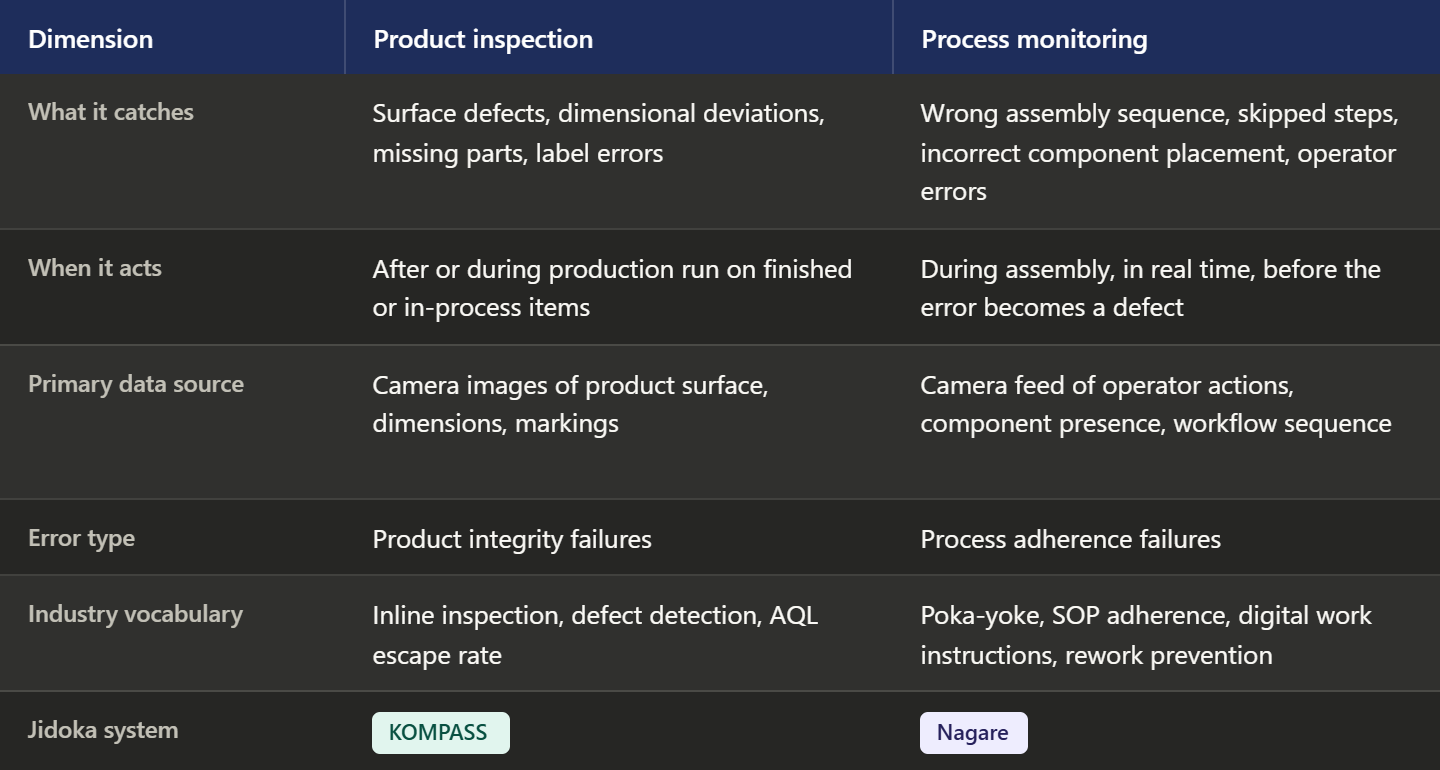
Hoe KOMPASS Productinspectie aanpakt
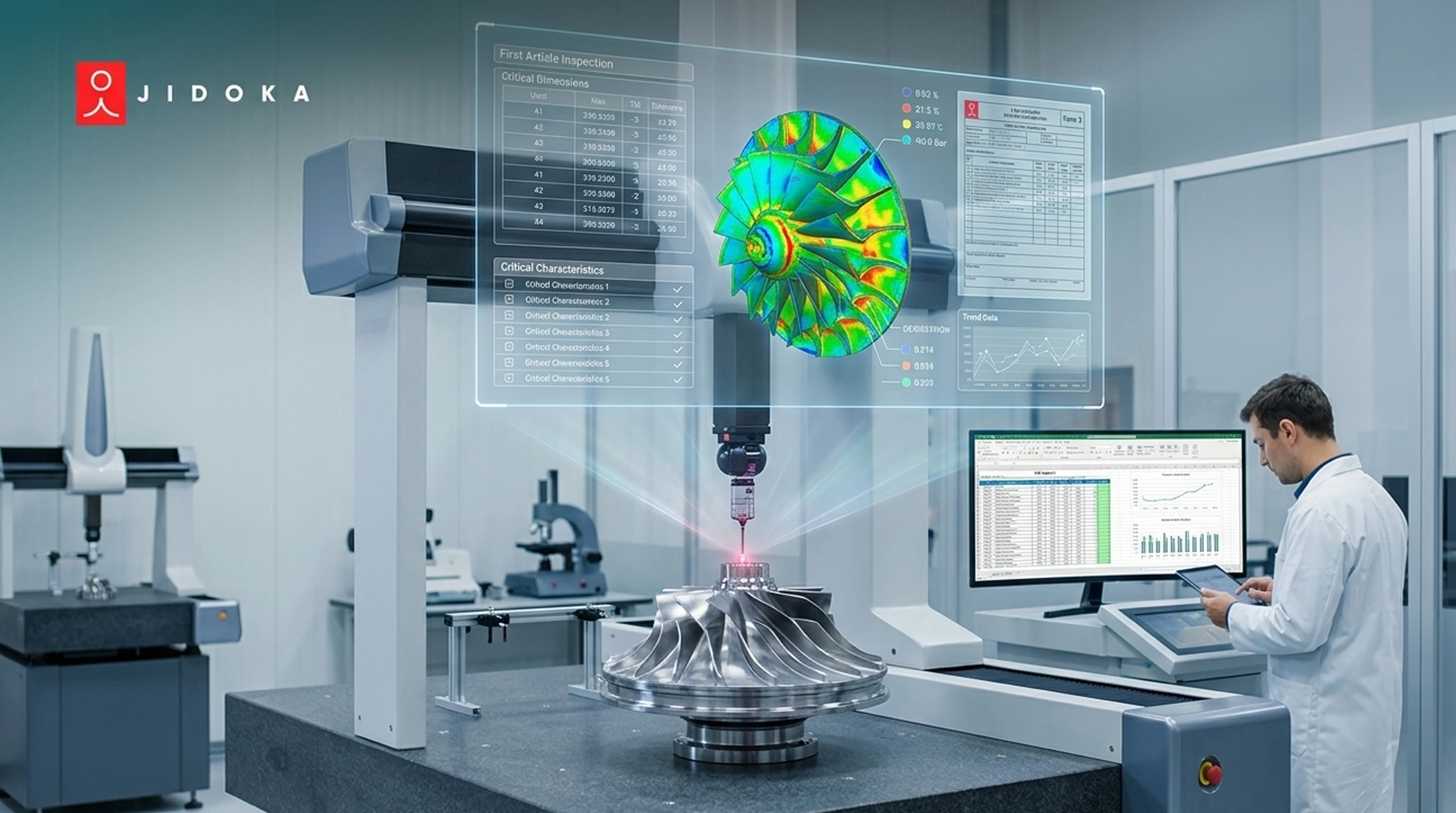
KOMPASS is de oplossing van Jidoka voor de Product Integrity Layer. Het voert inline visuele kwaliteitscontrole uit met maximaal 12.000 onderdelen per minuut met een nauwkeurigheid van 99,9% bij het detecteren van defecten, waarbij producten vanuit 360 graden worden geïnspecteerd terwijl ze door de productielijn bewegen.
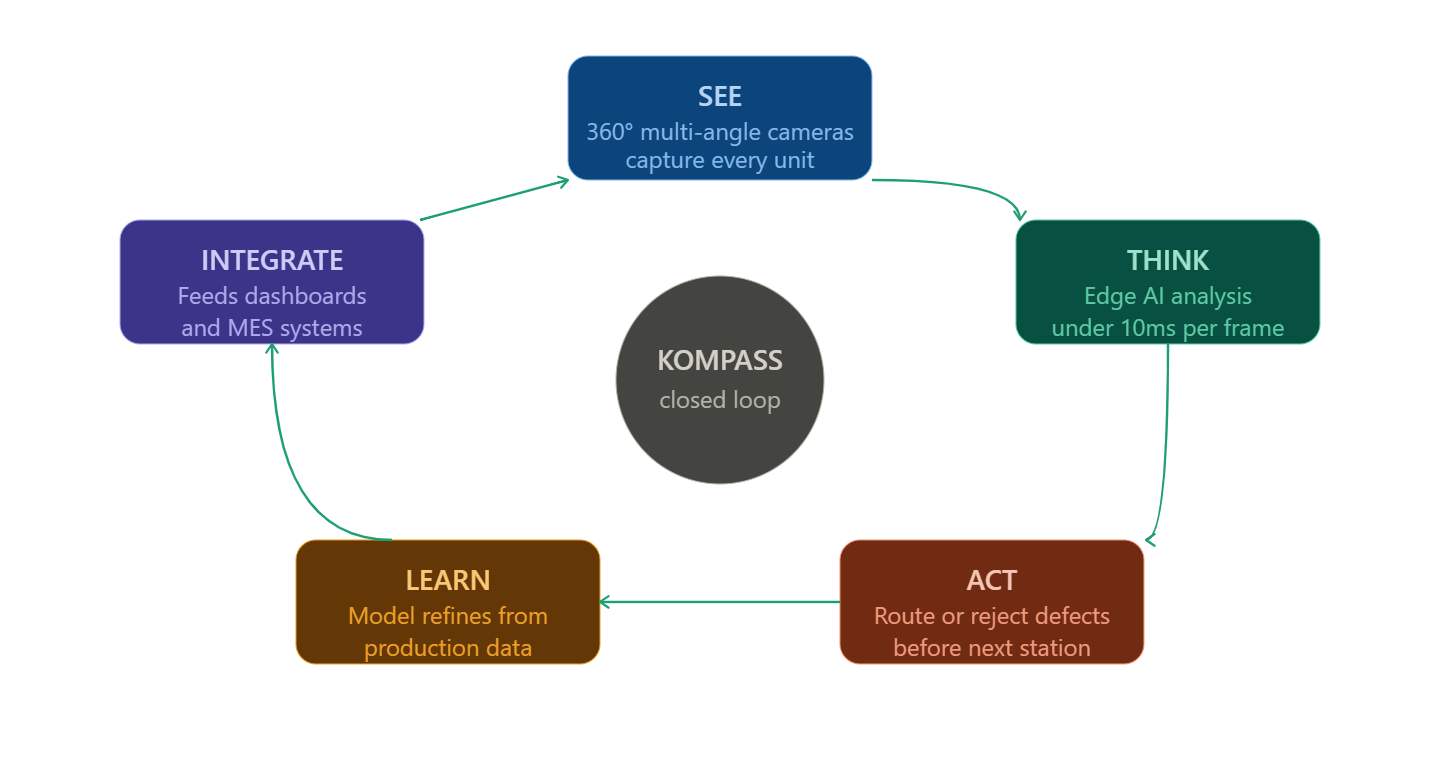
De architectuur draait een closed-loop in vijf fasen: ZIEN, DENKEN, HANDELEN, LEREN, INTEGREREN.
- ZIEN: Camera's met meerdere hoeken leggen het product in beweging vast.
- DENKEN: Edge AI analyseert elk frame in minder dan 10 ms en classificeert de toestand van het oppervlak, de maatnauwkeurigheid, de aanwezigheid van labels en de volledigheid van onderdelen.
- HANDELEN: Het systeem leidt defecte producten om of verwerpt ze voordat ze verder stroomafwaarts gaan.
- LEREN: Het model verbetert continu op basis van productiegegevens, waardoor de nauwkeurigheid na verloop van tijd toeneemt zonder handmatige hertraining.
- INTEGREREN: Gegevens worden ingevoerd in kwaliteitsdashboards en gekoppeld aan bestaande manufacturing execution systems.
Traditionele AI-visiesystemen voor kwaliteitscontrole kampen met een opstartprobleem: ze vereisen grote bibliotheken met defectafbeeldingen vóór implementatie, iets waar nieuwe productielijnen en productintroducties nog niet over beschikken. KOMPASS lost dit op met de DOJO-zelftrainingsengine. DOJO traint op basis van minder dan 10 afbeeldingen van goede producten. Er zijn geen defecte voorbeelden nodig en het kwaliteitsteam hoeft geen expertise in machine learning te hebben.
Het percentage onterechte afkeuringen is net zo belangrijk als het detectiepercentage. Het onterecht afkeuren van een goed product zorgt voor onnodige herstelkosten en verstoring van de productielijn. KOMPASS verlaagt het aantal onterechte afkeuringen met 40% in vergelijking met traditionele AI-visiesystemen.
Industrieën waar KOMPASS wordt ingezet: inspectie van auto-onderdelen op lopende banden, verpakkings- en labelcontrole in de FMCG-sector, integriteitscontrole van farmaceutische verpakkingen, en inspectie van soldeer- en assemblageprocessen in de elektronica.
Hoe Nagare assemblageprocessen monitort
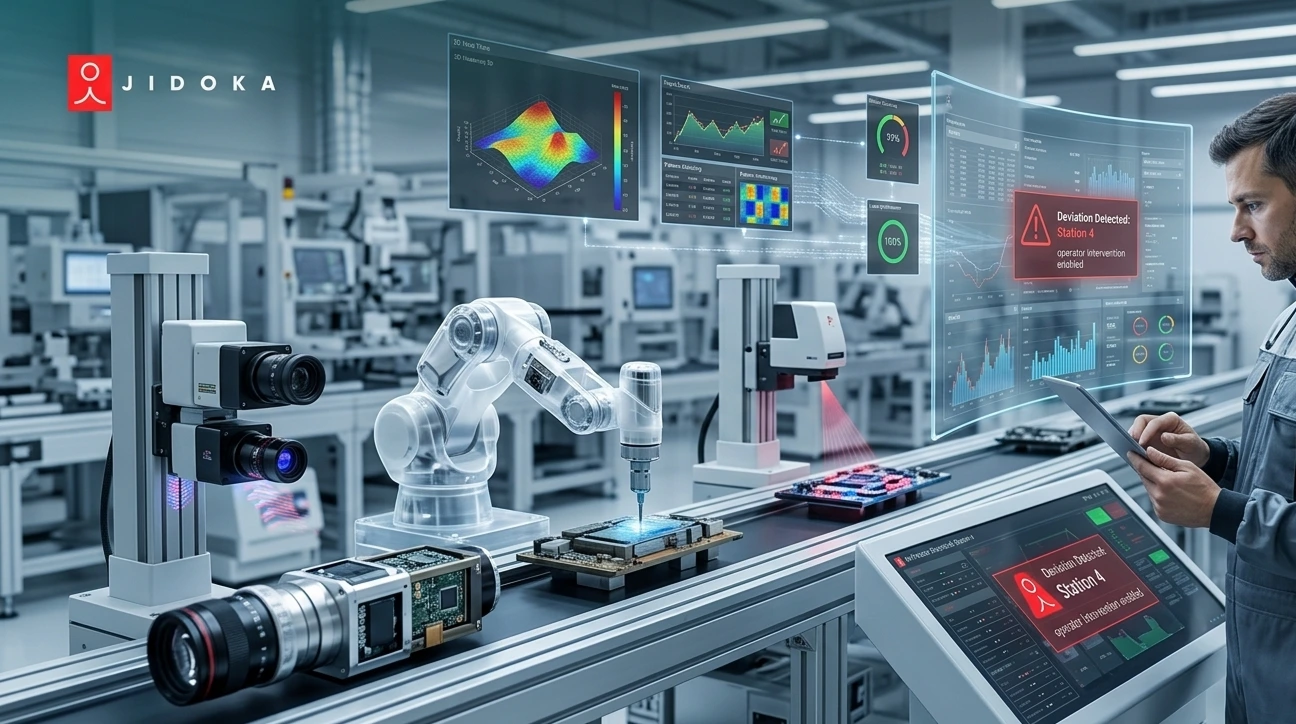
Nagare is de Process Integrity Layer-oplossing van Jidoka. Waar KOMPASS het product inspecteert, houdt Nagare in de gaten hoe het werk wordt uitgevoerd. Het volgt acties van operators, de aanwezigheid van onderdelen en de assemblagereeks in realtime met behulp van bestaande camera's. Bij de meeste implementaties is geen nieuwe hardware nodig.
Dezelfde SEE / THINK / ACT / LEARN / INTEGRATE architectuur is van toepassing, maar dan met andere inputs. De camera's van Nagare leggen processignalen vast: wat de operator doet, of het juiste onderdeel wordt vastgehouden en of de status van het station overeenkomt met de werkinstructie. De THINK-fase valideert deze signalen aan de hand van SOP's en digitale werkinstructies. Bij een afwijking activeert ACT een poka-yoke-waarschuwing of stopt het station voordat het product naar de volgende cel gaat.
Dit onderscheid is cruciaal. KOMPASS detecteert een defect nadat het is ontstaan. Nagare stopt de procesfout voordat er een defect kan ontstaan.
De resultaten van Nagare-implementaties: 30% betere procesnaleving, 35% minder herstelwerk, 25% hogere productiviteit en 30% minder procesafwijkingen.
“Nagare monitort elke assemblagestap met bestaande camera's, garandeert 100% naleving van SOP's en zorgt voor 35% minder herstelwerk zonder dat er geïnvesteerd hoeft te worden in nieuwe hardware.” - Jidoka Technologies
Twee extra mogelijkheden onderscheiden Nagare op de werkvloer.
AI Buddy Mode begeleidt operators in real time en houdt individuele vaardigheidsniveaus bij. Naarmate operators vorderen, neemt de behoefte aan toezicht af. Nieuwe operators bereiken sneller het gewenste niveau. Het resultaat is een lagere verhouding tussen supervisors en operators zonder dat dit leidt tot een toename van het aantal fouten.
Edge AI-implementatie verwerkt alle data on-premises. Geen afhankelijkheid van de cloud. Dit lost direct de zorgen over gegevensprivacy en latentie op die de adoptie van AI in de auto- en farmaceutische industrie in de weg staan, waar procesgegevens bedrijfseigen zijn en latentie niet getolereerd kan worden.
ROI-tijdlijn: Nagare wordt ingezet op bestaande camera-infrastructuur en levert binnen 12 maanden rendement op de investering.
Wanneer heb je KOMPASS, Nagare of beide nodig?
Dit is de beslissing die ertoe doet. De technologie is duidelijk. De moeilijkere vraag is welk probleem je daadwerkelijk ervaart.
Het Quality Problem Diagnostics Framework van Jidoka Technologies is een zelfevaluatie met vier vragen die fabrikanten naar de juiste oplossing leidt. Doorloop deze in volgorde.
V1: Waar ontstaan je defecten?
Als defecten productdefecten zijn, zoals maatafwijkingen, schade aan het oppervlak, ontbrekende onderdelen of fouten in labels, dan is de Product Integrity Layer niet onder controle. KOMPASS is de oplossing. Als defecten terug te voeren zijn op procesfouten, zoals een verkeerde montagevolgorde, het gebruik van verkeerde onderdelen of overgeslagen processtappen, dan is de Process Integrity Layer niet onder controle. Nagare is de oplossing.
V2: Wat is je defect escape rate?
Als je op steekproeven gebaseerde AQL-proces batches doorlaat die defecten bevatten, is het escape rate-probleem een gat in de productinspectie. KOMPASS dicht dit gat met 100% inline vision-gebaseerde kwaliteitscontrole. Als je uitgaande defectpercentage laag is, maar de kosten voor herstel en afval hoog blijven, worden de kosten stroomopwaarts geabsorbeerd. Nagare is dan de belangrijkste hefboom.
V3: Hoe ziet je huidige inspectie-infrastructuur eruit?
KOMPASS vereist hardware-integratie: modulaire vision-infrastructuur verbonden met transportbanden en uitwerpmechanismen. Nagare maakt in de meeste gevallen gebruik van bestaande CCTV-camera's. Als kapitaalinvesteringen beperkt zijn, is Nagare de snellere eerste implementatie. De implementatie van KOMPASS duurt 6 tot 8 weken van installatie tot productie-klaar.
V4: Welk faaltype bereikt de klant?
Retouren uit het veld door productdefecten, krassen, maatafwijkingen of ontbrekende onderdelen wijzen op KOMPASS. Retouren uit het veld of compliance-fouten door montagefouten, ontbrekende processtappen of verkeerde onderdelen wijzen op Nagare. Beide problemen samen vereisen beide systemen.
Machine Vision voor kwaliteitscontrole in diverse sectoren
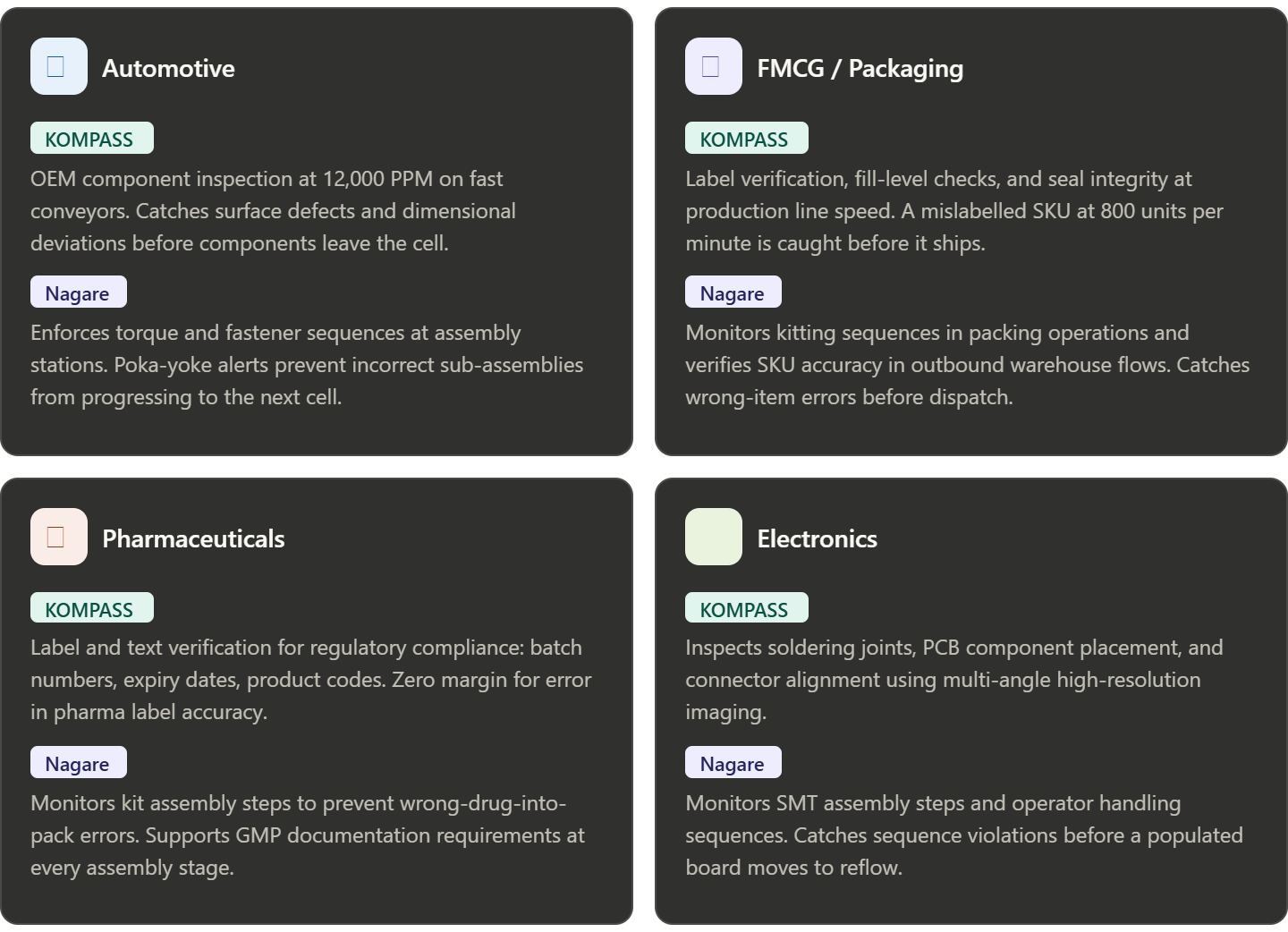
De verdeling tussen KOMPASS en Nagare pakt per sector anders uit. Elke onderstaande industrie combineert beide lagen, maar de specifieke faaltypen verschillen.
1. Automotive
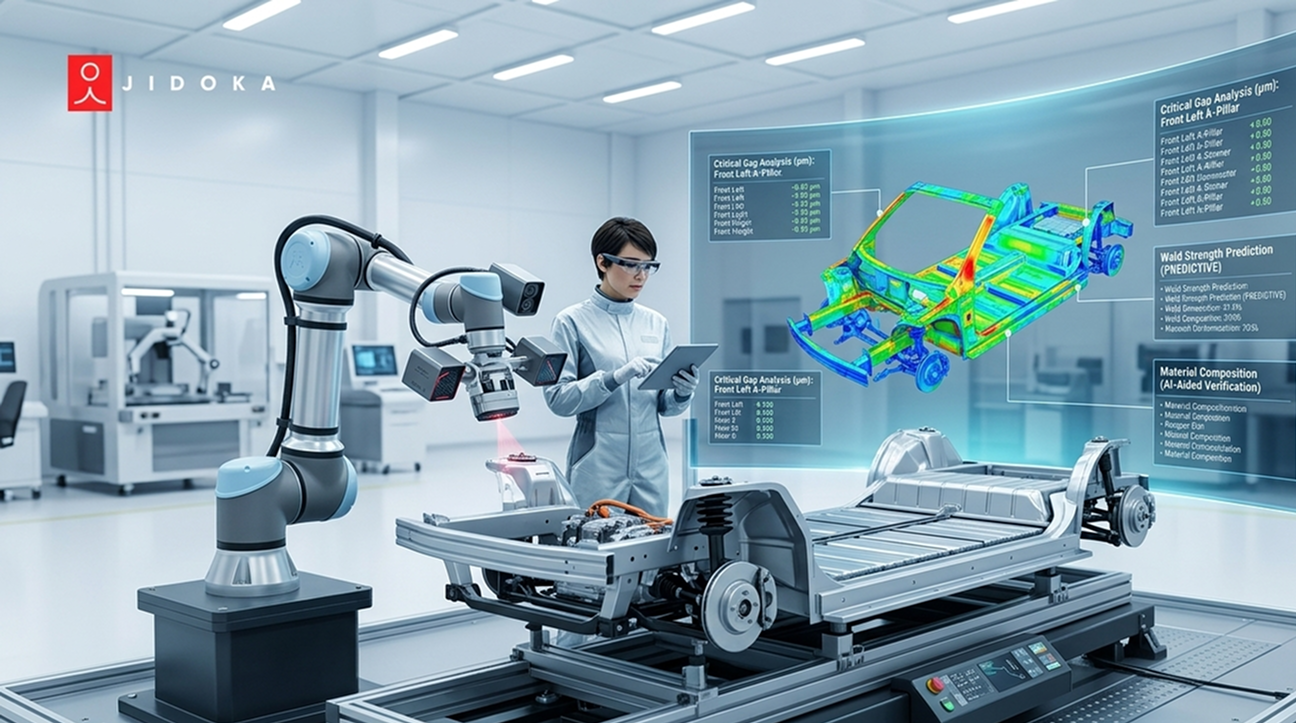
KOMPASS voert inspecties uit op OEM-onderdelen bij 12.000 PPM op snelle transportbanden, waarbij oppervlaktefouten, maatafwijkingen en de volledigheid van de assemblage worden gedetecteerd voordat onderdelen de cel verlaten. Nagare dwingt koppelreeksen en stappen voor het aanbrengen van bevestigingsmiddelen af bij assemblagestations, met poka-yoke-waarschuwingen die voorkomen dat onjuiste subassemblages doorgaan naar de volgende cel. Een te vast aangedraaid bevestigingsmiddel en een ontbrekend bevestigingsmiddel zijn twee verschillende problemen. Het ene is het terrein van KOMPASS. Het andere is dat van Nagare.
2. FMCG en verpakkingen
KOMPASS voert labelverificatie, vulniveaucontroles en zegelintegriteit uit op de snelheid van de productielijn. Een verkeerd gelabelde SKU bij 800 eenheden per minuut wordt opgemerkt voordat deze wordt verzonden. Nagare bewaakt kitting-reeksen bij verpakkingswerkzaamheden en verifieert de SKU-nauwkeurigheid in uitgaande magazijnstromen. Het product kan er correct uitzien en toch het verkeerde item voor de verkeerde bestelling zijn.
3. Farmaceutica
KOMPASS verzorgt label- en tekstverificatie voor naleving van regelgeving: batchnummers, vervaldata, productcodes. De foutmarge bij de nauwkeurigheid van farmaceutische labels is in feite nul. Nagare bewaakt stappen bij de assemblage van kits om fouten waarbij het verkeerde medicijn in de verpakking terechtkomt te voorkomen, en ondersteunt de documentatievereisten voor GMP. Een label dat de visuele inspectie doorstaat op het verkeerde product is de fout die carrières beëindigt.
4. Elektronica
KOMPASS inspecteert soldeerverbindingen, de plaatsing van PCB-componenten en de uitlijning van connectoren met behulp van hoge-resolutiebeelden vanuit meerdere hoeken. Nagare bewaakt SMT-assemblagestappen en de handelingen van operators, waardoor volgordefouten worden opgemerkt voordat een bestukt bord naar de reflow-oven gaat.
Volgens het U.S. National Institute of Standards and Technology (NIST) zijn defecten verantwoordelijk voor ongeveer 10% van de totale productiekosten. Die 10% is verdeeld tussen fouten in de productintegriteit (het domein van KOMPASS) en fouten in de procesnaleving (het domein van Nagare). De meeste fabrikanten gebruiken het ene instrument. De kosten van het andere blijven verborgen in herbewerking, afval en retourzendingen uit het veld.
Conclusie
Elke kwaliteitsmanager kent dit verhaal: investeringen in inspectietechnologie die nog steeds leiden tot recalls, of kosten voor herbewerking die niet dalen ondanks automatisering verderop in het proces. De reden is bijna altijd dezelfde. Productkwaliteit en proceskwaliteit zijn twee afzonderlijke problemen en ze vereisen twee afzonderlijke oplossingen.
KOMPASS bewaakt wat uw lijn verlaat. Nagare bewaakt hoe het wordt gemaakt. Het inzetten van beide is wat Jidoka verstaat onder First-Time-Right-productie. Als u weet welk probleem het uwe is, is de volgende stap een gesprek. Als u het niet zeker weet, is het Quality Problem Diagnostics Framework in dit artikel het juiste startpunt.
Boek een Jidoka-demo op jidoka-tech.
Veelgestelde vragen
1. Wat is het verschil tussen machine vision en computer vision in de productie?
Machine vision verwijst naar industriële beeldvormingssystemen die zijn ontworpen voor specifieke, gecontroleerde inspectietaken op productiesnelheid, waarbij doorgaans gebruik wordt gemaakt van speciale hardware en algoritmen. Computer vision is het bredere AI-veld dat beeldherkenning in diverse omgevingen omvat. In kwaliteitscontrole bij productie is machine vision de toegepaste subset: specifiek gebouwd, inline en met directe besluitvorming. De twee termen worden in leveranciersliteratuur door elkaar gebruikt, maar beschrijven verschillende werkingsgebieden.
2. Hoe nauwkeurig is AI-machine vision voor kwaliteitsinspectie?
Huidige AI-visiesystemen behalen een nauwkeurigheid van 99,5% tot 99,9% bij het detecteren van defecten op getrainde productielijnen. Menselijke visuele inspectie haalt onder constante omstandigheden een nauwkeurigheid van 70 tot 85%, wat verder afneemt door vermoeidheid, ploegendiensten en hoge doorloopsnelheden. Het verschil in nauwkeurigheid wordt groter naarmate de productiesnelheid toeneemt: bij 12.000 onderdelen per minuut is menselijke inspectie operationeel onmogelijk. De nauwkeurigheid van AI-visie blijft bovendien constant tijdens alle ploegendiensten, in tegenstelling tot menselijke inspectie.
3. Kunnen machine vision-systemen worden ingezet zonder de productielijn aan te passen?
Procesmonitoringsystemen zoals Nagare zijn specifiek ontworpen om op bestaande CCTV-infrastructuur te draaien, waardoor in de meeste gevallen geen nieuwe camerahardware nodig is. Productinspectiesystemen zoals KOMPASS vereisen modulaire vision-hardware die wordt geïntegreerd met transportbanden en uitwerpmechanismen, maar de modulaire infrastructuur van Jidoka sluit aan op bestaande automatisering. De implementatietijd voor KOMPASS bedraagt 6 tot 8 weken van installatie tot productiegereedheid; Nagare-implementaties kunnen sneller operationeel zijn door gebruik te maken van bestaande camera's.
4. Wat is de ROI-termijn voor kwaliteitscontrole met machine vision?
De ROI hangt af van de huidige defectpercentages, herstelkosten en inspectiearbeid. Fabrikanten die AI-kwaliteitscontrole implementeren, rapporteren defectreducties tot 50% en verbeteringen in de inspectiecyclus van 30 tot 50% (industriebenchmarks, 2025 tot 2026). Nagare wordt genoemd met een ROI-termijn van 12 maanden bij gebruik van bestaande camerahardware. De ROI-termijnen voor KOMPASS variëren per sector; implementaties in de farmaceutische en automobielindustrie met hoge risico's op terugroepkosten verdienen de investering doorgaans binnen 6 tot 18 maanden terug.
5. Vervangt machine vision menselijke kwaliteitsinspecteurs?
Machine vision voor kwaliteitscontrole versterkt de inspectie door repetitieve detectietaken op hoge snelheid uit te voeren die het menselijk vermogen te boven gaan. Het praktische resultaat in de meeste implementaties is dat inspectiepersoneel wordt ingezet voor waardevollere kwaliteitsactiviteiten, zoals root-cause analyse en het afhandelen van uitzonderingen. Nagare bevat specifiek een AI Buddy Mode die operators begeleidt en hun vaardigheidsontwikkeling volgt, waardoor menselijke capaciteiten worden versterkt in plaats van geëlimineerd.