Les fabricants sont confrontés à une pression énorme pour choisir le bon système Lincode ou Jidoka en tant que Le marché de l'inspection visuelle automatisée atteint 20,5 milliards de dollars cette année. Les usines constatent souvent une amélioration de 90 % de la détection des défauts lorsqu'elles cessent de se fier aux contrôles manuels.
Lincode a constaté que 80 % des plantes ont le plus de mal à contrôler la qualité. Les deux sociétés proposent outils d'apprentissage en profondeur pour résoudre ce problème. Vous devez savoir comment Lincode se compare à Jidoka en production réelle. Ce guide présente Jidoka et Lincode, la technologie des systèmes d'inspection visuelle par IA, et explique comment chacun d'entre eux répond aux exigences spécifiques de votre ligne.
Ce que Lincode apporte à la qualité des systèmes d'inspection visuelle par IA
Lincode simplifie la façon dont vous ajoutez de l'intelligence à votre configuration de production existante. Si vous avez déjà des caméras sur votre ligne et que vous souhaitez améliorer vos contrôles de qualité sans avoir à procéder à une refonte matérielle massive, cette plateforme vous offre la voie à suivre.
1. Présentation de la plateforme : LIVIS et LIVIS Edge+
L'écosystème Lincode s'articule autour de deux parties principales. Tout d'abord, la plateforme LIVIS fait office de centre de formation. Il s'agit d'une interface d'inspection par IA sans code dans laquelle vous gérez vos modèles. Deuxièmement, LIVIS Edge+ gère le travail proprement dit dans l'usine. Ce logiciel est situé à la périphérie et permet d'effectuer des contrôles en temps réel au fur et à mesure du passage des pièces.
L'équipe l'a construit après avoir visité des centaines d'usines pour comprendre pourquoi les anciens systèmes tombaient en panne. Aujourd'hui, Lincode a traité plus de 260 millions d'inspections. Ils utilisent une vaste bibliothèque de plus de 700 modèles pré-entraînés pour vous aider à démarrer rapidement.
2. Principaux atouts de Lincode LIVIS
- Indépendant du matériel : Vous pouvez utiliser Lincode avec presque toutes les marques de caméras industrielles. Cela en fait une solution idéale pour les plantes qui possèdent déjà des appareils photo et qui ne souhaitent pas en acheter de nouvelles.
- Interface simple : Votre équipe peut former un modèle de détection des défauts basé sur l'apprentissage profond en quelques heures. Vous n'avez pas besoin d'un diplôme en informatique pour le faire fonctionner.
- Configuration flexible : Vous pouvez l'exécuter sur le cloud ou tout conserver sur site si vos règles de sécurité des données sont strictes.
- Des résultats prouvés : Les utilisateurs voient souvent détection des défauts de surface les erreurs tombent à presque zéro. Une usine a même économisé 2 millions de dollars en réduisant le gaspillage de matériaux.
- Cas d'utilisation étendus : Il gère les tâches du logiciel de vérification de l'assemblage, vérifie les étiquettes et détecte même les objets étrangers à l'aide de apprentissage non supervisé.
3. Où Lincode indique les limites de déploiement
Lincode se concentre principalement sur les logiciels. Cela signifie que vous êtes responsable de vous assurer que vos caméras et vos lumières sont correctement configurées. Si l'éclairage est éteint, le système d'inspection visuelle par IA peut rencontrer des difficultés.
Bien que le logiciel soit déployé en moins de 30 jours, la réussite du projet dépend de la capacité de votre équipe interne à gérer le matériel physique.
Alors que Lincode se concentre sur les logiciels flexibles, Jidoka emprunte une voie différente en intégrant le matériel et les logiciels dans un seul package haut débit.
Ce que Jidoka offre avec KOMPASS et NAGARE
Technologie Jidoka crée un système d'inspection visuelle robuste basé sur l'IA qui fonctionne sous une pression de production intense. Alors que Lincode se concentre sur les logiciels, Jidoka intègre du matériel personnalisé à ses plateformes pour gérer des vitesses extrêmes et des matériaux difficiles.
Jidoka cible l'intégration de bout en bout pour les lignes complexes.
A) Présentation de la plateforme : KOMPASS et NAGARE
Jidoka construit sa réputation sur deux outils principaux : BOUSSOLE pour la détection des défauts de surface et NAGARE pour la vérification de l'assemblage. Ces systèmes vous aident à atteindre une production sans défaut dans les environnements à haute vitesse. Jidoka a grandi 10x cette année, démontrant sa force dans automobile et FMCG secteurs.
B) Les principaux atouts de Jidoka KOMPASS
- Inspection KOMPASS à haute vitesse: Procédés Plus de 12 000 pièces par minute avec Précision de 99,8 %.
- Apprentissage intelligent : Utilisations 60 à 70 % moins d'échantillons d'apprentissage pour les nouvelles variantes grâce à la détection des défauts par apprentissage profond.
- Inspection Edge AI: Effectue des contrôles en temps réel en moins de 10 ms.
C) Les principaux atouts de Jidoka NAGARE
- Poka-Yoke proactif: Moniteurs 100 % des étapes d'assemblage à l'aide d'un logiciel de vérification de l'assemblage pour éviter les erreurs.
- Gains opérationnels : Réduit les retouches de 35 % et améliore la productivité de 25 % grâce à un contrôle qualité en ligne.
- Traçabilité numérique: Crée une piste d'audit pour chaque unité produite dans votre configuration de fabrication de vision industrielle.
Bien que Lincode soit excellent pour les configurations logicielles rapides d'inspection par IA sans code uniquement, Jidoka est la référence en matière de matériel intégré capable de supporter un débit massif.
Maintenant que vous comprenez ce que chaque plateforme apporte, voyons comment elles se situent les unes par rapport aux autres dans l'usine.
Lincode contre Jidoka : face à face sur six critères de décision
Le choix entre Lincode et Jidoka dépend de votre environnement de production spécifique et de la structure de votre équipe. Les deux plateformes vous permettent d'éviter les vérifications manuelles, mais elles abordent différemment le matériel et les données à haut débit.
1. Vitesse de déploiement et exigences matérielles
Lincode met l'accent sur une approche axée sur le logiciel. Vous pouvez généralement déployer la plateforme LIVIS en moins de 30 jours à l'aide de vos caméras existantes. Cette flexibilité indépendante du matériel signifie que vous n'avez pas besoin d'acheter de nouveaux équipements pour démarrer.
Jidoka adopte une approche clé en main d'une durée de 4 à 8 semaines. Pendant plus longtemps, Jidoka gère la configuration complète des caméras, de l'éclairage et de la synchronisation PLC pour garantir que le système d'inspection visuelle par IA fonctionne parfaitement dès le premier jour.
2. Performances en matière de débit et de vitesse de ligne
Si vous utilisez une ligne à volume élevé, la vitesse est votre principale préoccupation. Jidoka KOMPASS publie des benchmarks de Plus de 12 000 pièces par minute et 300 millions d'inspections quotidiennes. Il est conçu pour la fabrication intensive de systèmes de vision industrielle à grande échelle.
Lincode fournit une inspection rapide par IA, mais ne publie pas de chiffres standard en termes de parties par minute. La plupart des utilisateurs de Lincode trouvent qu'il fonctionne bien pour les vitesses de production standard, où la flexibilité logicielle est plus importante que les enregistrements de débit bruts.
3. Vérification des données et des processus de formation
L'interface d'inspection par IA sans code de Lincode permet à votre équipe de créer des modèles à l'aide de plus de 700 options pré-entraînées. C'est la solution idéale pour les tâches rapides de détection des défauts de surface. Jidoka utilise la détection des défauts par apprentissage profond qui permet d'apprendre de nouvelles variantes avec 60 % à 70 % d'échantillons en moins.
De plus, Jidoka propose NAGARE vérification de l'assemblage pour suivre les étapes de l'opérateur. Tandis que Lincode gère le logiciel de vérification de l'assemblage pour le produit final, Jidoka surveille le processus réel pour éviter les erreurs avant que l'unité ne soit terminée.
Lincode vs Jidoka : comparaison directe
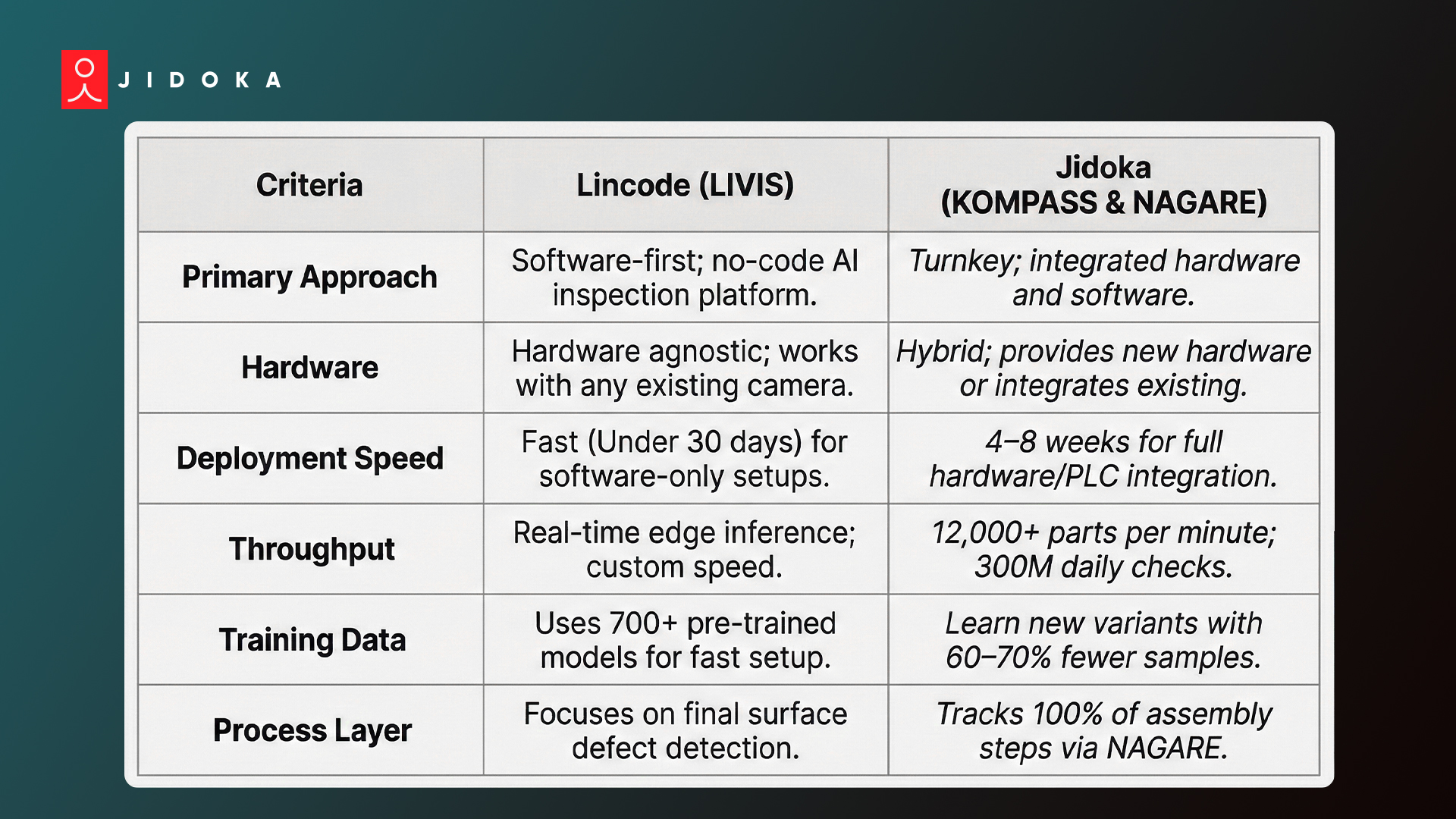
Les deux systèmes offrent des avantages uniques. Identifier les besoins spécifiques de vos installations est donc la meilleure façon de choisir.
Quel fabricant doit choisir quelle plateforme
Le choix entre Lincode et Jidoka dépend de la manière dont votre établissement gère le matériel et des données spécifiques que vous devez suivre. Les deux offrent une détection des défauts d'apprentissage en profondeur de haute qualité, mais votre choix dépend de votre choix : un outil axé sur le logiciel ou un package matériel entièrement intégré.
A) Quand Lincode LIVIS s'adapte mieux
Code de lin est le bon choix pour les équipes qui souhaitent conserver leur infrastructure de caméras existante. Comme il est indépendant du matériel, vous n'avez pas à dépenser votre budget pour de nouveaux capteurs ou objectifs.
Il fonctionne mieux pour :
- Des installations à haute diversité qui doivent déployer un logiciel d'inspection basé sur l'IA sans code sur de nombreux postes de travail dans le monde entier.
- Opérations avec de solides équipes informatiques internes capables de gérer la configuration physique des caméras et l'éclairage.
- Les usines exploitent des lignes à vitesse standard où la priorité est la facilité d'utilisation et l'intégration logicielle rapide plutôt que des records de débit extrêmes.
- Les établissements qui souhaitent disposer d'une vaste bibliothèque de plus de 700 modèles pré-entraînés pour démarrer leur détection des défauts de surface efforts.
B) Quand le jidoka s'adapte mieux
Jidoka est conçu pour une fabrication discrète à haute vitesse où chaque milliseconde compte. Bien qu'ils proposent un système complet d'inspection visuelle par IA clé en main qui comprend tout, des caméras à l'intégration de PLC, leur plateforme s'intègre également à votre matériel existant.
Cette flexibilité vous permet de ne pas avoir à démonter et à remplacer votre équipement actuel pour obtenir des résultats de premier ordre.
Il convient le mieux pour :
- Lignes se déplaçant à Plus de 12 000 pièces par minute qui ont besoin d'une vitesse d'inspection de la qualité en ligne garantie.
- La production implique des métaux réfléchissants ou des surfaces imprimées complexes qui nécessitent un éclairage et un réglage matériel spécifiques.
- Les installations qui ont besoin de surveiller le processus d'assemblage lui-même grâce à la vérification d'assemblage NAGARE pour guider les opérateurs en temps réel.
- Les équipes de direction qui préfèrent qu'un seul partenaire gère l'ensemble de la configuration de fabrication de la vision industrielle de bout en bout tout en utilisant les actifs existants.
Les deux plateformes fournissent les informations nécessaires pour moderniser votre contrôle qualité, que vous commenciez par une intégration logicielle ou matérielle complète.
Pourquoi les leaders du secteur manufacturier choisissent Jidoka Tech pour 300 millions d'inspections quotidiennes
Technologie Jidoka construit un système d'inspection visuelle basé sur l'IA qui fonctionne sous une pression de production intense. Notre équipe aligne les caméras, l'éclairage et la synchronisation des automates programmables pour garantir des performances constantes sur tous les quarts de travail.
Usines utilisant cette gestion des rapports de configuration Plus de 12 000 pièces par minute et 300 millions d'inspections quotidiennes.
Jidoka combine deux systèmes puissants pour étendre ses capacités :
- BOUSSOLE: Réalise Précision de 99,8 % et plus et passe en revue les images en moins de 10 ms. Il utilise la détection des défauts par apprentissage profond pour gérer les métaux réfléchissants et les pièces texturées avec 70 % de moins des échantillons de formation.
- NAGARE: Utilise les caméras existantes pour la vérification de l'assemblage NAGARE, en signalant les mauvaises séquences en temps réel pour réduire les retouches 35 %.
Cette approche d'inspection de la qualité en ligne s'exécute sur les unités périphériques locales afin d'éliminer les retards.
Réservez une démo avec Jidoka dès aujourd'hui pour voir comment ce système d'inspection visuelle basé sur l'IA s'adapte à votre chaîne de production.
Conclusion
Lincode et Jidoka Tech proposent des voies distinctes pour atteindre les objectifs de votre système d'inspection visuelle par IA. Lincode excelle grâce à ses interface d'inspection IA sans code et une flexibilité indépendante du matériel, ce qui en fait la solution idéale pour les déploiements centrés sur les logiciels.
Jidoka des pistes où un débit élevé et NAGARE la vérification de l'assemblage n'est pas négociable. Pour les fabricants dont les fuites de qualité entraînent des coûts élevés, l'approche intégrée de Jidoka fournit les données de performance qui font souvent défaut aux plateformes autonomes.
Les deux systèmes fournissent la détection des défauts par apprentissage profond nécessaire pour éliminer les erreurs manuelles. Réservez une démo avec Jidoka dès aujourd'hui pour découvrir la détection des défauts par apprentissage profond à haute vitesse et la vérification des assemblages NAGARE en action.
Questions fréquemment posées
1. Qu'est-ce que Lincode LIVIS et comment fonctionne-t-il ?
Lincode LIVIS est une plateforme d'inspection basée sur l'IA sans code qui utilise la plateforme LIVIS pour la formation et LIVIS Edge+ pour l'inférence. Il se connecte à n'importe quelle caméra pour détecter les défauts de surface, en utilisant plus de 700 modèles pré-entraînés pour fournir un système d'inspection visuelle basé sur l'IA sans programmation.
2. Qu'est-ce qui différencie Jidoka KOMPASS des lignes à grande vitesse ?
Jidoka KOMPASS traite plus de 12 000 pièces par minute pour un contrôle qualité en ligne. Contrairement à d'autres logiciels, cet outil de détection des défauts par apprentissage en profondeur examine les images en moins de 10 ms, garantissant ainsi à votre système d'inspection visuelle par IA une précision de 99,8 % lors de la fabrication de grands volumes de vision industrielle.
3. Lincode propose-t-il une vérification des étapes d'assemblage comme NAGARE de Jidoka ?
Lincode se concentre sur les contrôles des produits finis, tandis que la vérification d'assemblage NAGARE de Jidoka surveille les étapes en temps réel de l'opérateur. NAGARE agit comme un logiciel de vérification de l'assemblage, signalant les séquences erronées en temps réel. Cela ajoute une couche de processus qui fait souvent défaut aux systèmes d'automatisation d'inspection visuelle standard.
4. Quelle plateforme se déploie le plus rapidement : Lincode ou Jidoka ?
Lincode cible moins de 30 jours pour les configurations uniquement logicielles sur le matériel existant. Jidoka met 6 à 8 semaines à créer un système d'inspection visuelle par IA clé en main. Bien que Lincode soit plus rapide à intégrer, Jidoka gère tout le matériel d'inspection par IA de pointe et la synchronisation des automates de bout en bout.
5. Les deux plateformes peuvent-elles s'intégrer aux systèmes MES et ERP existants ?
Oui, Lincode et Jidoka prennent en charge l'intégration de la fabrication par vision industrielle. Utilisations de Lincode Modbus et Profinet, tandis que Jidoka se connecte à Keyence ou Siemens. Les deux fournissent des données à votre ERP, améliorant ainsi votre système de détection automatique des défauts et la visibilité globale de l'usine.