bottleneck analysis

What Is Bottleneck Analysis in Lean Manufacturing?

Learn what bottleneck analysis is, how it works in lean manufacturing and logistics, and which tools in 2026 help identify and eliminate production constraints fast.

Bottlenecks drain manufacturers of $50 billion annually. This massive cost includes late deliveries, extra shifts, and poor quality. Recent data shows one in five plants struggle with production capacity because of worker shortages. 

Traditional methods often miss these human constraints. Modern bottleneck analysis fixes this by using real-time data. Companies using AI see Overall Equipment Effectiveness jump by 50%

This guide shows you how a lean manufacturing bottleneck affects your floor. You will learn to use bottleneck analysis to find and fix issues. 

Here is how production bottleneck identification reduces work-in-process inventory today.

What Is Bottleneck Analysis in Lean Manufacturing?

Bottleneck analysis is a structured method to find the single step that limits your entire line. It ensures your process meets customer demand without creating waste.

A) The Theory of Constraints Connection — Why the Slowest Step Controls Everything

The Theory of Constraints proves your throughput only matches your slowest process. In 2026, smart factories move beyond balanced lines to a "managed bottleneck" strategy. 

They place the constraint where it is easiest to control. This protects your production capacity and Overall Equipment Effectiveness by managing the "drum" of the plant.

B) How Bottleneck Analysis Differs from General Process Improvement

Unlike general Kaizen, bottleneck analysis focuses only on the constraint. Improving a fast station adds no value; it only increases work-in-process inventory. Fixing the actual lean manufacturing bottleneck has a multiplier effect on total output. 

This specific focus separates high-performing plants from those just chasing minor gains. Understanding these core principles helps you spot the specific physical and digital triggers that slow down your floor.

Common Types of Production Bottlenecks and Their Root Causes

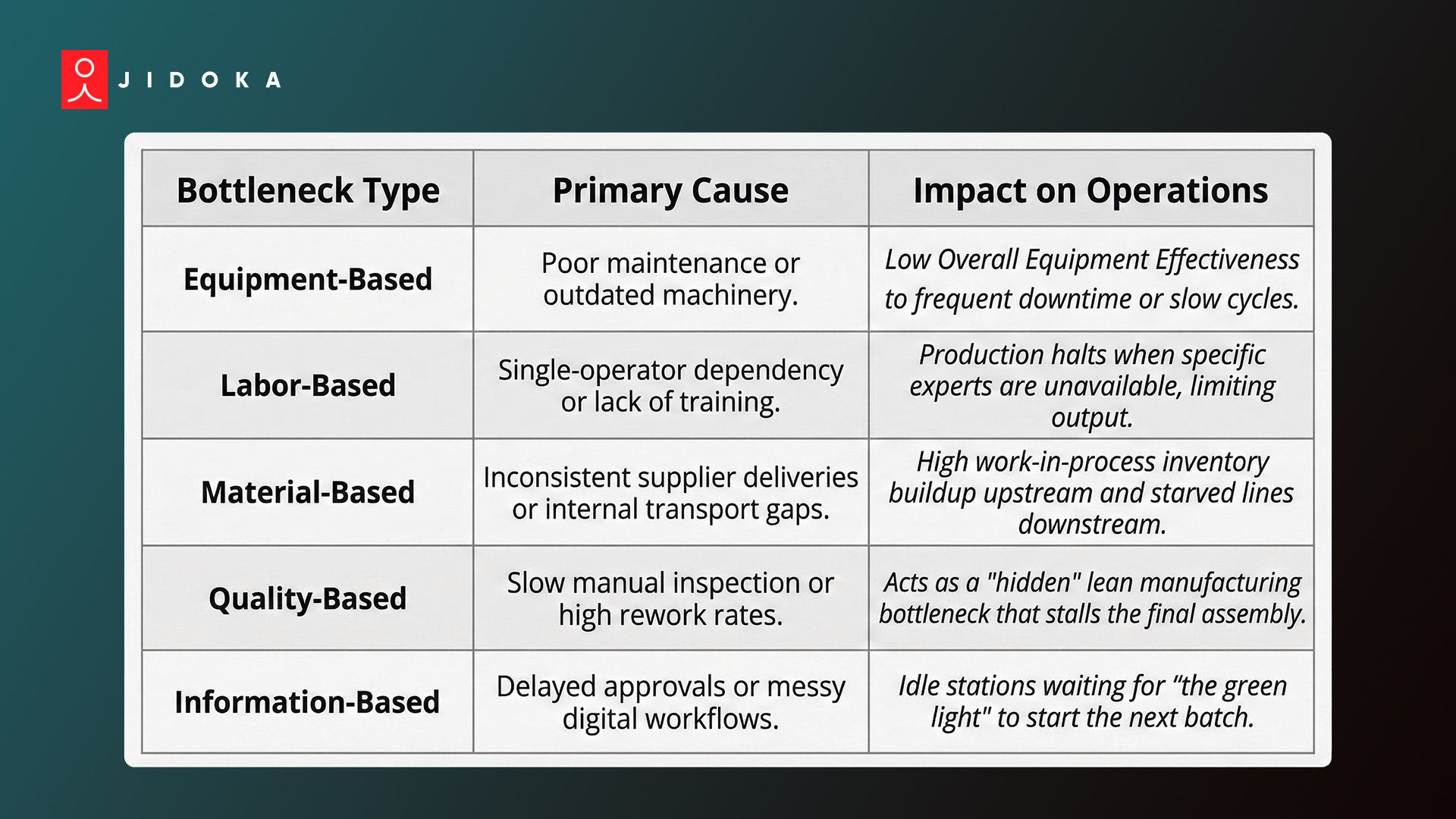
A lean manufacturing bottleneck is rarely just a slow machine. To improve production capacity, you must dig into why these delays happen in the first place.

1. Equipment-Based Bottlenecks

  • A) What it is: This occurs when a specific machine cannot keep up with the flow of the rest of the line, even when running at its highest speed.
  • B) Root Cause: The main cause is often "performance loss" from poor maintenance or using machines past their intended lifespan. When a tool has a high failure rate, it forces the entire line to stop, dragging down your Overall Equipment Effectiveness.

2. Labor and Skill Shortage Bottlenecks

  • A) What it is: This happens when production stalls because you lack the right people or the right skills at a specific station.
  • B) Root Cause: Relying on a single "hero" employee for a complex task creates a massive risk. If that person is sick or busy, the line stops. Recent data shows over 20% of plants face this because they haven't cross-trained staff to handle multiple roles.

3. Material Flow and Logistics Bottlenecks

  • A) What it is: This is the buildup of work-in-process inventory because parts aren't moving smoothly between stations.
  • B) Root Cause: Late supplier deliveries or messy internal transport cause this. Sometimes, the issue is actually at the inspection desk where parts wait hours for a manual check. This creates a "hidden" lean manufacturing bottleneck that stalls final assembly.

At a Glance: Common Production Bottlenecks and Root Causes

Identifying these causes allows you to move into the actual bottleneck analysis phase with a clear target.

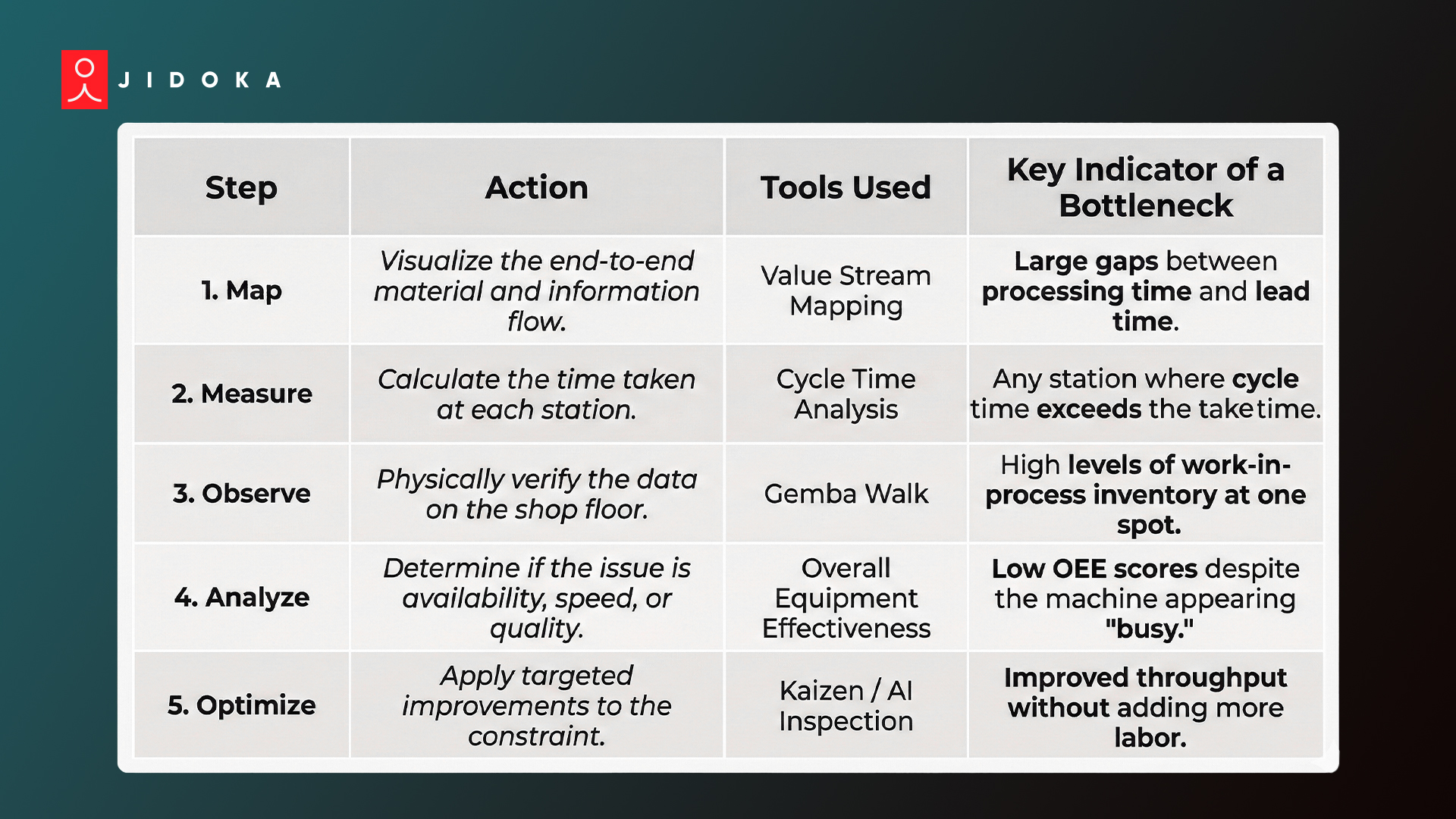
How to Conduct a Lean Manufacturing Bottleneck Analysis — Step by Step

You can stop guessing where your line slows down by using a structured bottleneck analysis. Follow these steps to improve your production capacity and clear out work-in-process inventory.

Step 1: Map the Full Production Flow with Value Stream Mapping

Value Stream Mapping helps you see the entire path of a product. It tracks how materials and information move from start to finish. This map highlights where parts sit idle. By using this tool, you find non-value-added time that simple observation misses.

Example: Mapping the Flow

Imagine a bicycle manufacturer using Value Stream Mapping. They find that while welding takes 20 minutes and painting takes 30 minutes, the frames sit in a cooling area for four hours. The Value Stream Mapping reveals that the cooling area is the true lean manufacturing bottleneck, not the machines themselves. This visual proof shifts the focus to better airflow or cooling racks instead of buying more welding gear.

Step 2: Measure Cycle Times and Takt Time to Locate the Constraint

Next, perform a cycle time analysis for every station. Compare these numbers to your takt time, which is the pace you must work to meet customer demand. If a station’s cycle time is higher than the takt time, you found a lean manufacturing bottleneck.

Example: Takt Time vs. Cycle Time

A packaging plant has a takt time of 60 seconds to meet a daily order of 480 units. The cycle time analysis shows:

  • Station A (Filling): 45 seconds
  • Station B (Capping): 75 seconds
  • Station C (Labeling): 50 seconds Since Station B exceeds the 60-second takt time, it is a confirmed lean manufacturing bottleneck. 

The plant now knows exactly where to apply Kaizen to speed up the capping process.

Step 3: Validate with Gemba Walks, OEE Data, and Queue Observation

Data alone isn't enough. Go on a Gemba walk to see the floor yourself. Look for piles of parts or idle workers. Check your Overall Equipment Effectiveness data to see if the delay comes from machine speed or poor quality. This physical check completes your production bottleneck identification process.

Example: The Gemba Walk

During a Gemba walk at an electronics plant, a manager notices a large pile of circuit boards sitting in front of the testing station. This is a classic sign of work-in-process inventory buildup. 

While the Overall Equipment Effectiveness data showed the machine was "running," the walk reveals that the operator is constantly stopping to fix a sensor error. This observation identifies a "transient bottleneck" that a spreadsheet would have missed.

Quick Guide: How to Conduct a Bottleneck Analysis

Modern tools now automate this data collection to help you react faster.

How Jidoka Technologies Helps You Eliminate Manufacturing Bottlenecks

Manual quality checks often act as a hidden lean manufacturing bottleneck. Jidoka Technologies solves this by integrating an AI-powered inline inspection AI system that runs at full production speed. 

Jidoka’s unique capabilities include:

  • KOMPASS: Achieves 99.8%+ accuracy on live lines, reviewing parts in under 10 ms to prevent flow delays.
  • NAGARE: Tracks every assembly step, flagging errors in real-time to cut rework by 35%.
  • High-Speed Output: Handles 12,000+ parts per minute, ensuring the inspection station never limits your production capacity.
  • Edge Computing: Runs locally to avoid lag, keeping your Overall Equipment Effectiveness high.

By automating the quality checkpoint, you remove the "stop-and-go" rhythm that creates work-in-process inventory.

Conclusion 

Bottleneck analysis identifies the specific step holding back your floor. Without it, you ignore the real causes of high work-in-process inventory. Manual production bottleneck identification is slow and often misses transient issues. 

This leads to a dangerous cycle: missed deadlines, exploding overtime costs, and lost contracts. If you don't fix these constraints, your production capacity will continue to shrink while competitors scale. 

Jidoka Technologies offers a way out by automating inspection. Our AI systems remove the quality checkpoint as a lean manufacturing bottleneck, helping you maintain a high Overall Equipment Effectiveness without the stress of manual errors.

Book a demo with Jidoka Technologies to see how AI-driven inspection eliminates your production constraints and boosts throughput.

Frequently Asked Questions

1. What is bottleneck analysis in lean manufacturing? 

Bottleneck analysis is the systematic process of identifying which step limits your production capacity. By finding this constraint, you can eliminate waste and improve flow. It is a fundamental tool for production bottleneck identification that ensures your entire line meets customer demand without delays.

2. How does the Theory of Constraints relate to bottleneck analysis? 

The Theory of Constraints states that every system has one weakest link. Bottleneck analysis identifies this link to prevent work-in-process inventory buildup. Focusing on this specific lean manufacturing bottleneck ensures that Kaizen efforts actually increase throughput rather than just shifting the problem elsewhere.

3. What tools help identify a lean manufacturing bottleneck? 

Manufacturers use Value Stream Mapping to visualize flow and cycle time analysis to measure station speed against takt time. Using a Gemba walk and tracking Overall Equipment Effectiveness provides real-time data. These tools simplify production bottleneck identification to keep your facility running smoothly.

4. What is the difference between persistent and transient bottlenecks? 

A persistent lean manufacturing bottleneck is a structural issue, like a slow machine. A transient bottleneck is temporary, often caused by staffing gaps or material shortages. Identifying both requires consistent bottleneck analysis to maintain steady production capacity and high Overall Equipment Effectiveness levels.

5. Can AI and automation help eliminate production bottlenecks? 

Yes, AI-powered systems automate production bottleneck identification by monitoring stations in real-time. Tools like Jidoka’s inspection AI remove manual checkpoints that create a lean manufacturing bottleneck. This technology slashes work-in-process inventory and ensures your quality checks never slow down your total output.

February 7, 2026
By
Shwetha T Ramakrishnan, CMO at Jidoka Tech

相談会開催中

品質と生産性を最大化するビジョン検査システムに関する相談会を実施中です。ぜひこの機会にお試しください。

お問い合わせ