Top 10 Machine Vision Companies in USA (Updated 2026)

Discover the top 10 machine vision companies transforming manufacturing with AI-powered inspection systems. Compare solutions, accuracy rates, and industry applications.

Factories once relied on human eyes to catch defects. That model breaks at speed. Top machine vision companies now drive quality using AI that sees every unit, every second, without fatigue. You feel the pressure when scrap rises, customers complain, or audits slow shipments. A modern machine vision inspection system fixes that by spotting patterns people miss and acting in real time.

This shift explains why buyers search for top machine vision companies instead of cameras or scripts. They want results. Fewer false rejects. Cleaner data. Stable output across shifts. These top machine vision companies combine deep learning, smart cameras, and edge processing to keep lines moving and teams confident.

This guide breaks down who leads, what they do best, and how to choose without guesswork.

The Rising Star: AI-First Visual Inspection

This category covers top machine vision companies built around AI from day one. They focus on results on the production line, not isolated tools. These teams handle software, hardware, and deployment together so quality stays stable at real factory speeds.

1. Jidoka Tech

Jidoka Tech builds end-to-end AI visual inspection software that runs directly on production lines. With 48+ trusted customers worldwide and 100+ successful implementations, the focus stays on stable accuracy at real factory speeds.

Key features

  • KOMPASS deep learning engine for defect detection and classification
  • Edge-based inference for real-time inspection decisions
  • Modular NAGARE hardware that fits existing conveyor setups
  • Human-in-the-loop feedback for continuous model improvement

Services offered and best for: AI inspection system deployment, production line automation, defect detection optimization, and manufacturers facing false rejects, quality drift, and inspection bottlenecks.

Why they are on the list: Jidoka Tech blends deep learning models, edge computing, industrial cameras, and line-level integration into one system. They stand out among top machine vision companies by selling inspection accuracy and scrap reduction, not disconnected tools.

2. Cognex Corporation

Cognex is one of the top machine vision companies known for large-scale deployment of AI-based inspection across factories and warehouses. Its systems support consistent quality checks in high-volume environments that demand speed and repeatability.

Key features

  • OneVision platform for building and managing AI models
  • In-Sight smart cameras for embedded inspection tasks
  • VisionPro tools for advanced image processing automation
  • Support for real-time quality control across sites

Services offered and best for: machine vision inspection system, AI visual inspection software, computer vision automation, and best for global manufacturers running multi-plant inspection programs.

Why they are on the list: Cognex earns its place among top machine vision companies by combining cloud-managed AI models, smart cameras, and production-ready software. The stack supports automated visual inspection, defect classification AI, and production line monitoring at enterprise scale.

3. Keyence Corporation

Keyence ranks among the top machine vision companies for hardware-driven inspection systems built for speed and precision. Its solutions focus on image quality and stable measurement in demanding factory conditions.

Key features

  • High-resolution smart cameras up to 25 megapixels
  • Integrated 2D and 3D vision systems
  • Built-in tools for automated visual inspection
  • Fast setup with minimal tuning for operators

Services offered and best for: machine vision inspection systems, industrial automation inspection, smart camera manufacturing, and high-mix production lines where image clarity and measurement accuracy drive inspection results.

Why they are on the list: Keyence stands out among top machine vision companies by prioritizing optics, sensors, and hardware reliability. Their systems support automated defect detection and real-time quality control without heavy dependence on complex AI training pipelines.

4. Basler AG

Basler AG focuses on camera-level vision technology that many top machine vision companies and system integrators rely on to build stable inspection setups in harsh industrial environments.

Key features

  • Industrial cameras with IP67 protection for factory floors
  • ace 2 camera series for high-speed image capture
  • Support for 2D and 3D vision systems
  • Broad compatibility with machine vision software stacks

Services offered and best for: machine vision inspection system components, industrial camera solutions, image processing automation, and manufacturers and integrators building custom inspection lines that demand durability

Why they are on the list: Basler earns recognition among top machine vision companies by delivering reliable camera hardware that supports automated visual inspection and high-speed inspection technology. Their sensor-driven approach fits environments where consistency, uptime, and image quality matter more than packaged software.

5. Teledyne Technologies

Teledyne Technologies focuses on extreme speed and precision, supporting top machine vision companies with imaging systems built for nonstop industrial inspection where every millisecond matters.

Key features

  • Line scan cameras for continuous material inspection
  • Global shutter sensors for distortion-free imaging
  • High frame rate capture for fast-moving production lines
  • Support for edge-based image processing automation

Services offered and best for: machine vision inspection system, high-speed inspection technology, industrial automation inspection, and best for steel, paper, textile, and web-based production lines running at constant speed

Why they are on the list: Teledyne stands out among top machine vision companies by specializing in high-speed sensors and cameras that power automated defect detection. Their technology enables real-time quality control in environments where standard vision systems fail.

6. SICK AG

SICK AG develops industrial vision systems where inspection directly drives automation. The company delivers machine vision inspection system solutions that connect visual data with machines, robots, and control logic on the factory floor.

Key features

  • 3D vision systems for object detection and positioning
  • Vision sensors built for industrial automation inspection
  • Direct PLC and robot controller integration
  • Real-time quality control tied to machine actions

Services offered and best for: machine vision inspection system, computer vision automation, vision-guided robotics, logistics, robotic picking, material handling, and automated production lines

Why they are on the list: SICK AG earns its place among top machine vision companies by focusing on action-driven vision. Their stack combines sensors, image processing automation, and control integration so automated visual inspection leads to immediate physical response, not delayed analysis.

7. OMRON Corporation

OMRON Corporation delivers AI-driven inspection systems built for fast setup and stable results. Its focus sits on top machine vision companies that need reliable defect detection without long training cycles or heavy tuning.

Key features

  • FH Series vision systems with AI Fine Matching
  • Rapid model learning for cosmetic defect detection
  • Support for automated visual inspection at line speed
  • Integrated controllers for production line monitoring

Services offered and best for: machine vision inspection system, AI visual inspection software, automated defect detection, best for electronics, automotive, and packaging lines dealing with frequent product changes

Why they are on the list: OMRON stands out among top machine vision companies by reducing AI learning time while keeping inspection stable. Their stack blends smart cameras, embedded AI, and image processing automation to support real-time quality control without complex setup.

8. Intel Corporation

Intel supports top machine vision companies by powering inspection systems at the edge. Its focus stays on fast inference, low-latency processing, and stable deployment for AI-driven inspection on factory floors.

Key features

  • OpenVINO toolkit for optimized edge inference
  • Hardware acceleration for AI-powered visual inspection
  • Support for real-time quality control workloads
  • Scalable edge computing vision architecture

Services offered and best for: Edge AI enablement, machine vision inspection system acceleration, image processing automation, and manufacturers running AI models directly on production lines with strict latency needs.

Why they are on the list: Intel earns a place among top machine vision companies by enabling deep learning defect detection at the edge. Its hardware and software stack supports automated visual inspection, production line monitoring, and defect classification AI without cloud dependency.

9. Sony Semiconductor

Sony Semiconductor plays a core role among top machine vision companies by supplying image sensors that define inspection accuracy. Its sensor technology directly impacts how machine vision inspection system setups capture defects at production speed.

Key features

  • Global shutter CMOS sensors for distortion-free capture
  • High sensitivity imaging for automated visual inspection
  • Support for high-speed inspection technology
  • Sensor designs optimized for industrial automation inspection

Services offered and best for: image sensor technology, smart camera manufacturing, machine vision inspection system foundations, and camera manufacturers and factories building AI visual inspection software on reliable image data.

Why they are on the list: Sony Semiconductor earns its place among top machine vision companies by controlling image quality at the sensor level. Its technology supports automated defect detection, real-time quality control, deep learning defect detection, and stable image processing automation before AI models even run.

10. National Instruments

National Instruments supports top machine vision companies through software-driven inspection systems that engineers customize for complex factory use cases where flexibility matters more than packaged workflows.

Key features

  • Vision Development Module for custom inspection logic
  • Support for image processing automation and measurement
  • Tight integration with test and automation hardware
  • Deployment support for edge-based inspection systems

Services offered and best for: vision software development, machine vision inspection system customization, industrial automation inspection, and engineering teams building custom inspection stations and R&D-driven production lines.

Why they are on the list: National Instruments earns recognition among top machine vision companies by enabling deep control over inspection logic. Their stack supports automated visual inspection, defect classification AI, and production line monitoring where teams need full ownership of how AI and vision behave.

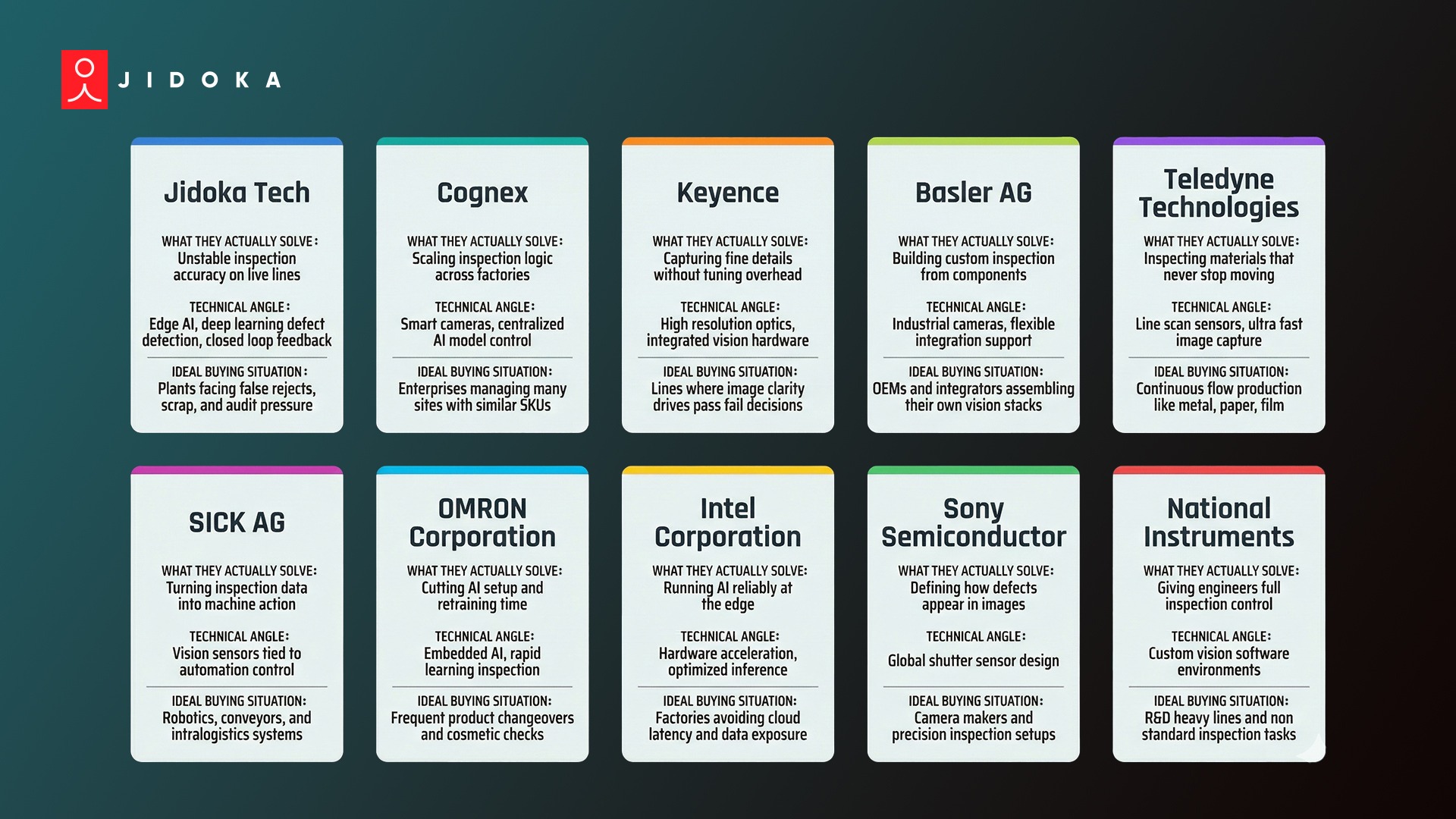
Top 10 Machine Vision Companies in USA At a Glance
Company What They Actually Solve Technical Angle Ideal Buying Situation
Jidoka Tech Unstable inspection accuracy on running production lines Edge AI with deep learning and closed loop correction Plants facing false rejects, scrap loss, or audit pressure
Cognex Scaling inspection logic across many production sites Smart cameras with centralized AI model control Large enterprises with similar SKUs across factories
Keyence Capturing fine surface and assembly detail without manual tuning High resolution optics and fully integrated vision hardware Lines where image clarity directly determines pass and fail
Basler AG Building custom inspection setups from individual components Industrial camera modules with broad integration support OEMs and integrators assembling their own vision architectures
Teledyne Technologies Inspecting materials moving nonstop at high speed Line scan sensors with ultra fast capture rates Metal, paper, and film lines needing continuous inspection
SICK AG Turning inspection output into machine level action Vision sensors integrated with automation control Robotics, conveyor systems, and intralogistics
OMRON Corporation Reducing AI configuration time across shifting SKUs Embedded AI enabling fast learning inspection Frequent changeovers and cosmetic evaluation tasks
Intel Corporation Running AI inference reliably on site without cloud Hardware acceleration and optimized edge models Factories avoiding cloud delays or data exposure
Sony Semiconductor Improving how defects are captured at the sensor level Global shutter sensor innovation Camera makers and ultra precise inspection setups
National Instruments Giving engineering teams full freedom in building custom logic Flexible vision software and modular tools R and D focused lines with unique inspection needs

Conclusion

Manual inspection and rule-based vision still cause pain on factory floors. Missed defects slip through. False rejects pile up. Quality teams fight unstable results across shifts. Data stays fragmented, so root causes stay hidden. Lines slow down. Costs rise. Customers notice.

The consequences hit hard. Scrap increases. Rework eats margins. Shipments face delays. Audits turn stressful. Over time, brands lose trust and teams lose confidence in inspection data. Ignoring these issues costs far more than fixing them.

That is where Jidoka steps in. Jidoka delivers AI visual inspection software built for real production lines, not lab demos. With edge-based machine vision inspection system deployment, deep learning defect detection, and stable integration, Jidoka helps manufacturers regain control, reduce waste, and keep quality consistent at speed.

Connect with Jidoka Tech to see how AI inspection can stabilize your production quality.

FAQs

1. How does Jidoka differ from other top machine vision companies?

Jidoka stands apart from top machine vision companies by delivering a full machine vision inspection system, not isolated tools. It combines AI visual inspection software, edge computing vision, automated visual inspection, and production line integration to reduce false rejects and stabilize real-time quality control.

2. How does AI reduce false rejects in visual inspection?

Traditional rules fail with variation. AI visual inspection software uses deep learning defect detection and defect classification AI to learn acceptable patterns. This approach improves automated defect detection, supports real-time quality control, and keeps machine vision inspection system accuracy stable across shifts.

3. Should vision inspection run on edge or cloud systems?

Edge-based machine vision inspection system setups deliver faster decisions and safer data handling. Edge computing vision supports automated visual inspection and production line monitoring in real time, while cloud platforms help with analytics, reporting, and multi-site performance tracking.

4. How long does a machine vision system take to deploy?

Deployment speed depends on design. Modular machine vision inspection system platforms using AI visual inspection software can go live in four to eight weeks. Custom computer vision automation projects often take longer due to integration, tuning, and validation needs.

December 22, 2025
By
Shwetha T Ramakrishnan, CMO at Jidoka Tech

相談会開催中

品質と生産性を最大化するビジョン検査システムに関する相談会を実施中です。ぜひこの機会にお試しください。

お問い合わせ