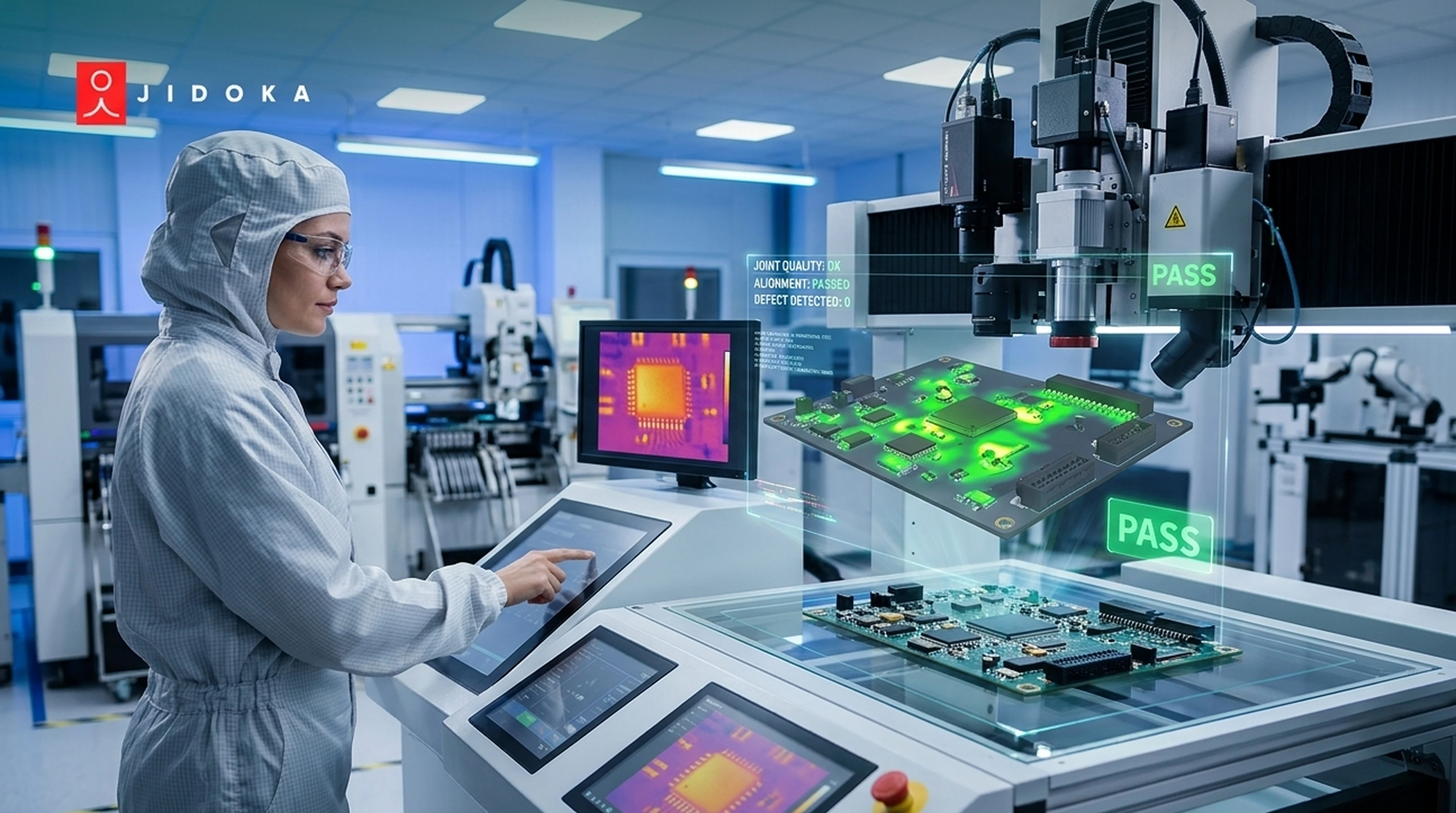
In 2023 werden wereldwijd 38,43 miljoen elektronische eenheden teruggeroepen omdat verouderde inspectiemethoden onderliggende defecten misten, wat in 2022 alleen al leidde tot 5,5 miljard dollar aan garantieclaims. Soldeerpasta-defecten zijn verantwoordelijk voor 35% van alle SMT-assemblagefouten en komen steevast pas bij de klant aan het licht, niet bij het inspectiestation (ltcircuit.com, 2024).
De kwaliteit van elektronica-productie holt achteruit zodra inspectie een knelpunt wordt. De structurele oplossing is AI-vision die werkt op productiesnelheid, niet op steekproefsnelheid. Deze gids legt uit waarom traditionele inspectie faalt bij grote volumes, wat AI-vision anders doet en hoe KOMPASS en NAGARE kunnen worden ingezet zonder actieve elektronicalijnen te verstoren.
Kernpunt: Elektronicaproducenten hoeven niet te kiezen tussen kwaliteit en doorvoer. Ze kampen met een probleem in de inspectie-architectuur. Traditionele automatische optische inspectie (AOI) bereikt een maximum van ongeveer 1.000 onderdelen per minuut, wat zorgt voor knelpunten in de lijn. KOMPASS van Jidoka inspecteert met 12.000 PPM en een nauwkeurigheid van 99,9%, waardoor het knelpunt volledig verdwijnt en volledige inline defectdetectie op elke eenheid behouden blijft.
Wat vereist kwaliteit in de elektronica-productie dat traditionele inspectie niet kan bieden?
Kwaliteit in elektronica-productie op schaal vereist 100% inline inspectie van soldeerverbindingen, componentplaatsing, connectorintegriteit en assemblagereeksen zonder enige vermindering van de doorvoer. Audits op basis van steekproeven en verouderde automatische optische inspectie missen variaties per ploeg en de defectpatronen bij een hoge productmix die pas zichtbaar worden bij volledige productievolumes.
Het doorvoerplafond van regelgebaseerde AOI
Traditionele automatische optische inspectie bereikt een maximum van ongeveer 1.000 onderdelen per minuut. Elke elektronica-productielijn die sneller dan 3.000 PPM draait, staat voor een structurele keuze: de lijn vertragen om de inspectiesnelheid bij te houden, of inspecteren via een gedeeltelijke steekproef en blinde vlekken accepteren. Beide uitkomsten leiden tot defecten die door de mazen van het net glippen.
Hoge percentages fout-positieven verergeren het probleem. Wanneer een inspectiestation 30% van de eenheden onterecht afkeurt, leren operators waarschuwingen te negeren. Die gewoonte creëert de gaten waardoor echte defecten onopgemerkt blijven. Het totale resultaat is het cijfer van 38,43 miljoen teruggeroepen eenheden: niet één catastrofale fout, maar duizenden individuele inspectiefouten in de wereldwijde elektronica-productie. Zie hoe Jidoka dit aanpakt in de elektronica-industrie met continue verificatie.
Wat productwissels bij een hoge productmix doen met defectprofielen
Elke productvariant in een lijn met een hoge productmix genereert een specifieke geometrie voor soldeerverbindingen, connectorconfiguraties en defectkenmerken. Regelgebaseerde AOI is geconfigureerd voor één referentietoestand. Wanneer de lijn overschakelt van variant 1 naar variant 3, zoekt het inspectiesysteem nog steeds naar de defectpatronen van variant 1.
Het resultaat: kwaliteitscontrole van PCB-assemblage die nauwkeurig is voor de ochtend-SKU, wordt structureel blind voor de specifieke faalwijzen van de middag-SKU. Scheurpatronen in aansluitingen veranderen met het type connector. De geometrie van soldeerholtes varieert met de dichtheid van de pads. Een systeem met vaste regels vereist handmatige herprogrammering bij elke wissel, wat uren duurt die het productieschema niet heeft. Verificatie van elektronica-assemblage op dit niveau vereist adaptieve AI, geen statische sjablonen.
Hoe verschilt een kwaliteitscontrolesysteem voor elektronica met AI van regelgebaseerde AOI?
Een inspectiesysteem op basis van AI gebruikt deep learning om defectdetectie per SKU aan te passen, elke eenheid op volledige productiesnelheid te inspecteren en automatische afkeuring bij defecten te activeren. Verouderde automatische optische inspectie gebruikt vaste regels die handmatige herprogrammering bij elke wissel vereisen en kan geen voorheen onbekende defecttypes detecteren wanneer productvarianten veranderen.
KOMPASS-architectuur en de DOJO zelf-trainende engine
KOMPASS verwerkt beelden aan de edge, on-premise, met inspectie vanuit meerdere hoeken en een classificatie van minder dan 10 milliseconden per eenheid. De DOJO zelf-trainende workflow verloopt in vier stappen: definieer het onderdeel en label referentiebeelden; upload de beeldenreeks (minder dan 10 goede referentiebeelden per onderdeel vereist); train en valideer het model; implementeer in de live productie. Er zijn in geen enkele fase externe ML-engineers nodig.
Resultaten van het kwaliteitscontrolesysteem voor elektronica bij KOMPASS-implementaties: 99,9% nauwkeurigheid bij defectdetectie, 40% minder foutieve afkeuringen en een doorvoer van 12.000 PPM.
KOMPASS inspecteert hoe producten eruitzien. NAGARE monitort wat operators doen om ze te maken. Bij kwaliteitscontrole in de elektronicaproductie is dat onderscheid het verschil tussen het detecteren van een defect en het voorkomen van het volgende. Inconsistente aandraaivolgordes bij PCB-assemblages en telecomkaarten veroorzaken microscheurtjes die onzichtbaar zijn bij inline-inspectie. Die microscheurtjes leiden tot uitval in het veld onder thermische of mechanische belasting, weken of maanden nadat het product is verzonden.
NAGARE monitort aandraaivolgordes in real-time aan de hand van de digitale SOP en onderschept dit faalmechanisme voordat het verergert. Elektronicafabrikanten die NAGARE gebruiken aan assemblagelijnen rapporteren een vermindering van 20% in defecte eenheden door procesfouten en 100% procesnaleving dankzij real-time begeleiding van de operator.
Welke defecten in de kwaliteit van circuitassemblage vangt AI-vision die steekproefsgewijze controle mist?
AI-vision in de elektronicaproductie detecteert defecten die onzichtbaar zijn voor regelgebaseerde systemen: randgevallen van soldeervariaties, beginnende corrosie bij connectoren, subtiele vervormingen van de behuizing en microscheurtjes door onjuiste aandraaimomenten die pas als uitval in het veld aan het licht komen onder thermische of mechanische belasting nadat het product is verzonden.
Soldeer- en PCB-defecten die pas later aan het licht komen
Koude lassen, soldeerholtes, soldeerbruggen, ontbrekende en verkeerd geplaatste componenten en verkeerde polariteit zijn kwaliteitsfouten in circuitassemblage die traditionele AOI mist wanneer de borddichtheid toeneemt of de lichtomstandigheden veranderen. Elk van deze bereikt de klant als een functioneel defect of een garantieclaim.
KOMPASS-resultaten op PCB-lijnen: 99% nauwkeurigheid bij defectdetectie, 20% minder rework, 10% hogere doorvoer. De 35% van de SMT-fouten die voortkomen uit defecten in soldeerpasta (ltcircuit.com, 2024) zijn precies de categorie defecten die inspectiesystemen voor SMT-processen die op steekproefsnelheid draaien, niet betrouwbaar kunnen onderscheppen voordat de productie vordert.
Connector- en terminalfouten die leiden tot garantieclaims
Scheurtjes in terminals in de vroege vormingsfase, inconsistentie bij het krimpen, corrosie en vormfouten in connectoren zijn de cumulatieve drijfveer achter de wereldwijde garantielast van 5,5 miljard dollar. Deze defecten zijn fouten in de preventie van elektronicadefecten: ze ontstaan tijdens de productie en komen in het veld aan het licht, omdat inspectie van PCB-assemblages op basis van steekproeven niet de dekking of de gevoeligheid heeft om ze inline te vangen.
KOMPASS-resultaten op connectorlijnen: 15% minder garantieclaims, 20% hogere doorvoer in vergelijking met handmatige inspectie. Beide statistieken cumuleren over een productiejaar: minder retourzendingen onder garantie verlagen de ondersteuningskosten; een hogere doorvoer verhoogt de omzet per machine-uur.
Defecten door procesfouten die geen enkele productinspectie kan detecteren
Onjuiste aandraaivolgordes laten geen zichtbaar spoor achter op het bord. Productinspectiesystemen hebben niets om te detecteren. Geen enkele camerahoek, geen enkele lichtconfiguratie en geen enkele regelset verandert die structurele beperking. De enige manier om dit faalmechanisme te onderscheppen is procesmonitoring: NAGARE monitort de aandraaivolgorde in real-time aan de hand van de digitale SOP terwijl de operator elke stap uitvoert.
Dit is het belangrijkste argument voor het combineren van KOMPASS en NAGARE: kwaliteitscontrole in de elektronicaproductie kent vier defectcategorieën, en de vierde (fouten door procesfouten) is structureel ontoegankelijk voor elke productinspectie-architectuur. Alleen al bij behuizings- en cosmetische defecten is een verbetering van 12% in inspectiesnelheid zichtbaar met AI ten opzichte van handmatige methoden.
Hoe verbetert AI de kwaliteit van elektronicaproductie zonder de doorvoer te vertragen?
AI-vision verbetert de kwaliteit van elektronicaproductie zonder extra inspectietijd door inline te werken met 12.000 PPM, sneller dan de meeste assemblagelijnen draaien. Beslissingen over defecten worden in milliseconden genomen met automatische afkeurroutering, waardoor er geen wachtrij ontstaat bij het inspectiestation en er geen compromis nodig is tussen dekking en lijnsnelheid.
De economie van het wegnemen van knelpunten
Conventionele inspectie draait onder de lijnsnelheid. Dit creëert een wachtrij. De wachtrij vertraagt de lijn of wordt omzeild. Beide resultaten reduceren de effectieve kwaliteitscontrole tot een fractie van de productieoutput. AI-vision met 12.000 PPM draait sneller dan de meeste assemblagelijnen voor elektronica. Het inspectiestation is nooit de beperkende factor.
Het ROI-model verandert fundamenteel wanneer inspectie wordt gezien als een middel om de opbrengst te verhogen in plaats van als een kostenpost voor compliance. Elk defect dat tijdens het proces wordt opgemerkt, kost de afkeurprijs van één eenheid. Elk defect dat onopgemerkt blijft en het veld bereikt, kost geld aan garantieservice, merkschade en mogelijke terugroepacties. De rekensom voor kwaliteitsverbetering in de elektronicaproductie is altijd in het voordeel van preventie boven herstel.
ROI-gegevens van Jidoka Electronics
Implementaties van Jidoka Electronics leveren een jaarlijkse besparing op van $ 40.000 per productielijn, een stijging van 18% in productie-efficiëntie en een vermindering van 22% in defecte eenheden wanneer KOMPASS en NAGARE samen worden ingezet. Een positieve ROI wordt binnen 8 tot 14 maanden behaald. Deze cijfers hebben betrekking op de winst in productdetectie door KOMPASS en de winst in procescompliance door NAGARE als een gecombineerd systeemresultaat, niet als afzonderlijke statistieken van geïsoleerde implementaties.
De parallelle impact van NAGARE: terwijl KOMPASS knelpunten in productinspectie wegneemt, elimineert NAGARE knelpunten in procescompliance door handmatige controlerondes van supervisors te vervangen door continue geautomatiseerde verificatie. Gecombineerd bieden de twee systemen verificatie van elektronica-assemblage op zowel productkwaliteit als proceskwaliteit.
Hoe zetten elektronicafabrikanten AI in voor PCB-assemblage-inspectie op actieve lijnen?
Elektronicafabrikanten zetten AI in voor PCB-assemblage-inspectie zonder verstoring door KOMPASS te integreren met bestaande camera's, PLC's en transportsystemen. De DOJO self-training engine traint SKU-specifieke inspectiemodellen in enkele dagen, waarbij live implementatie in 6 tot 8 weken haalbaar is naast de actieve productie, zonder de lijn stil te leggen.
Hardware-integratie en infrastructuurcompatibiliteit
KOMPASS integreert met bestaande camerahardware. Waar camera's ontbreken, dienen de modulaire vision-hardwareplatforms van Jidoka (Tigris, Huron, Fujin) als kant-en-klare inspectiestations. NAGARE wordt ingezet op bestaande CCTV- en werkvloercamera's, on-premise, zonder afhankelijkheid van de cloud. Beide maken verbinding met PLC's voor het automatisch triggeren van afkeuringen en met MES- en ERP-systemen voor volledige traceerbaarheid van de kwaliteit van de circuitassemblage.
Deze hardware-agnostische aanpak elimineert de kapitaaldrempel die upgrades van traditionele PCB-assemblage-inspectie vaak moeilijk te rechtvaardigen maakt. Bestaande infrastructuur wordt de basis voor de implementatie. De investering gaat naar het AI-model en de integratie, niet naar het vervangen van functionele hardware. Jidoka's defectdetectie en assemblagevalidatie use cases dekken de volledige reikwijdte van de implementatie.
Tijdlijn en het DOJO-trainingsproces
Van modeltraining tot live implementatie bedraagt de gebruikelijke tijdlijn 6 tot 8 weken. Kwaliteitsingenieurs definiëren onderdelen, uploaden minder dan 10 referentieafbeeldingen, valideren de nauwkeurigheid van het model op testmonsters en implementeren het systeem zonder externe ML-ingenieurs. Het gehele proces verloopt binnen de bestaande capaciteiten van het kwaliteitsteam.
Start de pilot op de lijn met het hoogste aantal retourzendingen of de hoogste herstelkosten, niet op het station dat het makkelijkst te integreren is. De pilotgegevens vormen de businesscase voor een uitrol over de gehele faciliteit zonder dat er vooraf een volledige kapitaalinvestering nodig is. Een kwaliteitscontrolesysteem voor elektronica dat ROI bewijst op het moeilijkste station, rechtvaardigt elke daaropvolgende implementatie.
Hoe presteren Jidoka Electronics-implementaties?
KOMPASS en NAGARE pakken samen beide defectcategorieën aan die conventionele kwaliteitsprogramma's in de elektronicaproductie missen: productdefecten die AOI mist bij productwissels of hoge dichtheid, en fouten die voortkomen uit het proces en die geen enkele productinspectie kan detecteren.
- KOMPASS AI: 99,9% nauwkeurigheid bij defectdetectie bij 12.000 PPM. 40% minder onterechte afkeuringen. 20% minder herbewerking op PCB- en connectorlijnen. [VERIFY: jidoka-tech.ai/products/kompass]
- NAGARE AI: 100% verificatie van aandraaimomenten en montage-SOP's. 20% minder defecte eenheden door fouten aan de bron van het proces.
- Gecombineerd: $40.000 jaarlijkse besparing per lijn, 18% hogere productie-efficiëntie, 22% minder defecten, ROI van 8-14 maanden.]
Plan een implementatie-assessment om te zien hoe KOMPASS en NAGARE kunnen worden geïntegreerd in uw elektronica-assemblagelijn zonder de lopende productie te onderbreken.
Conclusie
Kwaliteit en doorvoer in de elektronicaproductie zijn geen tegenstrijdige doelen. Beide worden bepaald door de vraag of inspectie op lijnsnelheid verloopt of een knelpunt vormt. Elk defect dat langs de AOI glipt en in het veld terechtkomt, kost vele malen meer om op te lossen dan een defect dat direct tijdens de productie wordt opgemerkt.
Ontdek hoe KOMPASS en NAGARE 99,9% inspectienauwkeurigheid leveren bij 12.000 PPM op elektronicaproductielijnen op jidoka-tech.ai/industry/electronics.
Veelgestelde vragen
1. Wat is kwaliteit in de elektronicaproductie en waarom is dit moeilijker te handhaven bij high-mix productie?
Kwaliteit in de elektronicaproductie betekent dat elke eenheid voldoet aan de exacte specificaties voor soldeerintegriteit, componentplaatsing, connectorbetrouwbaarheid en maatnauwkeurigheid. High-mix productie maakt dit lastiger omdat elke productvariant een uniek defectprofiel genereert. Op regels gebaseerde systemen vereisen handmatige herconfiguratie per SKU, wat bij elke productwissel inspectiegaten achterlaat die alleen adaptieve AI continu kan dichten.
2. Hoe verschilt een AI-systeem voor kwaliteitscontrole in de elektronica van traditionele automatische optische inspectie (AOI)?
Traditionele AOI maakt gebruik van vaste programmeerregels die falen wanneer productvarianten of omstandigheden veranderen, en bereikt een maximum van ongeveer 1.000 onderdelen per minuut. Een AI-systeem voor kwaliteitscontrole in de elektronica gebruikt deep learning om zich per SKU aan te passen, inspecteert met 12.000 PPM, neemt real-time beslissingen over afkeuringen en detecteert voorheen onbekende defecttypes zonder handmatige herprogrammering tussen productieruns.
3. Welke specifieke defecten detecteert KOMPASS bij PCB-assemblage-inspectie?
KOMPASS detecteert koude soldeerverbindingen, soldeerbruggen, onvoldoende soldeer, verkeerd geplaatste componenten en onjuiste polariteit bij de assemblage van printplaten. Voor connectorlijnen identificeert het scheuren in aansluitingen, krimpfouten, corrosie en gietfouten. Elektronicafabrikanten die KOMPASS gebruiken, rapporteren een nauwkeurigheid van 99% bij het detecteren van defecten, 20% lagere herstelpercentages en 15% minder garantieclaims als gevolg van verbindingsfouten.
4. Welke rol speelt NAGARE bij kwaliteitscontrole in de elektronicaproductie?
NAGARE monitort niet alleen het uiterlijk van het product, maar ook de handelingen van de operator. Bij kwaliteitscontrole in de elektronicaproductie verifieert het systeem in real-time aandraaivolgordes aan de hand van digitale SOP's. Hiermee worden micro-scheurtjes voorkomen die tijdens het proces ontstaan en die visuele inspectie niet kan detecteren, omdat er op het moment van ontstaan geen uiterlijk defect zichtbaar is. Fabrikanten die NAGARE inzetten op hun productielijnen voor elektronica, rapporteren een vermindering van 20% in defecte eenheden door procesfouten.
5. Welke ROI zien elektronicafabrikanten doorgaans bij AI-visuele inspectiesystemen?
Elektronicafabrikanten die Jidoka's KOMPASS gebruiken, rapporteren een jaarlijkse besparing van $40.000 per productielijn, een stijging van 18% in productie-efficiëntie, een vermindering van 15% in garantieclaims en een positieve ROI binnen 8 tot 14 maanden. De grootste winst wordt behaald door het elimineren van herstelcycli, het verminderen van onterechte afkeuringen en het voorkomen van defecten in het veld die bij traditionele AOI en handmatige inspectie vaak over het hoofd worden gezien.