De FDA verstuurde in het boekjaar 2024 105 waarschuwingsbrieven naar locaties voor de productie van geneesmiddelen voor menselijk gebruik vanwege kwaliteitsredenen, waarbij de verantwoordelijkheden van de kwaliteitscontrole-eenheid het vaakst werden genoemd (FDA OPQ-rapport boekjaar 2024). SOP-gerelateerde tekortkomingen kwamen in het boekjaar 2025 in meer dan 50% van de GMP-waarschuwingsbrieven voor (zamann-pharma.com, juni 2026).
Farmaceutisch kwaliteitsmanagement schiet tekort waar batchrecords eindigen: op het punt waar operators stappen uitvoeren, verificaties overslaan of ongedocumenteerde beslissingen nemen.
Deze gids legt het verschil uit tussen GMP-compliance-monitoring en monitoring op procesniveau, waarom contaminatie en etiketteringsfouten nog steeds de belangrijkste oorzaken zijn van recalls in de farmaceutische sector, en hoe KOMPASS en NAGARE beide faalpaden dichten.
Kernboodschap: GMP-compliance en real-time procesmonitoring zijn niet hetzelfde. Compliance bevestigt wat in batchrecords wordt gedocumenteerd. Procesmonitoring verifieert wat operators daadwerkelijk uitvoeren. Het niet naleven van SOP's kwam in het boekjaar 2025 in meer dan 50% van de FDA GMP-waarschuwingsbrieven voor, waardoor de kloof tussen documentatie en uitvoering de meest voorspelbare en vermijdbare faalfactor in farmaceutisch kwaliteitsmanagement is. (zamann-pharma.com, juni 2026)
Wat is farmaceutisch kwaliteitsmanagement en hoe verschilt dit van GMP-documentatie?
Farmaceutisch kwaliteitsmanagement is het geïntegreerde systeem van standaarden en controles dat ervoor zorgt dat elk geneesmiddel voldoet aan de veiligheids- en regelgevingsspecificaties. GMP vormt de basis voor documentatie, maar verifieert niet in real-time of operators elke productiestap correct hebben uitgevoerd tijdens een lopend productieproces.
Wat GMP-kaders daadwerkelijk vereisen en wat ze openlaten
Good Manufacturing Practice-kaders, waaronder FDA 21 CFR 210/211, EU GMP EudraLex Vol. 4 en de ICH Q10-vereisten voor farmaceutische kwaliteitssystemen, schrijven voor dat procedures als volgt worden gedocumenteerd, goedgekeurd en vastgelegd. ICH Q9 voegt hier kwaliteitsrisicomanagement aan toe. Samen definiëren deze kaders de documentatiebasis voor elk complianceprogramma in de farmaceutische productie.
Wat GMP niet doet: in real-time verifiëren of elke stap van de operator correct, in de juiste volgorde en op het juiste moment is uitgevoerd. Een ondertekend batchrecord bevestigt dat een stap is goedgekeurd en geregistreerd. Het kan niet aantonen of de stap correct is uitgevoerd, of een tussenstap is overgeslagen of dat er tijdens de uitvoering contaminatie is opgetreden. Farmaceutische procescompliance op uitvoeringsniveau valt buiten wat batchrecords kunnen vastleggen, ongeacht hoe volledig de documentatie is.
SOP-tekortkomingen als belangrijkste categorie in FDA-waarschuwingsbrieven
Meer dan 50% van de FDA GMP-waarschuwingsbrieven in het boekjaar 2025 noemde SOP-gerelateerde uitvoeringsfouten (zamann-pharma.com, juni 2026). Het terugkerende patroon: procedures bestonden, waren goedgekeurd, maakten deel uit van het formele kwaliteitssysteem en werden toch niet correct gevolgd tijdens de productie. De documentatie was in orde. De uitvoering faalde.
Dit is geen documentatieprobleem. Standaarden voor de productie van geneesmiddelen vereisen beide. De kloof in de meeste farmaceutische kwaliteitsmanagementsystemen is het ontbreken van een real-time mechanisme om de uitvoering door operators te bevestigen op het moment dat deze plaatsvindt. Batchrecords genereren bewijs nadat de kwaliteit is bepaald, niet terwijl deze wordt gecreëerd. De gegevens uit de FDA-waarschuwingsbrieven wijzen op een uitvoeringskloof die documentatiesystemen structureel niet kunnen dichten.
ICH Q10 en het farmaceutische kwaliteitssysteem
ICH Q10 beschrijft het GMP-kwaliteitsmanagementsysteem dat farmaceutische fabrikanten moeten onderhouden: een systeem dat continue verbetering mogelijk maakt en de garantie biedt dat producten consistent voldoen aan de beoogde kwaliteitseisen. De norm vereist expliciet monitoring en meting van procesprestaties, niet slechts de documentatie van de uitgevoerde stappen.
Real-time kwaliteitsmonitoring in de farmaceutische productie voldoet aan de monitoring- en meetvereisten waaraan periodieke auditcycli niet kunnen voldoen. Ontdek hoe de systemen van Jidoka ondersteuning bieden aan de farmaceutische industrie bij kwaliteitsprogramma's met continue verificatie tijdens productie en verpakking.
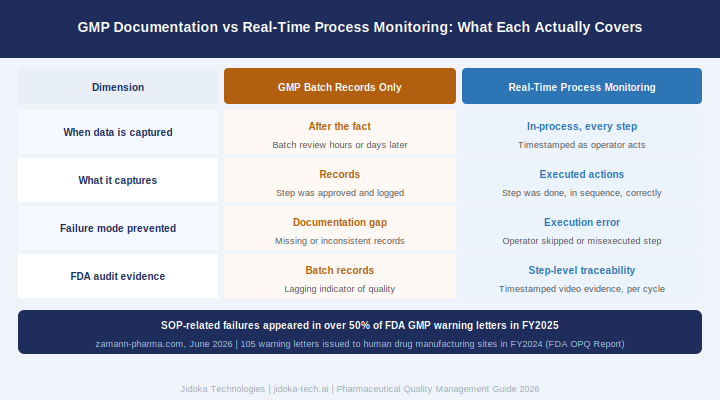
Figuur 1: GMP-batchrecords versus real-time procesmonitoring: wat elk vastlegt, wanneer, en welk bewijs voor de FDA dit oplevert
Waar ontstaan farmaceutische recalls en wat detecteert AI?
Besmetting van farmaceutische producten en etiketteringsfouten zijn geen willekeurige gebeurtenissen. Ze clusteren op specifieke, voorspelbare momenten in het proces: batchwisselingen, ploegendiensten en het aanvullen van etikettenvoorraad. Een steekproefcontrole na 2 uur in een run van 6 uur kan de fout die optreedt bij het verwisselen van de etikettenrol op uur 4 niet detecteren.
Waar etiketteringsfouten en besmetting clusteren
40% van de kwaliteitsafkeuringen in de farmaceutische productie komt voort uit onjuiste verpakking en etikettering. Besmetting veroorzaakt 30% van de farmaceutische recalls, met kosten van $10 miljoen tot $100 miljoen per incident. Beide faalcategorieën hebben een structurele oorsprong: ze treden op tijdens uitvoeringsmomenten die periodieke audits en batchrecords niet in real-time observeren.
Etiketteringsfouten pieken op drie momenten: de batchwisseling (wanneer de vorige set etiketten niet volledig is verwijderd), de ploegwissel (wanneer de nieuwe operator de etikettenstatus van de vorige ploeg niet verifieert) en de wissel van de etikettenrol (wanneer een operator halverwege een run een rol vervangt zonder verificatiestap). Geen van deze momenten wordt opgemerkt door een steekproefcontrole die vier uur eerder plaatsvond.
Wat KOMPASS levert voor farmaceutische verpakkingslijnen
KOMPASS detecteert vervormingen, kleurafwijkingen en variaties in vorm. Voor containers identificeert het vormfouten, braamvorming en onjuiste afdichting bij flacons en flessen. Voor productintegriteit detecteert het besmetting in tabletten, capsules en poederproducten. Voor etikettering: nauwkeurigheid en verificatie van batchcodes op elke eenheid, niet slechts op steekproefbasis.
Resultaten van KOMPASS bij farmaceutische implementaties: 99,9% nauwkeurigheid bij het detecteren van defecten en besmetting in farmaceutische kwaliteitscontrolesystemen, 10% hogere detectienauwkeurigheid dan handmatige inspectie, 5% foutieve afkeuringspercentage vergeleken met traditionele vision-systemen, 30% minder etiketteringsfouten, 20% snellere batchverificatie. Genoemde farmaceutische verpakkingsklant: Shriji Polymers.
Wat procesmonitoring toevoegt wat productinspectie niet kan
KOMPASS detecteert de besmette eenheid nadat deze de lijn heeft bereikt. NAGARE detecteert de operatorstap die de besmetting mogelijk maakte, waardoor wordt voorkomen dat de volgende eenheid besmet raakt voordat deze wordt geproduceerd. Dit zijn twee verschillende faalpaden, en alleen door beide aan te pakken is er sprake van volledig farmaceutisch kwaliteitsmanagement.
NAGARE monitort kritieke verpakkingsstappen: bevestiging van etikettenwissel, voltooiing van de vulverificatieprocedure, naleving van de afdichtingsstap en uitvoering van de reinigingsprocedure. Dit zijn de procesmomenten waar besmettingsincidenten ontstaan. Jidoka is het enige bedrijf dat zowel cognitieve productinspectie als intelligente procesoptimalisatie onder één dak aanbiedt.
Wat heeft een farmaceutisch kwaliteitscontrolesysteem nodig naast batchrecords?
Een farmaceutisch kwaliteitscontrolesysteem heeft meer nodig dan alleen ondertekende batchrecords. Het heeft real-time verificatie nodig van wat operators daadwerkelijk doen bij elke kritieke stap: of de juiste volgorde is gevolgd, de juiste materialen zijn gebruikt en elke verificatie is voltooid voordat het proces doorging naar de volgende fase.
Waarom batchrecords een achterlopende indicator van kwaliteit zijn
Een ondertekend batchrecord bevestigt dat een stap is goedgekeurd en geregistreerd. Het kan niet aantonen of de stap correct is uitgevoerd, in de juiste volgorde, op het juiste moment, of dat een substap is overgeslagen. Tegen de tijd dat een discrepantie in een batchrecord aan het licht komt tijdens de beoordeling, is het product vaak al vrijgegeven of in distributie.
Het probleem van achterlopende indicatoren: batchrecords leveren pas bewijs nadat de kwaliteit is bepaald, niet terwijl deze wordt vastgesteld. Kwaliteitsmanagementsystemen in de farmaceutische industrie die volledig op batchrecords zijn gebaseerd, zijn structureel reactief. Ze creëren een documentatie van wat er is gedaan, maar bieden geen realtime mechanisme om te garanderen dat dit correct is uitgevoerd. De frequentie van FDA-waarschuwingsbrieven over SOP-fouten bevestigt dat naleving van documentatie niet gelijkstaat aan naleving van de uitvoering.
Hoe realtime monitoring van SOP-naleving de bewijslast verandert
NAGARE controleert acties van operators op stapniveau aan de hand van digitale SOP's, identificeert afwijkingen voordat het proces vordert en genereert tijdgestempelde records op cyclusniveau van elke actie van de operator tijdens elke dienst. Resultaten van NAGARE bij implementaties voor naleving in de farmaceutische productie: 30% toename in procesnaleving, 35% minder herbewerking door uitvoeringsfouten, 30% lagere kosten voor toezicht en training, en een ROI binnen 12 maanden.
Het argument voor audit-gereedheid: videotraceerbaarheid op stapniveau via NAGARE is sterker bewijsmateriaal voor een FDA-audit dan een papieren of elektronisch batchrecord alleen. Het toont niet alleen aan dat een stap als voltooid werd geregistreerd, maar ook dat de operator elke handeling fysiek in de juiste volgorde heeft uitgevoerd, met een tijdstempel en videobeeld voor elke cyclus.
QMSR en de kloof in verificatiebewijs
De FDA QMSR, van kracht sinds 2 februari 2026, neemt ISO 13485:2016 op door verwijzing, waardoor die internationale norm de kracht van Amerikaanse wetgeving krijgt. QMSR vereist dat fabrikanten kwaliteitsmanagementsystemen aantonen die de procesuitvoering verifiëren, in plaats van deze alleen te documenteren. NAGARE genereert precies het uitvoeringsrecord op stapniveau dat QMSR-conforme kwaliteitsmanagementsystemen in de farmaceutische industrie vereisen als verificatiebewijs.
In een aanzienlijk deel van de FDA-waarschuwingsbrieven over het boekjaar 2025 kwamen fouten in de gegevensintegriteit voor. De on-premise edge AI van NAGARE genereert fraudebestendige, tijdgestempelde procesrecords die zowel voldoen aan de eis voor uitvoeringsverificatie als aan de verwachtingen omtrent gegevensintegriteit, zonder afhankelijk te zijn van cloudsystemen die extra nalevingsrisico's met zich meebrengen.
Hoe dichten KOMPASS en NAGARE samen beide faalpaden?
KOMPASS en NAGARE dichten de twee afzonderlijke faalpaden in het farmaceutisch kwaliteitsmanagement. KOMPASS detecteert productdefecten: contaminatie, verpakkingsfouten, onjuiste etikettering en afwijkingen in de vulling. NAGARE bewaakt de procesuitvoering: naleving van farmaceutische SOP's bij kritieke stappen, naleving van de operatorvolgorde en realtime waarschuwingen voor afwijkingen voordat er een defect product ontstaat.
KOMPASS voor inspectiedekking van farmaceutische producten
De volledige reikwijdte van KOMPASS voor farmaceutische productie: defectdetectie bij flacons, blisterverpakkingen en dozen; contaminatiedetectie bij tabletten, capsules en poederproducten; verificatie van etiketten en tekst, inclusief batchcodes, vervaldata, doseringsteksten, leesbaarheid van barcodes en vulniveaus; en het tellen van tabletten en flacons met een nauwkeurigheid van 99,5%.
Resultaten: 30% minder etiketteringsfouten, 25% verbetering in verificatie van containerintegriteit, 20% snellere batchverificatie, 10% minder telfouten. Elke metriek pakt direct een categorie uit de FDA-waarschuwingsbrieven aan: etikettering, containerintegriteit en de snelheid van batchrecordverificatie.
NAGARE voor naleving van farmaceutische processen bij kritieke controlepunten
NAGARE wordt ingezet bij kritieke farmaceutische processtappen: naleving van de verzegelingsprocedure, verificatie van labelwissels, vulbevestiging, voltooiing van reinigings- en ontsmettingsstappen en nauwkeurigheid bij het samenstellen van kits. Het voordeel van de implementatie: NAGARE draait op bestaande camera- en CCTV-infrastructuur met on-premise edge AI, zonder cloud, en genereert videotraceerbaarheid op cyclusniveau per stap.
Resultaten van NAGARE: 30% toename in procesnaleving, 35% minder herbewerking. In combinatie met KOMPASS resulteert dit in GMP-nalevingsmonitoring die zowel het productdefect (wat KOMPASS opvangt) als de procesafwijking die dit veroorzaakte (wat NAGARE onderschept) dekt, waardoor farmaceutische fabrikanten een volledige verificatielaag voor de uitvoering krijgen die batchrecords alleen niet kunnen bieden.
Jidoka Technologies: Ondersteuning voor farmaceutisch kwaliteitsmanagement
KOMPASS en NAGARE pakken de twee faalpaden aan die de meeste farmaceutische terugroepacties en FDA-waarschuwingsbrieven veroorzaken: productdefecten in de verpakkingsfase en uitvoeringsfouten door operators bij kritieke processtappen.
- KOMPASS: 99,9% nauwkeurigheid bij defect- en contaminatiedetectie. Controleert flacons, blisterverpakkingen, etiketten, vulhoogtes en tablet-aantallen. 30% minder etiketteringsfouten.
- Industrieën: Actief in farmaceutica, FMCG, en elektronica waar gedocumenteerde procesuitvoering een wettelijke vereiste is.
Plan een implementatie-assessment om te zien hoe KOMPASS en NAGARE beide faalpaden in uw farmaceutische kwaliteitsmanagementprogramma dichten.
Conclusie
Farmaceutisch kwaliteitsmanagement dat volledig vertrouwt op GMP-documentatie zal dezelfde categorieën waarschuwingsbrieven blijven genereren: SOP-fouten, contaminatie-incidenten en etiketteringsfouten. Deze ontstaan op het niveau van de operatoruitvoering, waar documentatiesystemen niet kunnen reiken.
Real-time procesmonitoring vervangt GMP niet. Het biedt de verificatielaag die GMP-compliance monitoring verwacht, maar niet zelfstandig kan afdwingen. Ontdek hoe KOMPASS en NAGARE beide faalpaden dichten op jidoka-tech.ai.
Veelgestelde vragen
1. Wat is farmaceutisch kwaliteitsmanagement en welke regelgevende kaders dekt het?
Farmaceutisch kwaliteitsmanagement is het geïntegreerde systeem dat ervoor zorgt dat elk geneesmiddel veilig en effectief is en consistent volgens specificaties wordt geproduceerd. Het omvat GMP-compliance onder FDA 21 CFR 210/211 en EU GMP EudraLex Vol. 4, kwaliteitsrisicobeheer onder ICH Q9, het farmaceutische kwaliteitsmanagementsysteem van ICH Q10 en CAPA-beheer in alle productie- en verpakkingsfasen.
2. Waarom blijven farmaceutische recalls voorkomen ondanks GMP-complianceprogramma's?
Farmaceutische recalls blijven voorkomen omdat GMP-compliance gebaseerd is op documentatie: het bevestigt dat procedures volgens de regels zijn vastgelegd, maar verifieert niet of de operator de kritieke stappen in real-time correct uitvoert. Besmetting veroorzaakt 30% van de recalls en etiketteringsfouten leiden tot 40% van de afkeuringen. Beide ontstaan op het niveau van de uitvoering, waar auditlogs pas worden gegenereerd nadat de fout al heeft plaatsgevonden.
3. Wat doet NAGARE in de farmaceutische productie en hoe ondersteunt het GMP-compliance?
NAGARE monitort acties van operators in real-time aan de hand van gedigitaliseerde SOP's en verifieert of elke stap in de juiste volgorde wordt uitgevoerd voordat het proces verdergaat. Voor compliance in de farmaceutische productie betekent dit dat kritieke stappen zoals het wisselen van etiketten, de controle van de vulling en het sealen gegarandeerd worden uitgevoerd. Dit genereert traceerbaarheid op stapniveau, wat sterker bewijsmateriaal voor FDA-audits oplevert dan batchrecords alleen.
4. Hoe verbetert AI-vision de kwaliteitscontrole bij farmaceutische verpakkingen en hoe vermindert het etiketteringsfouten?
AI-vision in farmaceutische verpakkingen controleert batchcodes, vervaldata, doseringsteksten, de oriëntatie van etiketten, vulhoogtes en de leesbaarheid van barcodes op elke eenheid, op productiesnelheid. KOMPASS behaalt een nauwkeurigheid van 99,9% bij het detecteren van defecten en besmetting, zorgt voor 30% minder etiketteringsfouten en maakt batchverificatie 20% sneller in vergelijking met handmatige inspectie. Het percentage foutieve afkeuringen bedraagt slechts 5%, vergeleken met traditionele vision-systemen.
5. Wat is de FDA QMSR en waarom is deze in 2026 van belang voor farmaceutisch kwaliteitsmanagement?
De FDA Quality Management System Regulation (QMSR), die op 2 februari 2026 van kracht werd, verving 21 CFR Part 820 door ISO 13485:2016 als referentie op te nemen, waardoor die norm de kracht van Amerikaanse wetgeving kreeg. Voor farmaceutisch kwaliteitsmanagement verhoogt dit de lat voor verificatiebewijs, waardoor tools voor real-time procesmonitoring zoals NAGARE direct relevant worden voor de toekomstige strategie rondom wettelijke compliance.