









MOTION-ACCURACY TRAINING FEEDBACK

Operator Motion Analysis to Show Trainees What to Correct

NAGARE supports operator motion analysis through configured observations of visible task actions and timing against an agreed reference. Trainers assess the available evidence. Precise hand trajectories, joint angles or posture scores require a demonstrated measurement setup, so ordinary footage is not treated as proof of those measurements.

Book a Training Demo

Trusted by manufacturers for error-free manual operations

THE PROBLEM

Good Results Can Hide Poor Technique

A trainee may build a correct unit with awkward reaches, extra movements or a grip that will tire them by midday. Trainers rarely have time to watch closely enough to see it.

Feedback Comes Too Late

Corrections arrive at the end of a session, when the trainee no longer remembers exactly how they moved.

Experts Cannot Explain Their Speed

Skilled operators work smoothly without thinking about it, so the reasons for their pace are hard to teach.

Bad Habits Cost Time and Comfort

Extra reaches and awkward stances slow the cycle and add strain that builds over months.
The Solution

Compare Every Movement With the Expert Method

Our AI process monitoring software, NAGARE™, supports operator motion analysis through camera observations of configured actions and timings. An expert reference helps trainers review differences. Any precise trajectory, angle or posture measure requires a demonstrated and validated assessment setup.

Review Visible Actions and Timing

  • Define task elements visible in the camera view
  • Review extra reaches, hesitations and unnecessary actions
  • Use observed movement as a prompt for trainer review
  • Assess whether both hands can be observed reliably
Agreed elements
Visible actions reviewed
Validated scope
Available feedback confirmed
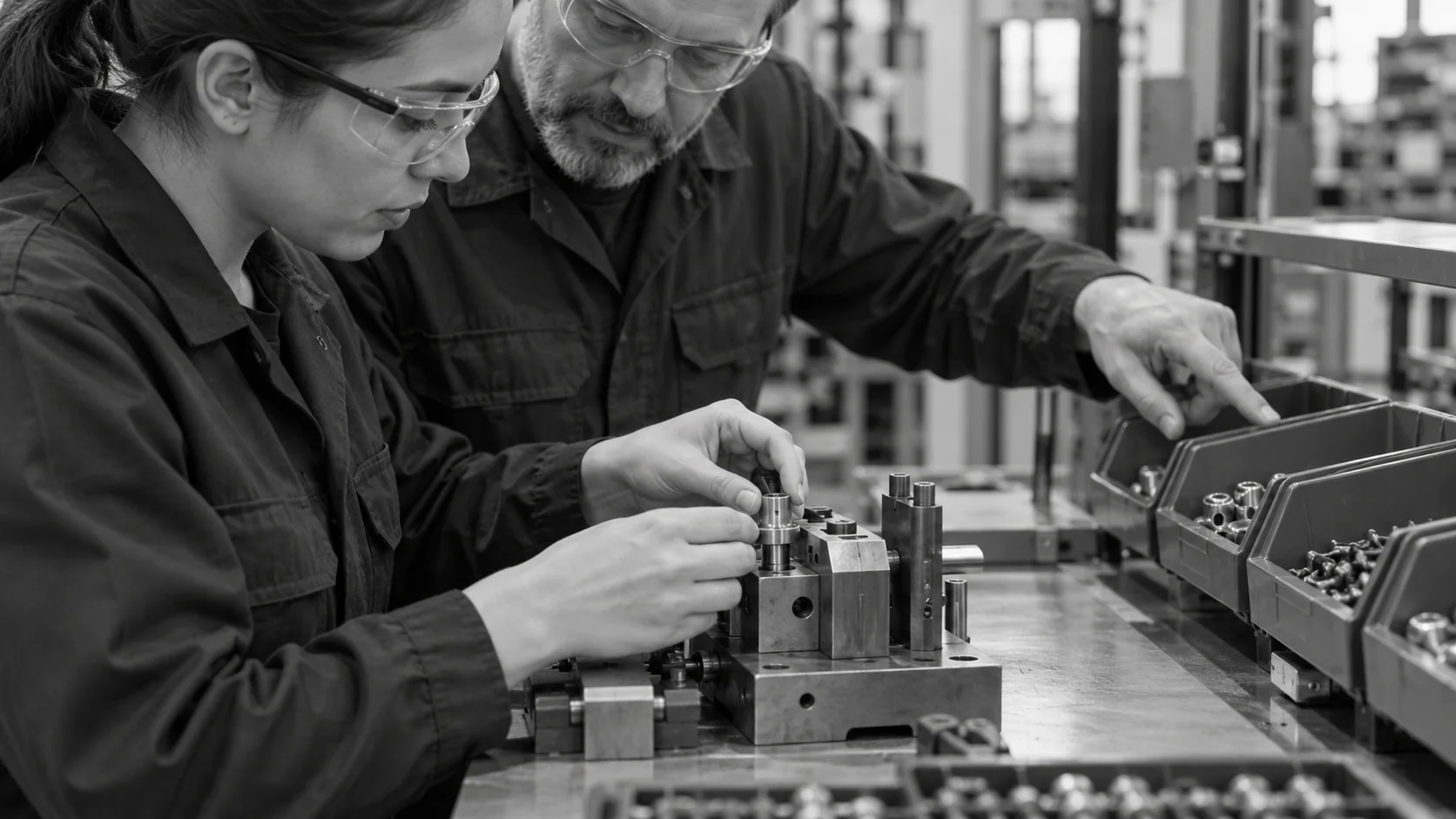
Conceptual illustration of a trainer coaching a trainee's hand placement and parts reach at an assembly fixture.

Give Feedback They Can Use

  • Review relevant trainee and expert clips where available
  • Discuss the visible action or timing difference
  • Record trainer-reviewed progress across sessions
  • Agree the feedback and record views the station will provide
Reference clips
Review workflow agreed
Across sessions
Reviewed progress recorded
HOW IT WORKS

How Motion Feedback Reaches the Trainee

Operator motion analysis starts with an agreed reference and observable task criteria. Confirm which action, timing and feedback outputs the assessment can demonstrate before promising detailed movement measurements.

Highlight #1

Record the Reference

Expert cycles provide reference footage of the agreed task. Trainers define visible actions and timing criteria rather than assuming one operator's body position is a universal standard.

Highlight #2

Track the Trainee

Configured checks observe the agreed actions and timings. Any trajectory, angle or posture output needs a demonstrated measurement method and validation.

Highlight #3

Review and Coach

Trainers review available clips and results with the trainee. Confirm which comparison views and feedback timing are provided in the station demonstration.

Connect With Us

Send a video of an expert and a trainee doing the same task. We will show the differences the analysis would highlight.

Get In Touch

Operator Motion Analysis Compared With Usual Training

Every method helps trainees improve. They differ in how precisely movement is measured and how quickly feedback arrives.

Training need
Trainer demonstration
Video recording alone
NAGARE AI
Movement detail
What the trainer notices
Visible but unmeasured
Configured visible actions and timings
Feedback timing
End of the session
After someone reviews footage
Agreed alert or trainer-review workflow
Progress tracking
Trainer memory
Not tracked
Reviewed progress, where records are configured
Coaching evidence
Habits form unnoticed
Habits seen late
Habits corrected early

Frequently Asked Questions

Why analyse movement rather than just the finished result?

A finished unit shows whether the task was completed correctly, not how efficiently or safely it was done. Two trainees can build the same good unit while one uses smooth, short movements and the other reaches, hesitates and twists. Hand motion analysis reveals that difference early, while the trainee is still forming habits and changing them is easy and cheap.

Where does the reference come from?

Record an expert operator performing the agreed method under representative conditions. That footage provides a reference motion for visible actions and timing. It does not automatically create a precise three-dimensional trajectory or posture standard. Where experts use different effective methods, trainers should agree what is acceptable and what the task requires. Review the reference when the method, product or station changes so a different but valid hand position is not treated as an error without a reason.

How are trainee and expert movements compared?

Research systems may split tasks into elemental motions and use techniques such as dynamic time warping to align sequences performed at different speeds. The cited study describes a research framework, not NAGARE's internal algorithm or a validated product feature. For your station, agree whether the available comparison concerns visible actions, timing or a demonstrated movement-path measure. Confirm the outputs with representative expert and trainee footage rather than assuming the algorithm or precision from a paper.

What kinds of problems does it find?

Reviewed clips may highlight an extra reach, hesitation, unnecessary movement or a grip that differs from the agreed method. Those observations are prompts for discussion: they do not by themselves establish a cause, a future discomfort outcome or a precise body-position measurement. A trainer can check the context and whether a different method is effective for that person. Demonstrate which findings are automatically flagged and which depend on human review before relying on the proposed feedback.

Can it reduce ergonomic strain?

Movement footage can support an ergonomics review by showing observable reaches or handling actions. It does not, by itself, establish load, exposure, joint angles, injury risk or a medical outcome. A competent ergonomics or safety reviewer should choose the assessment method and any additional measurements needed. Use the evidence to investigate a possible method or layout change, then assess its effect. Do not promise strain reduction merely because a camera observed a different movement.

How quickly does the trainee get motion feedback?

Agree the feedback workflow during the station demonstration. Available replay clips or configured action alerts may support a review after a cycle or a training block. Exact timing depends on the checks and system setup. Confirm whether trainee and reference views can be compared as required, rather than assuming a built-in side-by-side measurement tool. Trainers can then choose when to review simple corrections or more complex technique using the evidence the deployment actually retains.

Does it help experienced operators too?

Yes, especially when a method changes or a new product arrives. Comparing current movements with the updated reference shows where old habits persist. It also helps identify wasted motion that has crept into a familiar job over time, which is useful for continuous improvement as well as for training. Reviews are framed around the method, so experienced staff see them as support rather than criticism.

What should we send to set up operator motion analysis for training?

Send videos of expert operators and trainees performing the same task, the work instruction for that task and a note of the techniques you find hardest to teach. With that, we can record a reference, set up the camera view and show an example of the feedback a trainee would receive at the end of each cycle.

CONNECT WITH OUR EXPERTS

Show Us the Technique That Is Hardest to Teach

Share the tasks you train, an expert video and a trainee video. We will plan operator motion analysis for those tasks and explain timing and cost. A first training station usually runs within 4 weeks.

Book a Training Demo
Close video