









OPERATOR SKILL ASSESSMENT & SCORING

Operator Competency Assessment to Confirm Skills Objectively

NAGARE supports operator competency assessment with camera observations of configured task steps, cycle consistency and visible safety practices. Trainers agree the criteria and review the evidence, so an assessment can support a repeatable decision without treating a score as automatic proof of complete competence.

Book an Assessment Demo

Trusted by manufacturers for error-free manual operations

THE PROBLEM

Skill Sign-Offs Depend on Who Is Watching

Most plants certify operators through a trainer's observation and a checklist. The result depends on the assessor, the day and how carefully the checklist was applied.

Two Trainers, Two Verdicts

The same performance can pass with one assessor and fail with another, so certification means different things on different shifts.

Quizzes Miss the Hands

An operator can answer every question correctly and still lose rhythm or skip a step under real conditions.

Skills Fade Unnoticed

Once signed off, operators are rarely reassessed until something goes wrong, even on tasks they perform only occasionally.
The Solution

Score Real Performance Against the Standard

Our AI process monitoring software, NAGARE™, supports operator competency assessment by comparing configured visible task observations with agreed criteria. Records can inform trainer decisions. Scoring, task coverage and acceptance thresholds must be demonstrated for the proposed assessment station.

Measure What a Competent Operator Does

  • Check each step against the approved SOP
  • Measure cycle time and how consistent it is
  • Assess the configured visible safety practices within the camera coverage
  • Agree and validate the scoring criteria with your trainers
Every attempt
Scored the same way
Video-backed
Evidence for each score

Conceptual illustration of an assessor observing a trainee's assembly technique at a camera-equipped training bench.

Turn Scores Into Certification Decisions

  • Map scores to the levels your plant already uses
  • Define reassessment rules with the training team
  • Show trainers which steps need more practice
  • Agree how reviewed results update your skills records
Per task
Level assigned from the score
Due dates
Reassessment tracked
HOW IT WORKS

How an Assessment Station Scores a Task

Operator competency assessment with NAGARE compares each attempt with the way your best operators perform the task, using the same criteria for every candidate.

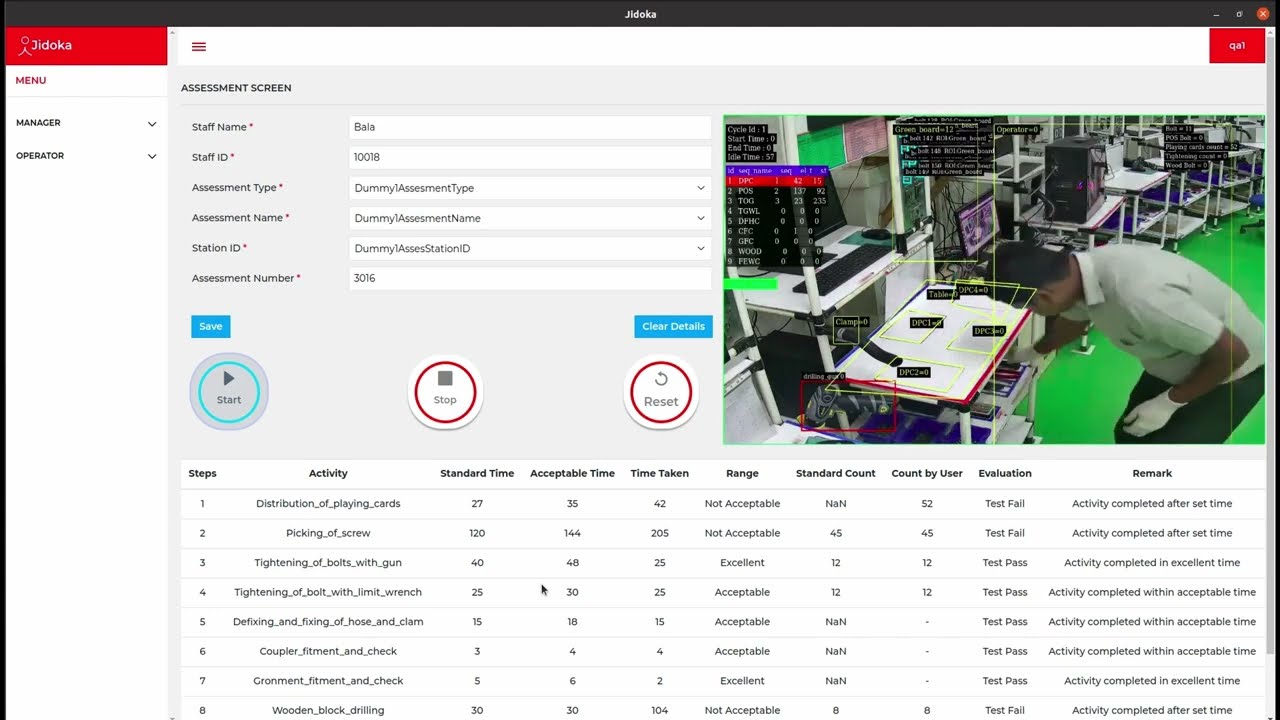
Official video frame showing an operator assessment screen with standard times, measured times and pass/fail results
Training-station application: the assessment screen compares task times and counts with standards and reports pass/fail results. Certification mapping is not demonstrated.
Highlight #1

Define the Standard

Recorded cycles from expert operators set the steps, timing and safety checks that define competent performance.

Highlight #2

Record the Attempt

The candidate performs the task at the station while the camera follows each step.

Highlight #3

Score and Certify

Results are scored against the standard, mapped to a level and stored with the video.

Connect With Us

Send one task's SOP and a video of an expert performing it. We will show how an attempt would be scored.

Get In Touch

Operator Competency Assessment Methods Compared

Every method aims to confirm that an operator can do the job. They differ in consistency, evidence and how often they can be repeated.

Assessment need
Trainer observation
Quizzes and LMS records
NAGARE AI
Consistency
Varies by assessor
Consistent but theoretical
Same criteria every time
What is assessed
Performance, by eye
Knowledge
Performance, measured
Evidence
Signed checklist
Test score
Video and step results
Assessment evidence
Certified on a judgement
Certified on knowledge
Certified on proven performance
CUSTOMER SUCCESS

Maruti Suzuki Scores Trainees Objectively at Assessment Stations

At Maruti Suzuki's training academies, NAGARE assessment stations record each trainee's SOP adherence, cycle times and safety practices, replacing subjective manual judgements.

Official Jidoka case-study cover for P&G and Maruti Suzuki process optimization
Maruti Suzuki Scores Trainees Objectively at Assessment Stations
Automotive

Maruti Suzuki's published results cover its AI-powered trainee assessments within the joint P&G and Maruti Suzuki case study.

  • Objective, data-driven evaluation of worker competency at assessment stations
  • 25% boost in training efficiency from AI-driven assessment

Frequently Asked Questions

Why do written tests fall short for shop-floor skills?

A written test shows what an operator knows, not whether they can perform the task at speed with real parts. Practical guides on workstation assessment recommend observable criteria checked during real work, because an operator can score well on a quiz and still lose rhythm under production conditions. Video scoring applies that principle to every attempt, with the same criteria each time and a record anyone can review.

How does camera scoring reduce assessor bias?

Consistent task criteria and retained video can reduce differences between assessors, but they do not eliminate every source of judgement bias or measurement error. Validate the checks across representative operators and task variations, and keep a trainer responsible for the decision. A disputed result should be reviewable against the footage and the agreed criteria. Trainers can use that review to improve the assessment method rather than assuming an automated score is inherently objective or complete.

What does an attempt get scored on?

Agree visible task criteria for the task, such as visible SOP adherence, cycle time consistency across attempts and specified safety practices. Confirm what the camera can observe and which checks need another source. Where a configured scorecard supports weighting, demonstrate how the criteria combine and how ambiguous observations are treated. Map a reviewed result to the plant's skills scale only after the trainers have validated those rules. A visible action does not prove every underlying skill or safe physical result.

How do scores relate to our competency levels?

Use the levels defined by your plant. A four-level matrix running from in training to able to train others is one possible example, not a universal industry rule. Agree the evidence and thresholds for each task and proficiency level, including the trainer sign-off needed for borderline or unobserved work. The score and video can support that decision where the assessment has been validated. They should not silently redefine the levels already recorded for the operator.

Can it support operator certification for audits?

An assessment record can support the plant's qualification decision where the task, date, criteria, reviewed result and relevant video are retained under the plant's process. Confirm the available record and export functions, retention and access in the proposed deployment. Auditors and the quality team decide whether that evidence meets their requirements. Camera observations do not themselves grant a qualification or prove competence in task elements outside the validated view and assessment scope.

How often should operators be reassessed?

Set reassessment and requalification rules according to task frequency, criticality and the plant's training process. Skill decay may matter for rarely performed work, but a camera result alone does not establish when a qualification expires. Agree how due dates, process changes and reviewed error patterns trigger another assessment, and confirm which tracking functions the deployment provides. Short refresher attempts can supply further evidence while a trainer retains responsibility for the resulting skills record.

What is an assessment station?

It is a workstation set up for assessments, either in a training area or on the line, with a camera positioned to see the task clearly. Maruti Suzuki's training academies use NAGARE stations of this kind to track how trainees follow the SOP, their cycle times and their safety habits. One station can serve several tasks if fixtures and parts are changed between sessions.

What should we send to set up operator competency assessment for a task?

Send the SOP for the task, your current checklist or skills matrix criteria and a few videos of expert operators performing it. Tell us how certification levels are defined today and who signs them off. With that, we can set the scoring criteria, design the station view and show a scored example from your own footage.

CONNECT WITH OUR EXPERTS

Show Us the Tasks You Certify Today

Share the tasks you certify, your current checklists and an expert video. We will plan operator competency assessment for those tasks and explain timing and cost. A first assessment station is usually ready in 4 weeks.

Book an Assessment Demo
Close video