.webp)
Todo fabricante que haya digitalizado sus procedimientos operativos estándar (SOP) y no haya visto ningún cambio en las tasas de defectos conoce esa sensación. El software de instrucciones de trabajo digitales está en marcha. Los operarios lo utilizan. La calidad sigue igual.
Ese resultado es habitual cuando los compradores tratan el software de instrucciones de trabajo digitales como una herramienta de entrega en lugar de una herramienta de cumplimiento normativo. La mayoría de las plataformas de instrucciones de trabajo electrónicas están diseñadas para hacer llegar las instrucciones a los operarios, no para verificar que esas instrucciones se hayan seguido realmente.
Esta guía detalla qué hace realmente el software de instrucciones de trabajo digitales, los seis factores que separan a las plataformas reales de los costosos gestores de documentos y dónde encaja Nagare de Jidoka Technologies.
Qué hace realmente el software de instrucciones de trabajo digitales
El software de instrucciones de trabajo digitales sustituye los SOP en papel y las guías de montaje impresas por una guía digital interactiva paso a paso que se entrega a los operarios en tabletas, teléfonos inteligentes o pantallas de estación de trabajo. Las plataformas modernas de instrucciones de trabajo digitales incluyen control de versiones, instrucciones multimedia, captura de comentarios de los operarios e integración con sistemas MES y de calidad. Los sistemas de supervisión activa van más allá: verifican el cumplimiento del operario en tiempo real.
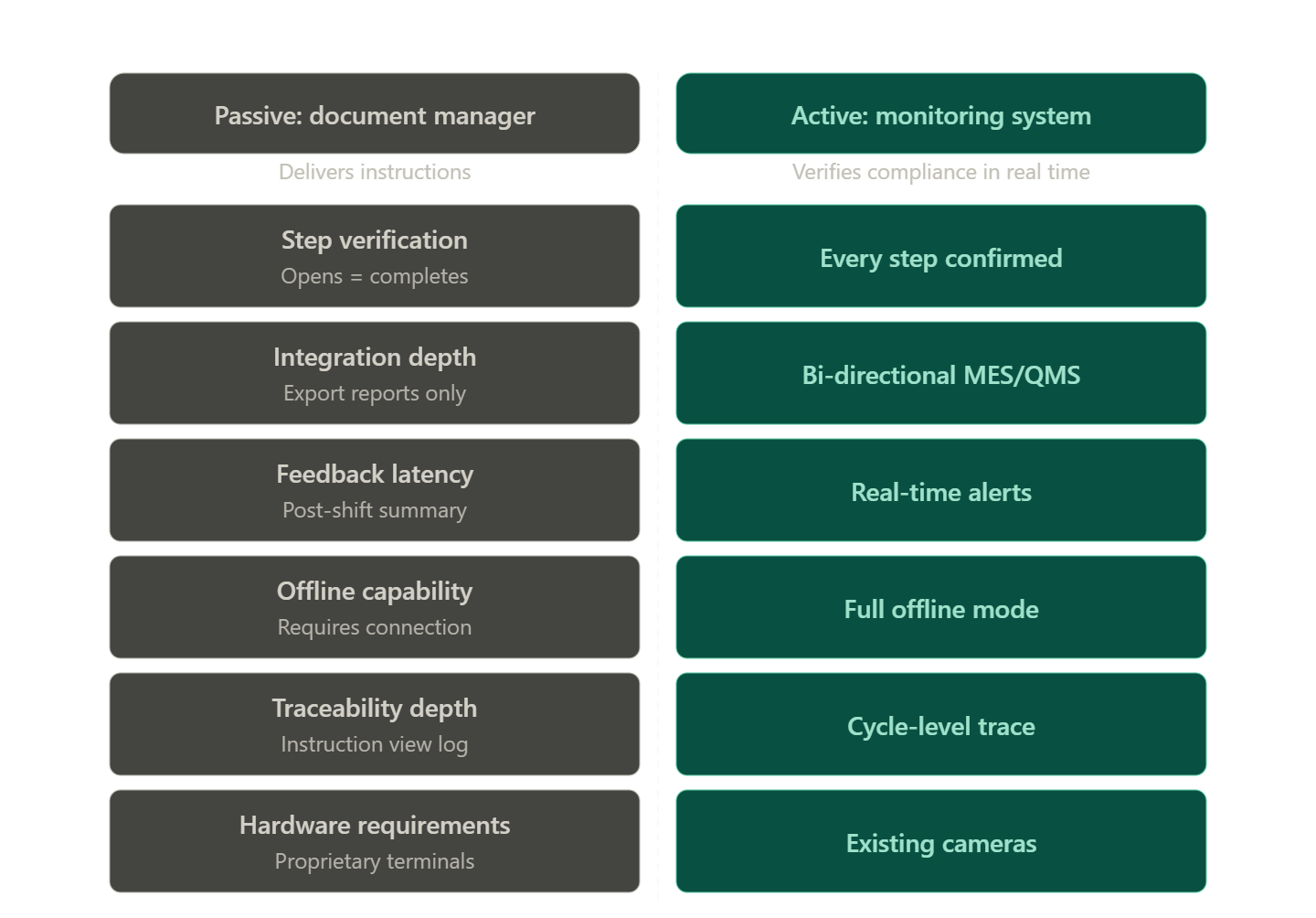
El paso del papel al software de instrucciones de trabajo electrónicas cambia algo más que el formato en el que viajan las instrucciones. Cambia lo que se puede rastrear, lo que se puede hacer cumplir y la rapidez con la que el equipo de calidad puede responder cuando algo sale mal.
Esto es lo que hace una plataforma de software de instrucciones de trabajo digitales a nivel funcional:
1. Control de versiones: Los cambios en las instrucciones se envían a todos los dispositivos en el momento en que se publican. Se acabó tener copias obsoletas en una carpeta en la estación tres mientras ingeniería ya va por la séptima revisión.
2. Contenido multimedia: Imágenes, vídeos y superposiciones en 3D guían a los operarios a través de montajes complejos o tareas de mantenimiento poco frecuentes donde una descripción escrita deja demasiado margen a la interpretación.
3. Captura de comentarios de los operarios: Los trabajadores señalan problemas, solicitan aclaraciones o informan de desviaciones directamente a través de la interfaz de instrucciones. Las plataformas que merece la pena evaluar dirigen esos avisos a un flujo de trabajo de mejora estructurado, no a una bandeja de entrada general.
4. Pista de auditoría: El software de instrucciones de trabajo electrónicas registra qué operario vio qué versión de la instrucción y en qué momento. Para la norma ISO, IATF 16949y entornos regulados por la FDA, esta es la base de cumplimiento que el papel no puede ofrecer.
5. Integración de sistemas: El software moderno de instrucciones de trabajo digitales se conecta con MES, ERPy sistemas de gestión de calidad a través de API. La entrega de instrucciones y los datos de ejecución fluyen en ambas direcciones, por lo que los datos de finalización impulsan la mejora, no solo la documentación.
Ese punto de integración es donde terminan la mayoría de las guías comparativas y donde comienza la verdadera evaluación.
Los seis factores que separan a las plataformas reales de los gestores de documentos
El error de adquisición más común en esta categoría es tratar la compra de un software de instrucciones de trabajo digitales como una actualización de gestión documental. Los gestores de documentos entregan instrucciones. Los sistemas de monitoreo activo verifican que se hayan seguido las instrucciones. Estos seis factores hacen que esa distinción sea concreta antes de comprometerse con cualquier proveedor.
La mayoría de las páginas de comparación de software de instrucciones de trabajo electrónicas se detienen en las listas de funciones. Ninguna explica la diferencia entre una plataforma que registra que un operario abrió una instrucción y una que confirma que cada paso se completó antes de que el operario pase a la siguiente estación. Estos seis factores sí lo hacen.
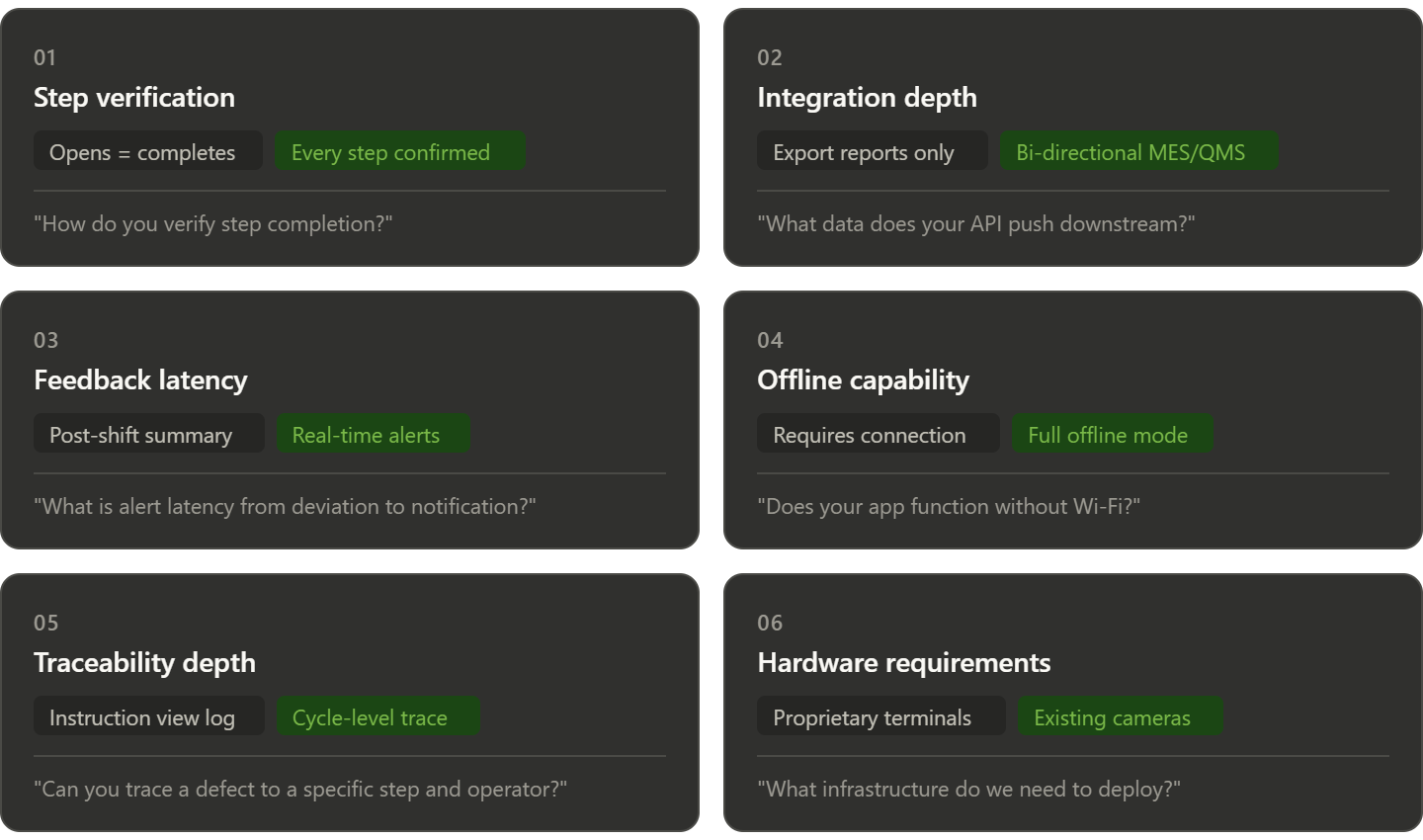
Factor 1: Verificación del cumplimiento a nivel de paso
Los gestores de documentos registran que un operario abrió la vista del software de instrucciones de trabajo digitales. Los sistemas de monitoreo activo confirman que cada paso se completó antes de comenzar el siguiente. Pregunte directamente a los proveedores: "¿Cómo verifican la finalización de los pasos?" Cualquier respuesta que involucre paneles de control, porcentajes de finalización o casillas de verificación de confirmación es una respuesta sobre la entrega, no sobre la aplicación.
Factor 2: Profundidad de integración
El software de instrucciones de trabajo electrónicas que funciona como un repositorio de contenido independiente no mejorará las métricas de calidad. La integración bidireccional con el MES, donde los datos de finalización de las instrucciones fluyen hacia los registros de calidad y las órdenes de trabajo, y donde los datos del MES pueden activar actualizaciones de instrucciones o bloqueos de calidad, es lo que diferencia a un sistema que mejora las operaciones de uno que simplemente las documenta. Pregunte qué envía la API, no solo qué recibe.
Factor 3: Latencia de retroalimentación en tiempo real
Los informes posteriores al turno detectan los problemas cuando el daño ya está hecho. Una plataforma de software de instrucciones de trabajo digitales que alerta a un supervisor en el momento en que ocurre una desviación es una herramienta fundamentalmente distinta a una que exporta un resumen al final del turno. La diferencia se mide en el costo de retrabajo por estación y por turno.
Factor 4: Capacidad sin conexión
Las plantas de producción con Wi-Fi deficiente en instalaciones antiguas necesitan una arquitectura que funcione primero sin conexión. Si la plataforma de software de instrucciones de trabajo digitales requiere conectividad de red para mostrar las instrucciones, está creando una dependencia de producción que fallará durante una interrupción del Wi-Fi, un traslado de línea o una expansión de las instalaciones.
Factor 5: Profundidad de la trazabilidad
Las instrucciones de trabajo sin papel solo son útiles para el análisis de causa raíz si el sistema puede vincular un defecto específico al operador, paso y momento exactos en los que ocurrió una desviación. Sin ese nivel de detalle, el análisis de causa raíz sigue siendo una suposición disfrazada de datos.
Factor 6: Requisitos de hardware
Las plataformas de instrucciones de trabajo visuales para la fabricación que funcionan en tabletas estándar y cámaras existentes son más rápidas de escalar y más fáciles de reemplazar. Las plataformas que requieren terminales propietarios o gafas de realidad aumentada conllevan un costo total de propiedad que va mucho más allá de la tarifa de licencia, y la dependencia del hardware nunca aparece en una tabla comparativa de funciones.
La cuestión de la entrega frente a la aplicación es la que la mayoría de los compradores no plantea hasta después de la implementación, y la consolidación en este mercado añade otra capa a esa evaluación.
Contexto del mercado: qué significa la consolidación para los compradores
Tres adquisiciones importantes entre 2023 y 2024 transformaron el mercado del software de instrucciones de trabajo digitales. Para los compradores que evalúan plataformas hoy en día, esas adquisiciones significan hojas de ruta modificadas, precios migrados y conjuntos de funciones que pueden ya no coincidir con lo que se revisó originalmente.
Esto no es una crítica a los proveedores. Es el contexto fáctico que determina si la plataforma de software de instrucciones de trabajo electrónicas que evalúa en el segundo trimestre seguirá teniendo el mismo conjunto de funciones, precio y enfoque de desarrollo en el cuarto trimestre.
- SwipeGuide adquirida por L2L (septiembre de 2024): El producto independiente ya no existe. swipeguide.com redirige a l2l.com. (FuenteLos antiguos clientes de SwipeGuide o los nuevos clientes potenciales que evalúen la plataforma basándose en su conjunto de funciones original deberán volver a evaluar el producto actual desde cero.
- Poka fue adquirida por IFS (junio de 2023, ~200 millones de dólares): Poka opera ahora como el componente de trabajador conectado de IFS Cloud. (Fuente) Las decisiones sobre precios y hoja de ruta están ahora vinculadas a la estrategia empresarial de IFS, no a las prioridades del equipo de producto original de Poka.
- Proceedix fue adquirida por SymphonyAI: Ahora se posiciona como un componente de IA empresarial en lugar de una herramienta independiente de digitalización de órdenes de trabajo. (Fuente)
Tres aspectos a verificar antes de comprometerse con cualquier plataforma de software de instrucciones de trabajo digitales en 2026:
- Si la plataforma tiene una hoja de ruta independiente que no esté vinculada a las decisiones de empaquetado empresarial de una empresa matriz
- Si los precios han migrado a mínimos empresariales desde la adquisición
- Si las funciones principales del producto original se mantienen o si se están eliminando en favor de la plataforma matriz
Los líderes del mercado con hojas de ruta independientes en 2026 incluyen a Dozuki, Tulip, VKS, Manual.to y Nagare de Jidoka Technologies. La independencia siempre debe confirmarse en el momento real de la adquisición, no basándose en una guía comparativa escrita seis meses antes.
Cómo encaja Nagare en el panorama de las instrucciones de trabajo digitales
Nagare de Jidoka Technologies no es una herramienta de entrega de software de instrucciones de trabajo digitales. Es una capa de verificación de procesos que se sitúa por encima o junto a su software de instrucciones de trabajo electrónicas existente, utilizando visión artificial en las cámaras existentes para confirmar que cada paso del ensamblaje se completó físicamente antes de que el operario pase al siguiente.
"Las instrucciones de trabajo digitales le dicen a los operarios qué hacer. Nagare verifica que lo hicieron, en tiempo real, en cada paso, en cada turno, y cierra el ciclo con su sistema de calidad". — Jidoka Technologies
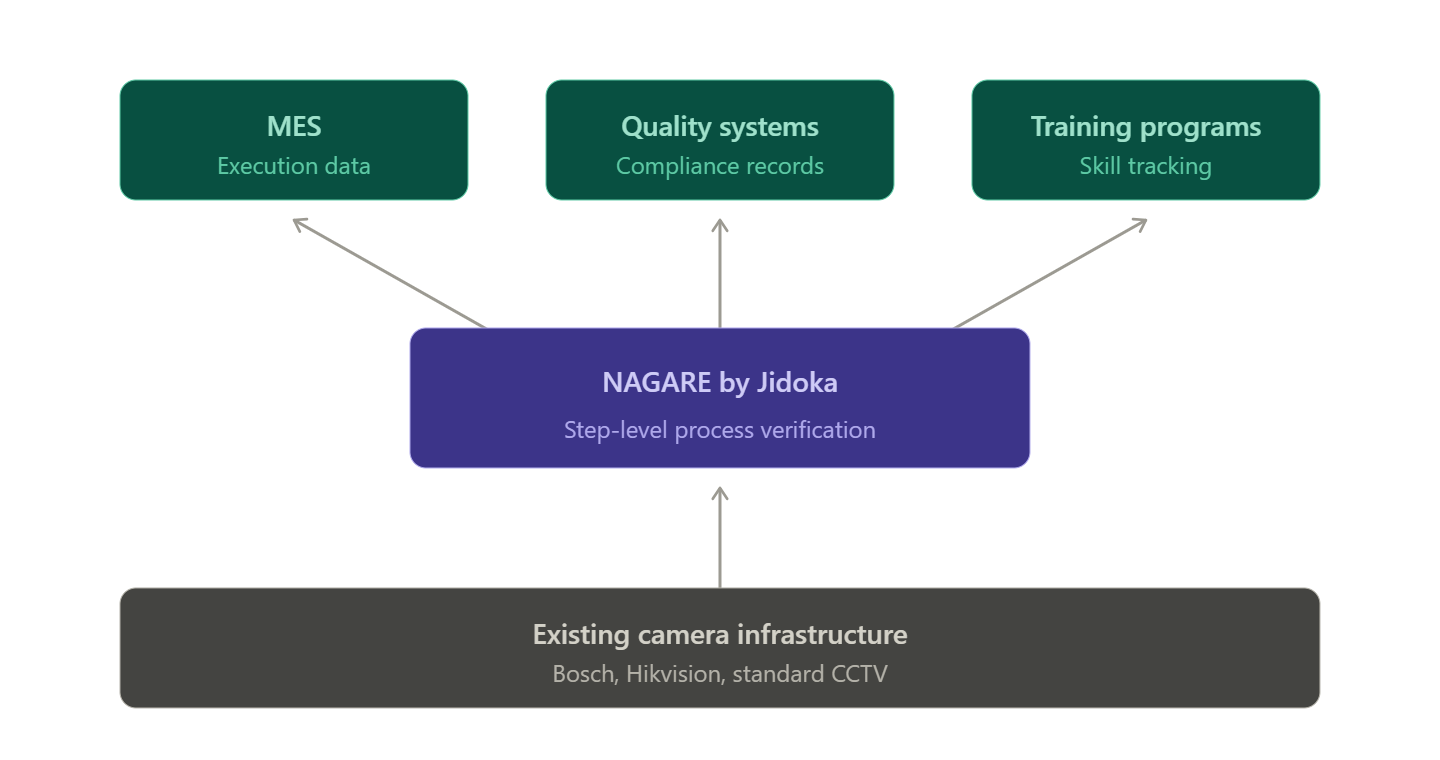
La mayoría de los sistemas de instrucciones para operarios del mercado se limitan a mostrar la información. Nagare verifica que el trabajo se haya realizado conforme a la guía de instrucciones digitales, utilizando visión artificial a través de las cámaras que ya tiene instaladas.
Aquí es donde Nagare destaca frente a la matriz de seis factores:
1. Verificación a nivel de paso: Nagare confirma que cada acción física en la secuencia de montaje se ha llevado a cabo, no solo que el operario haya abierto el software de instrucciones de trabajo. Menos de 10 ms por fotograma, con una precisión superior al 99,8 %.
2. Profundidad de integración: Nagare se conecta a sistemas MES, de calidad y programas de formación. Los datos de ejecución a nivel de ciclo fluyen hacia los sistemas posteriores para impulsar la elaboración de informes de cumplimiento y la mejora continua, más allá de la simple documentación.
3. Latencia de retroalimentación: Nagare emite avisos correctivos con una latencia inferior a un segundo mediante arquitectura de IA en el borde (edge AI). Los operarios reciben orientación antes de que una unidad no conforme llegue a la siguiente estación.
4. Requisitos de hardware: Nagare funciona con las cámaras de CCTV Bosch y Hikvision existentes. Sin terminales propietarios, sin gafas de realidad aumentada y sin ciclos de adquisición de hardware especializado.
5. Trazabilidad: NAGARE realiza un seguimiento del 100 % de los pasos de montaje y señala piezas faltantes o secuencias incorrectas en tiempo real, proporcionando a los equipos de calidad un registro de ejecución a nivel de ciclo para cada unidad producida.
Jidoka Technologies tiene Más de 45 clientes con más de 300 millones de piezas inspeccionadas al día. El sistema funciona en unidades de borde locales, manteniendo un rendimiento constante de más de 12 000 piezas por minuto en todos los turnos.
Conclusión: La plataforma que verifica, no solo entrega
La mayoría de las inversiones en software de instrucciones de trabajo digitales no logran mejorar las métricas de calidad por una razón: leer una instrucción y ejecutarla correctamente son dos eventos distintos. La entrega no garantiza el cumplimiento. La mejora de la calidad a nivel de paso requiere un software de instrucciones de trabajo electrónicas que verifique el cumplimiento en tiempo real, registre las desviaciones en el momento en que ocurren y reintegre esos datos en su sistema de calidad.
Si su inversión en software de instrucciones de trabajo digitales no ha reducido su tasa de defectos, la capa que falta es la verificación de procesos en tiempo real. Nagare añade esa capa utilizando su infraestructura de cámaras existente.
Hablemos de cómo se ve esto en su línea de producción: Reservar una demostración.
Preguntas frecuentes
1. ¿Cuál es la diferencia entre las instrucciones de trabajo digitales y un POE?
Un Procedimiento Operativo Estándar describe el proceso general y el resultado que debe lograrse. El software de instrucciones de trabajo digitales ofrece el detalle paso a paso de cómo realizar cada tarea, de forma interactiva, con imágenes, video y orientación en tiempo real, reemplazando las hojas impresas que son difíciles de actualizar e imposibles de verificar a escala.
2. ¿Puede el software de instrucciones de trabajo digitales reemplazar las hojas de inspección de calidad en papel?
Sí. Las plataformas modernas de software de instrucciones de trabajo electrónicas reemplazan las hojas de inspección en papel con formularios digitales que validan las entradas del operador frente a rangos aceptables y marcan las no conformidades en tiempo real. Cada entrada se registra con una marca de tiempo y el ID del operador. Los sistemas de monitoreo activo como Nagare van más allá: verifican el proceso físico, no solo el registro de inspección.
3. ¿Cómo se integran las plataformas de instrucciones de trabajo digitales con los sistemas MES?
La profundidad de la integración varía considerablemente. La mayoría de las herramientas de software de instrucciones de trabajo digitales ofrecen conectividad API que permite que los datos de finalización fluyan hacia las órdenes de trabajo y los registros de calidad del MES. La integración bidireccional, donde los datos del MES activan actualizaciones de instrucciones o retenciones de calidad, requiere plataformas de software de instrucciones de trabajo electrónicas más capaces. Confirme los detalles de la API, los esquemas de datos y la compatibilidad con el MES antes de la adquisición.
4. ¿Cuánto tiempo lleva migrar de instrucciones de trabajo en papel a digitales?
Un fabricante de tamaño mediano con entre 200 y 500 instrucciones puede completar normalmente la migración al software de instrucciones de trabajo digitales en un plazo de 8 a 16 semanas. Las plataformas con creación asistida por IA reducen ese cronograma. Añada de 4 a 8 semanas si se requiere integración con MES.