Les évasions de qualité dans le secteur de la fabrication vous coûtent de l'argent. Les anciens systèmes ne peuvent pas gérer les vitesses de production actuelles ou les défauts complexes. Les recherches montrent que les limites de précision des inspections manuelles font que les inspecteurs omettent jusqu'à 40 % des défauts.
La précision diminue de manière significative au cours de la première heure. Si votre ligne fait 10 000 unités par jour dans un 80 % taux de détection, 20 défauts parviennent aux clients chaque jour. Le marché de la vision industrielle se développe en raison de l'échec des anciennes méthodes.
Ce guide présente l'inspection visuelle par IA par rapport à l'inspection traditionnelle à l'aide de BOUSSOLE. Vous verrez comment l'inspection KOMPASS AI réduit votre taux d'élimination des défauts. Cette technologie s'adapte parfaitement à votre chaîne de production.
Là où les méthodes d'inspection traditionnelles ne fonctionnent pas
Les anciens outils échouent parce qu'ils s'appuient sur des yeux humains ou sur un code statique. Ces méthodes ne peuvent pas suivre la vitesse et la variété des chaînes de production modernes. KOMPASS comble directement ces lacunes.
1. Inspection visuelle manuelle : le problème de la fatigue
L'inspection manuelle échoue car les yeux humains se fatiguent rapidement. Vous constaterez des limites de précision lors de l'inspection manuelle après seulement 20 minutes de tâches répétitives. Cela entraîne un taux d'élimination des défauts plus élevé, car les ouvriers passent à côté des défauts inférieurs à 0,5 mm.
À 500 unités par minute, le cerveau oublie des détails. KOMPASS résout ce problème. KOMPASS AI Inspection fournit un système d'inspection IA qui permet une inspection visuelle constante de haute précision sans fatigue ni coûts de main-d'œuvre élevés.
2. Vision industrielle basée sur des règles : le problème de la rigidité
Plus vieux inspection optique automatisée les outils utilisent la vision industrielle basée sur des règles pour les contrôles de qualité. Cette logique fonctionne pour les tests de présence simples mais échoue lors de changements dans le monde réel.
- Les changements d'éclairage ou les vibrations du produit interrompent le flux de fabrication du système de vision industrielle.
- Les changements de produits nécessitent des heures de reprogrammation par des experts.
- La vision industrielle basée sur des règles ne peut pas s'adapter aux surfaces brillantes ou texturées.
- Des changements de caméra mineurs entraînent des interruptions coûteuses du système.
KOMPASS résout ces problèmes. L'inspection IA KOMPASS fournit un système d'inspection IA flexible qui surpasse toute inspection visuelle IA par rapport à une comparaison d'inspection traditionnelle.
Ces échecs montrent pourquoi les entreprises ont besoin de meilleurs outils. KOMPASS offre un meilleur moyen de relever ces défis.
Ce que KOMPASS AI Inspection fait différemment
BOUSSOLE modifie la façon dont vous gérez le contrôle qualité en utilisant la détection des défauts par apprentissage profond au lieu des anciennes mathématiques. Ce logiciel apprend vos produits à travers des images et s'adapte à votre gamme.
1. Apprentissage approfondi à partir de règles fixes
L'atelier de votre usine change constamment. KOMPASS utilise inspection IA en ligne pour découvrir à quoi ressemble une pièce parfaite à partir d'exemples d'images. Contrairement à la vision industrielle basée sur des règles, ce système d'inspection basé sur l'IA gère facilement la complexité des surfaces et les variations organiques.
Il identifie tout écart par rapport à la norme, même si le défaut est nouveau. Cette approche d'inspection visuelle de haute précision permet à votre chaîne de fonctionner sans mises à jour manuelles constantes.
2. Des spécifications de performance qui résistent à la pression de production
Vous avez besoin de rapidité et de précision. KOMPASS offre une précision de plus de 99,8 % sur les lignes actives. Dans le cadre d'une inspection visuelle basée sur l'IA en tête-à-tête par rapport à un test d'inspection traditionnel, ce système gagne sur tous les plans :
- Passez en revue chaque image en moins de 10 ms.
- Découvrez de nouveaux produits en utilisant 60 à 70 % moins d'échantillons d'entraînement.
- Fonctionne comme un robuste inspection optique automatisée outil pour métaux réfléchissants et pièces texturées.
- L'inspection KOMPASS AI élimine le taux d'échec de 20 % observé lors des contrôles manuels.
3. Inspection déployée en périphérie : pourquoi c'est important à la vitesse de la chaîne
La latence nuit à la productivité. KOMPASS utilise l'inspection déployée en périphérie pour traiter les données localement sur votre sol.
- Aucun retard dans le cloud ni aucune défaillance du réseau n'interrompent votre production.
- Supporte des vitesses de Plus de 12 000 pièces par minute.
- Fournit des résultats cohérents à chaque quart de travail.
- KOMPASS fonctionne comme un centre de fabrication fiable de systèmes de vision industrielle pour 300 millions de contrôles quotidiens.
Ce système d'inspection basé sur l'IA permet de conserver votre débit élevé tout en diminuant votre taux d'échappement par défaut. L'inspection KOMPASS AI fonctionne tout simplement mieux que les anciens outils.
Comparaison directe : KOMPASS et méthodes traditionnelles
La comparaison de KOMPASS avec les anciennes méthodes montre pourquoi les usines modernes sont en train de changer. Ces chiffres prouvent comment un système d'inspection basé sur l'IA gère mieux la pression du monde réel que des yeux ou un code rigide.
1. Précision pour tous les types de défauts
Les contrôles manuels présentent des limites en termes de précision des inspections manuelles, qui atteignent souvent un pic de 80 % avant de chuter. Vieux vision industrielle basée sur des règles fonctionne pour les pièces simples mais échoue sur les surfaces brillantes ou texturées.
KOMPASS fournit inspection visuelle de haute précision avec une précision soutenue de 99,8 % et plus. Ce système d'inspection par IA détecte les défauts subtils des métaux réfléchissants et les géométries complexes qui échappent aux autres outils.
2. Vitesse et débit
Les contrôles manuels créent des goulots d'étranglement lorsque votre ligne dépasse 100 unités par minute. L'inspection optique automatisée traditionnelle est rapide mais arrête la production pendant des heures pendant la reprogrammation.
L'inspection KOMPASS AI examine les images en moins de 10 ms. Lors d'un test de vitesse d'inspection visuelle par IA par rapport à un test de vitesse d'inspection traditionnel, KOMPASS gagne en prenant en charge plus de 12 000 pièces par minute sans ralentir.
3. Évolutivité et gestion des variantes
La mise à l'échelle du travail manuel implique l'embauche de plus de personnes, ce qui augmente votre taux d'élimination des défauts en raison d'incohérences. KOMPASS utilise le deep learning détection des défauts pour découvrir de nouvelles variantes avec 60 à 70 % d'échantillons en moins.
- KOMPASS intègre de nouvelles références en quelques heures.
- Les limites de précision de l'inspection manuelle rendent la mise à l'échelle coûteuse.
- L'inspection par IA en ligne permet de maintenir la qualité sur plusieurs lignes.
- L'inspection KOMPASS AI réduit les temps d'arrêt lors des changements de produits.
KOMPASS par rapport aux méthodes traditionnelles :
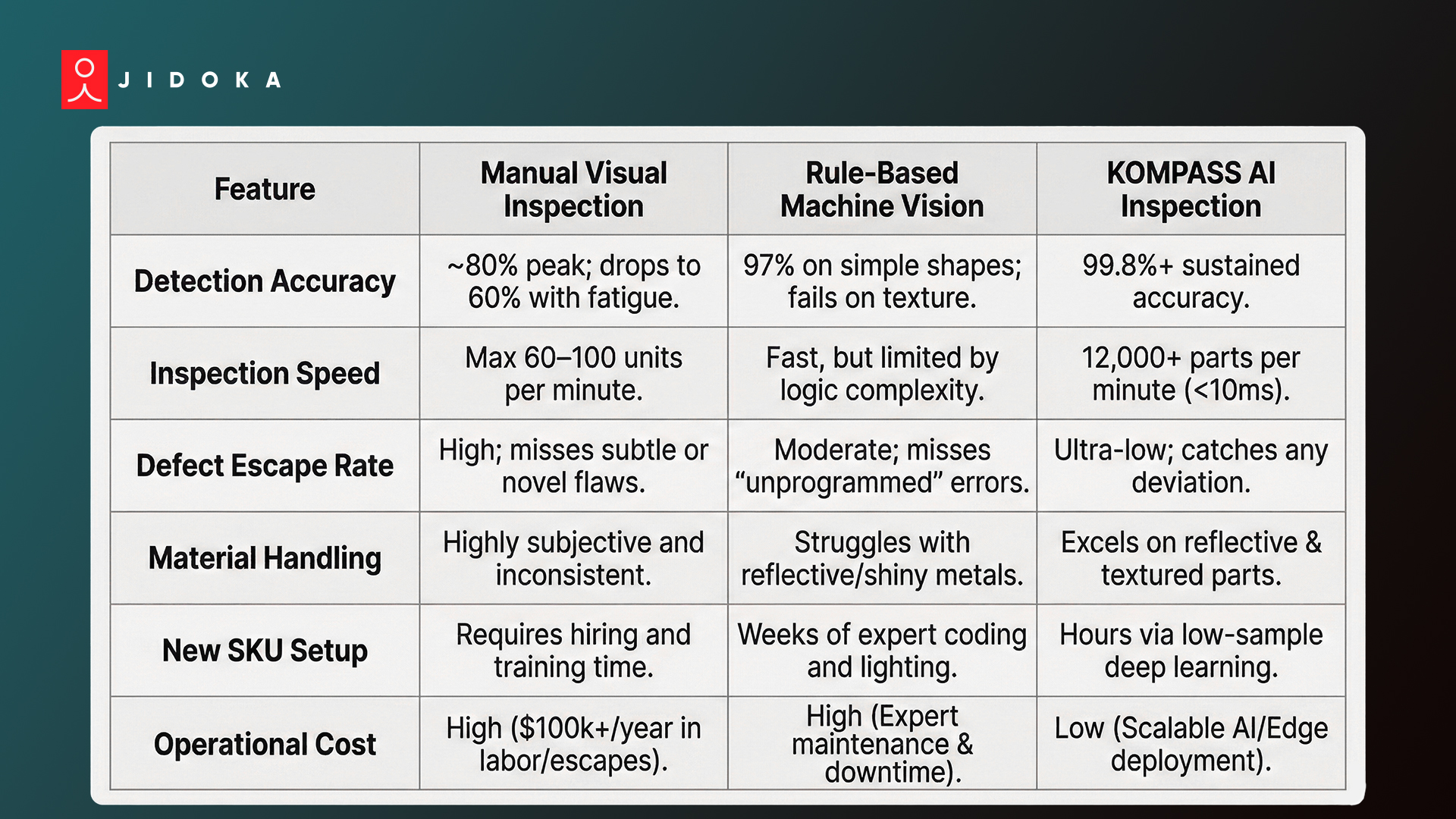
Cette comparaison montre que KOMPASS est le meilleur choix pour la fabrication de systèmes de vision industrielle. Ce système d'inspection par IA fournit les résultats dont votre ligne de production a besoin.
Comment Jidoka Tech comble l'écart entre les limites d'inspection traditionnelles
Technologie Jidoka fournit un système d'inspection basé sur l'IA qui fonctionne sous une pression de production réelle. Notre équipe intègre des caméras, un éclairage et une synchronisation PLC pour garantir que l'inspection KOMPASS AI fonctionne à chaque quart de travail.
Notre configuration permet BOUSSOLE pour effectuer une inspection visuelle de haute précision à des vitesses de Plus de 12 000 pièces par minute.
Capacités spéciales de l'écosystème Jidoka :
- BOUSSOLE: Réalise Précision de 99,8 % et plus et utilise la détection des défauts par apprentissage profond pour traiter les métaux réfléchissants ou les pièces texturées.
- NAGARE: Cet analyste des processus suit les étapes d'assemblage et signale les pièces manquantes en temps réel pour réduire les retouches 35 %.
- Inspection déployée en périphérie: Le traitement local garantit une latence nulle et empêche les arrêts de ligne.
Ce système d'inspection par IA réduit votre taux d'évacuation des défauts grâce à une inspection IA en ligne. Découvrez comment KOMPASS AI inspecte peut corriger vos écarts de qualité spécifiques.
Conclusion
La fabrication moderne exige une rapidité extrême. Cependant, les yeux humains sont confrontés à des limites de précision lors de l'inspection manuelle, ce qui augmente votre taux d'élimination des défauts. À mesure que la fatigue s'installe, les produits défectueux sont inévitablement transmis à vos clients.
Ces évasions entraînent des rappels massifs, des responsabilités légales et des dommages permanents à la marque. Un seul défaut oublié peut interrompre vos activités et détruire votre réputation.
Technologie Jidoka fournit BOUSSOLE en tant que système d'inspection IA fiable. En utilisant la détection des défauts par apprentissage profond, les résultats d'inspection de KOMPASS AI surpassent les normes d'inspection traditionnelles.
Connectez-vous à Jidoka Tech pour voir comment ce système d'inspection par IA s'adapte à votre chaîne de production.
FAQs
1. Qu'est-ce que KOMPASS et en quoi diffère-t-il des systèmes AOI standard ?
KOMPASS est un système d'inspection basé sur l'IA qui utilise détection des défauts par apprentissage profond au lieu de règles fixes. Contrairement à la vision industrielle basée sur des règles, l'inspection KOMPASS AI apprend à partir des images pour identifier les défauts complexes grâce à une inspection visuelle de haute précision sur n'importe quelle chaîne de fabrication de systèmes de vision industrielle.
2. Pourquoi la précision de l'inspection manuelle diminue-t-elle si rapidement pendant un quart de travail ?
Les limites de précision de l'inspection manuelle sont dues à la fatigue des yeux humains en 20 minutes. Cela entraîne un taux d'échappement des défauts plus élevé. KOMPASS remplace les contrôles manuels par une inspection IA en ligne, garantissant une inspection visuelle de haute précision tout au long de chaque quart de travail sans risque d'erreur humaine.
3. KOMPASS peut-il gérer des lignes de production à haute diversité avec des changements fréquents ?
Oui L'inspection KOMPASS AI entraîne de nouvelles variantes en utilisant 60 à 70 % d'échantillons en moins que les modèles standard. Ce système d'inspection par IA accélère les changements, ce qui le rend supérieur dans le débat sur l'inspection visuelle par IA par rapport à l'inspection traditionnelle pour la fabrication de systèmes de vision industrielle à haute diversité.
4. Qu'est-ce qui rend le déploiement de pointe important pour un système d'inspection basé sur l'IA ?
L'inspection déployée en périphérie traite les données localement pour éliminer la latence du cloud. Cela garantit que votre inspection optique automatisée suit le rythme des lignes se déplaçant à plus de 12 000 pièces par minute. KOMPASS garantit l'absence de temps d'arrêt et une inspection visuelle constante de haute précision sans avoir besoin d'Internet externe.
5. Quels types de défauts sont détectés par KOMPASS et que les systèmes basés sur des règles ne détectent pas ?
KOMPASS détecte les rayures subtiles sur les métaux et les textures réfléchissants que la vision industrielle basée sur des règles ignore. En utilisant apprentissage en profondeur détection des défauts, ce système d'inspection IA identifie tout écart par rapport à la norme, réduisant ainsi de manière significative votre taux global d'élimination des défauts sur les lignes sous tension.
6. Quelle est la différence entre KOMPASS et l'inspection manuelle en trois exemplaires ?
Les contrôles manuels triples sont coûteux et présentent toujours des limites de précision en raison de la fatigue partagée. L'inspection KOMPASS AI offre à elle seule une précision de plus de 99,8 %. Il s'agit de l'outil d'inspection visuelle de haute précision le plus rentable pour la fabrication de systèmes de vision industrielle modernes.