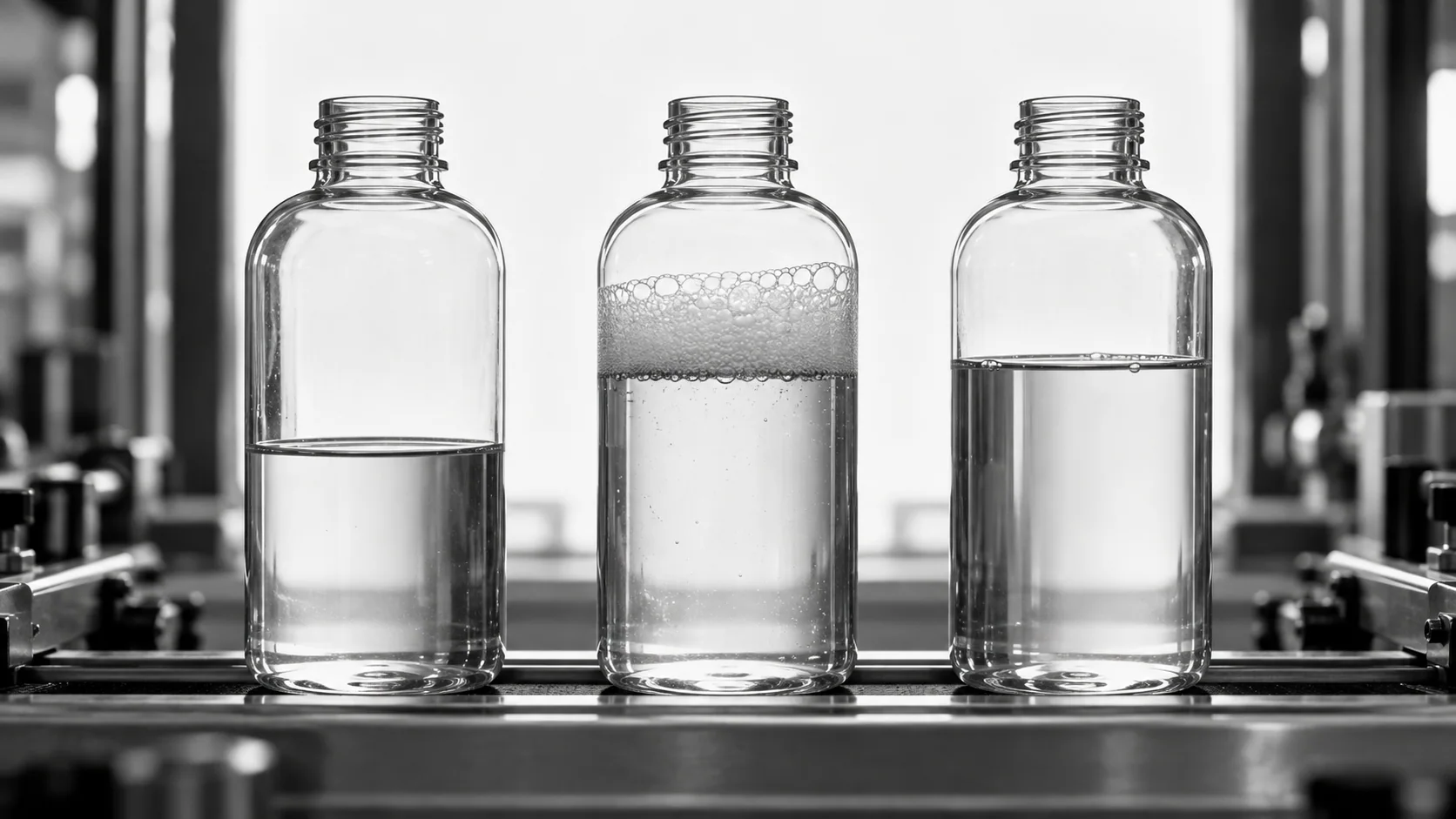





Find the Real Liquid Line
- Backlight transparent containers so the liquid line is sharp
- Separate foam and meniscus from the true fill line
- Ignore label edges, embossing and container marks
- Apply limits by product and container size
KOMPASS brings fill level inspection to every bottle and container leaving the filler. AI vision finds the true liquid line through foam, meniscus and label edges, compares it with your limits and signals the line so underfilled and overfilled containers are removed before capping.
Filling heads drift, valves stick and nozzles drip. A container a few millimetres low looks normal at a glance, but it breaches declared quantity and invites complaints.
Our AI Product Inspection system, KOMPASS™, performs fill level inspection with vision models trained on your containers and products, locating the real liquid line on every container. Each level reading is stored with an image of the container.

Fill level inspection measures where the liquid line sits. KOMPASS combines a clear view of the line, models trained on your products and a direct link to the reject mechanism.
Transparent containers are backlit so the liquid line stands out. The camera sits after the filler or capper, at the height of the target level.
The model finds the true line through foam, meniscus and label edges, then measures the level against your limits.
Wrong fills are rejected, filling-head trends flag faulty valves and every result is stored with its image.
Send us containers filled at the target, low and high levels, plus foamy examples. We will assess lighting and camera position for your line.
Get In TouchEach method depends on seeing or sensing the liquid line. The difference is how it copes with foam, meniscus and container variation.
Jidoka's in-process inspection for Diageo covers labels and fill level at 300 bottles per minute, with automated ejection of non-conforming bottles.

Diageo's published results include fill level checks within its complete labelled-bottle inspection.
Fill level inspection with vision captures each container against a backlight, so the liquid appears as a sharp change in brightness. The model locates that line and measures its height against your limits. Because training includes your products, it separates the real liquid line from a foam layer, the curved meniscus and printed or embossed marks on the container. Each result is stored with its image, so a reviewer can see exactly where the line was found.
Foam can sit above the liquid and hide the true level, and the meniscus curves the line at the container wall. Simple threshold sensors read the foam top or the wrong edge and either reject good containers or pass short ones. A model trained on foamy and still examples learns where the true fill height sits in both cases. Carbonated drinks and detergents are typical examples where this matters.
For fill level inspection, transparent bottles in glass or plastic are the most straightforward, including coloured glass with suitable lighting. Translucent containers can work when the liquid line is visible through the wall. Labels that cover the fill area need a view above or below the label, and fully opaque containers need a different technology. Container colour and wall thickness are checked during the trial, because both affect lighting.
For containers you cannot see through, such as cans, foil-wrapped necks or fully printed bottles, a camera cannot see the liquid. X-ray inspection or similar penetrating methods measure fill there. We assess this during scoping and say clearly when your containers need something other than vision, rather than forcing a camera solution. Some lines combine both, using vision for clear products and X-ray where packs are opaque.
A checkweigher measures total weight, which mixes product weight with container weight variation. Vision measures the liquid line directly, which suits transparent containers where declared volume and appearance both matter. Many lines use both: vision for every container at the filler and weighing where regulations or opaque packs require it. Weighing also cannot show where in the container the liquid sits, which matters for appearance.
Yes. Underfill detection and overfill checks use the same measurement with upper and lower limits. Overfilled containers waste product, can reduce headspace below what the cap or seal needs and may cause leaks. Both limits are set per product and container size, and both are trended to show whether the filler is drifting high or low. Trends by filling head help the team correct the filler instead of rejecting containers one by one.
Usually straight after the filler or after capping, at the height of the target level. Close to the filler, foam is more likely and the liquid may still be moving, so a short distance downstream often gives a steadier reading. The position also needs space for a reject mechanism before containers reach the labeller or case packer. The right position is confirmed during the trial with your actual products.
Send containers filled at the target level, just under and just over your limits, and examples with foam. Add the products, container types, line speed and filler layout. With that, we can recommend lighting, camera position and reject placement for fill level detection on your line. Foamy samples are especially useful, because they set how the station separates froth from liquid.
Share your containers, products, fill limits and line speed. We will plan fill level inspection after your filler and explain timing and cost. Most KOMPASS deployments finish in 6 to 8 weeks.