









Classify Every Defect at Line Speed
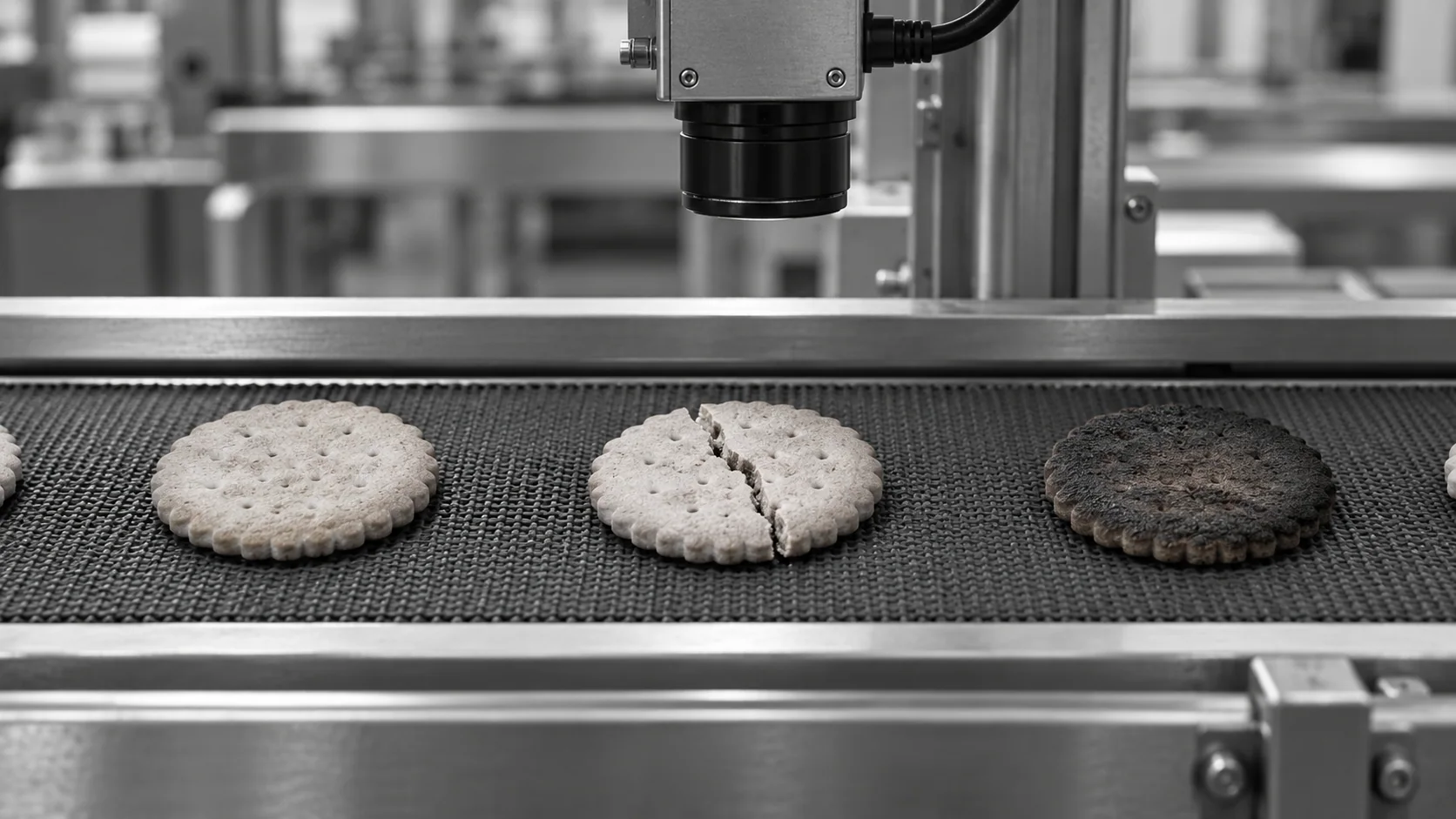
- Detect cracks, chips, burns, deformities and missing features
- Classify defects by type and severity
- Send minor defects to a rework or second-grade lane
- Learn normal variation so good product is not rejected
KOMPASS brings defect sorting to every item on the line, removing faulty ones without stopping production. AI vision classifies each defect, tracks the item to the reject point and triggers the right mechanism at the right moment, so defective product is removed before packing.
An inspection that spots a defect but cannot remove the right item in time still lets bad product through. Defect sorting on fast lines depends on timing, tracking and the reject mechanism as much as on detection.
Our AI Product Inspection system, KOMPASS™, runs defect sorting end to end: AI models trained on your products classify defects, each failing item is tracked along the conveyor and the reject mechanism fires at the right moment. Every decision is stored with an image.

Jidoka's demonstration shows defect sorting on a high-speed biscuit line. KOMPASS detects cracks, chipped edges, burn marks, dark spots, wrong orientation and cream faults, and defective biscuits are tracked and rejected automatically.
Cameras across the conveyor width capture each item, and the model classifies any defect against your standard.
Each failing item is tracked along the conveyor so the mechanism fires at exactly the right item.
The item is removed, removal is confirmed and every decision is stored with its image and defect type.
Send us examples of the defects you need removed, your line speed and product spacing. We will assess inspection and reject mechanism options for defect sorting on your line.
Get In TouchEach method can remove defective product. The difference is how reliably defect sorting removes the right item at speed.
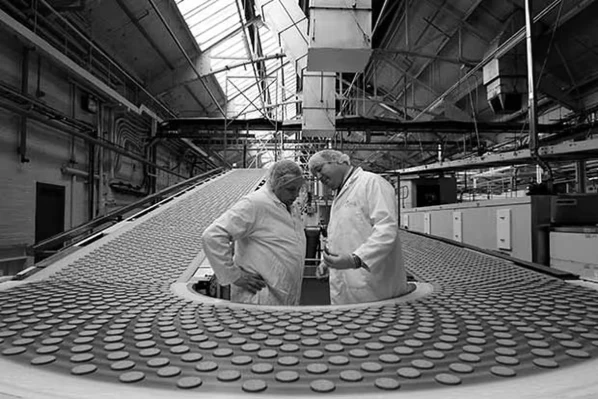
KOMPASS detects cracks, chips and burn marks on Britannia's biscuit lines, and the Tigris automatic rejection unit removes defective pieces without stopping production.

Published results for Britannia's in-line defect sorting and rejection of biscuits.
Defect sorting combines three steps: inspecting every item, deciding whether its defects fail your standard and physically removing the failing items. KOMPASS handles the inspection and decision with AI models trained on your products, then tracks each failing item and triggers the reject mechanism. Items can also be split into reject, rework and pass streams depending on defect type and severity. Every decision is stored with its image, so quality teams can review exactly why an item was removed.
Air jets suit light items such as biscuits, snacks and small parts. Pusher arms and flippers suit cartons, bottles and heavier items, while diverter gates suit items that need routing to a separate conveyor. Robots can pick items where gentle handling matters. The choice depends on item size, weight, fragility, spacing and line speed. Mechanisms are chosen so they remove the failing item without disturbing its neighbours.
Each failing item is tracked from the camera to the reject point. Encoder tracking measures conveyor movement precisely, so the mechanism fires when that specific item arrives, even if the belt speed changes. The timing includes the mechanism's own response time. That matters most when items are close together and a slight error would hit a neighbouring good item. Tracking is tested during commissioning with marked test items at full speed.
A jammed pusher, a blocked nozzle or low air pressure can stop a reject without anyone noticing. Reject confirmation uses a sensor or camera at the reject point to check that each rejected item actually left the line. If it did not, the line can stop or alert the team, so a defective item never continues silently. The confirmation result is logged too, so maintenance can see when a mechanism starts to fail.
Yes. Not every defect means scrap. Items with cosmetic or minor defects can go to a rework lane or be packed as second-grade product, while serious defects go to the reject bin. Defect classes and their destinations are agreed with your quality team, which reduces waste without letting serious defects through. This kind of quality sorting turns some would-be scrap into saleable product.
Training includes acceptable items with normal variation, so the model learns what does not count as a defect. Over-rejection is measured separately from missed defects during validation, and limits are adjusted until both meet your targets. A review lane can be used during the first weeks before fully automatic rejection is switched on. Agreed examples of acceptable variation also help operators trust the station quickly.
Inspection and rejection are designed together for your conveyor. Multiple cameras can cover a wide conveyor, and the mechanism is chosen to act within the spacing between items. Feasibility is confirmed against the full cycle of capture, decision, tracking and removal, not inspection speed alone, as shown on Jidoka's high-speed biscuit line. Where the spacing is too tight for one mechanism, the layout is adjusted before installation.
Send examples of the defects you need removed, with acceptable items for comparison, your throughput, product spacing and conveyor layout. Tell us where reject, rework and pass streams can go. With that, we can recommend cameras, tracking and the mechanism for a reject system on your line. Acceptable items close to the reject limit are as important as clear defects for training.
Share your defect examples, line speed, product spacing and layout. We will design defect sorting for your products and set out timing and cost. KOMPASS deployments typically run 6 to 8 weeks.