












SIZE-BASED SORTING

Size Sorting to Route Every Part to the Right Class

KOMPASS brings size sorting to parts and products as they move along the line. AI vision measures each item, assigns it to the size class your grade limits define and triggers the diverter for that lane, so mixed sizes are separated automatically.

Discuss Your Sorting

Trusted by manufacturers to improve quality on the line

THE PROBLEM

Mixed Sizes Cause Problems at Every Step After

When parts or products of different sizes end up together, assembly jams, packs look uneven and customers receive the wrong grade. Sorting them by hand or with fixed gaps is slow and imprecise.

Manual Grading Drifts

People sorting by eye or with a gauge slow down and disagree on borderline items, especially near the boundary between two classes.

Fixed Gaps Wear and Clog

Rollers, sieves and slots change as they wear, and they sort on one dimension only. Odd shapes slip into the wrong class.

Wrong Class, Wrong Customer

An oversize part in an undersize bin causes assembly faults downstream, and a mixed pack becomes a complaint.
The Solution

Measure Every Item, Then Route It

Our AI Product Inspection system, KOMPASS™, performs size sorting with calibrated vision and trained models that measure each item and assign it to a class. The decision drives the diverter and is stored with an image of every item.

Assign Each Item to the Right Class

  • Measure length, width, diameter or area as each item passes
  • Use the dimension, or combination, that defines your grades
  • Assign each item to a class from your grade limits
  • Flag items outside every class for review
Every item
Measured and classed
Your grades
Limits you define
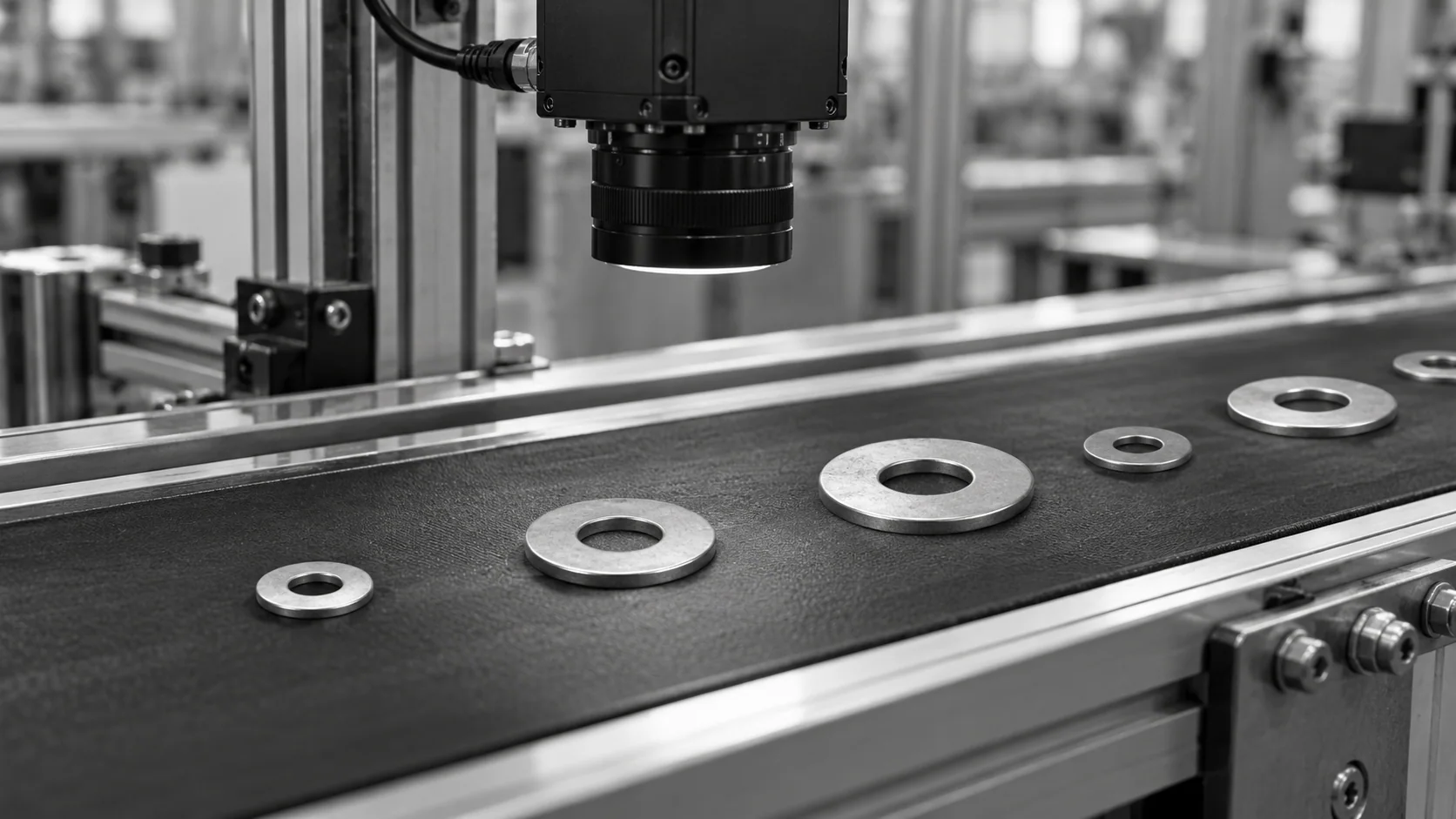
Conceptual illustration of washers with different diameters beneath an inspection camera.

Drive the Diverter for Each Lane

  • Trigger diverter gates, air jets or pushers per class
  • Track each item from camera to its lane
  • Report counts per class for production records
  • Store each decision with its image for review
Per class
Counts and trends
Image evidence
Every decision reviewable
HOW IT WORKS

From Camera to Sorting Lane

Size sorting combines measurement, classification and timing. KOMPASS brings them together with a calibrated view, models trained on your items and a direct link to the diverters.

Highlight #1

Present Items One at a Time

Items are spaced on the conveyor so each is seen clearly. The camera view is calibrated so pixels convert to millimetres.

Highlight #2

Measure and Assign a Class

The model measures the defining dimensions and assigns each item to the class set by your grade limits.

Highlight #3

Divert and Record

The item is tracked to its lane and diverted, while counts per class and every image are stored.

Connect With Us

Send us samples across your size range, your grade limits and the throughput you need. We will assess presentation and diverter timing for size sorting on your line.

Get In Touch

What Changes When Sorting Is Based on Measurement?

Manual grading, mechanical sizing and vision-based size sorting each have a place. The difference is how precisely and flexibly items are classed.

Sorting need
Manual grading
Mechanical sizing
KOMPASS AI
Precision near class limits
Varies by person
Depends on wear of gaps and rollers
Measured against your limits
Dimension used
Judged by eye
Usually one dimension
The dimension or combination you choose
Changing grades
Retrain people
Change hardware
Change limits in software
First-Time-Right
Depends on attention
Stable until parts wear
Routes every item to the right class

Frequently Asked Questions

How does vision decide which class an item belongs to?

Size sorting with vision measures each item from a calibrated image, using the dimension or combination of dimensions that defines your grades, such as diameter, length or area. The measurement is compared with your grade limits to assign one of your size classes. The decision is then sent to the diverter for that class, timed to the moment the item reaches its lane. Each decision is stored with its image and measurement, so any class assignment can be checked later.

Which items can be sorted by size?

Washers, bushings, fasteners, moulded parts, castings, seeds, nuts and many food products are common examples. Items should be presented one at a time or with enough space between them for the camera to see each clearly. Singulation, using a feeder or spaced conveyor, is usually the first step in designing the station, because measurement depends on it. The trial confirms how items behave on the feeder before any hardware is ordered.

Why move away from sieves and rollers?

For size grading, mechanical graders sort by passing items through gaps, which works for simple shapes but wears over time and usually considers one dimension only. Irregular shapes can slip through in the wrong orientation. Vision measures the actual item and applies limits in software, so classes stay consistent and can be changed for a new product without changing hardware. It also removes the need to stop the line to adjust gaps when products change.

What happens to items that fit no class?

Oversize parts and undersize parts that fall outside every class go to a separate lane for review or scrap. Items that cannot be measured reliably, for example because two are touching, are routed to a recirculation or review lane instead of being guessed. Counts of out-of-range items also show when the upstream process is drifting. That makes the out-of-range lane a useful early warning, not just a waste bin.

How are items routed to their lanes?

Diverter gates, pneumatic diverters, pushers or flippers move each item into the sorting lanes for its class. The station tracks each item from the camera to the diverter using conveyor speed or an encoder, so the right item is moved even when items are close together. The choice of mechanism depends on item size, weight and fragility.

Can it separate stock from several sources?

Yes. Mixed-size batches, such as returned stock, combined production runs or parts from several machines, can be separated into classes in one pass. Counts per class show how the mix breaks down. Where items also differ in type, size sorting can be combined with product identification at the same station. The station can also record which source each class came from when that information is available.

How is sorting precision validated?

Run items with known sizes across every class, including items just inside and just outside each boundary. Compare the assigned classes with reference measurements and check results at the intended throughput. Class boundaries may need a small margin near boundaries, agreed with your quality team, depending on how measurement variation compares with the class width. Results are repeated across shifts to confirm the station holds its precision.

What should we send to plan sorting by size?

Send samples across your full size range, the class boundaries, the throughput you need and how items arrive today. Tell us how many classes you sort into and where the lanes can go. With that, we can recommend presentation, camera setup and diverters for a size sorting machine on your line. Samples near each class boundary matter most, because they test the station's precision.

CONNECT WITH OUR EXPERTS

Show Us the Sizes You Need to Separate

Share samples, grade limits, throughput and how items arrive. We will design size sorting around your classes and walk through timing and cost. Most KOMPASS projects go live in 6 to 8 weeks.

Discuss Your Sorting
Close video