Cualquier proveedor de soluciones de IA para la fabricación en 2026 puede mostrar una demostración impecable, un panel con cifras impresionantes y la promesa de estar listos para la producción en seis semanas. El verdadero proyecto comienza después del contrato: las revisiones de seguridad alargan los plazos, la integración resulta difícil, la adopción se estanca y el departamento financiero pregunta dónde quedó el retorno de inversión. Tres de cada cuatro implementaciones de IA en la fabricación se detienen en la fase piloto. La causa raíz en la mayoría de los casos no es la capacidad del proveedor, sino la calidad de los datos, algo que el comprador nunca evaluó antes de firmar.
Por qué la mayoría de los pilotos de IA en la fabricación se estancan antes de alcanzar la escala de producción
La mayoría de los pilotos de soluciones de IA para la fabricación se estancan antes de alcanzar la escala de producción, y la causa raíz en la gran mayoría de los casos es la calidad de los datos, no la capacidad del modelo. El 68% de los ejecutivos de tecnología cita la mala calidad de los datos como la razón principal por la que las iniciativas de IA fracasan, un patrón que se mantiene tanto en la inspección visual como en el mantenimiento predictivo y las categorías de IA para programación (BuildMVPFast, marzo de 2026).
Además, el 74% de los líderes organizacionales informa que los datos de su empresa aún no están listos para la IA (Guía de adquisición de SpecLens AI, marzo de 2026). El desafío de la guía de implementación de IA en la fabricación no es encontrar proveedores de IA capaces, sino confirmar que la infraestructura de datos de la propia organización compradora pueda soportar cualquier despliegue de IA antes de comenzar la selección del proveedor.
La brecha entre la demostración y la producción que estanca los pilotos
Los proveedores de IA para la fabricación demuestran flujos de trabajo asistidos con conjuntos de datos seleccionados, paneles creados a partir de datos históricos limpios y plazos de implementación que comienzan después de configurar el software. Lo que no demuestran en la presentación inicial es qué sucede cuando su modelo se expone a la inconsistencia e incompletitud de los datos de producción reales: etiquetado irregular, tipos de defectos poco comunes con ejemplos de entrenamiento insuficientes, datos de sensores con lagunas y obstáculos de integración que el equipo de TI solo revela durante la revisión de seguridad.
El patrón de fracaso es consistente en todas las categorías de soluciones de IA para la fabricación (Marco de evaluación de proveedores de IA de AINinza, abril de 2026): el piloto funciona bien con el subconjunto de datos limpios utilizado durante la evaluación, pero pierde rendimiento una vez expuesto al entorno completo y desordenado de los datos de producción que la evaluación nunca probó. El comprador concluye que el proveedor exageró. El proveedor concluye que los datos del comprador no eran lo que describieron. Ambos tienen razón.
Por qué la calidad de los datos es la causa raíz, no la excusa
El etiquetado inconsistente de imágenes de defectos es el fallo de calidad de datos más común en los despliegues de visión artificial: el mismo tipo de defecto etiquetado de forma diferente por tres operadores a lo largo de seis meses de datos históricos produce un modelo que no puede clasificar ese defecto de manera fiable. Los tipos de defectos poco comunes con menos de 50 ejemplos etiquetados producen modelos que pasan por alto esa categoría por completo. Las lagunas en los datos de los sensores en las aplicaciones de mantenimiento predictivo producen modelos que aprenden a predecir basándose en las lecturas disponibles en lugar del conjunto completo de parámetros, generando alertas falsas sobre las variables faltantes.
Ninguno de estos es un fallo de capacidad del modelo. Son fallos en la preparación de los datos que una evaluación de preparación de datos previa a la contratación del proveedor habría identificado y presupuestado antes de firmar el contrato de la solución de IA para la fabricación.
Qué significa realmente la preparación de los datos antes de cualquier conversación con un proveedor
La preparación de los datos para una solución de IA en la fabricación significa cuatro cosas: un volumen suficiente de ejemplos etiquetados para los requisitos de entrenamiento de cada categoría de IA, una taxonomía de etiquetado consistente aplicada a todo el conjunto de datos históricos, un formato de datos accesible que el sistema de IA pueda ingerir sin conversión manual y términos claros de propiedad de los datos que permitan al proveedor de IA utilizar los datos de la planta para el entrenamiento y refinamiento del modelo. Solo el 60% de los fabricantes tiene una estrategia de IA dedicada (WorkInsiders, enero de 2026), y la mayoría de esas estrategias no incluyen una evaluación previa de preparación de datos antes de comenzar la selección del proveedor.
Marco de evaluación de cinco preguntas para soluciones de IA en manufactura
El marco de evaluación de cinco preguntas para plataformas de IA en fábricas se aplica a todas las categorías de IA: inspección visual, mantenimiento predictivo, monitoreo de cumplimiento de procesos y optimización de programación. Un proveedor que no puede responder a las cinco preguntas con especificidad está presentando una demostración. Un proveedor que responde a las cinco con evidencia documentada es un candidato para producción.
Pregunta 1: ¿Cómo se mide el valor y cuál es la línea base de antes y después?
La decepción más común tras la implementación de una solución de IA en manufactura es la ausencia de una línea base de medición acordada previamente. Si el proveedor y el comprador no acordaron qué métrica rastrear, con qué frecuencia y cuál era el valor base antes de la implementación, no hay forma de demostrar el ROI después de la misma.
Exija a cada proveedor que especifique el KPI exacto que mejora su sistema, el método de medición y el valor base como parte del contrato. Un proveedor que dice "el ROI depende de su contexto" sin proponer una metodología de medición está confirmando que no tiene un caso de ROI estructurado. Esa respuesta es una señal para solicitar referencias de instalaciones comparables donde los datos de línea base frente a resultados estén documentados.
Pregunta 2: ¿Qué datos necesita el sistema y los tiene usted?
Cada categoría de solución de IA en manufactura tiene un requisito de datos específico. La IA de visión requiere imágenes de defectos etiquetadas, un mínimo de 200 por tipo de defecto. El mantenimiento predictivo requiere datos históricos de sensores con eventos de falla registrados, típicamente 12 meses como mínimo. El monitoreo de cumplimiento de procesos requiere SOP digitales y cobertura de cámara de las áreas de trabajo de los operadores. La optimización de programación requiere cronogramas de producción históricos y datos reales con información de restricciones.
La evaluación de selección de proveedores de IA para manufactura debe incluir una auditoría de datos estructurada donde el proveedor revise una muestra de sus datos reales y confirme si cumplen con sus requisitos de entrenamiento antes de firmar el contrato. Un proveedor que procede a la contratación sin revisar sus datos está asumiendo que estos cumplen con sus requisitos. Esa suposición es donde comienza el 68% de los fallos de IA.
Pregunta 3: ¿Cómo se integra el sistema en su stack actual?
La integración es donde la mayoría de los proyectos de implementación de IA en manufactura superan su cronograma y presupuesto originales. El acceso mediante API a los sistemas QMS, MES y PLC de la planta es el requisito de infraestructura. Un sistema de IA de visión que genera eventos de clasificación de defectos pero no puede enviarlos al endpoint NCR del QMS crea una nueva isla de datos.
Exija un documento de especificación de integración por escrito de cada proveedor antes de firmar el contrato: a qué sistemas se conectan, a través de qué protocolo API y cómo es el formato de datos de los eventos salientes. Ejecute una integración API de prueba de concepto con su QMS real durante el período de evaluación. Cualquier proveedor que posponga la integración para después del contrato está posponiendo el descubrimiento de un posible obstáculo.
Pregunta 4: ¿Qué sucede cuando la confianza de la IA es baja?
Toda solución de IA en manufactura genera resultados de baja confianza para casos que quedan fuera de su distribución de entrenamiento. La pregunta es qué sucede con esos resultados: ¿el sistema los marca para revisión humana, rechaza el producto automáticamente o los pasa como un producto bueno? La ausencia de una ruta de escalamiento diseñada para baja confianza es la brecha de capacidad de nivel de producción más común en sistemas de IA que funcionan bien en demostraciones curadas.
El flujo de trabajo de revisión de baja confianza define dónde permanece el juicio de calidad humano en el proceso. Un sistema de IA de visión que marca casos por debajo del 88% de confianza para inspección humana antes de tomar una decisión de rechazo protege la calidad en el borde. Un sistema que toma decisiones binarias de pasa/no pasa en todos los casos independientemente de la confianza produce falsos negativos en casos límite que una ruta de escalamiento diseñada habría detectado.
Pregunta 5: ¿Cuál es el cronograma de implementación realista, incluida la preparación de datos?
Un proveedor que cotiza un cronograma de puesta en marcha de seis semanas está cotizando el tiempo de configuración de software para una instalación cuyos datos ya están limpios, etiquetados y accesibles. El cronograma de implementación realista de IA en manufactura para la mayoría de las instalaciones incluye una auditoría de datos de 2 a 4 semanas, de 4 a 8 semanas para la preselección y evaluación de proveedores, y de 8 a 16 semanas para un piloto estructurado con criterios de éxito definidos antes de cualquier decisión de escala de producción. Eso es un mínimo de 14 a 28 semanas desde la decisión hasta el resultado del piloto validado.
Los proveedores que cotizan un número de cronograma único sin desglosar estas fases están cotizando el escenario más rápido posible. Solicite un cronograma por fases con el componente de preparación de datos explícitamente definido. El cálculo de costos de la solución de IA de fábrica debe incluir la mano de obra de preparación de datos como una partida, no como una ocurrencia tardía descubierta en la semana 6.
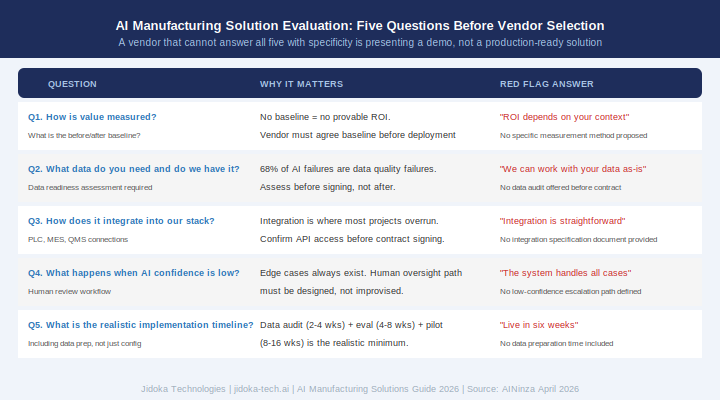
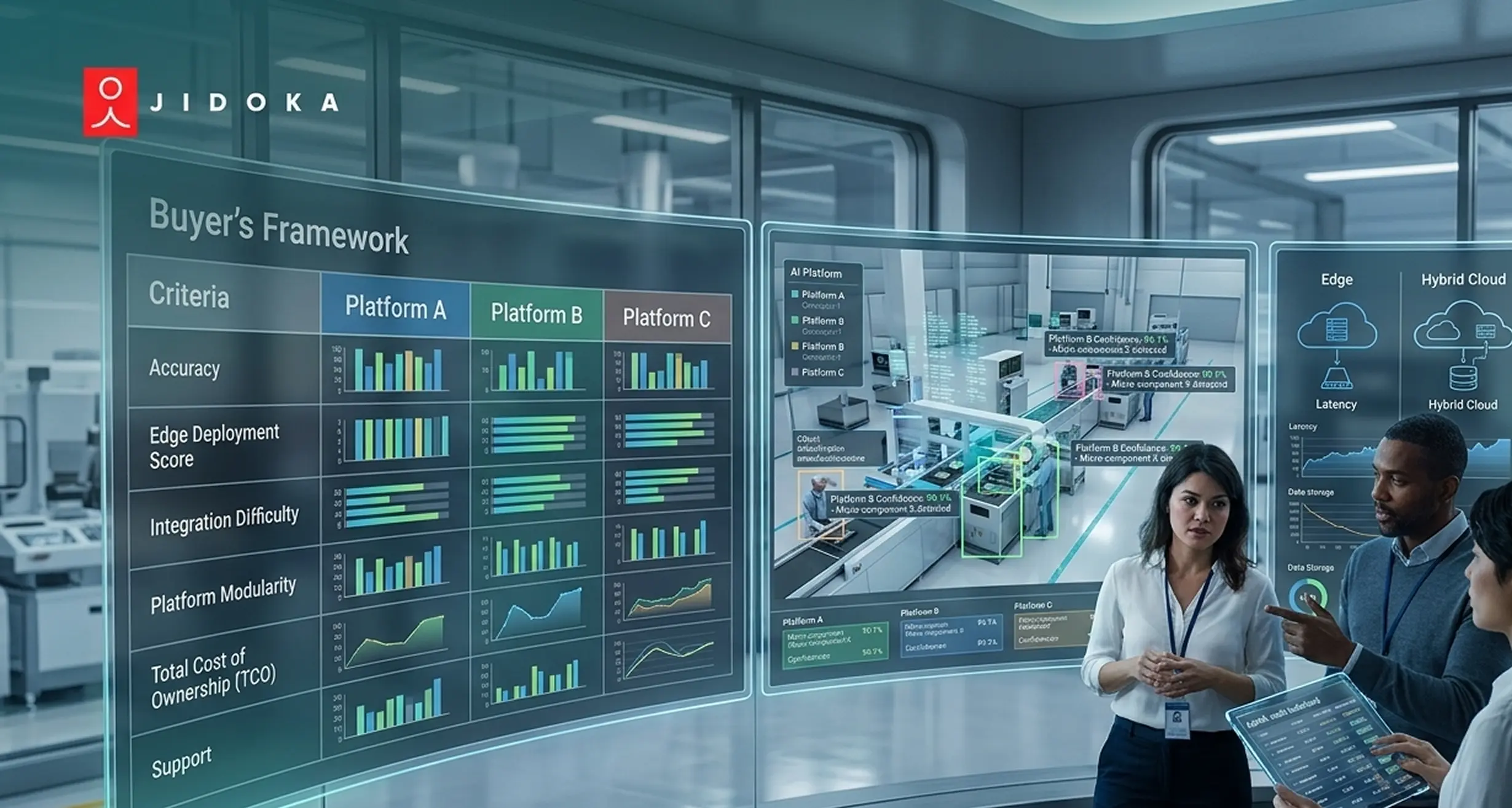
Figura 1: Marco de evaluación de cinco preguntas para soluciones de IA en manufactura con respuestas de alerta roja para cada criterio
Las cuatro categorías de soluciones de IA para la fabricación
Las cuatro categorías principales de soluciones de IA para la fabricación son el mantenimiento predictivo, la visión artificial para el control de calidad, el seguimiento del cumplimiento de procesos y la optimización de la programación de la producción. Cada una requiere una base de datos diferente y resuelve un problema operativo fundamentalmente distinto. Evaluarlas bajo una única categoría de "IA para la fabricación" sin distinguirlas entre sí genera comparaciones de proveedores que confunden tipos de capacidades que no compiten entre sí.
Categoría n.º 1. IA para el mantenimiento predictivo
La IA para el mantenimiento predictivo pronostica fallos en los equipos con entre 14 y 30 días de antelación a partir de datos de sensores de vibración, temperatura, consumo de corriente y acústicos (Guía de IA para la fabricación de TeepTrak, abril de 2026). El requisito de datos consiste en lecturas históricas de sensores con eventos de fallo registrados cronológicamente durante al menos 12 meses, además de un sistema de gestión de mantenimiento (CMMS) que registre los eventos de mantenimiento reales para el entrenamiento del modelo.
La comparación de plataformas de producción con IA para el mantenimiento predictivo debe evaluar el tiempo de antelación de las alertas (con cuánta antelación se predice el fallo), la tasa de falsas alarmas (con qué frecuencia se envía mantenimiento sin encontrar una avería) y la calidad de la integración con el CMMS. Un sistema que predice fallos con 30 días de antelación pero genera un 25 % de falsas alarmas erosiona la confianza del equipo de mantenimiento en los 90 días posteriores a su implementación.
Categoría n.º 2. Visión artificial para el control de calidad
La visión artificial para el control de calidad clasifica los defectos del producto con una cobertura de inspección del 100 %, logrando una precisión del 99 al 99,8 % en implementaciones de producción bien entrenadas, frente al 85 % de los sistemas de visión artificial basados en reglas (Mejor software de inspección por IA de iFactory, 2026). El requisito de datos es un mínimo de 200 imágenes de defectos etiquetadas por tipo de defecto, obtenidas de la línea de producción real y del entorno de iluminación correspondiente.
La inspección por visión artificial KOMPASS es la implementación de grado industrial de Jidoka para esta categoría; realiza la clasificación de defectos en tiempo real a velocidad de producción y transmite eventos de inspección estructurados a plataformas QMS mediante API. La evaluación de soluciones de IA para la fabricación en el ámbito de la visión artificial debe probar la precisión y la tasa de falsos positivos con el propio conjunto de imágenes de defectos del comprador antes de tomar cualquier decisión de adquisición.
Categoría n.º 3. Seguimiento del cumplimiento de procesos
El seguimiento del cumplimiento de procesos verifica que los operarios de producción completen las instrucciones de trabajo en la secuencia correcta, en el tiempo de ciclo adecuado y con los materiales correctos. El requisito de datos son los procedimientos operativos estándar (SOP) digitalizados para cada paso de la producción y la cobertura mediante cámaras de todas las áreas de trabajo de los operarios. Esta categoría de IA respalda directamente la investigación de causas raíz en los flujos de trabajo CAPA al proporcionar registros de desviaciones de proceso con marca de tiempo.
NAGARE es la implementación de Jidoka para el seguimiento del cumplimiento de procesos, que proporciona datos de cumplimiento del operario a nivel de paso, vinculando los resultados de los defectos del producto con desviaciones específicas del proceso. KOMPASS y NAGARE cubren conjuntamente tanto la inspección de calidad como el cumplimiento de procesos dentro del mismo entorno de producción, alimentando con datos integrados los flujos de trabajo CAPA del QMS.
Categoría n.º 4. Optimización de la programación de la producción
La optimización de la programación de la producción utiliza IA para asignar capacidad, secuenciar pedidos y equilibrar las líneas de producción basándose en restricciones que las herramientas de programación manual gestionan mediante hojas de cálculo y la experiencia del operario. El requisito de datos son los programas de producción históricos, los datos de finalización real frente a la planificada y los registros de restricciones del MES.
Esta categoría es la que más se aleja de la inspección por IA en planta y el seguimiento del cumplimiento que abordan KOMPASS y NAGARE. Los compradores que comparan la IA de programación bajo la misma etiqueta de "IA para la fabricación" que la inspección por visión o el mantenimiento predictivo están comparando soluciones con requisitos de datos, plazos de implementación y metodologías de medición del ROI fundamentalmente diferentes.
Un plan de implementación basado en datos para la IA en la fabricación
Una guía de implementación de IA para la fabricación que comienza con la selección de proveedores antes de evaluar la preparación de los datos genera proyectos piloto que se estancan. La secuencia correcta es: primero, auditoría de datos; segundo, preselección de proveedores; tercero, proyecto piloto estructurado; y cuarto, decisión de escalado basada en la evidencia del piloto, no en la proyección de ROI del proveedor.
Fase 1: Auditoría de datos antes de hablar con cualquier proveedor (semanas 2 a 4)
La auditoría de datos debe responder a cuatro preguntas para la categoría de IA objetivo: cuántos ejemplos etiquetados existen para cada clase que el modelo debe aprender, qué tan consistente es la taxonomía de etiquetado en el conjunto de datos histórico, cuál es el formato de los datos y si son accesibles sin conversión manual, y cuáles son los términos de propiedad de los datos en los contratos actuales con los proveedores de QMS, MES y sensores.
Una auditoría de datos que revela menos de 100 ejemplos etiquetados para un tipo de defecto clave es una señal sobre los plazos del proyecto, no un impedimento. Significa que la fase de recopilación de datos debe presupuestarse y programarse antes de comenzar la evaluación de proveedores. Un proveedor de soluciones de IA para fabricación que le diga durante la presentación que la recopilación de datos se gestionará después de la firma del contrato le está indicando que el costo y el cronograma no están dentro del alcance de su contrato.
Fase 2: Preselección y evaluación de proveedores (semanas 4 a 12)
Aplique el marco de cinco preguntas a cada candidato de la lista corta de proveedores. Exija una prueba de concepto con sus datos reales antes de enviar cualquier recomendación de adquisición a la dirección. El marco de evaluación de plataformas de IA para fábricas de cinco preguntas aplicado en esta etapa genera un registro de evaluación documentado que respalda la decisión de compra y proporciona una base para medir el ROI tras la implementación.
Para inspección visual mediante IA para el control de calidad específicamente, exija una prueba de precisión en vivo con al menos 500 imágenes etiquetadas de su taxonomía de defectos real antes de discutir el contrato. Para el mantenimiento predictivo, exija al proveedor que revise una muestra de sus datos de sensores y confirme por escrito que cumple con sus requisitos de datos de entrenamiento.
Fase 3: Piloto estructurado con criterios de éxito definidos (semanas 8 a 24)
Un piloto estructurado se diferencia de un piloto de proveedor estándar en un aspecto crítico: los criterios de éxito y la metodología de medición se acuerdan antes de que comience el piloto, no se evalúan después. El comprador especifica el KPI, la línea base, la frecuencia de medición y la mejora mínima requerida para tomar una decisión de escalado positiva. El proveedor acepta estos criterios antes de que comience el piloto.
Ejecute el piloto con datos de producción en condiciones reales. Ejecute la solución de IA para fabricación en paralelo con el método existente durante un mínimo de 30 días antes de eliminar cualquier protección de calidad actual. Utilice los resultados del piloto, no las proyecciones de ROI del proveedor, como base para la decisión de inversión en escalado.
Fase 4: Decisión de escalado basada en la evidencia del piloto (mes 6 en adelante)
La decisión de escalado debe basarse en tres resultados documentados del piloto: la mejora medida en el KPI objetivo frente a la línea base acordada previamente, el costo total de la fase piloto frente al costo proyectado de la implementación en producción y la evaluación de preparación operativa (¿sabe el equipo cómo ejecutar el sistema, responder a las alertas e introducir nuevos casos límite en el modelo?).
Tres de cada cuatro pilotos de soluciones de IA para fabricación se estancan porque la decisión de escalado se toma sin esta evidencia, basándose en impresiones anecdóticas del piloto o en estudios de casos de proveedores de contextos diferentes. Las instalaciones que escalan la IA con éxito son aquellas que definen el éxito antes de que comience el piloto y toman la decisión de escalado basándose en evidencia medida una vez que este termina.
Conclusión
Tres de cada cuatro pilotos de soluciones de IA para fabricación se estancan, y la causa raíz es casi siempre una calidad de datos que el comprador nunca evaluó, no una capacidad del proveedor evaluada con demasiada generosidad. El marco de cinco preguntas y la secuencia de priorizar la preparación de los datos de esta guía distinguen a las instalaciones que escalan su inversión en IA de aquellas que solo tienen un piloto estancado que mostrar al final del ciclo presupuestario.
Vea cómo funcionan KOMPASS y NAGARE frente al marco de evaluación de cinco preguntas utilizando sus propios datos de producción en jidoka-tech.
Preguntas frecuentes
1. ¿Por qué la mayoría de los proyectos piloto de IA en manufactura no logran escalar a producción?
La mayoría de los proyectos piloto de soluciones de IA en manufactura no logran escalar a producción debido a problemas de calidad de datos, no a las capacidades del modelo. El 68% de los ejecutivos de tecnología señala la mala calidad de los datos como la razón principal del fracaso de las iniciativas de IA. El patrón de fracaso se repite en todas las categorías: un modelo funciona bien con datos de prueba seleccionados, pero pierde eficacia al enfrentarse a la inconsistencia e incompletitud de los datos reales de producción, ya que el comprador nunca evaluó la preparación de los datos antes de comenzar la selección del proveedor.
2. ¿Qué preguntas debe hacer antes de elegir un proveedor de IA para manufactura?
Haga cinco preguntas antes de elegir un proveedor de IA para manufactura: cómo se mide el valor y cuál es la línea base de comparación, qué datos requiere el sistema y si usted los posee, cómo se integra en su infraestructura actual, qué sucede cuando la confianza de la IA es baja y quién revisa esos resultados, y cuál es el cronograma de implementación realista, incluyendo el tiempo de preparación de datos. Un proveedor que no pueda responder a estas cinco preguntas con especificidad está presentando una demostración, no una solución de IA para manufactura lista para producción.
3. ¿Cuánto tiempo lleva implementar una solución de IA para manufactura?
Los cronogramas de implementación de IA en manufactura dependen en gran medida de la preparación de los datos: una auditoría de datos suele tomar de 2 a 4 semanas, la preselección y evaluación de proveedores de 4 a 8 semanas, un piloto con criterios de éxito definidos dura de 8 a 16 semanas, y las decisiones de escalado se toman solo después de medir los resultados del piloto frente a criterios predefinidos. Los proveedores que ofrecen una cifra única de tiempo sin desglosar estas fases están citando el escenario más optimista, no el realista para el punto de partida de los datos de una planta.
4. ¿Cuáles son las principales categorías de soluciones de IA para manufactura?
Las cuatro categorías principales de soluciones de IA para manufactura son: mantenimiento predictivo (previsión de fallos en equipos a partir de datos de sensores), visión artificial para inspección de calidad (clasificación de defectos en tiempo real a partir de imágenes de producción), monitoreo de cumplimiento de procesos (verificación de acciones del operador frente a procedimientos operativos estándar digitales) y optimización de la programación de la producción. Cada categoría requiere una base de datos diferente y resuelve un problema operativo fundamentalmente distinto. Comparar plataformas de IA de producción en las cuatro categorías bajo un mismo marco de evaluación genera resultados poco precisos.
5. ¿Cómo evaluar la preparación de los datos antes de una implementación de IA en manufactura?
Evalúe la preparación de los datos verificando cuatro criterios para la categoría de IA objetivo: volumen suficiente de ejemplos etiquetados (mínimo 200 por clase para visión artificial, 12 meses de historial de sensores para mantenimiento predictivo), taxonomía de etiquetado consistente en todo el conjunto de datos históricos, formato de datos accesible que el proveedor pueda ingerir sin conversión manual y términos claros de propiedad de datos en los contratos de los sistemas existentes. Una guía de implementación de IA en manufactura que comience con esta evaluación antes de la selección del proveedor reduce la tasa de estancamiento de los pilotos del 75% a una fracción para los compradores bien preparados.