En la mayoría de las fábricas, los datos de producción circulan en una sola dirección: del plan a la planta. Sale el programa. Las máquinas arrancan. Las piezas avanzan. Los defectos se acumulan. El turno siguiente empieza con el mismo plan, sin cambios.
La fabricación en bucle cerrado rompe ese ciclo devolviendo los datos de ejecución de planta a la planificación, la gestión de calidad, los estándares de proceso y la formación. Así, cada ciclo de producción mejora de forma medible respecto al anterior; no solo cuando un evento Kaizen obliga a revisarlo.
Esta guía desglosa las tres definiciones distintas de fabricación en bucle cerrado, señala dónde la mayoría de los sistemas dejan abierto el bucle de ejecución y muestra cómo la IA lo hace alcanzable hoy.
Las tres definiciones de fabricación en bucle cerrado y cuál le afecta a usted
Bajo el nombre de fabricación en bucle cerrado conviven tres sistemas distintos. Cada uno cierra un hueco de realimentación diferente: la precisión de la planificación, la desviación de parámetros de máquina o la ejecución humana del proceso. Saber cuál le falta es el diagnóstico.
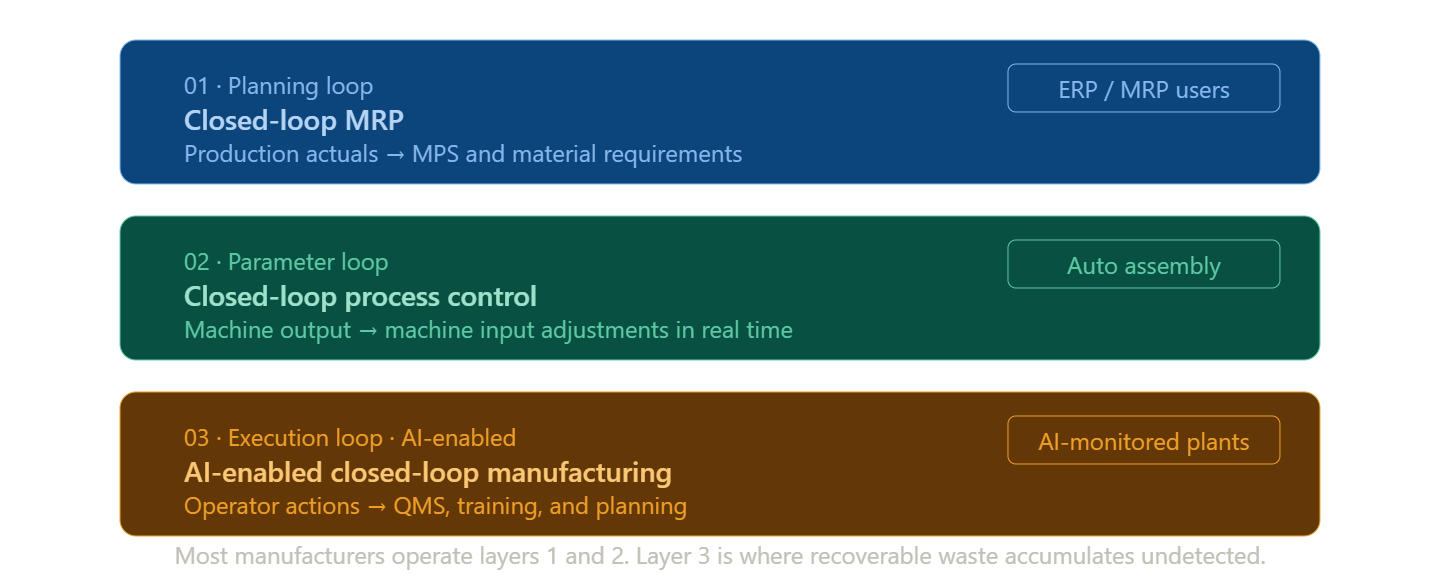
1. Bucle de planificación: MRP en bucle cerrado
En la capa de planificación, la fabricación en bucle cerrado devuelve los datos reales de producción al sistema MRP para ajustar de forma continua las necesidades futuras. El bucle se cierra cuando los datos de ejecución recalibran el plan. Es la definición de los años setenta y lo que entiende por «bucle cerrado» la mayor parte de la documentación de ERP.
2. Bucle de parámetros: control de proceso en bucle cerrado
A nivel de máquina, un sistema de producción en bucle cerrado mide una salida del proceso, la compara con un parámetro objetivo y ajusta automáticamente la entrada de la máquina para mantenerse en el objetivo. El control de par en el atornillado de automoción gobernado por PLC es el ejemplo estándar. La realimentación es física y ocurre en milisegundos.
3. Bucle de ejecución: fabricación en bucle cerrado con IA
La capa más reciente y más decisiva para los fabricantes discretos. Los datos en tiempo real sobre las acciones del operario, el cumplimiento de la secuencia de montaje y los resultados de calidad vuelven automáticamente a los sistemas de calidad, formación y planificación. Sin informes manuales. Sin resúmenes de fin de turno.
La fabricación en bucle cerrado más completa hace funcionar las tres capas a la vez. El bucle de planificación cierra el hueco de programación. El de parámetros cierra el de desviación de máquina. El de ejecución cierra el hueco del proceso humano. La mayoría de los fabricantes que hoy usan ERP tienen los dos primeros. El bucle de ejecución es donde el sistema pasa de limitarse a informar sobre sí mismo a corregirse de verdad.
MRP en bucle cerrado: el sistema de realimentación de la planificación
En la capa de planificación, la fabricación en bucle cerrado convierte el plan maestro de producción de un documento estático de ejecución en un plan que se corrige solo, devolviendo los datos reales de planta a las necesidades de material y capacidad en tiempo real.
El MRP estándar es una tubería de un solo sentido. El plan maestro genera necesidades de material. Esas necesidades disparan compras y órdenes de producción. Lo que ocurre de verdad en planta permanece invisible para el plan. Las averías de máquina, los retrasos de proveedor y los rechazos de calidad no lo ajustan automáticamente. El planificador interviene a mano, normalmente cuando el daño ya se ve.
El MRP en bucle cerrado añade el camino de vuelta. Cinco módulos funcionales componen esa arquitectura de realimentación:
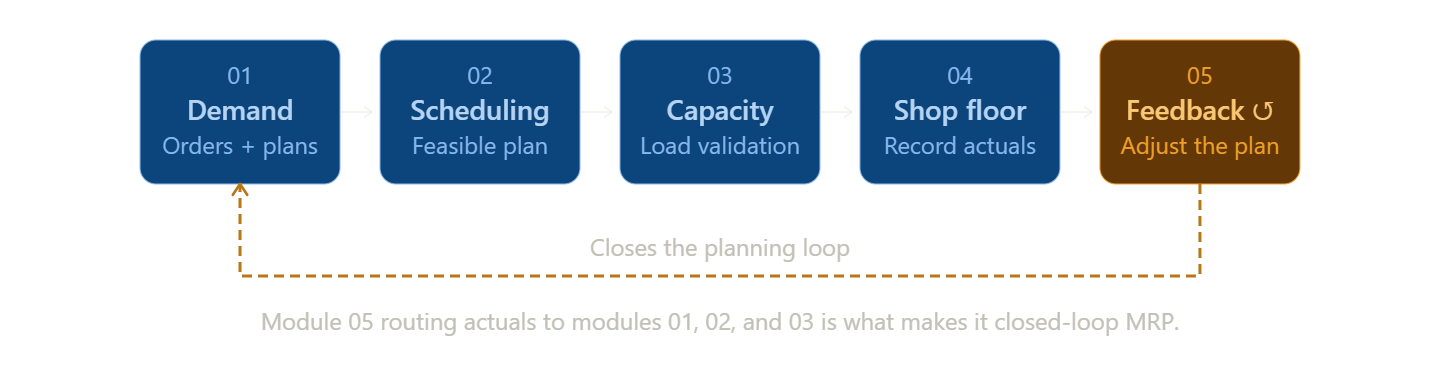
- Gestión de la demanda: consolida pedidos y previsiones en una única imagen actualizada de la demanda.
- Plan maestro de producción (MPS): traduce la demanda en un plan viable y escalonado en el tiempo.
- Planificación de necesidades de capacidad (CRP): valida el MPS frente a la capacidad disponible de máquina y de mano de obra antes de lanzarlo.
- Control de planta: ejecuta las órdenes y registra los datos reales: cantidades completadas, tiempos de ciclo, desviaciones.
- Realimentación y replanificación: devuelve esos datos reales al MPS y al MRP para ajustar las necesidades futuras de forma continua.
La realimentación del módulo 5 hacia los módulos 1 a 3 es lo que convierte la operación en un bucle cerrado a nivel de planificación. Sin ese camino de vuelta, lo que tiene es MRP. No fabricación en bucle cerrado.
Y solo funciona cuando los datos de planta vuelven de forma automática. La mayoría de las plantas con ERP tienen los módulos 1 a 4. El módulo 5 es donde el bucle se cierra o se queda abierto, y en la mayoría de las plantas la recogida manual de datos lo mantiene abierto.
Incluso cuando el módulo 5 funciona de forma automática, la capa de ejecución que hay por encima suele seguir de par en par.
El hueco de ejecución que la mayoría de los sistemas siguen dejando abierto
Cerrar el bucle en la capa de ejecución exige algo que la mayoría de los sistemas no pueden dar: un registro continuo y completo de lo que los operarios hicieron realmente, en qué paso, en qué estación y durante qué turno.
Su MRP sabe que se completaron 250 unidades. No sabe que 18 de ellas se montaron con una desviación de secuencia en la estación 4, en el turno de noche, por los mismos dos operarios, tres días seguidos. Y nunca lo sabrá salvo que alguien abra un informe de no conformidad. La mayoría de las desviaciones de secuencia no producen un defecto inmediato: se acumulan hasta que lo producen.
Cómo es ese vacío en planta
- Los sistemas de gestión de calidad solo reciben las no conformidades que los operarios registran. Las desviaciones de proceso que no generan un defecto visible de inmediato nunca entran en el QMS.
- Los sistemas de formación reciben datos de cursos completados. No reciben datos sobre qué operarios se desvían de qué pasos concretos en producción real.
- Los equipos de mejora continua analizan muestras de auditorías periódicas. No ven tendencias por turno del cumplimiento de pasos en todas las estaciones a la vez.
El bucle se rompe en la capa de ejecución porque históricamente no existía un mecanismo de observación escalable capaz de capturarla. Un auditor humano cubre una estación cada vez. La inspección de fin de línea detecta los defectos cuando ya están incorporados. Ninguno cierra el bucle en el origen.
Cerrarlo exige observar cada acción del operario, cada ciclo y cada turno, y encaminar esos datos a los sistemas que los necesitan. Un marco de bucle cerrado que se detiene en la planificación deja la capa de mayor impacto completamente abierta.
Antes, cerrar este bucle exigía observadores humanos dedicados. Ya no.
Cómo la IA cierra el bucle de ejecución: los cinco flujos de datos
Una operación en bucle cerrado con IA crea cinco flujos de datos concretos que antes no eran viables a escala de producción. Cada uno lleva datos de ejecución de planta a un sistema capaz de actuar sobre ellos de forma automática.
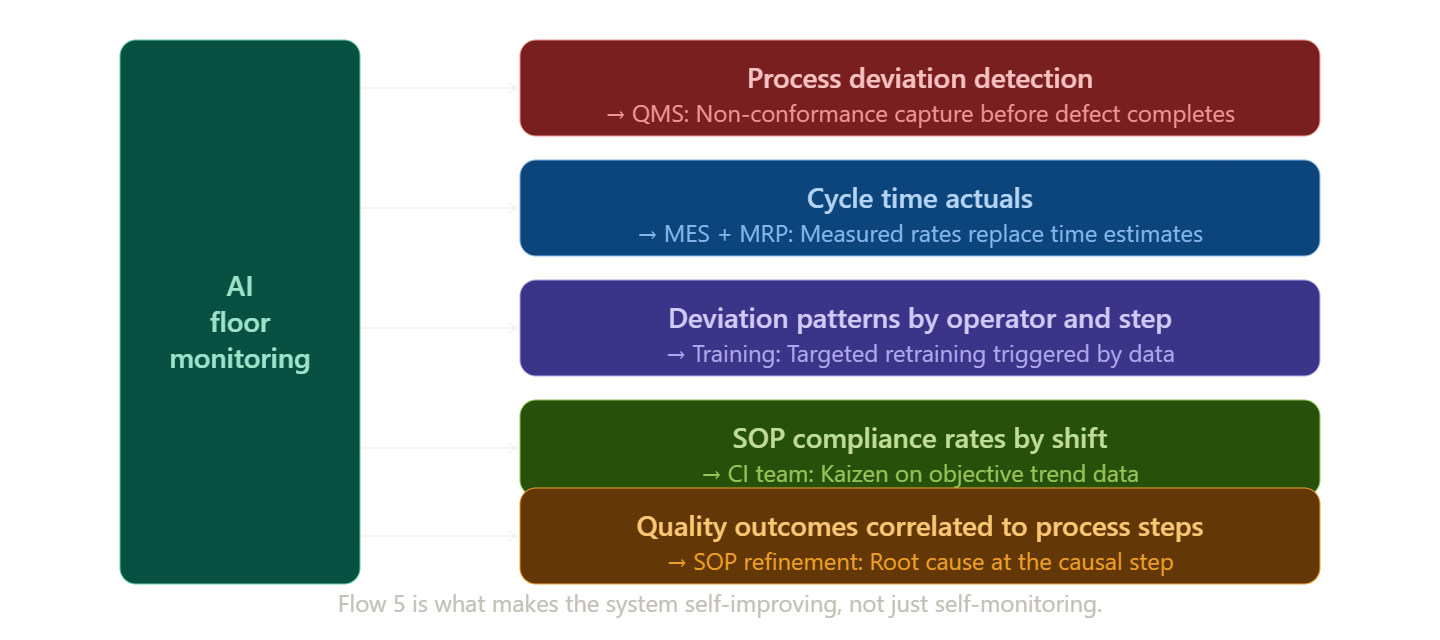
El quinto flujo es el que hace que el sistema se mejore a sí mismo en lugar de limitarse a vigilarse. Cuando los resultados de calidad se correlacionan con desviaciones concretas en pasos concretos, el SOP se ajusta en el origen.
Por qué esto exige IA y no solo cámaras
Una cámara graba. La IA interpreta. La diferencia está en la escala. Un observador humano audita con atención real una estación por turno. Un sistema de supervisión con IA cubre todas las estaciones a la vez, en cada ciclo y cada turno, y produce un registro del 100 % de las unidades fabricadas. Esa cobertura es lo que vuelve continuos y accionables los cinco flujos.
Sin ella, el bucle de ejecución se queda abierto por infraestructura, no por decisión. Los flujos no requieren cámaras nuevas si ya hay cámaras IP en planta. La capa de IA corre en unidades locales en el borde. Ningún vídeo sale de la fábrica. Ninguna latencia de nube afecta al bucle.
Cerrar las tres capas a la vez no es una capacidad de futuro. Es una decisión de despliegue.
Cómo NAGARE cierra el bucle de ejecución
NAGARE sigue el 100 % de los pasos de montaje con las cámaras existentes, señala piezas ausentes y secuencias erróneas en tiempo real y entrega los cinco flujos de datos a los sistemas de calidad, formación y mejora continua conectados.
- Desviación de proceso al QMS: cada desviación genera un registro estructurado (estación, operario, paso, marca de tiempo) que se integra directamente en el QMS como precursor de no conformidad.
- Tiempos de ciclo reales al MES y al MRP: los datos por estación sustituyen las estimaciones de ingeniería por ritmos de producción medidos, lo que mejora la precisión del programa.
- Patrones de desviación a formación: la analítica saca a la luz patrones por operario y por paso a lo largo de los turnos, y permite disparar reciclaje dirigido a partir de datos.
- Cumplimiento del SOP a mejora continua: las tasas continuas de cumplimiento en todos los turnos y estaciones sustituyen a las muestras de auditoría periódica para el equipo Kaizen.
- Correlación proceso-calidad con KOMPASS: los datos de ejecución de NAGARE se combinan con los de inspección de KOMPASS para identificar qué desviación concreta está causalmente ligada a qué tipo de defecto.
Junto a KOMPASS, el sistema de inspección de Jidoka con un 99,8 % de precisión y menos de 10 ms por fotograma, el resultado es un sistema que cierra las tres capas: planificación, parámetros y ejecución. Toda la inferencia se ejecuta en las instalaciones mediante IA en el borde. La integración cubre los MES, QMS, ERP y plataformas de formación existentes sin sustituirlos.
Toda la arquitectura se construye sobre lo que ya tiene en planta. Sin arrancar y reemplazar. Solo la capa de flujo de datos que faltaba.
Conclusión: el bucle completo ya está al alcance
La fabricación en bucle cerrado no es la compra de una tecnología. Son tres bucles de realimentación funcionando juntos: planificación, parámetros y ejecución. La mayoría de las plantas tienen los dos primeros. El bucle de ejecución es donde se acumula, turno tras turno y sin detectarse, el desperdicio recuperable.
Y es también donde la IA genera el impacto más directo y medible. Si su programa de calidad sigue basado en auditorías manuales y formación asignada por calendario, el bucle de ejecución está abierto. Un sistema que hace funcionar las tres capas es la arquitectura que lo cambia.
Hablemos de cómo construirlo para su planta. Reserve una conversación con Jidoka aquí.
Preguntas frecuentes
1. ¿Qué es la fabricación en bucle cerrado?
Es un sistema de producción en el que los datos de planta en tiempo real vuelven automáticamente a la planificación, la gestión de calidad, los estándares de proceso y la formación para mejorar el ciclo siguiente. El bucle se cierra cuando la ejecución en planta pasa a ser una entrada activa para las decisiones futuras, y no un registro estático archivado al acabar el turno.
2. ¿Qué es el MRP en bucle cerrado y en qué se diferencia del MRP estándar?
El MRP estándar genera planes de material a partir del plan maestro y los ejecuta en un solo sentido. El MRP en bucle cerrado añade un mecanismo de realimentación: los datos reales de producción vuelven al MRP de forma continua para ajustar los planes futuros. El «bucle cerrado» se refiere en concreto a ese camino de vuelta de la planta a la planificación que el MRP estándar no tiene. (Fuente)
3. ¿Qué es un sistema de realimentación en bucle cerrado en fabricación?
Es un sistema que mide una salida del proceso, la compara con un objetivo y ajusta automáticamente la entrada para mantenerlo. Aplica tanto a sistemas físicos, como el control de temperatura por PLC, como a sistemas basados en datos, donde la información sobre las acciones del operario ajusta automáticamente las asignaciones de formación, los avisos de calidad y las entradas de planificación, en lugar de esperar a una auditoría manual.
4. ¿Cómo hace posible la IA la fabricación en bucle cerrado?
Automatizando los cinco flujos que cierran el bucle de ejecución: eventos de desviación a la gestión de calidad, tiempos de ciclo reales a la planificación, patrones de desviación a formación, datos de cumplimiento del SOP a los equipos de mejora continua y correlaciones proceso-calidad para revisar el SOP. Esos flujos exigen una cobertura de observación del 100 % en cada estación y cada turno, que es lo que aporta la visión con IA de forma continua.
5. ¿Qué diferencia hay entre la fabricación en bucle abierto y en bucle cerrado?
Un sistema en bucle abierto ejecuta un plan de producción sin incorporar automáticamente la retroalimentación de la ejecución real. Un sistema en bucle cerrado envía automáticamente los datos de ejecución a los sistemas de planificación, calidad y procesos, de modo que cada ciclo se apoya en el anterior. Los sistemas en bucle abierto requieren análisis manual para generar mejoras; el bucle cerrado automatiza esa retroalimentación de forma continua.