Les leaders industriels utilisent désormais des outils de suivi des défauts pour réduire les coûts. Le marché de cette technologie atteindra 6,07 milliards de dollars d'ici 2035. De nombreuses entreprises perdent 20 % de leurs ventes à cause d'une mauvaise qualité.
Les yeux humains oublient trop d'erreurs. Utilisations logicielles modernes de détection des défauts de fabrication détection des défauts par apprentissage profond pour résoudre ce problème. Vous avez besoin d'une détection des défauts en temps réel pour garder une longueur d'avance sur la concurrence.
Les outils d'inspection de la qualité choisis par les fabricants offrent une précision de détection des défauts de 99,8 %. Ils utilisent l'inspection visuelle par IA pour détecter les problèmes à la vitesse de la ligne. Voici les dix meilleurs outils de suivi des défauts pour votre usine.
Ce qu'il faut rechercher dans les outils de suivi des défauts de fabrication avant de comparer une liste
Vous ne devriez pas acheter un système simplement parce qu'il a un son de haute technologie. Les directeurs d'usine intelligents recherchent des outils de suivi des défauts qui permettent de résoudre des problèmes spécifiques aux sols. De nombreuses personnes confondent de simples applications de journalisation et un logiciel complet de détection des défauts de fabrication.
Utilisez cette liste de contrôle pour choisir la technologie adaptée à votre établissement.
A) Les quatre critères de performance qui séparent les systèmes prêts à la production des systèmes pilotes
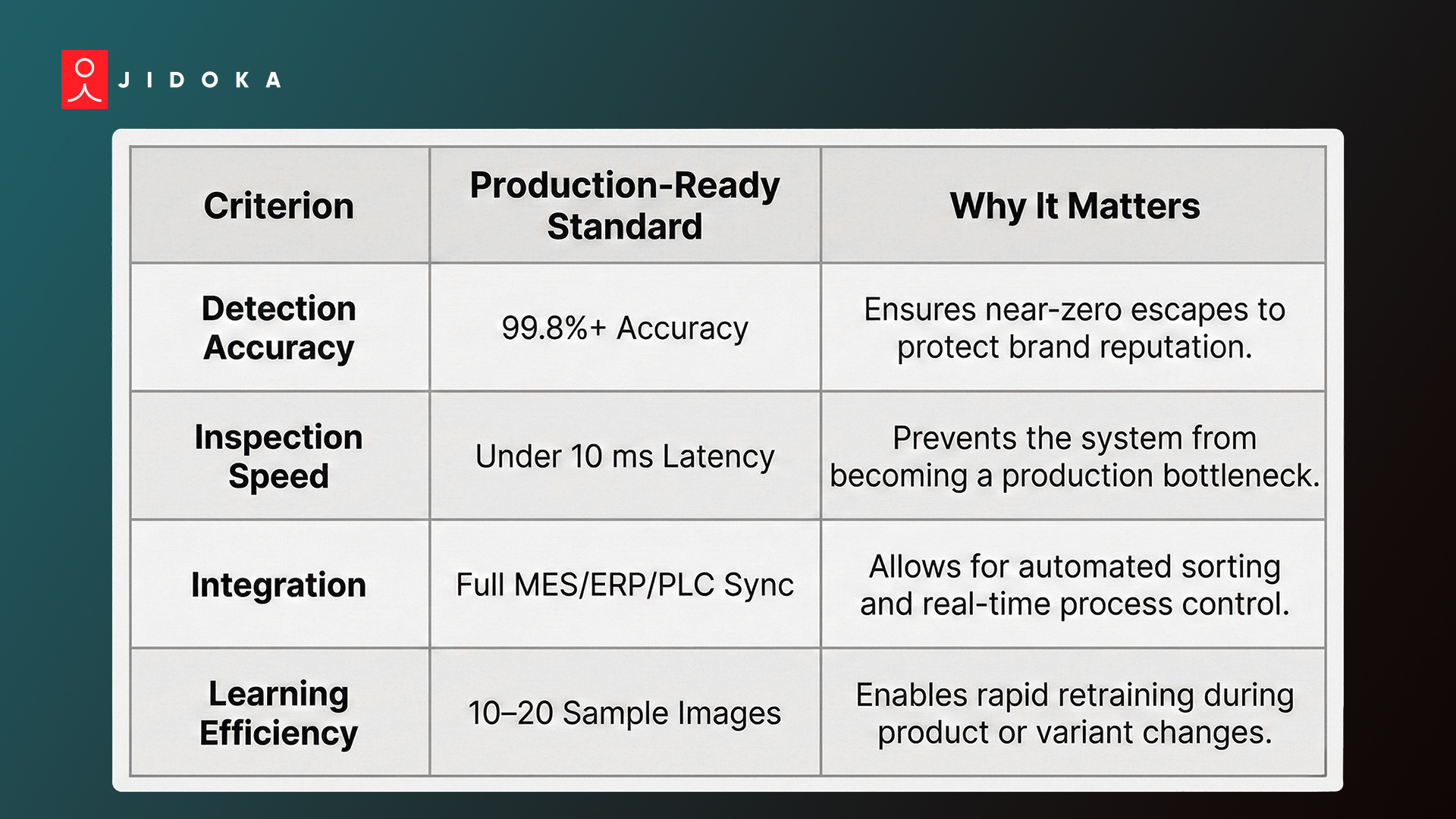
Les outils de suivi des défauts de pointe doivent répondre à des normes strictes pour survivre dans un environnement de production 24 heures sur 24, 7 jours sur 7. Si un outil échoue à ces tests, cela devient un handicap.
- Précision de détection : Votre système a besoin d'une précision de 95 % pour être utile. Les meilleurs outils d'inspection de la qualité utilisés aujourd'hui par les équipes de fabrication atteignent 99,8 %.
- Vitesse d'inspection : Les lignes rapides ont besoin de résultats en moins de 10 ms. Tout retard crée un goulot d'étranglement.
- Compatibilité d'intégration : Les bons outils de suivi des défauts communiquent avec votre MES et votre ERP via des protocoles standard.
- Efficacité de l'apprentissage : Vous voulez un système qui apprend à partir de 20 images, et non de 2 000 échantillons.
Indicateurs de performance clés pour les systèmes d'inspection prêts à être utilisés en production
B) Logiciel de détection des défauts de fabrication par rapport au suivi des défauts basé sur le système QMS : deux outils différents
Certaines personnes utilisent le mauvais nom pour désigner leur technologie. Les logiciels de détection des défauts de fabrication font généralement référence à une vision IA en ligne qui détecte les erreurs au fur et à mesure qu'elles se produisent. UNE QMS enregistre ces erreurs pour une analyse ultérieure.
- La vision artificielle empêche les pièces défectueuses d'avancer.
- Les plateformes QMS gèrent les formalités administratives et les dossiers juridiques.
- Vous avez besoin des deux pour gérer une boutique moderne.
Pour choisir les bons outils de suivi des défauts, il faut savoir quel travail vous devez terminer en premier.
Examinons les principales options pour 2026 afin de voir comment elles gèrent ces exigences.
Les 10 meilleurs outils de suivi des défauts pour la détection des défauts de fabrication en 2026
Les usines modernes ont besoin de plus que de simples grumes pour maintenir la qualité. Vous avez besoin d'outils de suivi des défauts qui détectent les erreurs avant qu'elles n'atteignent vos clients. Ces systèmes utilisent la détection des défauts en temps réel pour surveiller les lignes de production sans ralentir votre production.
Comparaison rapide des 10 meilleurs outils de suivi des défauts pour 2026
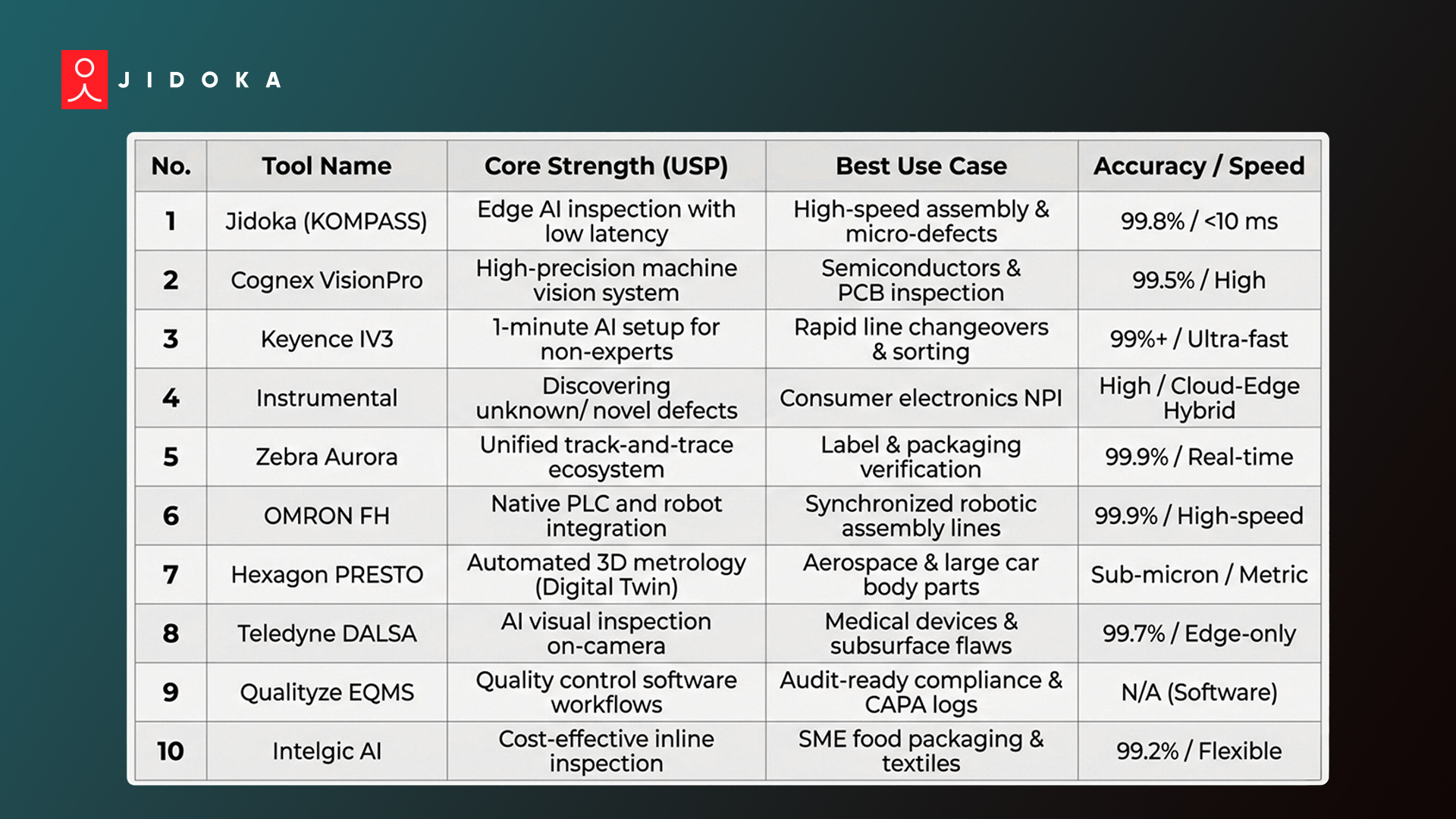
En choisissant le bon logiciel de détection des défauts de fabrication, vous vous assurez que votre installation reste rentable et efficace.
1. Jidoka Technologies (BOUSSOLE + NAGARE)
Jidoka Technologies fournit une suite pilotée par l'IA qui gère l'inspection en ligne pour une production à grande vitesse. Leur plateforme utilise la détection des défauts par apprentissage profond pour identifier les micro-défauts sur des surfaces complexes telles que le métal réfléchissant ou le plastique texturé. Il remplace les contrôles manuels par un système de vision industrielle plus rapide et plus fiable.
Caractéristiques principales :
- BOUSSOLE: Cet outil effectue une inspection visuelle IA à haute vitesse à 12 000 pièces par minute.
- NAGARE: Ce système surveille les étapes d'assemblage en temps réel pour éviter les erreurs humaines et les composants manquants.
- Déploiement Edge : Le logiciel fonctionne sur les unités locales pour garantir un faible taux de faux positifs sans dépendre de la vitesse du cloud.
USP : Délivre Précision de détection des défauts de 99,8 % et traite les cadres situés en dessous 10 ms. Il vous aide à atteindre un retour sur investissement en seulement 8 à 12 mois en réduisant les coûts de rebut et de retouche jusqu'à 35 %.
Pourquoi choisir Jidoka Technologies : Vous devriez choisir Jidoka si vous avez besoin d'une solution clé en main qui s'intègre à votre matériel actuel. Il s'agit de l'un des outils de suivi des défauts les plus polyvalents pour les lignes à volume élevé.
Les industries desservent : Automobile, FMCG, Produits pharmaceutiques, Appareils électroniques, Fabrication générale, logistique.
Critiques : 4,9/5 étoiles ⭐⭐⭐⭐⭐
2. Série Cognex VisionPro + In-Sight
Cognex reste un leader mondial en combinant du matériel de haute précision avec un logiciel avancé de détection des défauts de fabrication. Leur dernière série In-Sight 3800 utilise l'inspection par IA de pointe pour gérer les lignes à grande vitesse avec une extrême clarté.
Il s'agit d'un système de vision industrielle robuste conçu pour les tâches complexes qui nécessitent à la fois une logique basée sur des règles et une détection des défauts par apprentissage profond.
Caractéristiques principales :
- VisionPro ViDi 4.1.0 : Ce logiciel mis à jour propose le « mode Few Sample », qui vous permet d'entraîner le système avec seulement 5 à 10 images de défauts rares.
- In-Sight L38: Une 3D spécialisée inspection optique automatisée outil qui utilise la numérisation laser pour détecter les défauts en fonction de la hauteur.
- Interface de feuille de calcul intelligente : Les utilisateurs peuvent configurer détection des défauts en temps réel sans écrire de code, en utilisant un environnement de type Excel pour la logique.
USP : Réalise plus de Taux de lecture de 99 % sur les codes DPM et les hits difficiles Précision de détection des défauts de 99,5 % dans des environnements difficiles. Le système minimise votre taux de faux positifs, même en cas de dérive de rotation ou de décalage d'éclairage.
Pourquoi choisir Cognex : Choisissez Cognex si vous avez besoin d'un écosystème mature avec un support complet. C'est le meilleur choix pour la fabrication d'outils d'inspection de haute précision où la fiabilité du matériel n'est pas négociable.
Les industries desservent : Semi-conducteurs, automobile, produits pharmaceutiques, électronique, alimentation et boissons.
Critiques : 4,8/5 étoiles ⭐⭐⭐⭐⭐
3. Série Keyence CV-X/IV3
Keyence propose une approche conviviale pour la fabrication d'outils d'inspection de la qualité. Leur série IV3 utilise la détection des défauts par apprentissage profond pour simplifier les inspections complexes. Vous pouvez configurer ce système de vision industrielle sans compétences spécialisées en programmation ni formation en ingénierie de vision.
Caractéristiques principales :
- Enseignement automatique par IA : Ce logiciel vous permet d'entraîner le capteur en lui montrant simplement une partie « OK » et une partie « NG ».
- Design tout-en-un : Le matériel comprend des objectifs intégrés et un éclairage à haute intensité pour assurer une stabilité inspection en ligne environnement.
- Navigateur IV3 : Ce logiciel de contrôle qualité sur PC vous permet de gérer plusieurs capteurs et de visualiser instantanément les données de détection des défauts en temps réel.
USP : Permet une « configuration en 1 minute » qui élimine le besoin de connaissances spécialisées en vision. Le système offre une haute précision de détection des défauts pour les contrôles de présence et les tâches de tri simples sur les lignes à grande vitesse.
Pourquoi choisir Keyence : Vous devriez choisir Keyence si votre équipe doit déployer rapidement des outils de suivi des défauts sur plusieurs stations. Il s'agit du meilleur logiciel de détection des défauts de fabrication pour les installations qui privilégient la facilité d'utilisation à une personnalisation approfondie.
Les industries desservent : Automobile, électronique grand public, dispositifs médicaux, emballage, alimentation et boissons.
Critiques : 4,7/5 étoiles ⭐⭐⭐⭐⭐
4. Instrumental (Discover AI)
Instrumental est au service des équipes d'ingénierie qui ont besoin de détecter les défauts de fabrication que les systèmes de vision standard ne détectent pas. Cette plateforme basée sur le cloud est spécialisée dans la détection d'anomalies inconnues en comparant chaque unité à une base de référence numérique.
Il vous permet de surveiller la qualité de la production à distance et d'identifier les causes profondes sans être physiquement présent sur le terrain.
Caractéristiques principales :
- Découverte de nouveaux défauts : Le moteur d'inspection visuelle IA identifie automatiquement les nouveaux modes de défaillance après avoir détecté seulement cinq unités.
- Enregistrement de données unifié : Il regroupe les images de n'importe quel système de vision industrielle ou appareil à rayons X dans un seul tableau de bord consultable.
- Analyse des défaillances à distance : Les ingénieurs utilisent la détection des défauts par apprentissage profond pour effectuer des démontages virtuels et isoler les problèmes sur les sites d'usine du monde entier.
USP : Fournit »Résultats du premier jour« en supprimant le besoin d' « unités dorées » préprogrammées ou de kits d'entraînement complets. Il identifie généralement un défaut jusqu'alors inconnu lors de la première session de formation, accélérant ainsi les délais de commercialisation des composants électroniques complexes.
Pourquoi choisir Instrumental : Vous devez sélectionner Instrumental si vous gérez une production à mix élevé ou si vous lancez de nouveaux produits. C'est le seul outil qui découvre activement les nouveaux problèmes au lieu de simplement vérifier les critères de réussite/échec connus.
Les industries desservent : Électronique grand public, aérospatiale, stockage de données, dispositifs médicaux, automobile.
Critiques : 4,8/5 étoiles ⭐⭐⭐⭐⭐
5. Zebra Aurora (anciennement Matrox Imaging)
Zèbre Aurore fournit un écosystème logiciel unifié pour les logiciels de détection des défauts de fabrication. Il associe la puissance de la bibliothèque d'imagerie Aurora à un matériel de système de vision industrielle moderne.
Cet outil excelle dans la détection d'erreurs complexes dans l'emballage et l'assemblage à l'aide de l'inspection visuelle par IA.
Caractéristiques principales :
- ImagePerfect+ : Cette fonction capture 16 images différentes avec des paramètres uniques en un seul déclencheur pour une meilleure précision de détection des défauts.
- Comparaison d'images dorées : Il identifie rapidement les défauts en comparant les pièces de production en direct à une norme de référence parfaite.
- Apprentissage profond Aurora : Un module complémentaire spécialisé qui utilise des réseaux neuronaux pour résoudre des tâches de fabrication difficiles d'outils d'inspection de la qualité, telles que la lecture de texte déformé.
USP : Zebra Aurora atteint un taux de lecture de 99,9 % et offre une détection des défauts en temps réel directement sur l'appareil. Il utilise des outils de formation « Astrocyte » pour réduire votre taux de faux positifs de 25 % par rapport aux capteurs standard.
Pourquoi choisir Zebra : Sélectionnez Zebra si vous utilisez déjà leurs scanners ou imprimantes. Il s'agit de l'outil de suivi des défauts le plus interopérable pour une suite logicielle de contrôle qualité qui s'étend de l'entrepôt à la ligne.
Les industries desservent : Logistique, alimentation et boissons, automobile, santé, emballage.
Critiques : 4,6/5 étoiles ⭐⭐⭐⭐
6. Système de vision OMRON FH
OMRON connecte l'ensemble de votre usine grâce à la fabrication d'outils d'inspection de la qualité à haute vitesse. La série FH utilise la détection des défauts par apprentissage profond pour imiter la sensibilité humaine lors de la détection de rayures.
Ce système de vision industrielle s'intègre nativement aux robots pour automatiser les flux de détection des défauts en temps réel.
Caractéristiques principales :
- Correspondance entre IA et précision : Ce logiciel de contrôle qualité détecte les variations acceptables à partir de 100 images non défectueuses afin d'ignorer les motifs de surface inoffensifs.
- Imagerie à déclencheurs multiples : Il capture des composants longs à grande vitesse à l'aide d'une inspection en ligne sans arrêter la chaîne de production.
- Filtre de détection des rayures AI : Un outil pré-entraîné qui identifie les imperfections sur les surfaces brillantes lors de l'inspection visuelle par IA sans aucun réglage manuel des paramètres.
USP : Un contrôleur unique gère huit caméras simultanément, offrant une reproductibilité à 100 % pour la précision de la détection des défauts. Il atteint un taux de lecture de 99,9 % sur étiquettes d'emballage tout en réduisant votre taux de faux positifs en filtrant les marques de soudure et les ombres.
Pourquoi choisir OMRON : Choisissez OMRON si vous devez relier les outils de suivi des défauts directement à votre API ou à vos contrôleurs de mouvement. Il s'agit du meilleur logiciel de détection des défauts de fabrication pour les chaînes de montage synchronisées à grande vitesse.
Les industries desservent : Automobile, Alimentation et boissons, produits pharmaceutiques, électronique, semi-conducteurs.
Critiques : 4,7/5 étoiles ⭐⭐⭐⭐⭐
7. Inspection hexagonale basée sur PRESTO/CMM
Hexagon PRESTO propose une suite modulaire de cellules robotiques pour des mesures 3D automatisées. Ces outils de suivi des défauts utilisent des lasers et des scanners pour effectuer une inspection en ligne haute résolution de pièces de grande taille. Il élimine le besoin de mesures manuelles en créant un jumeau numérique de chaque composant.
Caractéristiques principales :
- Suivi optique HYPERSCAN : Cette technologie capture 8,3 millions de points par seconde lors de l'inspection visuelle par IA sans utiliser d'autocollants de référence sur les pièces.
- Numérisation directe ATS800 : Il permet une inspection optique automatisée de haute précision à distance, en mesurant avec précision les arêtes fines et les fixations.
- Programmation sans collision : Le logiciel génère automatiquement des trajectoires robotiques, ce qui facilite le déploiement d'un logiciel de détection des défauts de fabrication dans des cellules complexes.
USP : Offre une précision de détection des défauts inférieure au micron pour les pièces d'une taille maximale de 7 mètres. Le système permet une « fabrication zéro défaut » en mesurant 100 % des caractéristiques critiques en quelques minutes plutôt qu'en quelques heures.
Pourquoi choisir Hexagon : Choisissez Hexagon si votre installation gère des composants volumineux tels que des carrosseries de voitures ou des ailes d'avion. Il s'agit du premier système de vision industrielle pour la vérification dimensionnelle de haute précision lorsque la vision au niveau de la surface ne suffit pas.
Les industries desservent : Aérospatial, automobile, ferroviaire, énergie, fabrication générale.
Critiques : 4,8/5 étoiles ⭐⭐⭐⭐⭐
8. Teledyne DALSA Firefly DL
Teledyne DALSA concentre l'intelligence de haute performance dans une caméra qui tient dans la paume de votre main. Ce système de vision industrielle élimine le besoin d'ordinateurs externes coûteux en traitant les images là où l'action se produit.
Si vous avez besoin d'automatiser des décisions de qualité délicates qui nécessitent généralement l'intervention d'un œil humain, cette centrale d'inspection basée sur l'IA de pointe est votre meilleur choix pour l'inspection en ligne.
Principales fonctionnalités :
- Formation à l'IA Astrocyte™ : Oubliez le codage complexe ; ce logiciel de contrôle qualité vous permet d'entraîner des réseaux de neurones en quelques minutes pour gérer la détection des défauts en temps réel.
- Détection de défauts invisibles : Alors que la plupart des outils de suivi des défauts ne voient que la surface, ce système fonctionne avec des capteurs à rayons X et thermiques pour détecter les fissures cachées.
- Moteur Neuro™ : Le processeur intégré à l'appareil photo conserve Inspection visuelle par IA rapide, en maintenant une faible latence et un débit élevé.
L'avantage gagnant : Il offre une précision de détection des défauts impressionnante de 99,7 % grâce à une méthode unique de « tuling ». Cela permet à l'appareil photo de repérer un petit nœud de 10 pixels dans une image massive sans perdre de détails.
Idéal pour : Vous devriez opter pour Teledyne DALSA si votre espace de travail est restreint ou si vous avez besoin d'un logiciel mobile de détection des défauts de fabrication. Il s'agit de la référence absolue en matière d'inspection optique automatisée à enjeux élevés dans les laboratoires et les hangars aérospatiaux.
Secteurs desservis : Dispositifs médicaux, aérospatiale, défense, transformation du bois, imagerie scientifique.
Évaluation de l'utilisateur : 4,7/5 étoiles ⭐⭐⭐⭐⭐
9. Qualitez l'EQMS (QMS avec gestion du cycle de vie des défauts)
Qualityze EQMS fournit l'épine dorsale numérique pour gérer les données de qualité de votre usine via une plateforme cloud alimentée par l'IA. Contrairement aux capteurs matériels, ce logiciel de détection des défauts de fabrication se concentre sur la phase de post-détection, en automatisant les journaux de non-conformité et les actions correctives.
Caractéristiques principales :
- Gestion des non-conformités basée sur l'IA : Ce logiciel de contrôle qualité utilise un « assistant QAI » pour suggérer automatiquement les causes profondes et les mesures correctives.
- Codes de défaut normalisés : La plateforme vous aide à classer les problèmes récurrents afin d'analyser les tendances à long terme dans les différentes stations de fabrication d'outils d'inspection de la qualité.
- Flux de travail prêts à être audités : Il suit chaque défaut, de sa découverte à sa résolution, en maintenant un fil numérique conforme à la norme 21 CFR Part 11 pour les régulateurs.
USP : Réduit les coûts opérationnels de 50 % et améliore la conformité réglementaire de 61 % grâce à l'automatisation Flux de travail CAPA. Il repose sur la plate-forme sécurisée Salesforce, offrant une vue à 360 degrés de la précision de votre détection des défauts sur les sites mondiaux.
Pourquoi choisir Qualityze : Vous devriez choisir Qualityze si vous possédez déjà des caméras de vision mais que vous avez besoin d'un moyen de gérer les données et les audits qui en résultent. Il s'agit du meilleur outil de suivi des défauts pour passer des feuilles de calcul compliquées à un écosystème de qualité structuré et piloté par l'IA.
Les industries desservent : Sciences de la vie, dispositifs médicaux, Produits pharmaceutiques, Automobile, Aérospatial, Électronique.
Critiques : 4,5/5 étoiles ⭐⭐⭐⭐
10. Inspection visuelle Intelgic AI
Intelgic propose une approche flexible et prête pour le cloud pour la fabrication d'outils d'inspection de la qualité sans vous ruiner. Il met l'accent sur l'accessibilité, faisant de la détection des défauts en temps réel une réalité pour les petites et moyennes usines.
Ce logiciel de détection des défauts de fabrication se caractérise par sa variété et permet de détecter facilement les défauts sur tout, des tissus aux étiquettes alimentaires, sans faire appel à une équipe d'ingénieurs de vision.
Principaux points forts :
- Déploiement hybride : Vous pouvez exécuter votre inspection visuelle par IA sur des appareils périphériques locaux pour plus de rapidité ou dans le cloud pour une analyse de données massive.
- Reconversion rapide : Le modèle de détection des défauts par apprentissage profond de la plateforme apprend de votre environnement de production unique et devient plus intelligent à chaque changement de poste.
- Analyse de surface polyvalente : Il est spécialisé dans la détection de motifs incohérents, ce qui en fait un système de vision industrielle de premier plan pour les textiles et la fabrication de feuilles en continu.
L'essentiel : Intelgic affiche un taux de précision de détection des défauts de 99,2 % et peut être déployé deux fois plus rapidement que les systèmes d'entreprise traditionnels. Il réduit efficacement votre taux de faux positifs, en veillant à ce que les « bons » produits ne finissent pas à la poubelle.
Pourquoi il convient à votre gamme : Choisissez Intelgic si vous avez besoin d'un outil de suivi des défauts évolutif qui évolue avec votre activité. Il s'agit du logiciel de contrôle qualité le plus rentable pour les fabricants qui souhaitent une IA de niveau professionnel à un prix abordable.
Secteurs desservis : Textiles, emballages alimentaires, produits chimiques, imprimerie, petites et moyennes entreprises manufacturières.
Évaluation de l'utilisateur : 4,4/5 étoiles ⭐⭐⭐⭐
Conclusion
Le choix des mauvais outils de suivi des défauts entraîne un gaspillage élevé et des coûts de main-d'œuvre inutiles. De nombreux outils d'inspection de la qualité sur lesquels s'appuient les installations de fabrication ne détectent pas les erreurs subtiles, ce qui entraîne des retours de produits coûteux.
Le choix d'un logiciel de détection des défauts de fabrication inadéquat signifie souvent l'absence de défauts critiques qui finissent par atteindre vos clients. Ces problèmes non détectés nuisent à vos résultats et nuisent à la confiance à long terme. Les outils de suivi des défauts de qualité inférieure ne peuvent tout simplement pas suivre les vitesses de production modernes.
Jidoka Technologies fournit un système de vision industrielle robuste qui garantit Précision de détection des défauts de 99,8 %. Notre système de détection des défauts en temps réel détecte les problèmes instantanément, garantissant ainsi le bon déroulement de vos opérations et un niveau de qualité élevé.
Demandez une démo pour voir nos outils de suivi des défauts en action sur votre ligne de production spécifique dès aujourd'hui.
FAQs
1. Qu'est-ce qu'un outil de suivi des défauts dans le secteur de la fabrication ?
Un outil de suivi des défauts identifie et gère les défauts des produits pendant la production. Les logiciels modernes de détection des défauts de fabrication utilisent la détection des défauts en temps réel pour signaler immédiatement les problèmes. Ces outils d'inspection de la qualité utilisés par les équipes de fabrication garantissent que chaque pièce répond aux normes avant de quitter l'usine.
2. Quelle est la différence entre une inspection visuelle basée sur l'IA et un système de suivi des défauts du système de gestion de la qualité ?
L'inspection visuelle par IA utilise un système de vision industrielle pour une inspection en ligne afin de détecter instantanément les défauts physiques. Un outil de suivi des défauts QMS gère la documentation et les flux de travail CAPA. La plupart des usines ont besoin des deux pour maintenir une précision de détection des défauts et une conformité élevées.
3. Quel niveau de précision un outil de suivi des défauts doit-il atteindre sur une ligne ?
Pour une production à grande vitesse, les outils de suivi des défauts doivent dépasser 95 % de précision. Les principaux logiciels de détection des défauts de fabrication tels que Jidoka atteignent une précision de détection des défauts de 99,8 %. Un faible taux de faux positifs est également essentiel pour éviter les temps d'arrêt inutiles et les coûts de mise au rebut inutiles.
4. En quoi les outils de détection des défauts par apprentissage profond diffèrent-ils des systèmes basés sur des règles ?
Les systèmes basés sur des règles utilisent une logique fixe qui échoue sur des surfaces complexes. La détection des défauts par apprentissage profond utilise des réseaux neuronaux pour apprendre à partir des images, ce qui permet aux outils de suivi des défauts d'identifier les rayures subtiles ou les changements de texture que le matériel d'inspection optique automatique standard oublie souvent.
5. Les outils de suivi des défauts peuvent-ils s'intégrer aux systèmes MES et ERP ?
Oui, les logiciels professionnels de détection des défauts de fabrication se connectent via des protocoles industriels tels que OPC-UA. Cela permet aux données de détection des défauts en temps réel de circuler dans votre MES, garantissant ainsi que votre logiciel de contrôle qualité et votre ERP restent à jour avec des rapports précis sur le rendement et les rebuts.