CCTV Analytics for Manufacturing: How to Turn Passive Cameras Into an Operational Intelligence Layer

Turn your existing CCTV into a real-time operational intelligence layer. Learn how AI analytics converts passive factory cameras into assembly verification and OEE monitoring tools.

The average manufacturing facility has cameras installed on 70 to 80% of its production floor. Almost all of them are recording footage that nobody watches unless something goes wrong. 

That same camera recording an assembly station, costing roughly $200 per year in storage, could be generating real-time SOP compliance data, OEE metrics, and quality alerts for the cost of software and an edge compute unit. The infrastructure is already there. The operational value is not being extracted.

This article covers exactly what cctv analytics manufacturing can extract from cameras already in place: what data each use case generates, how edge AI processes it without cloud upload, and what the deployment path looks like for a single assembly line.

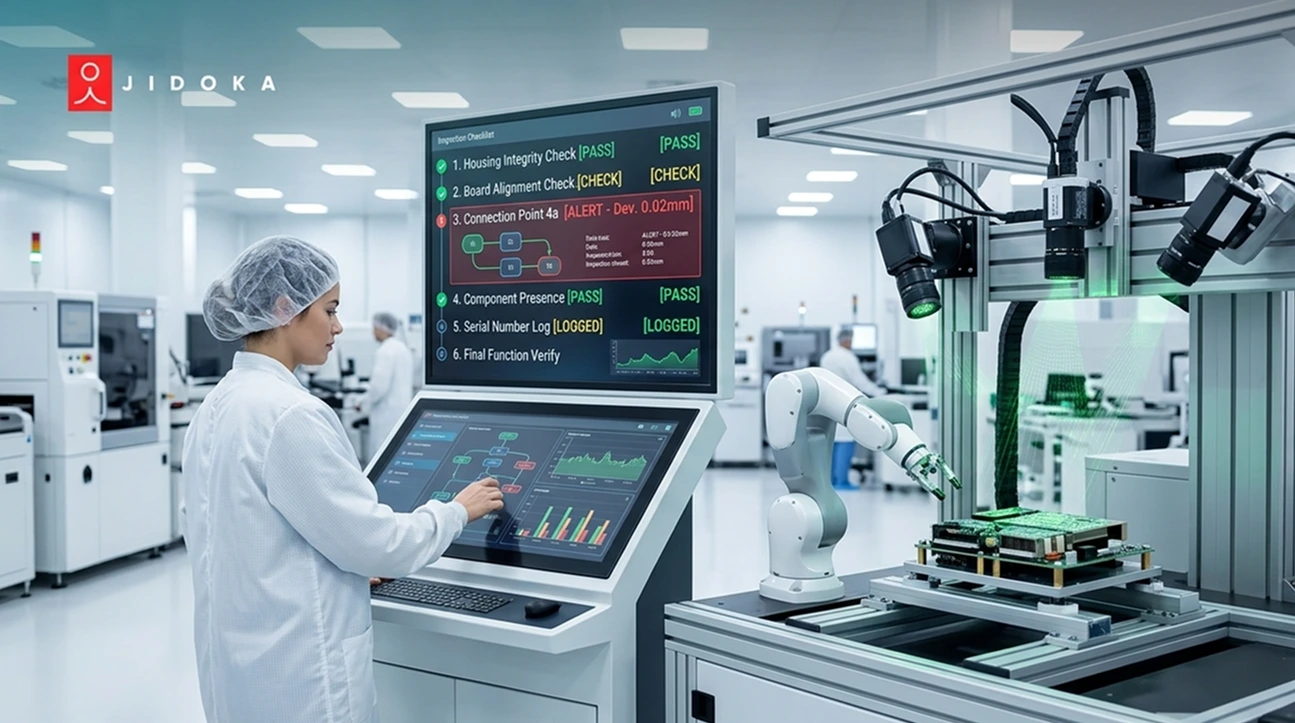
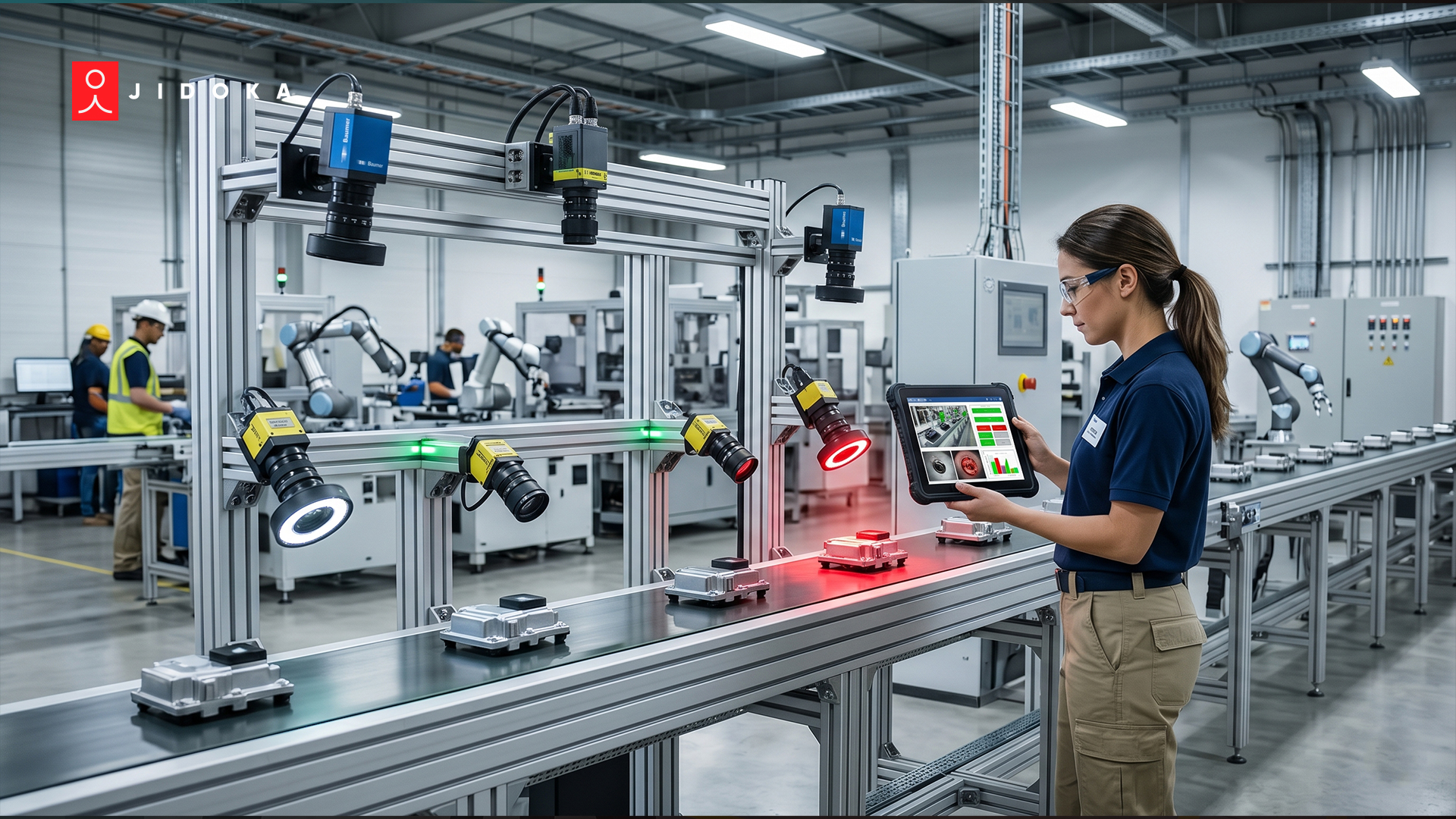
CCTV analytics for manufacturing converts existing camera infrastructure into an operational intelligence layer by applying edge AI to video feeds. The AI reads production sequences, verifies assembly steps against digital SOPs, measures cycle times, detects defects, and feeds OEE data into ERP systems, without requiring new cameras, cloud upload, or security footage review.

Why Most Factory CCTV Is Passive Infrastructure With Untapped Operational Value

Most plant managers know their cameras are there for security. Few have mapped what those same cameras are recording from an operational perspective. Every cycle, every assembly action, every idle period, and every deviation is already on tape. None of it is being used.

Standard factory floor monitoring system infrastructure records continuously but does not understand what it captures. Footage is stored for incident review and reviewed only when a problem requires it. The camera above an assembly station watches every cycle. It sees every operator step, every component placement, every machine stop, and every deviation from the standard sequence. That evidence is being recorded to a hard drive and overwritten after 30 days.

The operational data embedded in that footage is specific and actionable. A camera watching a torque station captures every cycle start, every tool pickup, every torque application, and every cycle completion. It sees whether the operator performed step 3 before step 4, or skipped step 2 entirely. It sees how long each cycle took compared to the standard. It sees when the station went idle and for how long. All of that data currently generates zero output.

The infrastructure gap is not the camera. It is the compute layer between the camera and a structured data output. An edge compute unit running a vision AI model connects to the existing camera feed, processes each frame at sub-10ms latency, and converts what the camera sees into structured operational metrics. Nagare by Jidoka Technologies processes video feeds at up to 12,000 parts per minute using cameras already installed on the line, without a single hardware replacement.

The cost comparison is direct. Passive CCTV: storage cost, maintenance cost, and periodic review time, with zero operational output. Camera based production monitoring via edge AI: the same camera, plus an edge unit and software, generating continuous SOP compliance data, OEE metrics, and quality alerts per shift. In facilities where we have run the audit before deployment, the camera coverage gap between what is already installed and what would be needed to monitor all assembly areas is typically under 20%.

“Every camera already installed on a production floor is recording the evidence of process adherence or deviation. CCTV analytics converts that evidence into real-time operational intelligence.” - Jidoka Technologies. 

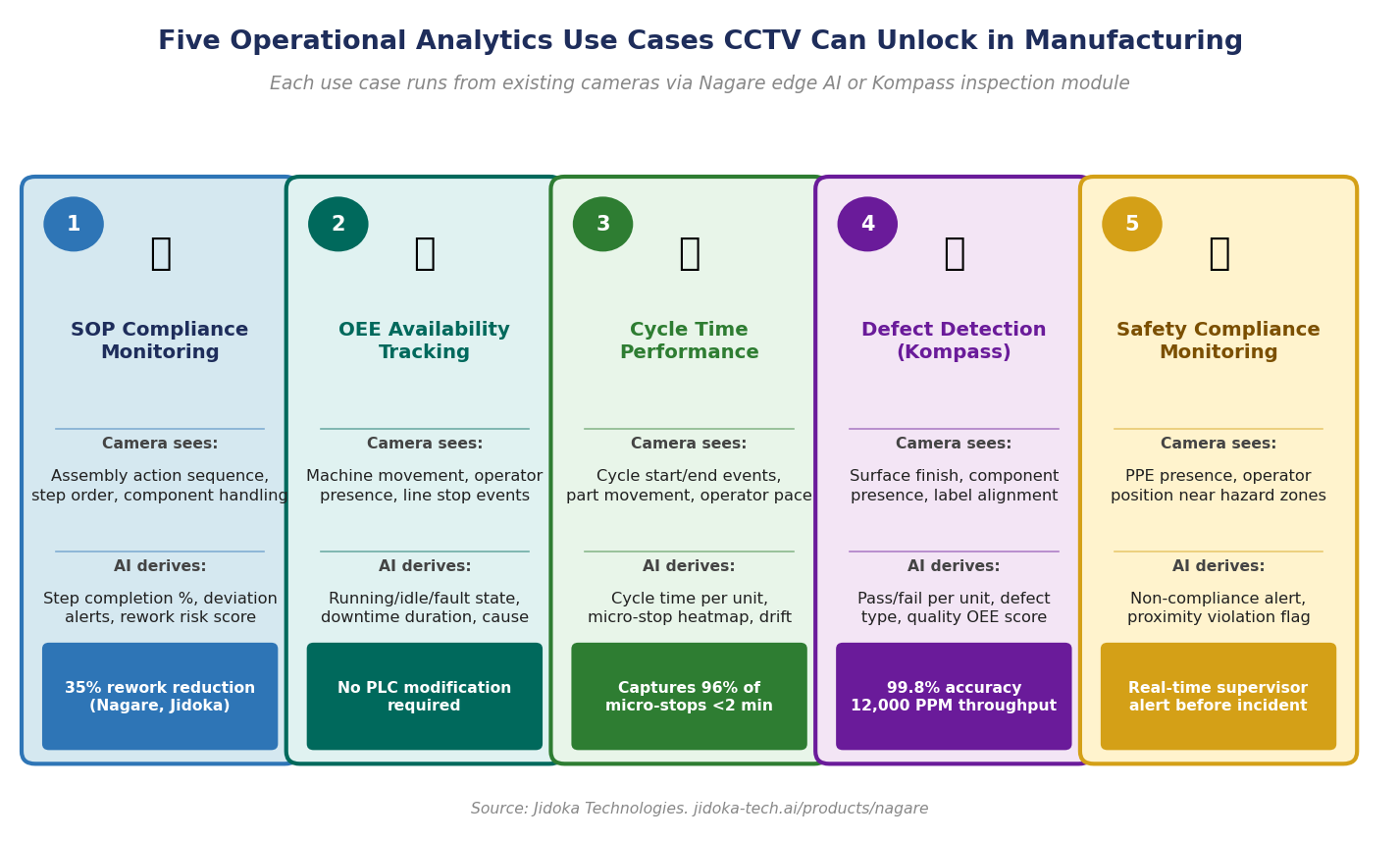
Five Operational Analytics Use Cases CCTV Can Unlock in Manufacturing

Each of the five use cases below runs from camera infrastructure already present on most factory floors. The question for each one is not whether your cameras can see it. The question is whether you have the AI layer to convert what they see into a structured operational alert or metric.

Each of these five cctv analytics manufacturing streams comes from the same camera infrastructure. Video AI manufacturing platforms convert the same camera feed into five distinct operational analytics streams depending on the AI model configuration and the production environment. Each use case has a specific data output and a specific operational decision it supports.

Use Case 1: SOP Compliance Monitoring

The camera watches the assembly sequence. The AI compares what it observes against the digital SOP loaded into Nagare: the correct step order, the correct tool usage, the correct component placement. When an operator skips a step or performs steps out of sequence, an alert fires at the station in real time. 

The operator self-corrects before the part advances to the next station. Nagare monitors 100% of assembly steps across the shift and cuts rework by 35% in documented Jidoka deployments by catching deviations at the point of occurrence rather than at end-of-line inspection.

Use Case 2: OEE Availability Tracking

The second cctv analytics manufacturing use case converts the camera feed into OEE availability data. The camera watches the machine and the station. The AI classifies machine state from the video feed: running, idle, or fault. It detects when a machine stops, how long the stop lasts, and what the operational pattern around the stop looks like. 

The OEE availability component updates in real time without any PLC modification or sensor installation. In the ai surveillance manufacturing context, this is the use case with the lowest deployment complexity because it requires no process-specific model training. Machine stop events produce a distinct visual signature that generalises across equipment types.

Use Case 3: Cycle Time Performance Monitoring

The camera watches cycle completion events: part arrival, operator engagement, process completion, part departure. The AI measures cycle duration against the standard cycle time established at deployment. Any cycle exceeding the standard by more than 5% is flagged as a micro-stop or speed loss event. 

Micro-stops under two minutes are the single largest unrecognised performance loss category in discrete manufacturing, accounting for 15 to 25% of total performance OEE loss (MachineCDN, 2026). Camera-based cycle time monitoring captures 96% of micro-stops under two minutes. Manual logging captures approximately 4%.

Use Case 4: Defect Detection via Kompass Integration

Jidoka's Kompass module extends cctv analytics manufacturing into inline quality inspection. Kompass runs AI vision inspection at up to 12,000 parts per minute with 99.8% detection accuracy, converting the inspection camera feed into a continuous quality OEE signal. 

The quality rate updates in real time: every defective unit is logged at the moment of production, not at the end-of-line inspection gate. This converts the quality OEE component from a lagging daily metric to a live shift signal that can trigger IPQC escalation before a defect cluster forms.

Use Case 5: Safety Compliance Monitoring

The camera watches operator position and PPE usage. The AI detects PPE non-compliance (missing helmet, missing gloves near a defined hazard zone) and proximity violations when an operator enters a machine safety boundary during operation. 

Safety compliance is the cctv analytics manufacturing use case with the clearest legal justification across all jurisdictions: employer duty of care creates a legitimate basis for continuous monitoring in physical hazard environments. The alert fires before an incident occurs, not after a near-miss is reported at shift end.

How Edge AI Processes Camera Feeds Without Cloud Upload or Latency

The most common objection to video AI manufacturing among operations and IT directors is data privacy. Where does the video go? Who can access the footage? Edge AI architecture eliminates that objection at the infrastructure level, not through a privacy policy.

The data privacy architecture of cctv analytics manufacturing platforms is the most important technical decision in the category. The difference between cloud-based video analytics and edge AI is not a configuration choice. It is an architectural difference that determines where footage goes, who can access it, and how fast the system responds. 

For existing camera AI monitoring in automotive and electronics manufacturing, where customer data agreements often restrict where production data can be processed, edge AI is the only viable architecture.

1. Edge Processing: The AI Runs at the Camera

In Nagare's architecture, the vision model runs on a local compute unit connected to the camera at the production station. The model processes each frame from the camera feed, extracts the relevant operational event (step completion, machine state, cycle time, deviation), and generates a structured data record. 

The frame itself is not stored and not transmitted. Only the structured data output leaves the edge unit. This is architecturally equivalent to a calculator: the calculation happens locally, and only the result is transmitted. The input data never leaves the device.

2. Data Privacy: What Leaves the Facility

Video frames are processed in real time and discarded after inference. The structured data outputs (OEE metrics per shift, SOP deviation events with timestamp and station ID, cycle time per unit, quality alert flags, safety incidents) are stored locally and transmitted to ERP via the local network. 

No footage leaves the facility. No raw video is transmitted over any network. For manufacturers under ISO 27001 or automotive OEM data agreements, this architecture preserves data sovereignty without requiring a cloud access exception.

“Nagare processes all video data locally on edge hardware. No footage leaves the facility. Only structured operational metrics are transmitted to ERP or dashboard systems.” - Jidoka Technologies.

3. Latency: Why Sub-10ms Matters for Real-Time Alerts

Cloud-based video analytics typically add 100 to 500ms of processing latency between frame capture and alert generation. At a production speed of 12,000 parts per minute, 500ms of latency means eight additional units produced after a deviation is detected before the alert reaches the operator. 

Sub-10ms edge processing means the alert fires at the station before the part advances to the next station. For SOP compliance alerting, the latency difference determines whether the deviation is caught at the unit or 40 units downstream at the inspection gate.

4. ERP Integration via Local Network

Nagare feeds structured OEE, quality, and compliance data directly into ERP systems via the local facility network. No public internet dependency, no cloud routing, no API calls to external services. The data pipeline runs entirely within the facility's network boundary. 

For smart camera factory deployments where the facility network is segmented for security reasons, Nagare operates within the production network segment and pushes data to the ERP system through the existing network gateway without requiring new firewall rules for external connectivity.

What the Deployment Process Looks Like: From Passive CCTV to Operational Intelligence in Days

The deployment question most operations directors ask is how long it actually takes and what disruption to expect. For a single assembly line, the answer is 8 to 14 days from camera audit to live monitoring, with zero production downtime during installation.

Every cctv analytics manufacturing deployment starts from the same question: which cameras are already in place and what operational area do they cover. The deployment path is structured around what already exists in your facility. Because Nagare deploys on existing cameras, the hardware procurement phase that dominates sensor-based monitoring implementations is eliminated. The deployment runs in five steps.

Named Framework: 5-Step CCTV-to-Intelligence Deployment Protocol

A five-step deployment sequence for converting existing factory CCTV into a live operational intelligence layer. Each step has a defined output and a defined timeline. The full sequence completes in 8 to 14 days for a single assembly line.

Step 1: Existing Camera Audit (Day 1 to 2)

Assess camera placement, resolution, and field of view coverage against the assembly areas you want to monitor. The audit maps which existing cameras provide sufficient coverage for SOP compliance monitoring and which areas have coverage gaps. In most facilities, the gap between existing camera coverage and full assembly area coverage is under 20%. The audit output is a camera-to-use-case assignment that defines the monitoring scope before any hardware is installed.

Step 2: SOP Digitalisation (Day 3 to 5)

Translate paper or PDF work instructions into Nagare's digital SOP format. This step defines the reference sequence the AI compares against during live monitoring. Each step in the SOP is mapped to a visual signature the camera can observe: tool pickup, component placement, orientation check, torque application. The quality of the SOP digitalisation directly determines the compliance detection accuracy, which is why a Jidoka deployment engineer guides this step rather than leaving it to the facility team alone.

Step 3: Edge Unit Installation (Day 5 to 7)

The edge compute unit is installed at the camera station. No network infrastructure changes are required. The unit connects to the existing camera feed and to the facility's local network at the same point the camera already uses. Installation is typically under two hours per station. There is no production downtime: the edge unit connects to the camera feed in parallel with the existing security recording, which continues uninterrupted.

Step 4: Model Configuration (Day 7 to 12)

Nagare's AI is configured to recognise the assembly actions specific to your product from the camera angle established in Step 1. This is not generic object detection. The model is trained on the visual signatures of your specific SOP sequence at your specific station. A calibration run using production samples confirms that the model detects each step correctly before go-live. Any step where detection accuracy falls below threshold is flagged for camera position adjustment or additional model training.

Step 5: Live Monitoring (Day 13 to 14)

The system goes live. Supervisor alerts are configured with threshold values for SOP deviation, cycle time overrun, and OEE availability drop. The ERP data feed is enabled and validated against a known production sample. The shift supervisor receives the first live OEE and compliance dashboard at the start of the first monitored shift. A Jidoka deployment engineer monitors the first live shift and adjusts alert thresholds based on actual production conditions before handing the system to the facility team.

Your Cameras Are Already Watching. The Question Is Whether You Are Listening.

The cameras on your production floor are already recording every assembly action, every machine stop, and every cycle that matters for quality and operational efficiency. The infrastructure cost has already been paid. The data is already being captured and discarded. The only missing piece is the AI layer that converts what those cameras see into a live operational intelligence stream your shift supervisors can act on before the shift ends.

Nagare by Jidoka Technologies was built for this conversion: it takes the cctv analytics manufacturing infrastructure you already have and turns it into a continuous process monitoring system, without new cameras, without cloud dependency, and without a six-month integration project. Request a Jidoka deployment audit to find out which of your existing cameras cover the assembly areas where SOP compliance and OEE gaps are costing you the most.

Frequently Asked Questions

1. What Is CCTV Analytics in Manufacturing?

CCTV analytics in manufacturing applies AI vision models to existing camera feeds to extract operational data including SOP compliance, machine availability, cycle time, and defect events. Unlike security analytics which detect incidents after the fact, manufacturing cctv analytics manufacturing monitors production processes in real time and triggers immediate corrective alerts at the operator station before the deviation advances downstream.

2. Can I Use Existing Cameras for AI Process Monitoring?

Yes. Platforms like Nagare by Jidoka Technologies are designed to deploy on existing camera infrastructure without hardware replacement. The edge AI model connects to the existing camera feed via a local compute unit, processes video in real time, and generates operational metrics without storing or transmitting footage. A camera audit at the start of deployment confirms which existing cameras provide sufficient resolution and field of view for each use case.

3. How Accurate Is AI-Based Assembly Verification From CCTV?

AI-based SOP compliance monitoring accuracy varies by implementation quality, camera placement, and model training. Jidoka's Kompass integration achieves 99.8% accuracy in visual inspection applications at production speeds up to 12,000 parts per minute. Assembly step verification accuracy depends on camera angle and lighting quality, which the deployment audit in Step 1 assesses and optimises before go-live. Accuracy figures from vendor marketing materials should be verified against your specific product and camera configuration.

4. What Data Does CCTV Analytics Generate for Manufacturing ERP Systems?

CCTV analytics platforms like Nagare feed structured data into ERP systems including OEE availability and performance metrics per line and shift, SOP deviation events with timestamp and station ID, cycle time per unit, quality alert flags, and safety compliance incidents. This data replaces manual operator entry and eliminates the lag time of end-of-shift reporting. All data is transmitted via the local facility network with no cloud dependency.

June 1, 2026
By
Dr. Krishna Iyengar, CTO at Jidoka Tech

相談会開催中

品質と生産性を最大化するビジョン検査システムに関する相談会を実施中です。ぜひこの機会にお試しください。

お問い合わせ