GMP Self-Inspection: What Auditors Actually Check and How AI Monitoring Supports It

Understand what GMP self-inspection auditors check across documentation, data integrity, and process control, and how AI monitoring closes the gaps between audit cycles.

An FDA inspector asks to see the audit trail for a process deviation from 14 weeks ago. Your team spends 40 minutes searching through production folders, shift logs, and paper records to surface a timestamped entry a compliant system should have produced in under a minute. That is not a technology gap. It is a self-inspection GMP failure.

GMP self-inspection exists to find that gap before a regulator does. This guide explains what auditors triangulate across three inspection zones, why most pharmaceutical inspection programs miss Zone 2 entirely, and how AI monitoring closes the evidence gap between audit cycles.

What GMP Self-Inspection Is and Why Most Programs Miss the Point

Self-inspection GMP is a structured internal audit, conducted by trained qualified personnel, that verifies manufacturing processes, documentation controls, and quality systems against regulatory requirements. Per EU GMP Chapter 9, it must run at regular intervals with findings documented and corrective actions tracked to closure.

The distinction most pharmaceutical inspection programs blur: a self-inspection GMP program is preventive, and a regulatory audit is evaluative. A regulator arrives to determine current compliance. Your internal team inspects to find what that regulator would find before they arrive. These are different cognitive tasks, and conflating them is why most self-inspection GMP programs produce comfortable findings rather than useful ones.

Internal audit teams tend to inspect what they are confident about. Real inspectors probe what the records do not explain cleanly. The gap between those two approaches is where most pharmaceutical inspection observations originate.

The February 2026 FDA Compliance Program Manual update (CP 7382.850) signals that regulatory methodology is evolving. Manufacturers who have not reviewed whether their self-inspection GMP framework maps to current inspector scrutiny patterns are operating on outdated assumptions.

The most expensive self-inspection GMP programs are the ones that confirm compliance. The most valuable thing is to find what the next inspector flags on day one.

The GMP Self-Inspection Audit Intelligence Framework

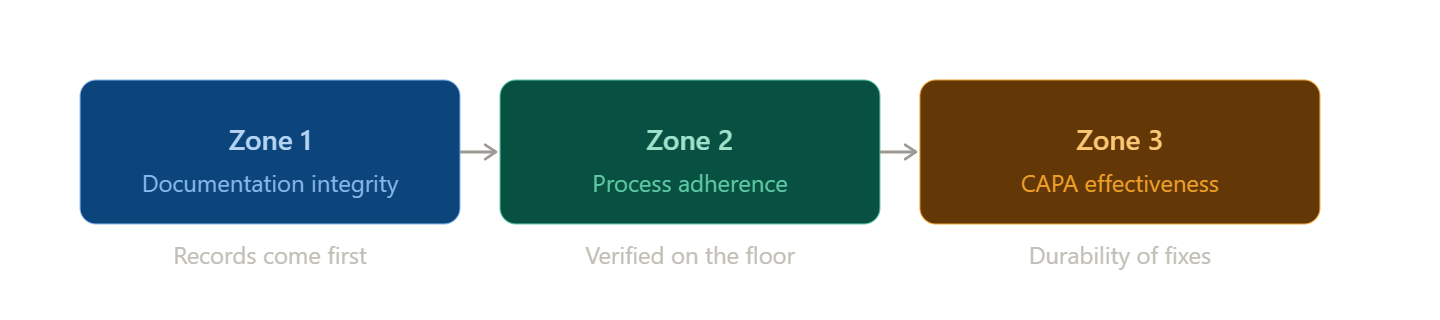
Self-inspection GMP programs become diagnostic only when they model auditor behavior, not just auditor checklists. The GMP Self-Inspection Audit Intelligence Framework (Jidoka Technologies) maps the three zones experienced inspectors triangulate during a pharmaceutical inspection: documentation integrity, process adherence, and CAPA effectiveness, in that exact order.

Auditors enter Zone 1, move to Zone 2 to verify that documents reflect actual operations, and close at Zone 3 to determine whether the quality system eliminates problems or records them.

This is not a checklist model. It is an attention map. Knowing what evidence each zone requires separates a self-inspection GMP program that prepares a team for documentation review from one that surfaces the same gaps a regulator finds on an unannounced pharmaceutical inspection.

Audit Readiness Zones and Required Evidence
Zone What Auditors Look For Evidence That Satisfies
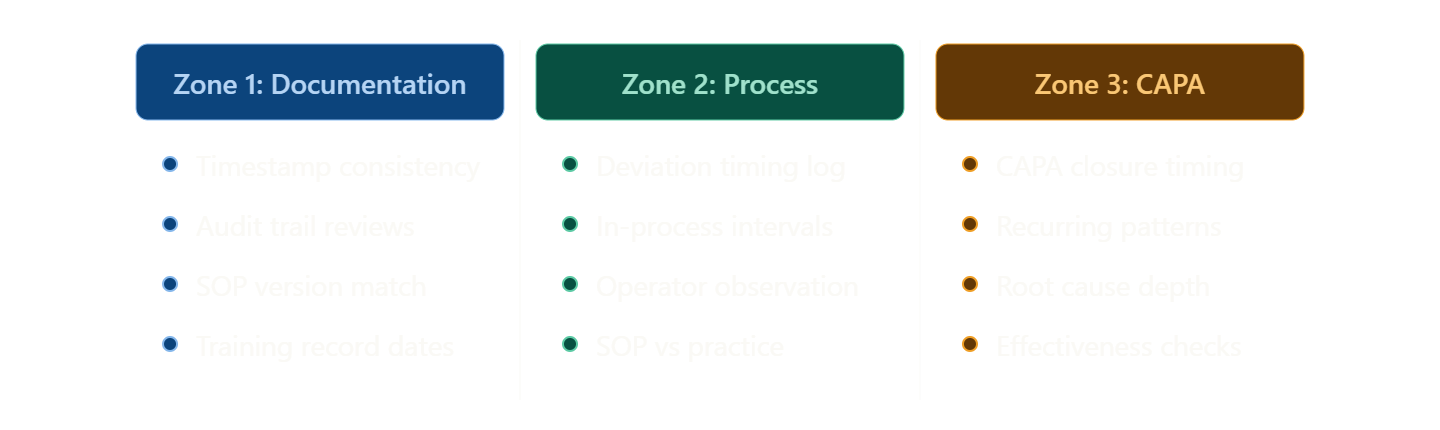
Zone 1: Documentation Integrity Timestamp consistency, audit trail review status, SOP version alignment, and training records Time stamped unaltered records with dated audit trail review logs
Zone 2: Process Adherence SOP to practice alignment, real time deviation capture, and shift level consistency Timestamped deviation records, shift level adherence rates, and video referenced events
Zone 3: CAPA Effectiveness Recurring deviation patterns, root cause depth, and effectiveness check timing Post CAPA deviation trend data and effectiveness checks at 90 to 180 day intervals

What Auditors Actually Check, Zone by Zone

The following is not a restatement of what regulations say inspectors should examine. It is a pattern-level breakdown of where experienced auditors focus attention during a pharmaceutical inspection and what triggers a formal finding.

Zone 1: Documentation Integrity

Batch records are the first documents auditors request in any pharmaceutical inspection. They verify that every critical step carries an operator signature, a supervisor countersign where the SOP requires it, and a timestamp consistent with the production schedule. Out-of-sequence timestamps are the most common trigger for a data integrity finding across inspection in the pharmaceutical industry.

Audit trail controls are the second focus. Under 21 CFR Part 11, audit trails must be enabled and actively reviewed, not just enabled. Auditors do not ask whether audit trail functionality exists. They ask for the date of the last review. A system with functional trails and no documented review is a finding.

SOP version control is the third check. Auditors verify that the SOP version on the production floor matches the currently approved version. A single operator following a superseded procedure is a critical finding, regardless of whether the outcome met specification.

Training records close Zone 1. Every operator performing a critical process must carry a dated, signed training record aligned to the current SOP version. Auditors cross-reference training dates against SOP revision dates. A record predating the most recent revision is a compliance gap.

Zone 2: Process Adherence

Deviation logs are examined for two things: whether deviations were captured and how quickly. A deviation logged 48 hours after occurrence is a data integrity finding. Most facilities track deviation counts but underestimate how many timing failures are embedded in the log without trend analysis.

In-process monitoring records are verified against the SOP-required check intervals, not just overall existence. A temperature log with a four-hour gap where the SOP requires two-hour checks is a finding. Auditors count intervals, not records.

Live operator observation is the most diagnostic Zone 2 activity. Auditors watch operators perform critical steps against the current SOP. Steps performed from memory, without reference to the approved document, are flagged. Correct execution does not cancel the finding.

GMP compliance monitoring in real time is where AI-based systems contribute directly. Visual inspection pharmaceutical industry teams relying on point-in-time audits cannot verify whether operators follow SOPs consistently across all shifts. A system that monitors continuously produces Zone 2 evidence that self-inspection GMP and pharmaceutical inspection both require.

Zone 3: CAPA Effectiveness

CAPA closure verification examines whether the effectiveness check was performed, documented, and reviewed at the correct post-closure interval (typically 90-180 days), and whether the method was capable of detecting recurrence.

Recurring deviation pattern analysis is the highest-risk finding in Zone 3. When the same deviation type appears more than twice in 12 months, auditors treat it as CAPA system failure regardless of whether each instance carries a closed CAPA. Closed CAPAs and eliminated root causes are not the same outcome.

Root cause quality determines whether a CAPA is systemic or cosmetic. A CAPA whose root cause reads "operator error" without a process-level corrective action signals to auditors that the quality system addresses observations rather than causes.

How AI Monitoring Closes the Evidence Gap Between Audit Cycles

Self-inspection GMP programs run quarterly or semi-annually. A pharmaceutical inspection from regulators can arrive with 24-48 hours notice. The evidence gap between those two timelines is where most findings originate, not in audit-week performance.

Most pharmaceutical manufacturers operate in inspection mode for two to three weeks around a scheduled audit, then revert to normal. The quality risk does not pause during those months.

What continuous AI monitoring produces for self-inspection GMP readiness:

  • Shift-level SOP adherence rates by station and operator. Machine-generated, timestamped records of every production cycle, stored on local edge units with no central server dependency.
  • Real-time deviation alerts at the moment of occurrence. The timestamp gap that produces Zone 2 findings disappears when the system records the event, not when the operator logs it retrospectively.
  • Recurring deviation pattern data across rolling periods. An aggregated view feeding directly into the CAPA initiation process with data rather than anecdote.

NAGARE (Jidoka Technologies) operates on existing CCTV cameras with edge AI, monitors production workflows against digital SOPs in real time, and generates timestamped records that Zone 2 audit evidence requires. Pharmaceutical deployments require IQ/OQ/PQ validation before AI-generated records are treated as GMP-compliant audit trail entries under 21 CFR Part 11. 

Inspection machines in the pharmaceutical industry contexts running continuous monitoring report one consistent shift: QA teams arrive at self-inspection GMP reviews with shift-organized adherence data before the audit team enters the floor, rather than reconstructing a picture from logs and memory.

Building a Self-Inspection Program That Finds What Regulators Find

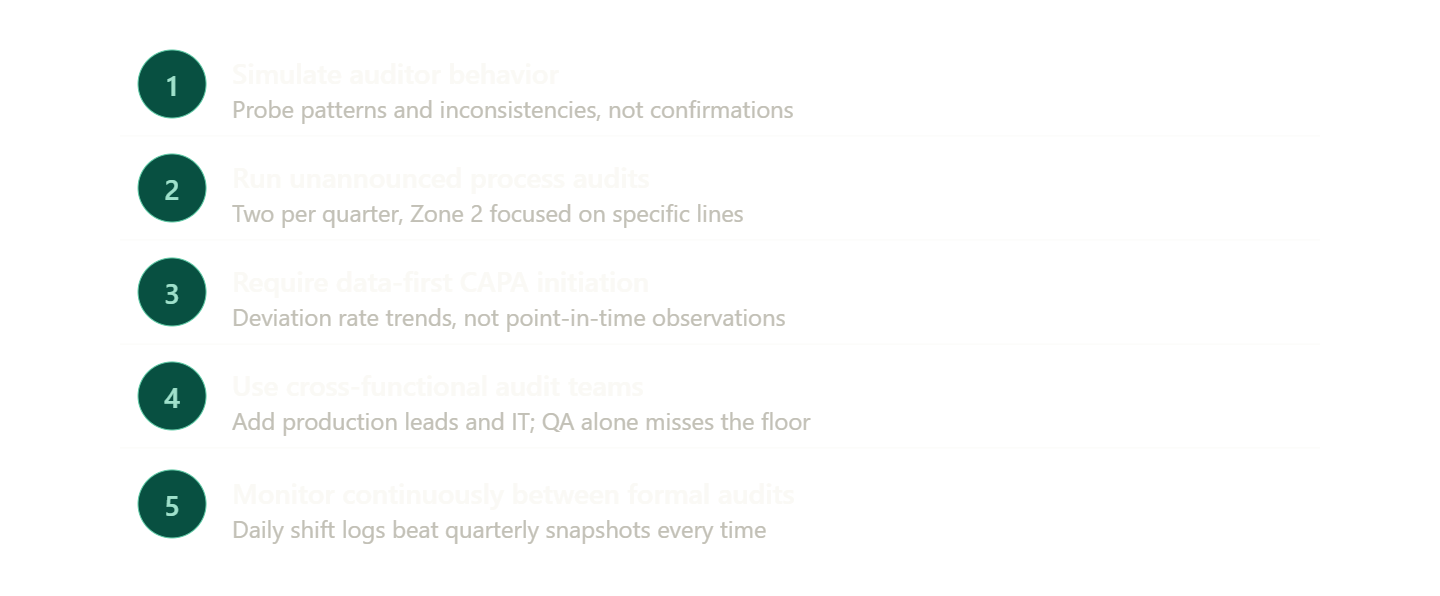
The GMP Self-Inspection Program Quality Principles (Jidoka Technologies) are behavioral commitments, not procedural additions. Each one changes what a self-inspection GMP program actually detects.

Principle 1: Auditor simulation, not checklist completion. Train internal auditors to probe for inconsistency patterns rather than confirm compliance. Actual FDA warning letters from the past 12 months are the most accurate training material available. 

Principle 2: Unannounced internal process audits. A scheduled self-inspection GMP allows preparation. Two unannounced Zone 2-focused checks per quarter on specific production lines are more diagnostic than one formal semi-annual facility-wide audit.

Principle 3: Data-first CAPA initiation. Every CAPA initiated from a self-inspection GMP finding must carry a quantified data source. "We observed an operator skipping a step" is not a CAPA trigger. "Station 4 deviation rate rose from 1.1% to 3.9% over six weeks" is.

Principle 4: Cross-functional audit teams. Self-inspection blind spots concentrate in teams composed entirely of QA staff. Include production leads and IT personnel responsible for electronic record systems. QA staff read documentation well. Production leads identify process adherence gaps that documentation does not capture.

Principle 5: Continuous monitoring between formal audits. A daily shift-level deviation log reviewed by a line supervisor provides more value to ongoing GMP compliance monitoring than a quarterly audit that surfaces accumulated issues. The formal self-inspection GMP validates the continuous record. It does not replace it.

Jidoka Technologies: Continuous Zone 2 Evidence for GMP-Ready Operations

Jidoka Technologies builds AI inspection systems that perform under real production pressure. For pharmaceutical manufacturers who need continuous Zone 2 evidence between self-inspection GMP audit cycles, 

NAGARE monitors production workflows against digital SOPs on existing cameras, generating timestamped deviation records and shift-level adherence data across every production cycle.

  • Real-time deviation alerts at the moment of occurrence, not retrospective operator entries
  • Shift-level SOP adherence records by station and operator, stored on local edge units
  • Consistent performance at 12,000+ parts per minute across all shifts

Pharmaceutical deployments require IQ/OQ/PQ validation before NAGARE output counts as GMP-compliant audit trail data under 21 CFR Part 11. The Jidoka team works through those validation requirements before go-live. 

Let's talk about getting there.

Conclusion

The FDA inspector asking for a 14-week-old deviation audit trail is testing whether the self-inspection GMP program builds evidence or confirms assumptions. When continuous AI monitoring is in place, that record surfaces in seconds: deviation alert, corrective action entry, effectiveness check, timestamped and organized. 

The pharmaceutical inspection finding that would have triggered months of remediation instead demonstrates the quality system working exactly as designed. That is the standard worth building to.

FAQs

1. What is GMP self-inspection?

Self-inspection GMP is a structured internal audit conducted by trained qualified personnel to verify that manufacturing processes, documentation, and quality systems comply with regulatory requirements before a regulatory authority inspects. Per EU GMP Chapter 9, audits must run at regular intervals with documented findings and corrective actions tracked to closure timelines.

2. What do GMP auditors check during a pharmaceutical inspection?

Auditors triangulate three zones in every pharmaceutical inspection: documentation integrity (timestamp consistency, audit trail reviews, SOP version match, training records), process adherence (deviation timing, in-process intervals, live operator observation), and CAPA effectiveness (recurring patterns, root cause depth, effectiveness check documentation). Zone 2 is where most manufacturers carry the largest undetected gap.

3. How often should pharmaceutical manufacturers conduct GMP self-inspections?

EU GMP Chapter 9 requires self-inspection GMP at regular intervals with frequency set by risk level. Most manufacturers run formal audits quarterly or semi-annually. That is a minimum, not a ceiling. High-risk operations benefit from continuous process adherence monitoring between formal audit cycles to maintain Zone 2 evidence year-round.

4. What is the most common finding during a GMP pharmaceutical inspection?

Data integrity failures are the most consistent finding across FDA, EU GMP, and WHO inspections. Specific patterns include electronic records missing active audit trail review logs, deviation entries recorded retrospectively, and SOP-to-practice discrepancies where observed operations do not match documented procedures. Zone 1 failures are the most frequent trigger in inspection in the pharmaceutical industry.

5. Can AI monitoring replace GMP self-inspection?

No. AI monitoring supports self-inspection GMP by generating continuous Zone 2 evidence between audit cycles. NAGARE (Jidoka Technologies) produces timestamped SOP adherence records and real-time deviation alerts that improve the evidence QA teams bring to each audit. The structured evaluation, cross-functional team, and CAPA initiation must remain human-led to satisfy EU GMP Chapter 9 and 21 CFR requirements.

May 30, 2026
By
Shwetha T Ramakrishnan, CMO at Jidoka Tech

相談会開催中

品質と生産性を最大化するビジョン検査システムに関する相談会を実施中です。ぜひこの機会にお試しください。

お問い合わせ