Smart Factory Monitoring: What It Actually Requires and How Nagare Delivers It

Smart factory monitoring requires more than connected machines — it requires production floor intelligence: real-time process verification, operator guidance, and closed-loop action.

The smart factory monitoring system market is growing fast. Manufacturers are deploying IIoT sensors, MES platforms, and live dashboards at scale. And yet, in plant after plant, the operations director still learns about a production problem from a supervisor walking through the door. The data is flowing. Intelligence is not. That gap between a connected factory and a genuinely smart factory monitoring system is where most manufacturers are stuck right now. 

This guide breaks down what that gap actually looks like, what it takes to close it, and where most monitoring deployments stop short.

What Smart Factory Monitoring Actually Means Beyond the Dashboard

A smart factory monitoring system is not defined by the number of sensors deployed or the dashboards running on the operations floor. It is defined by whether real-time data generates a floor-level intervention before the production window closes. Connected data without a closed action loop is a reporting tool. Not an intelligence system.

Every vendor in this space defines a "smart factory" by technology stack. That framing serves vendors, not operations directors. What matters on the plant floor is whether a deviation on line 3 at 2:47 PM gets corrected at 2:48 PM, or shows up in the morning report at 7 AM.

That difference is not hardware. It is architecture.

A genuinely digital monitoring system has three components beyond the sensor layer:

  • A defined alert threshold tied to the actual production event, not a statistical average
  • A clear response protocol that routes the alert to the person who can act, at the station where action is needed
  • A closed-loop log recording what happened, who responded, and what the result was

Most deployments have the sensor layer. The other three are where the gap lives. So what does it actually take to qualify as a smart system?

The Three Requirements of a Genuinely Smart Monitoring System

The Smart Factory Intelligence Checklist is a three-question test any operations team can apply to their current deployment today. A "no" on any one of them means the system is monitoring but not managing.

Smart Factory Intelligence Checklist: 3-Question Test
Requirement What to Ask Your Current System What a "No" Means
Real-time capture at the right layer Does it capture both machine and process level data simultaneously? Operator driven quality failures remain invisible to the monitoring stack
Actionable alerts within the production event window Does it alert the right person within the same 30 to 90 second production window? Defective units leave the station before anyone can respond
Closed-loop accountability Does it log every intervention, including responder, action taken, and outcome? You collect surveillance data instead of improvement data and cannot verify ROI

Requirement 1: Real-Time Capture at the Right Layer

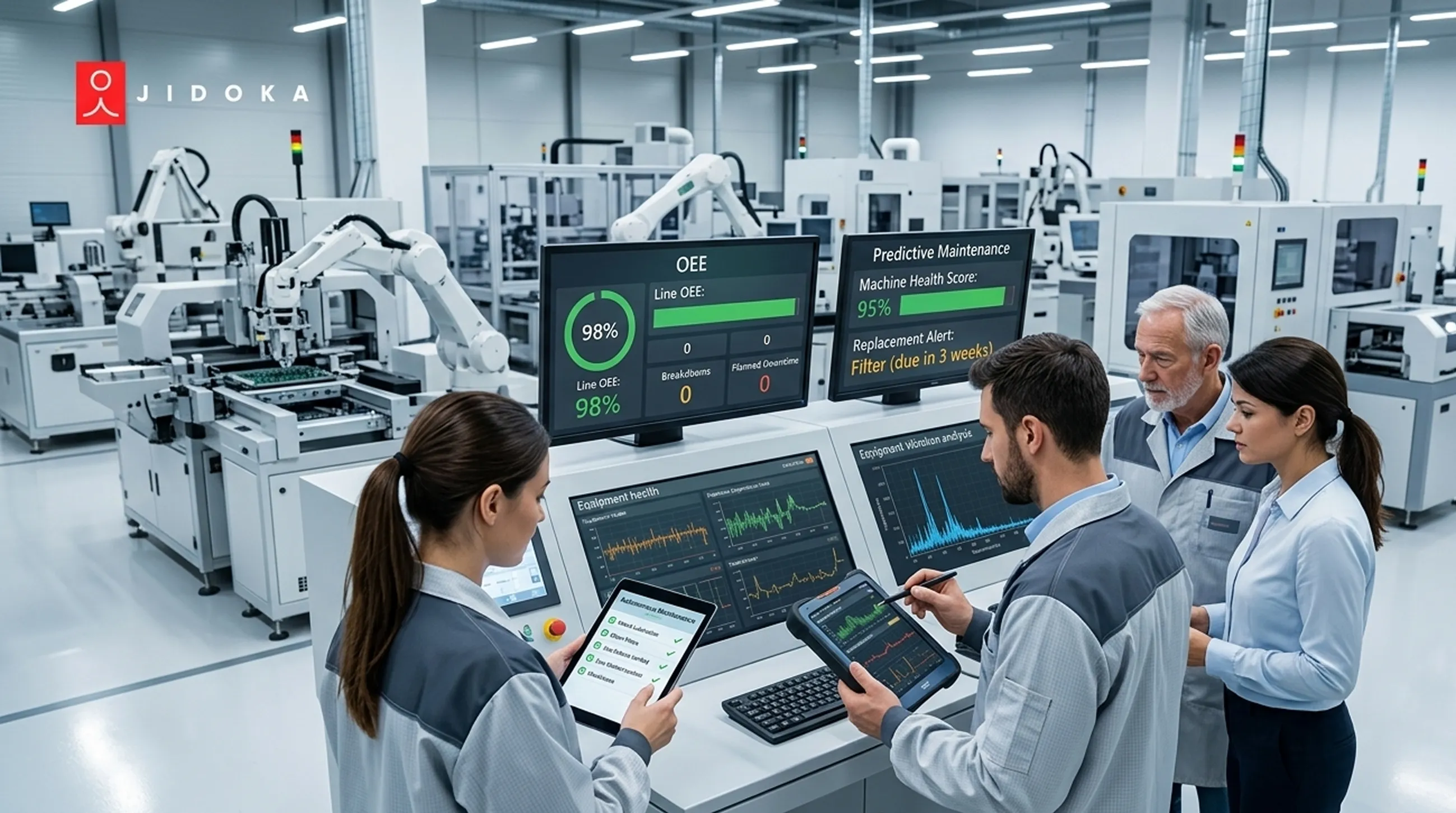
Machine-level data captures OEE, downtime, cycle time, and equipment condition. It tells you what the machine produced. It does not tell you how it was produced.

Process-level data captures operator actions, assembly sequences, and component presence at each station. A line running at 78% OEE can still generate defects at the process layer that the machine sensor never sees. A smart factory monitoring system that only monitors machines is half a monitoring system. The process layer is where quality failures originate and where machine data goes silent.

Requirement 2: Actionable Alerts Within the Production Event Window

A dashboard that requires a supervisor to check it is not an alert system. An alert that fires at the operator station the moment a step is missed, that is an alert system.

The production window for most discrete assembly operations runs between 30 and 90 seconds per unit. The alert must arrive and be actionable inside that window. Anything longer means the affected unit moves downstream, and the cost of correction multiplies with every station it crosses before detection.

Requirement 3: Closed-Loop Accountability

Every floor intervention triggered by the digital monitoring system must be logged. Who responded, what action was taken, what the outcome was. Without that log, a plant cannot verify whether its monitoring investment is actually improving performance or just generating noise. Data without a closed loop is surveillance. Intelligence requires a feedback mechanism.

Production Floor Intelligence: What Machine Data Cannot See

Production floor intelligence is the real-time capture of operator actions and process steps, verified against digital SOPs, with deviations detected and flagged before the affected unit exits the station.

Failure Types Outside Traditional Machine Sensor Detection
Failure Type Visible to Machine Monitoring Visible to Process Monitoring
Operator skips a torque step No: machine ran, cycle completed Yes: action missing versus SOP
Wrong component in correct location No: part count incremented Yes: object detection flags mismatch
Correct steps in wrong sequence No: no alarm generated Yes: action recognition detects sequence deviation

In all three cases, OEE is unaffected. The shift ends at a number that looks acceptable. The rework or customer escape surfaces later, after the window to fix it cheaply has closed.

Shift-to-shift variation is where this gap becomes a direct cost problem. OEE averaged across three shifts can read 76% while individual shifts range between 68% and 84%. A smart factory monitoring system averages that spread at the machine layer and hides it. 

Production floor intelligence reveals that the variation is operator-driven, not machine-driven, and pinpoints exactly which steps and stations are responsible.

How Smart Factory Monitoring Connects to Continuous Improvement

A smart factory monitoring system generates value past the alert event. The alert is the trigger. The structured data behind it is the input to three downstream workflows that determine whether monitoring spend compounds or stagnates.

A) CAPA: Structured Deviation Data Over Narrative Reports

Every production deviation logged by the digital monitoring system becomes a structured data point in the corrective action process. Patterns across shifts and stations surface root causes that single-event investigation cannot reach. CAPA fed by event-level monitoring data is faster, more specific, and more actionable than CAPA built on supervisor incident narratives.

B) Operator Training: Data-Driven, Not Calendar-Driven

Process monitoring identifies which operators deviate from SOP most frequently, at which specific steps, and on which shifts. That data converts training from a scheduled activity into a targeted intervention. 

Retraining the operator who consistently skips step 4 on the torque sequence is a fundamentally different action than running a quarterly refresher for the whole shift team. Monitoring data makes that specificity possible.

C) Kaizen: Cycle-Level Traceability for Real Improvement Cycles

Kaizen events need cycle-time data at the step level. They rarely have it in floor-collected form. Production workflow monitoring traceability provides exactly that: where cycle times vary, which steps run longer than planned, and where sequence changes reduce elapsed time. The monitoring system becomes the data infrastructure for improvement cycles, not just a real-time alarm tool.

How Nagare Delivers All Three Requirements

Nagare is Jidoka Technologies' shop floor AI monitoring system built around the three requirements above. Where most smart factory monitoring systems stop at the machine layer, Nagare extends coverage into the process layer using existing camera infrastructure.

1. Dual-Stream AI for the Process Layer: Two simultaneous AI streams run on existing camera feeds. Object Detection confirms component presence and placement. Action Recognition tracks operator steps against the SOP sequence in real time. Nagare reads everything that happens between cycle start and cycle end, which is exactly what machine sensors miss. Works with standard RTSP/IP cameras from Bosch, Hikvision, and comparable manufacturers.

2. On-Premises Edge AI: Zero Latency, No Data Exposure: Nagare runs entirely on local edge hardware. No video leaves the floor. No cloud round-trip adds latency. The alert fires at the operator station within the production event window, every time.

3. Full Traceability and System Integration: Every step, deviation, alert, and operator response is logged and integrates with MES, QMS, and training platforms. Documented deployments show 20 to 35% rework reduction from this closed-loop structure. 48+ customers, 100+ implementations, up to 300 million parts per day.

Nagare in practice:

  • Tracks 100% of assembly steps through existing cameras
  • Flags missing parts, wrong components, and sequence deviations before the unit exits the station
  • Cuts rework by 20 to 35% across documented deployments
  • Requires no camera hardware changes in most installations
  • Deploys at pilot scale across 2 to 4 stations in 3 to 5 days

To map Nagare against your current monitoring gaps, talk to the Jidoka team.

The Gap Is Not a Hardware Problem

Most manufacturers running a connected factory already have the infrastructure a smart factory monitoring system needs. The sensors are there. The cameras are there. The network is there. What is missing is the process layer analysis, the closed-loop alert architecture, and the traceability log that turns monitoring data into improvement data.

Apply the Smart Factory Intelligence Checklist to your current deployment. 

  • Does it capture both machine and process data? 
  • Does it alert the right person within the production event window? 
  • Does it log every intervention and outcome? 

A "no" on any of the three means the gap is measurable, and the cost is showing up somewhere: in rework, in customer escapes, or in shift-to-shift variation nobody can explain. 

Let's talk about what that looks like for your line.

FAQs

1. What is a smart factory monitoring system?

A smart factory monitoring system captures production events in real time, converts them into floor-level alerts within the same production event window, and logs every intervention and its outcome. The defining characteristic is closed-loop accountability. Connected dashboards generate data. A smart monitoring system generates corrective action and a measurable record of whether that action improved performance over time.

2. What is the difference between a connected factory and a smart factory?

A connected factory has sensors and dashboards delivering machine data to operations teams. A smart factory converts that data into action within the same production event window. The difference is not the technology stack, it is closed-loop architecture. Connected factories generate data. Smart factories generate decisions with logged outcomes. Most Industry 4.0 investments stop at the connected layer.

3. What is production floor intelligence and why does OEE not cover it?

OEE measures machine performance: availability, performance rate, and quality yield from machine output. Production floor intelligence additionally captures what the operator does at each station, whether the correct sequence was followed, whether components were correctly installed, and whether process steps matched the SOP. A line can report acceptable OEE while process deviations at individual stations generate downstream rework that machine data never surfaces.

4. How does Nagare support continuous improvement in a smart factory?

Nagare stores cycle-level process traceability data covering every step, deviation, and operator action. That data feeds CAPA with structured event logs instead of incident narratives, identifies which operators deviate at which steps for data-driven training, and provides the step-level cycle-time data Kaizen events need. The connected factory monitoring system becomes the data infrastructure for improvement cycles, not just a real-time alert tool.

5. Does Nagare require new camera hardware to deploy?

No. Nagare works with existing RTSP/IP cameras from standard manufacturers including Bosch and Hikvision. The system runs on local edge hardware entirely on-premises, requires no cloud connectivity, and deploys at pilot scale across 2 to 4 stations in 3 to 5 days. Most installations go live without any camera infrastructure changes (Source).

May 28, 2026
By
Sekar Udayamurthy, CEO of Jidoka Tech

相談会開催中

品質と生産性を最大化するビジョン検査システムに関する相談会を実施中です。ぜひこの機会にお試しください。

お問い合わせ