inventory management

What Is Inventory Management? Types & Benefits 2026

What is inventory management? Learn types, benefits, real-world examples, and how manufacturers cut stockout and overstock losses in 2026.

Retailers and manufacturers lost $1.7 trillion in 2024. A stockout depletes your revenue. Overstocking wastes your cash. You will see different inventory management types and clear inventory management benefits to help you. 

We cover demand forecasting, just-in-time inventory, and ABC analysis. Learn to track raw materials inventory and safety stock with a perpetual inventory system. Improve your inventory turnover ratio and manage MRO inventory right now. 

These steps help your business stay profitable. You need a plan for your production goals and daily tasks to succeed in inventory management.

What Is Inventory Management and Why the Textbook Definition Isn't Enough in 2026

Modern inventory management uses a perpetual inventory system to stop a stockout. You gain inventory management benefits by syncing digital data with real floor stock.

A) The Core Function: Beyond Just Tracking Stock

Use demand forecasting to avoid overstocking and improve your inventory turnover ratio. This inventory management step balances your cash with your orders. Good inventory management provides clarity when you stop wasting money on shelf space. 

A perpetual inventory system keeps your raw materials inventory moving without any expensive or messy delays.

B) The Four Types of Inventory Every Manufacturer Must Control

Track these four areas using ABC analysis to prioritize your efforts:

  • raw materials inventory for production
  • Work-in-process for assembly
  • Finished goods for sales
  • MRO inventory for repairs 

These inventory management types prevent a stockout. They keep your safety stock levels lean to help your business save money.

Next, you must choose the specific strategy that fits your daily production goals.

Key Inventory Management Types: Which Method Fits Your Operation

You must choose the right inventory management types to match your facility goals. The right choice brings immediate inventory management benefits.

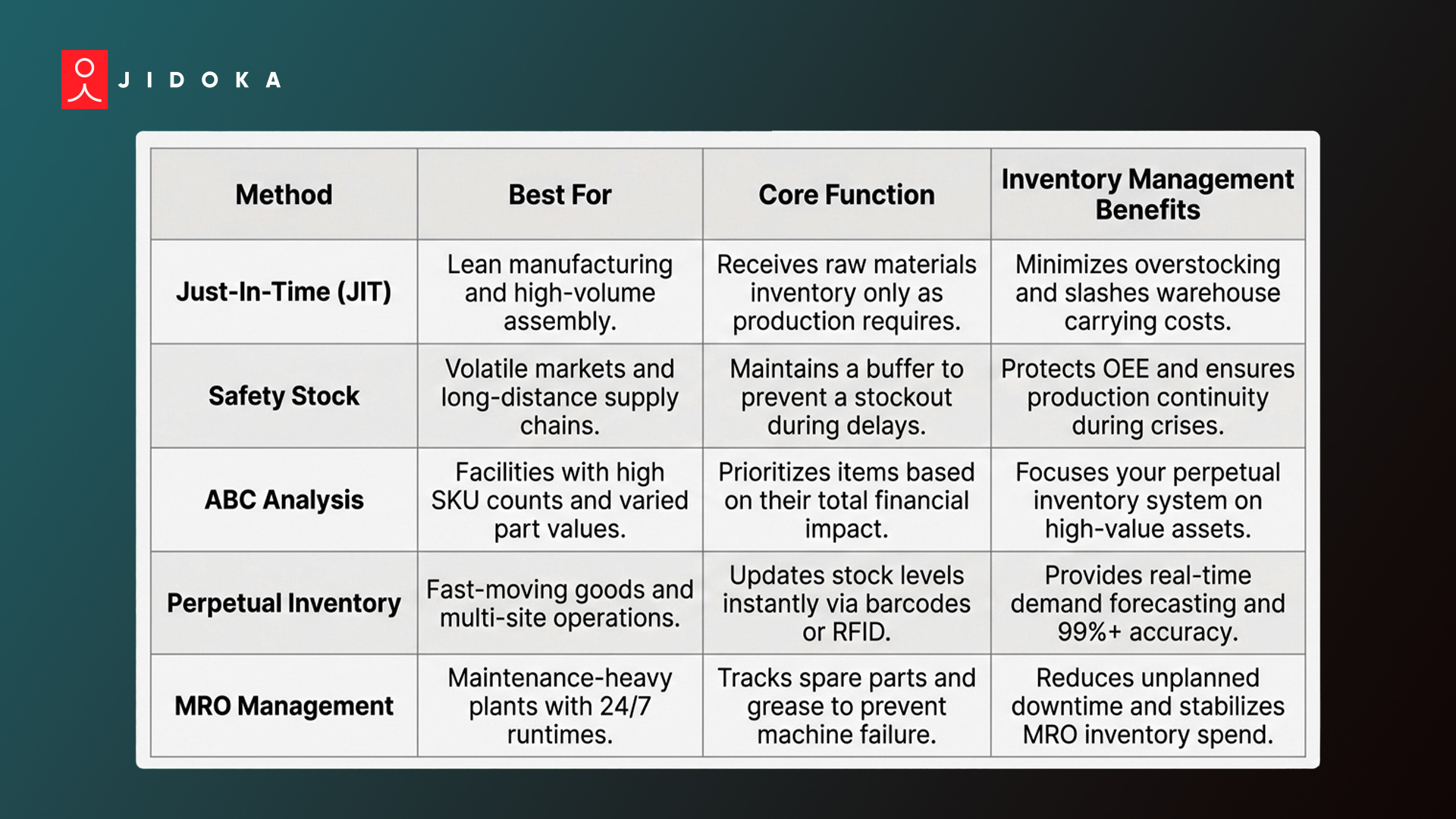
1. Just-In-Time (JIT) vs. Safety Stock: The Core Trade-Off

Using just-in-time inventory keeps your facility lean and cuts storage costs. However, keeping safety stock prevents a stockout when suppliers fail. 

Use these criteria for your strategy:

  • Use just-in-time inventory for high-volume, stable parts.
  • Maintain safety stock for long-lead-time raw materials inventory.
  • Balance both to improve your inventory turnover ratio.

2. ABC Analysis: Why Not All Inventory Deserves Equal Attention

Perform an ABC analysis to group your raw materials inventory by value. Class A items get your full focus. Use a perpetual inventory system to track high-value parts daily. 

Automation handles Class C items like bolts or MRO inventory grease. This inventory management method ensures you never waste time on low-value items that don't drive profit.

3. Perpetual vs. Periodic Inventory Systems

A perpetual inventory system updates your counts instantly via barcodes. This is superior to periodic systems because it provides:

  • Real-time demand forecasting data.
  • Automatic alerts to prevent a stockout.
  • Higher accuracy for your raw materials inventory levels. 

Stop guessing your stock levels and start using live data to see the inventory management benefits.

Inventory Management Methods At a Glance:

This clarity leads directly to the specific results you see in your budget.

Real Benefits of Inventory Management — Specific, Measurable, Not Generic

Optimizing your inventory management creates measurable financial gains. These inventory management benefits show up directly in your cash flow and daily production efficiency.

1. Cash Flow and Carrying Cost Reduction

Effective inventory management stops overstocking which immediately frees up your trapped cash for other business needs. By applying an ABC analysis to your stock, you ensure your budget goes toward the parts that actually sell rather than dust-collectors. 

This strategic shift improves your inventory turnover ratio and significantly lowers your monthly storage fees. You will see carrying costs drop by up to 30% once you clear out old MRO inventory and use better demand forecasting to lean out your raw materials inventory.

2. Production Continuity and OEE Impact

A sudden stockout stops your machines and wastes labor hours. Maintaining proper safety stock through a perpetual inventory system ensures your line never goes cold. This consistency is one of the top inventory management benefits for modern plants.

  • Prevent production halts with automated alerts for low MRO inventory.
  • Use just-in-time inventory to keep the shop floor organized and safe.
  • Boost your OEE (Overall Equipment Effectiveness) by having the right raw materials inventory ready for every shift.

These operational wins provide the foundation for handling complex orders across different manufacturing styles.

Inventory Management Examples Across Manufacturing Environments

Different industries use specific inventory management types to succeed. See how inventory management strategies work in real factories to get the best inventory management benefits.

1. Discrete Manufacturing: High-Mix, Low-Volume Inventory Challenges

In car plants, you manage raw materials inventory using just-in-time inventory to save space. You track thousands of parts with a perpetual inventory system to prevent a stockout during assembly.

  • Use ABC analysis for expensive engines.
  • Track bolts as C-class items. 

This inventory management stops overstocking and keeps your inventory turnover ratio high.

2. Process and Continuous Manufacturing: Where MRO Inventory Drives Uptime

Food plants use demand forecasting for inventory management of perishable raw materials inventory. You must keep enough safety stock of jars to avoid a stockout. 

Since machines run 24/7, tracking MRO inventory is vital for constant uptime. These inventory management types ensure your product remains fresh and your production never stops unexpectedly.

Real-time data makes these examples work, which is where specialized technology steps in to help.

How Jidoka Tech Helps Inventory Management Teams Cut Rework and Reject Rates

Jidoka Tech closes the gap between your perpetual inventory system and the physical shop floor. Our AI inspection system stops overstocking errors by ensuring every part consumed matches your digital record. 

By using real-time data, you gain massive inventory management benefits through precise station-level tracking.

  • KOMPASS: This high-accuracy inspector reaches 99.8%+ accuracy on raw materials inventory checks, reviewing frames in under 10 ms to prevent a stockout of quality parts.
  • NAGARE: This analyst tracks 100% of assembly steps to flag missing MRO inventory or wrong sequences, cutting rework by 20–35%.
  • Edge Computing: Systems run on local units to ensure your inventory management types stay updated without lag or delay.

Jidoka’s just-in-time inventory support keeps your inventory turnover ratio high and your production lines moving. 

Conclusion

Efficient inventory management keeps your production floor moving. Yet, picking the wrong inventory management types leads to a stockout or expensive overstocking. 

These errors drain your cash and stop your lines. You risk losing customers and your market share to faster competitors. This $1.7 trillion distortion destroys your margins and halts your growth. 

Jidoka Tech fixes these gaps by connecting your perpetual inventory system to real-time vision. You gain inventory management benefits like a better inventory turnover ratio and precise demand forecasting. 

Reach out to Jidoka Technologies to see how demand forecasting and vision systems fix your stock accuracy today.

FAQs

1. What is inventory management in simple terms?

Inventory management is the process of tracking raw materials inventory, WIP, and finished goods to ensure you have enough stock without overstocking. Using a perpetual inventory system provides real-time data to help you avoid a costly stockout and improve your inventory turnover ratio.

2. What are the four types of inventory in manufacturing?

The four inventory management types are raw materials inventory, work-in-process, finished goods, and MRO inventory used for repairs. Mastering these categories through ABC analysis helps you maintain a perfect safety stock balance. This focus brings measurable inventory management benefits to your facility.

3. What is the difference between JIT and safety stock?

Just-in-time inventory keeps your warehouse lean to save cash, while safety stock acts as a buffer to prevent a stockout during supplier delays. Most managers use both inventory management types to improve demand forecasting and keep their inventory turnover ratio high.

4. How does poor inventory management affect production?

Bad inventory management causes a stockout that stops machines, ruins your inventory turnover ratio, and creates expensive downtime. Without a perpetual inventory system, you risk overstocking the wrong parts. This inefficiency wipes out the inventory management benefits you need to stay profitable.

5. What is ABC analysis in inventory management?

ABC analysis groups items by value so you can focus your perpetual inventory system on the most expensive parts. This inventory management step ensures your raw materials inventory and MRO inventory are always ready. It stops overstocking and protects your vital cash flow.

6. What is inventory distortion and how much does it cost?

Inventory distortion is the combined loss from a stockout or overstocking, costing businesses $1.7 trillion globally. It happens when you lack proper demand forecasting and weak inventory management types. Fixing this improves your inventory turnover ratio and overall inventory management benefits immediately.

February 11, 2026
By
Shwetha T Ramakrishnan, CMO at Jidoka Tech

相談会開催中

品質と生産性を最大化するビジョン検査システムに関する相談会を実施中です。ぜひこの機会にお試しください。

お問い合わせ