












LOT & BATCH-CODE VERIFICATION

Lot Code Verification
to Catch Wrong Codes Before Dispatch

KOMPASS adds lot code verification to every pack on the line. AI reads each lot, batch and date code, compares it with the batch record for the running order and signals the line when a code is missing, unreadable or carried over from the last run.

Discuss Your Code Check

Trusted by manufacturers to improve quality on the line

THE PROBLEM

A Code Can Be Printed Perfectly and Still Be Wrong

Lot and batch codes link every pack to how it was made. When the code is missing, illegible or belongs to the previous order, that link breaks, and a recall can widen to stock that was never affected.

Changeovers Carry Old Codes Forward

The coder is not updated, or is updated late. The first packs of the new run carry the previous batch number, and they look perfectly normal.

Coders Fail Quietly

Low ink, a blocked nozzle or a printer skip leaves codes faint, partial or absent. Nobody notices until someone reads one.

Presence Checks Do Not Read

A sensor that confirms print exists cannot tell whether it says the right thing. A wrong digit passes as easily as a right one.
The Solution

Match Every Code to the Order Being Run

Our AI Product Inspection system, KOMPASS™, handles lot code verification with models trained on your print, checking each lot, batch and date code against the active order. Results reach the line controls with an image of every failure.

Read the Code, Then Check It Is the Right One

  • Read lot, batch, date and serial fields on every pack
  • Compare each field with the active order or recipe
  • Catch codes carried over from the previous run at changeover
  • Separate unreadable print from wrong content in the result
Every pack
Code read and matched
Active order
The reference for every check
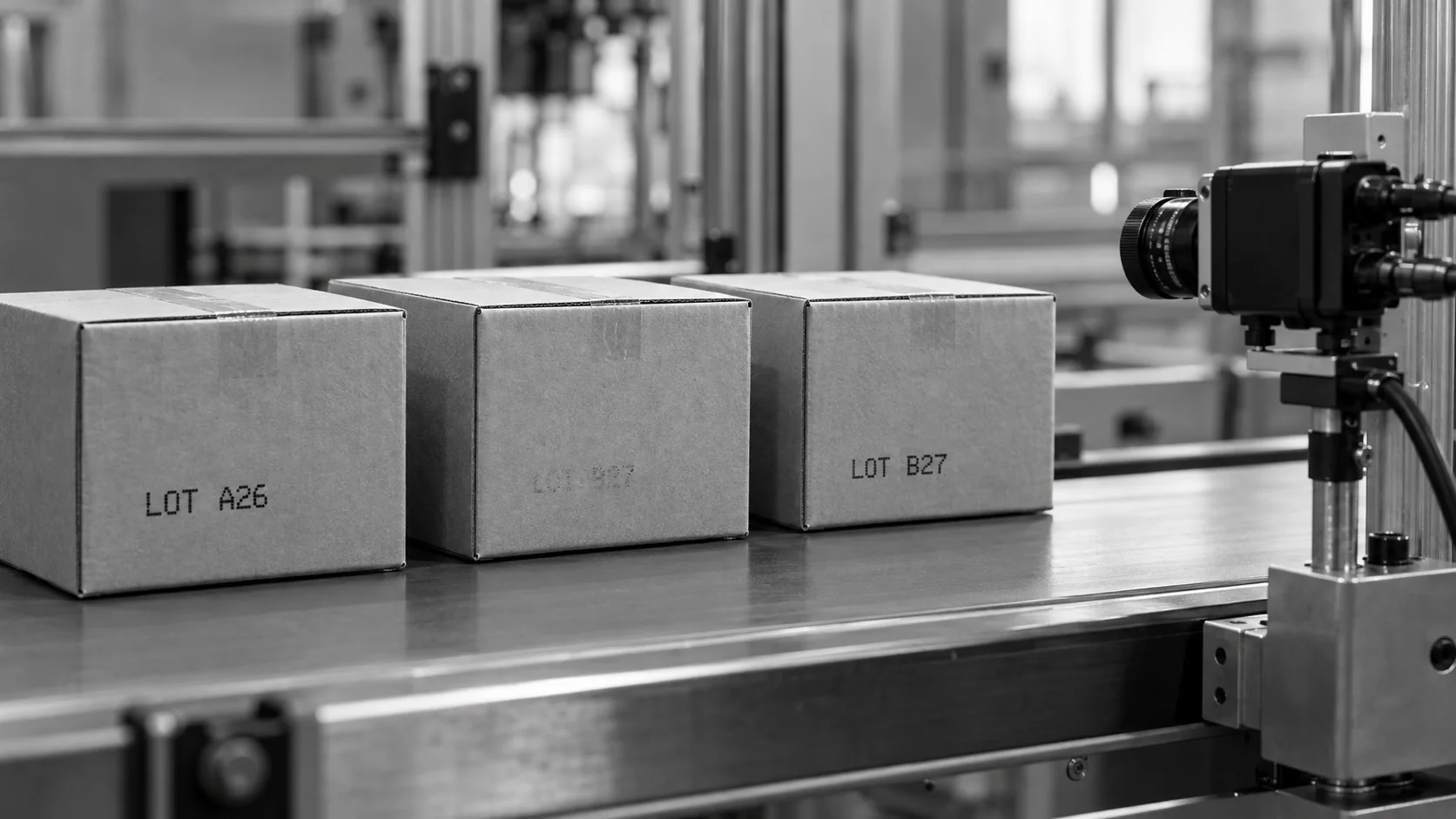
Conceptual illustration of cartons with clear and faint sample lot codes beside an inspection camera.

Stop the Bad Code Before It Spreads

  • Reject packs with missing, unreadable or mismatched codes
  • Stop the line after repeated failures from the same coder
  • Store each result and failure image for traceability
  • Show failure trends by coder, shift and product
Failure images
Root cause visible
Digital record
Proof every code was checked
HOW IT WORKS

See KOMPASS Verify Batch Codes in Real Time

Jidoka's demonstration shows lot code verification in real time: KOMPASS reads batch codes, dates and serial numbers as packs pass the coder. A print-synchronised trigger captures each pack, and inspection results and NG images are recorded for digital traceability.

Official video frame showing two captured batch-code images with character-detection boxes
Batch-code application: printed batch, date and serial fields are read and verified, with inspection records and a configured rejection response.
Highlight #1

Capture Each Code as It Is Printed

A trigger linked to the coder captures every pack with the code in view. Controlled lighting isolates the printed region on the substrate.

Highlight #2

Read and Compare With the Order

The model reads each field and checks it against the active order, so wrong, missing and unreadable codes are all caught.

Highlight #3

Reject, Alert and Record

Failing packs are rejected or held, repeated failures alert the team, and every result is stored with its image.

Connect With Us

Send us examples of good, faint and wrong codes and how your order data reaches the coder. We will assess the imaging and integration the check needs.

Get In Touch

What Changes When Every Code Is Matched to the Order?

Each method needs a readable code. The difference is whether lot code verification checks the content, and how quickly a coder problem reaches the team.

Inspection need
Manual inspection
Traditional machine vision
KOMPASS AI
Wrong code after changeover
Found if someone reads the first packs
Caught only if the expected value is updated
Checked against the active order on every pack
Faint or broken print
Judged differently by each person
Read failures rise as print degrades
Trained on your real print variation
Record of checks
Paper log at intervals
Pass or fail counts
Result and image for every failure
First-Time-Right
Depends on attention at changeover
Stable while print stays ideal
Stops wrong codes before dispatch
CUSTOMER SUCCESS

Appasamy Verifies Codes, Labels and Serial Numbers on Every Lens Pack

Appasamy needed one inspection to cover lens presence, printed codes and labels, QR-based serial number consistency, particles and packaging integrity across 4 product variants and 8 lens shapes. KOMPASS sorts every pack OK or NG.

Official Jidoka case-study cover for Appasamy Associates lens-packaging inspection
Appasamy Verifies Codes, Labels and Serial Numbers on Every Lens Pack
Medical Devices

These are published results for the complete lens packaging inspection, of which code checks are one part.

  • 100% automated inspection of every lens pack
  • Zero missing or wrong parts

Frequently Asked Questions

What does code verification check beyond print quality?

Lot code verification checks that the code says the right thing, not only that it is legible. KOMPASS reads each field and compares it with the batch record or active order. A pack fails if the code is missing, unreadable or different from what should be printed. That catches the most expensive error, a perfectly printed code that belongs to another batch or another day. Presence sensors and simple readers cannot make that comparison, because they do not know which code is correct.

Where does the expected code come from?

Usually from the same source that feeds the coder: the work order, a recipe on the line controller or a manufacturing system. When the order changes, the expected code changes with it, so operators do not have to type values into the inspection station. Where that link does not exist yet, a supervisor can confirm the code at the start of each run. The link is tested during commissioning by running a planned changeover and confirming the reference updates.

Can it catch codes carried over from the last run?

Yes. The switch between orders is when most coding errors happen, because the coder message is updated late or not at all. Because every pack is compared with the new order, the first pack with an old lot number fails immediately. The station can also stop the line after a set number of consecutive failures, so a whole pallet is not coded wrongly before anyone reacts.

What usually causes coding failures?

Missing codes usually come from a printer skip, a jam or a product that reached the coder out of position. Smudged print comes from contact before the ink dries, low ink, a blocked nozzle on the inkjet coder or condensation on the pack. The failure images stored by the station show which pattern you have, which points maintenance to the right fix. Trends by coder and shift show whether failures are random or tied to one machine.

Does it verify expiry dates as well as lot numbers?

Yes. Date code verification uses the same reading, with a rule for what the date should be. An expiry date is usually calculated from the production date and shelf life, so the station can check both the format and the value. Best-before, use-by and manufacturing dates can be checked together with lot fields when they share the same print area. Where packs carry several dates, each field is checked against its own rule.

How does it support recalls and audits?

Every inspection result is stored with the code read, the expected value and a time stamp, and NG images are kept for every failure. That creates a digital record that each pack was checked, which supports traceability and is the evidence auditors ask for when they review batch code verification. If a recall happens, the record helps confirm which codes actually left the plant.

How is the camera synchronised with the coder?

A print trigger from the coder or a product sensor tells the camera when the code is in position. That keeps the code in the same place in every image and avoids reading a pack before printing has finished. Reading on fast lines depends on that timing as much as on reading, so it is set up and tested during commissioning. If products arrive unevenly spaced, the trigger also prevents two packs being captured in one image.

What do you need from us to set up code checks on our line?

Send samples of good, faint, smudged and wrong codes, the code format for each product and how order data reaches your coder today. Add the line speed, pack materials and the reject position. With that, we can recommend camera placement, lighting and integration for lot code verification on your line and plan the validation.

CONNECT WITH OUR EXPERTS

Show Us the Code Your Current Check Lets Through

Share your code samples, formats, order data source and line speed. We will plan lot code verification at your coder and give you a timeline and budget. Expect go-live in roughly 6 to 8 weeks.

Discuss Your Code Check
Close video