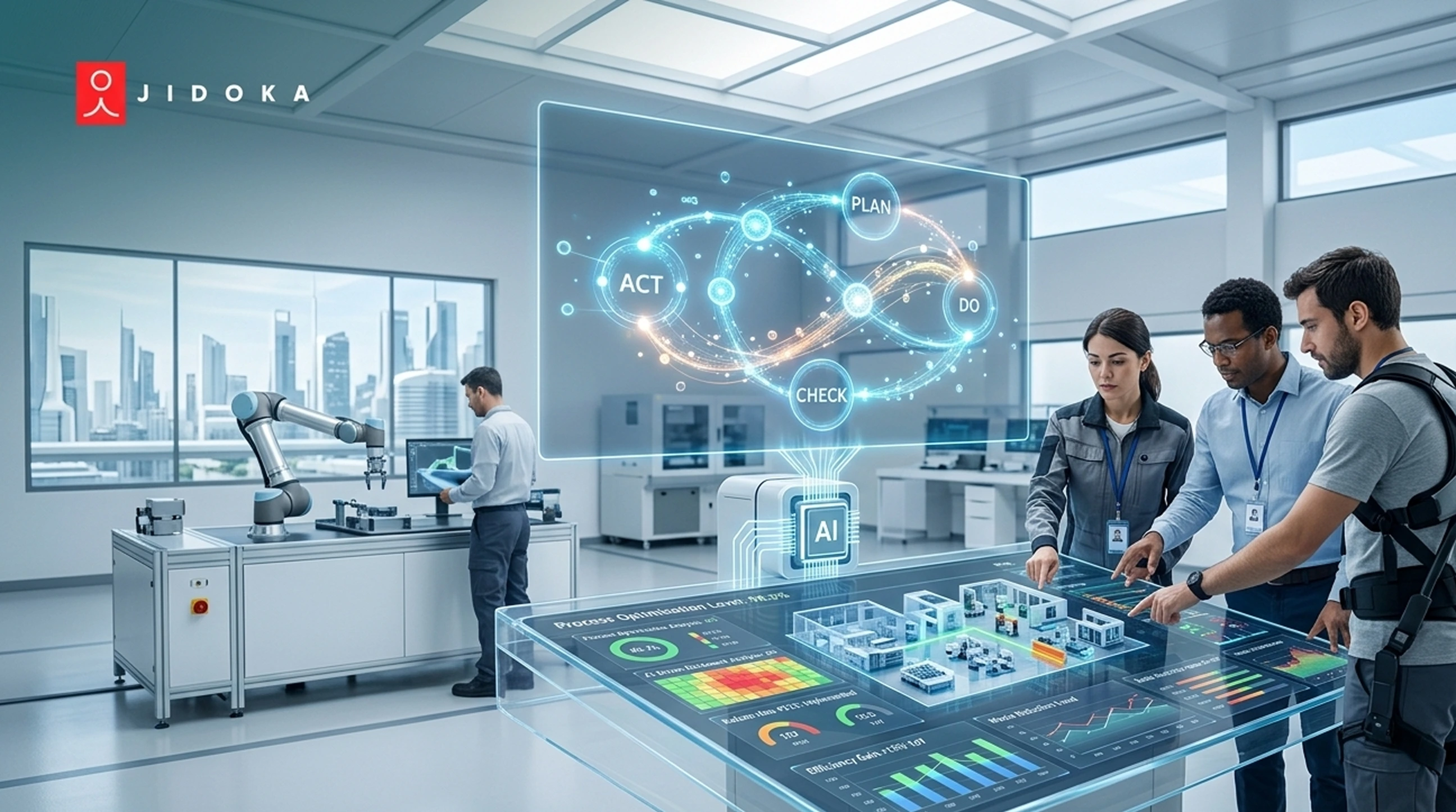
47% van de fabrikanten gebruikt in 2026 AI in kwaliteitsprocessen, een stijging ten opzichte van 33% in 2025, waarbij 71% verwacht dat de uitgaven aan kwaliteit zullen toenemen (Pulse of Quality in Manufacturing 2026 Survey, GlobeNewswire, 3 juni 2026). Deze versnelling weerspiegelt een structureel probleem bij continuous improvement in de productie: PDCA, Kaizen en Six Sigma zijn gebaseerd op datalussen, maar de data die deze lussen voedt, wordt op de meeste werkvloeren nog steeds handmatig verzameld.
AI-monitoring verandert wat CI kan opleveren door de 'Check'-fase continu te maken. Deze gids legt de belangrijkste CI-raamwerken uit, waar ze op grote schaal tekortschieten en hoe AI-procesmonitoring dit gat dicht.
Wat is continuous improvement in de productie en waarom lopen klassieke raamwerken tegen een datamuur aan?
Raamwerken voor continuous improvement in de productie vertrouwen op nauwkeurige, tijdige data uit de 'Check'-fase van elke verbetercyclus. Wanneer die data afkomstig is van handmatige rondgangen en periodieke logboeken, draait de verbeterlus in maandelijkse cycli. Wanneer AI deze data automatisch per productiecyclus levert, wordt de lus verkort tot cycli per ploegendienst, zonder extra personeel.
1. PDCA: Het fundament waarop de meeste fabrieken op verouderde data draaien
De PDCA-cyclus (Plan, Do, Check, Act) verloopt in vier fasen: Plan definieert het probleem en het verbeterdoel; Do implementeert de verandering op kleine schaal; Check vergelijkt de werkelijke resultaten met de verwachte; Act standaardiseert de verbetering of herziet de aanpak. De cyclus herhaalt zich continu. De effectiviteit hangt volledig af van de nauwkeurigheid en tijdigheid van de data in de Check-fase.
De meeste fabrieken verzamelen data voor de Check-fase één keer per ploegendienst via logboeken van operators, handmatige kwaliteitscontroles en steekproeven. Die data komt uren na de procesgebeurtenissen binnen die ze beschrijven. Een defectpercentage dat om 10:00 uur piekte, verschijnt pas om 14:00 uur in de Check-data en in de Act-beslissing tijdens de ochtendvergadering van de volgende dag. De cyclus voor continuous improvement die dagen zou moeten duren, duurt weken omdat de Check-fase met vertraging werkt.
2. Six Sigma DMAIC en het meetprobleem
De DMAIC-structuur van Six Sigma (Define, Measure, Analyze, Improve, Control) vereist statistisch valide datasets in zowel de Measure- als de Control-fase. Op de meeste werkvloeren is de data in de Measure-fase gebaseerd op steekproeven, niet op volledige gegevens. Data uit steekproeven bevat statistische ruis die de schijnbare variatie vergroot en het identificeren van de werkelijke hoofdoorzaak in de Analyze-fase bemoeilijkt.
Het raamwerk voor productieverbetering dat Six Sigma biedt, is solide. De data die nodig is om volledig effectief te functioneren, vereist echter 100% inspectiedekking en procesregistraties op stapniveau; zaken die handmatige verzameling op productieschaal niet kan bieden. Dit is de structurele datamuur die alle drie de grote CI-raamwerken delen: ze zijn gebouwd voor volledige data, maar worden ingezet met onvolledige data.
3. Value Stream Mapping en de beperking van retrospectieve analyse
Value Stream Mapping (VSM) voor operationele verbetering in de productie identificeert vertragingen zonder toegevoegde waarde tussen procescellen. De beperking die VSM deelt met alle statische analysetools: het toont de verspilling die bestond op het moment van observatie, niet de verspilling die zich op dit moment ophoopt. Een VSM die op maandag is gemaakt, beschrijft maandag accuraat. Tegen vrijdag zijn ploegpatronen, machinestatussen en de samenstelling van operators echter allemaal veranderd.
Hetzelfde geldt voor handmatige tijdsstudies en observaties op de werkvloer die worden gebruikt voor lean continuous improvement-baselines. Kaizen-teams ontdekken vaak dat de baseline-data die vóór het evenement is verzameld, niet overeenkomt met de productierealiteit die ze tijdens het evenement observeren, omdat handmatige steekproeven de volledige variatie tussen ploegen, operators en machinestatussen niet kunnen vastleggen. Zie hoe de systemen van Jidoka dit aanpakken voor algemene productie en automotive CI-programma's.
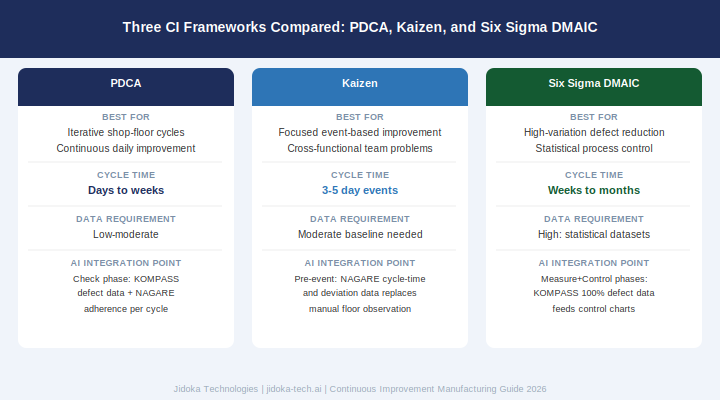
Figuur 1: PDCA vs. Kaizen vs. Six Sigma DMAIC: beste use-case, cyclustijd, datavereisten en AI-integratiepunt voor elk framework
Hoe stimuleren Kaizen-events in de productie Lean continue verbetering op de werkvloer?
Kaizen-events in de productie zijn gerichte, tijdsgebonden workshops (meestal 3 tot 5 dagen) waarin een cross-functioneel team een specifiek procesprobleem analyseert, een oplossing test en een standaard implementeert. De effectiviteit hangt af van de nauwkeurigheid van de basisgegevens vooraf en de striktheid van de monitoring om de verbetering na afloop van het event te behouden.
Hoe structureer je een Kaizen-event dat blijvende resultaten oplevert?
Vijf standaardfasen bepalen Kaizen-events in de productie die duurzame resultaten opleveren. Voorbereiding: definieer de scope, verzamel basisgegevens en stel meetbare doelen vast. Dag 1: observeer en breng de huidige situatie in kaart, valideer de basislijn aan de hand van wat het team daadwerkelijk op de werkvloer ziet. Dag 2 tot 3: genereer en test oplossingen met behulp van de geverifieerde basislijn. Dag 4: implementeer en standaardiseer de winnende oplossing, update de SOP. Dag 5: rapporteer de resultaten en stel het audit-schema voor de komende 30 dagen vast.
De basisgegevens die bij de voorbereiding worden gebruikt, bepalen hoe nauwkeurig het verbeterdoel is. Als gegevens over defecten of cyclustijden gebaseerd zijn op handmatige steekproeven, is de basislijn al vertekend voordat het event begint. Een Lean continue verbetering-event met een vertekende basislijn levert een verbeterdoel op dat te hoog of te laag kan zijn, waardoor het meten van succes vanaf het begin dubbelzinnig wordt.
Waarom Kaizen-winsten tussen events door vervagen
De meest voorkomende faalfactor bij Kaizen-verbeteringen: operators vallen binnen enkele weken na afloop van het event terug in hun oude gewoontes. De verbetering was tijdens het event reëel, maar werd niet zodanig verankerd dat deze bestand is tegen normale variaties in ploegendiensten. Er werd een nieuwe standaard gecreëerd, maar er is geen handhavingsmechanisme dat garandeert dat elke operator deze bij elke cyclus en in elke ploeg volgt.
NAGARE's digitale werkinstructies en real-time SOP-verificatie bieden de handhavingslaag voor Lean continue verbetering die dit gat dicht. Elke productiehandeling wordt vergeleken met de goedgekeurde standaard en afwijkingen worden in real-time gemarkeerd. De verbetering uit het Kaizen-event wordt fysiek afgedwongen, in plaats van alleen gedocumenteerd.
Welke data heeft een Kaizen-event nodig die handmatige observatie niet kan bieden?
Kaizen-teams hebben drie soorten data nodig die handmatige observatie niet betrouwbaar kan leveren: variatie in cyclustijd per operator en per ploeg (niet alleen de gemiddelde cyclustijd, maar de volledige verdeling die laat zien wanneer en waarom deze piekt), de frequentie en duur van micro-stops per station (korte ongeplande stops die nooit de drempel voor een onderhoudsticket bereiken, maar gezamenlijk aanzienlijke capaciteit opslokken), en afwijkingen op stapniveau van de standaardwerkvolgorde (welke stappen worden door de operator overgeslagen of in een andere volgorde uitgevoerd, en hoe vaak).
NAGARE levert al deze drie datapunten automatisch vanuit de bestaande camera-infrastructuur, waardoor teams bij Kaizen-events in de productie een feitelijke basislijn krijgen die subjectieve observatie op de werkvloer vervangt. De Jidoka NAGARE-pagina merkt op dat traditionele AI-systemen 'een gebrek aan diepgaande traceerbaarheid hebben, wat Kaizen-initiatieven beperkt', een positioneringspunt dat hier direct van toepassing is.
Welke CI-tools heeft een programma voor continue verbetering in de productie in 2026 echt nodig?
Een programma voor continue verbetering in de productie heeft in 2026 vier categorieën tools nodig: een framework voor productieverbetering om verbetercycli te structureren (PDCA of DMAIC), een methode voor verspillingsanalyse (Value Stream Mapping of 5 Whys), een laag voor real-time dataverzameling en een mechanisme voor de handhaving van standaardwerk. De eerste twee zijn goed ingeburgerd. Bij de laatste twee schieten de meeste programma's tekort.
1. Framework-tools: PDCA, DMAIC en A3
Drie primaire framework-tools dekken de meeste behoeften voor CI-productietools. PDCA voor iteratieve verbetering op de werkvloer waar snelheid belangrijker is dan statistische nauwkeurigheid. DMAIC voor datarijke Six Sigma-projecten in processen met hoge variatie, waarbij de hoofdoorzaak statistische analyse vereist om deze te isoleren. A3 voor gestructureerde documentatie van de hoofdoorzaak: een formaat van één pagina dat teams dwingt om het probleem, de huidige situatie, de analyse, de doelsituatie en het actieplan te definiëren in een formaat dat een fabrieksmanager in vijf minuten kan beoordelen.
A3 is vernoemd naar het A3-papierformaat, maar de waarde is disciplinair: het beperkt de probleemdefinitie tot wat op één pagina past, waardoor teams gedwongen worden om de essentiële causale keten te prioriteren boven uitgebreide documentatie. Het werkt goed als documentatieformaat voor de output van het productieverbeteringsframework, of dit nu uit een PDCA-cyclus of een Kaizen-event komt.
2. Tools voor verspillingsidentificatie: VSM, 5 Whys en Fishbone
VSM identificeert vertragingen zonder toegevoegde waarde tussen procescellen. 5 Whys herleidt een specifiek defect via vijf oorzakelijke lagen naar het daadwerkelijke systeemfalen. Visgraatdiagrammen (Ishikawa) brengen oorzaken in kaart op het gebied van machines, methoden, materialen, metingen, omgeving en mensen voor problemen met meerdere oorzaken.
De beperking die deze tools delen: ze zijn retrospectief. VSM toont de verspilling die bestond op het moment van observatie. 5 Whys beschrijft een defect dat al heeft plaatsgevonden. Visgraatanalyse richt zich op een foutpatroon dat al zichtbaar is in productiedata. Tools voor continu verbeteren in de productie die zijn ontworpen voor real-time inzicht, in plaats van retrospectieve analyse, vereisen een andere datatoevoer dan wat deze tools afzonderlijk bieden.
3. Real-time data en handhaving van standaardwerk: waar AI het gat in continu verbeteren dicht
NAGARE levert drie datastromen die nodig zijn voor programma's voor continu verbeteren: verdeling van cyclustijden per station en ploeg (voor analyse van prestatievariaties), data over SOP-naleving op stapniveau (voor handhaving van standaardwerk) en afwijkingsfrequentie per operator (voor prioriteitsstelling van trainingen). KOMPASS levert data over defectpercentages bij 100% inspectiedekking voor de analyse van kwaliteitstrends, wat de PDCA-kwaliteitscyclus voedt.
Productie-AI behaalt een gemiddelde ROI van 200%, de hoogste van elke sector, omdat elke AI-verbetering direct gekoppeld is aan een kostenpost die al wordt gemeten (Capgemini Research Institute, Smart Factories Report 2025). NAGARE-procesresultaten: 30% toename in procesnaleving, 35% minder herbewerking, 25% hogere productiviteit, 30% lagere kosten voor toezicht en training.
Hoe versterkt AI-procesmonitoring een raamwerk voor productieverbetering?
AI-procesmonitoring versterkt een raamwerk voor productieverbetering door de dataverzameling waar PDCA, Kaizen en Six Sigma op vertrouwen te automatiseren. In plaats van dat 'Check'-data één keer per ploeg uit handmatige logboeken komt, levert AI continu data op cyclusniveau. Hierdoor worden verbetercycli versneld van maandelijkse naar ploeggebonden cycli, zonder extra personeel.
1. Hoe NAGARE de PDCA-controlefase versnelt
NAGARE monitort elke productiecyclus aan de hand van de goedgekeurde digitale SOP, classificeert elke cyclus als conform of afwijkend en logt het type afwijking, de tijdstempel en de operator. Dit verandert de 'Check'-fase van de PDCA-cyclus van een handmatige dataverzameling in een continue, geautomatiseerde stroom. Ploegleiders ontvangen afwijkingsmeldingen tijdens de dienst, niet pas aan het einde, waardoor beslissingen in de 'Act'-fase binnen minuten in plaats van weken kunnen worden genomen.
De geïntegreerde benchmark voor Lean plus AI-prestaties uit de blog over productieoptimalisatievan Jidoka: 20 tot 40% hogere doorvoer, 35 tot 50% minder defecten, terugverdientijd van 8 tot 10 maanden. Vergeleken met traditioneel Lean: 15 tot 25% doorvoer, 10 tot 15% minder defecten, terugverdientijd van 12 tot 18 maanden. Het prestatieverschil zit in de cyclustijd van de 'Check'-fase: continu verbeteren in de productie verloopt sneller wanneer de datacyclus continu draait.
2. Hoe KOMPASS defectdata invoert in de tracking voor continu verbeteren
KOMPASS biedt 100% inline inspectie tot 12.000 PPM, wat een defectsignaal genereert dat continu wordt bijgewerkt in plaats van aan het einde van de ploeg. Deze trenddata over defecten voedt DMAIC-controlediagrammen voor Six Sigma, PDCA-kwaliteitsmetrieken en baselines voor Kaizen-events met nauwkeurige, volledige productiedata in plaats van steekproefsgewijze tellingen aan het einde van de lijn.
Het verschil in de kwaliteit van het programma voor continu verbeteren is aanzienlijk: een Six Sigma-project dat gebruikmaakt van 100% KOMPASS-defectdata identificeert de werkelijke verdeling van de hoofdoorzaken. Hetzelfde project dat gebruikmaakt van 10% steekproefdata werkt met een vertekende verdeling. De output van een raamwerk voor productieverbetering is slechts zo nauwkeurig als de data die erin gaan. Bekijk hoe KOMPASS defectdetectie en labelverificatie integreer met CI-programma's.
3. Wat de data van het WEF Lighthouse Network zegt over AI-gestuurde CI
Het Global Lighthouse Network van het World Economic Forum ontdekte dat 189 toonaangevende industriële faciliteiten een gemiddelde stijging van 53% in arbeidsproductiviteit behaalden, waarbij AI-procesbewaking als de belangrijkste drijfveer werd genoemd.
Lean zonder realtime monitoring werkt met auditcycli die te traag zijn voor de moderne productiesnelheid. AI zonder lean heeft geen standaard om af te dwingen. Continue verbetering in de productie bereikt het meest wanneer gestructureerde CI-kaders definiëren wat er moet gebeuren en AI-monitoring verifieert of dit ook daadwerkelijk gebeurt. Geen van beide levert de volledige prestatiewinst zonder de ander. Ontdek hoe NAGARE en KOMPASS uw bestaande CI-programma versnellen.
Hoe Jidoka programma's voor continue verbetering in de productie versnelt
De procesdata op stapniveau van NAGARE en de 100% defectdekking van KOMPASS geven CI-programma's de twee databronnen die handmatige observatie en steekproeven nooit tegelijkertijd konden leveren: realtime, volledige defectdata en realtime, volledige data over procesnaleving.
- NAGARE: Handhaving van digitale werkinstructies met realtime monitoring van SOP-naleving. Voedt PDCA-check- en Kaizen-baselines met data op cyclusniveau. 30% winst in procesnaleving.
- KOMPASS: 100% defectdetectie op productiesnelheid. Voedt Six Sigma-controlediagrammen en PDCA-kwaliteitsmetrieken met volledige data, in plaats van benaderingen op basis van steekproeven.
- In diverse sectoren: Actieve CI-ondersteuning in automotive, FMCG, elektronicaen algemene productie.
Plan een implementatie-assessment om te zien hoe NAGARE- en KOMPASS-data de kloof in de controlefase van uw huidige CI-programma dichten.
Conclusie
Raamwerken voor continue verbetering in de productie zijn niet veranderd. PDCA, Kaizen en Six Sigma zijn in 2026 nog net zo solide als toen Toyota ze definieerde. Wat wel is veranderd, is de data die beschikbaar is om de controle- en meetfasen te voeden.
AI-procesmonitoring maakt de controlefase continu en geeft CI-teams data op cyclusniveau die handmatige observatie nooit kon bieden. Ontdek hoe NAGARE uw bestaande CI-programma versnelt op jidoka-tech.ai.
Veelgestelde vragen
1. Wat is continue verbetering in de productie en welke raamwerken worden hiervoor gebruikt?
Continue verbetering in de productie is de praktijk van het doorvoeren van regelmatige, incrementele wijzigingen om verspilling te elimineren, defecten te verminderen en de doorvoer te verhogen. De drie belangrijkste raamwerken zijn PDCA (Plan-Do-Check-Act) voor iteratieve cycli op de werkvloer, Kaizen voor dagelijkse incrementele verbetering en gestructureerde evenementen, en de DMAIC-structuur van Six Sigma voor statistisch gestuurde defectreductie in processen met een hoge variatie.
2. Wat is de PDCA-cyclus en hoe werkt deze in de productie?
De PDCA-cyclus doorloopt vier fasen: Plan definieert het probleem en de beoogde verbetering; Do implementeert de wijziging op kleine schaal; Check vergelijkt de werkelijke resultaten met de verwachte resultaten; Act standaardiseert de verbetering of herziet de aanpak. Bij continue verbetering in de productie herhaalt de cyclus zich continu. De effectiviteit hangt af van de nauwkeurigheid en tijdigheid van de data in de controlefase, waar de meeste fabrieken de grootste achterstand hebben.
3. Wat is het verschil tussen Kaizen-evenementen in de productie en de dagelijkse Kaizen-praktijk?
Kaizen-evenementen in de productie zijn gerichte workshops, meestal van 3 tot 5 dagen, waarbij een cross-functioneel team een specifiek procesprobleem analyseert, een oplossing implementeert en een nieuwe standaard vaststelt. De dagelijkse Kaizen-praktijk is de voortdurende gewoonte van kleine verbeteringen door alle operators tijdens elke dienst. Evenementen creëren de standaard; dagelijkse praktijk en tools voor het handhaven van standaardwerk, zoals NAGARE's digitale SOP's behoud dit tussen evenementen door.
4. Welke data heeft een CI-productieprogramma nodig die handmatige observatie niet kan bieden?
Handmatige observatie kan geen afwijkingsgegevens op cyclusniveau, micro-stopfrequentie per station en ploeg, of SOP-naleving per stap per operator bieden. Deze drie datastromen zijn essentieel voor nauwkeurige PDCA-checkcycli en Kaizen-baselines. NAGARE legt alle drie automatisch vast via de bestaande camera-infrastructuur en levert deze in real-time, waardoor periodieke rondgangen op de werkvloer worden vervangen door continue geautomatiseerde monitoring.
5. Welke ROI levert AI-ondersteunde continue verbetering op in vergelijking met traditionele lean-methodieken alleen?
Traditionele lean-programma's leveren 15 tot 25% doorvoerwinst op over een periode van 12 tot 18 maanden. Het integreren van AI-procesmonitoring met lean versnelt dit naar 20 tot 40% doorvoerwinst en 35 tot 50% minder defecten met een terugverdientijd van 8 tot 10 maanden, omdat de Check-fase op elke cyclus draait in plaats van op elke ploeg. Productie-AI behaalt een gemiddelde ROI van 200%, de hoogste van elke sector, omdat verbeteringen direct gekoppeld zijn aan kosten die al worden gemeten. (Capgemini Research Institute, Smart Factories Report 2025; jidoka-tech.ai/blogs/manufacturing-optimization-using-ai)