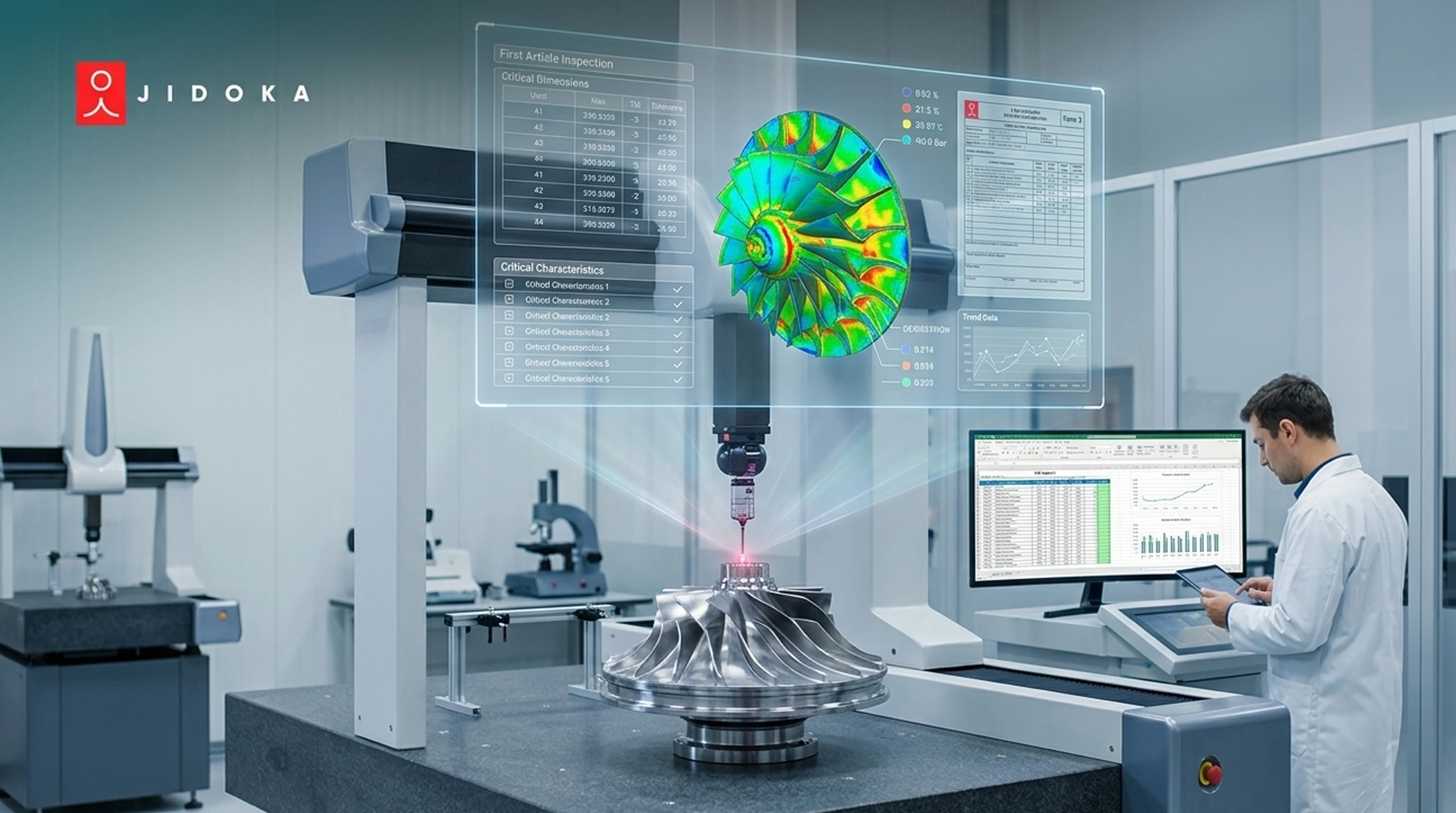
Una pieza nueva que llega a la planta de producción conlleva riesgos invisibles. Un error dimensional en la configuración de producción genera desperdicios en miles de unidades antes de que alguien lo detecte. En 2025, los errores de dimensionamiento geométrico causaron el 38 por ciento de todos los retrasos en la introducción de nuevos productos en los sectores industriales (Manufacturing Leadership Council 2025).
Las inspecciones de entrada tradicionales detectan problemas después de las tiradas de producción. La inspección de primer artículo los detecta antes. Esta guía le proporcionará un plan claro de la secuencia de verificación necesaria para una cualificación exitosa de piezas nuevas.
Punto clave: La inspección de primer artículo es un proceso de verificación de producción que confirma que la maquinaria de fabricación puede repetir con precisión las especificaciones de ingeniería. Ejecutar esta evaluación inicial antes de la activación completa de la fábrica evita el desperdicio masivo, mitigando directamente los errores de herramientas que cuestan 15 veces más corregir después del lanzamiento (American Society for Quality 2024).
¿Qué es la inspección de primer artículo en la fabricación?
La inspección de primer artículo es un proceso formal de verificación que prueba la primera tirada de producción de un componente nuevo, confirmando que las herramientas de producción y los ciclos de fabricación generan piezas que coinciden con las especificaciones exactas del diseño de ingeniería.
1. Diferenciación de la primera muestra frente a las tiradas de prototipos
Una muestra de primer artículo no es un prototipo. Los prototipos se construyen utilizando accesorios temporales, formas impresas en 3D o configuraciones de prueba en una sola máquina. El primer artículo sale de las herramientas de producción exactas, a las mismas velocidades y avances previstos para el volumen total.
Esta distinción aísla los errores en el entorno de producción en lugar de los errores de diseño. Un prototipo fallido revela un problema de diseño. Una inspección de primer artículo fallida revela un problema de proceso o de herramientas. Corregir un error de herramientas en esta etapa cuesta una fracción de lo que costaría después de que se envíen 2000 unidades con el mismo defecto.
2. Inspección de primer artículo frente al proceso de inspección PPAP
La inspección de primer artículo se centra en un único lote de producción para verificar la conformidad dimensional en un momento específico. El proceso de inspección PPAP (Proceso de Aprobación de Piezas de Producción) evalúa la capacidad estadística a largo plazo en tiradas de producción más grandes.
La inspección de primer artículo pregunta: "¿Esta configuración produjo una pieza correcta?". La aprobación de piezas de producción pregunta: "¿Puede esta configuración producir piezas correctas de manera fiable, en volumen y a través de múltiples turnos?". Los proveedores de automoción y las organizaciones aeroespaciales a menudo completan ambos en secuencia: la FAI aprueba las herramientas, luego PPAP valida la capacidad del proceso.
3. Cuándo se activa una revisión
La mayoría de los sistemas de calidad definen cuatro activadores automáticos: series de producción iniciales, cambios de herramientas, modificaciones en proveedores de materias primas o traslados de instalaciones. Cualquiera de estos restablece el estado de verificación del primer artículo. Los protocolos estandarizados reducen los ciclos de rediseño en un promedio del 29 por ciento (Aerospace Industries Association 2024). Los sistemas de gestión de calidad ISO 9001 codifican estos eventos de activación para fabricantes de todos los sectores.
La máquina supera la calibración, pero el proceso sigue sin pasar la inspección.
Lo que estos activadores ponen en marcha es un flujo de trabajo de documentación: tres formularios específicos que conforman el registro de cumplimiento completo.
¿Cómo completar un informe de verificación de primer artículo (FAIR)?
Un informe de verificación de primer artículo documenta cada dimensión física y propiedad del material del componente de muestra, rastreando las mediciones variables frente a las tolerancias de ingeniería para confirmar la configuración del equipo antes de la aprobación de la producción.
Para obtener más información sobre cómo la inspección de calidad del producto se integra en flujos de trabajo de calidad más amplios, los recursos publicados por Jidoka cubren métodos de verificación relacionados en diversos entornos de producción.
Formulario 1: Responsabilidad del número de pieza
El Formulario 1 registra la información administrativa: nombres de las piezas, niveles de revisión de los planos, números de serie, referencias de contratos y datos de la organización proveedora. Esto crea un rastro de cumplimiento ininterrumpido para los auditores externos de los sectores aeroespacial o automotriz que revisan el paquete FAIR.
Tratar el Formulario 1 como una simple tarea administrativa es un error. Si la revisión del plano en el Formulario 1 no coincide con la revisión utilizada para la medición, todo el paquete de cumplimiento no superará la verificación de trazabilidad. Los auditores comparan el Formulario 1 con las revisiones de las órdenes de compra. Una sola discrepancia puede detener un envío.
Formulario 2: Responsabilidad del producto
El Formulario 2 captura las certificaciones de materias primas, las especificaciones de procesos especiales y los datos de pruebas funcionales. Adjuntar los informes certificados de pruebas de materiales de los proveedores de acero o polímeros directamente al Formulario 2 satisface la mayoría de los requisitos de trazabilidad aeroespacial y automotriz bajo SAE International AS9102.
El procesamiento de datos tiene la misma importancia. Si una pieza requiere un tratamiento térmico con una especificación de dureza concreta, el Formulario 2 debe incluir el registro de temperatura y los resultados de la prueba de dureza. La falta de esta documentación genera una brecha de cumplimiento que un auditor de AS9102 o IATF señalará, incluso si la pieza física supera todas las comprobaciones dimensionales.
Formulario 3: Responsabilidad de las características
El Formulario 3 es el registro de mediciones: cada dimensión numerada del plano técnico, comparada con los valores medidos reales, los rangos de tolerancia y el estado de aprobado/rechazado. Aquí es donde se concentra la mayor parte del tiempo de inspección.
La transcripción manual de estas hojas requiere una media de 6,5 horas por diseño de componente (Quality Digest 2025). Para un componente aeroespacial complejo con más de 400 características numeradas, eso supone casi un turno completo dedicado exclusivamente a la documentación. Los registros de calibración de los instrumentos también deben ser trazables según los estándares nacionales de metrología del NIST, o los datos del Formulario 3 no superarán una auditoría independiente.
Una vez que se sabe lo que requieren los tres formularios, la secuencia real en planta para completarlos sigue un orden específico por una razón.
¿Cuáles son las etapas secuenciales de la calificación de piezas nuevas?
La calificación de piezas nuevas exige una secuencia estructurada: numerar el plano, extraer la primera pieza, medir cada característica con instrumentos calibrados y, a continuación, resolver cualquier discrepancia antes de conceder la aprobación del primer artículo.
Paso 1: Numeración del plano y preparación
Antes de iniciar cualquier mecanizado, los ingenieros numeran cada dimensión, tolerancia y nota del plano. Cada número rodeado por un círculo corresponde directamente a una fila del Formulario 3. Omitir este paso significa que los inspectores pueden medir 200 características y aun así pasar por alto 40 críticas.
Los planos ocultan dimensiones dentro de llamadas compuestas. Una llamada de posición real relativa a tres referencias controla hasta seis relaciones geométricas simultáneamente. La numeración del plano obliga a incluir cada uno de esos requisitos en la lista de medición antes de que la máquina se ponga en marcha. Vea cómo se comparan los métodos de inspección en máquina en diferentes entornos de producción.
Paso 2: Inspección de la primera pieza y recopilación de datos
Una vez que la máquina alcanza la estabilidad térmica, los operarios extraen el primer componente real. La inspección de la primera pieza utiliza máquinas de medición por coordenadas (CMM) para características de tolerancia estrecha y escáneres ópticos para geometrías de superficie complejas.
La medición por CMM de un componente de precisión típico lleva de 45 minutos a 2 horas, dependiendo del número de características y del acceso a la máquina. Los resultados se integran directamente en el Formulario 3. Algunas instalaciones utilizan escaneo óptico junto con la CMM para capturar mapas de desviación de superficie que los datos dimensionales por sí solos no pueden mostrar. Las capacidades de detección de defectos de Jidoka amplían esta cobertura a la verificación de producción en línea una vez que se aprueban las herramientas. La trazabilidad de la calibración según los estándares del NIST es obligatoria para todos los instrumentos de medición utilizados en esta etapa.
Paso 3: Gestión de discrepancias y aprobación
Cualquier dimensión fuera de tolerancia recibe una etiqueta de no conformidad. La ruta de acción se divide según la gravedad: disposición de ingeniería para desviaciones menores dentro de los límites funcionales, corrección de herramientas y reinspección para errores dimensionales reales, o rechazo de material del proveedor en caso de fallos en los insumos recibidos.
La falta de alineación inicial entre ingeniería y el taller provoca el 44 por ciento de los eventos de no conformidad en la cadena de suministro de nivel 1 durante las fases de lanzamiento (Automotive Industry Action Group 2024). Esa cifra cae drásticamente cuando los criterios de aceptación de tolerancia se documentan por escrito antes de fabricar la primera pieza, en lugar de negociarse después de que aparece una etiqueta de rechazo.
Ejecutar esta secuencia de tres pasos manualmente funciona para lanzamientos de bajo volumen. El cálculo cambia cuando su planta realiza docenas de lanzamientos de piezas nuevas por trimestre.
¿Cuándo deberían las plantas automatizar los flujos de trabajo de aprobación del primer artículo?
Los flujos de trabajo manuales de aprobación del primer artículo crean cuellos de botella en la documentación durante los lanzamientos de producción. El software de automatización de informes de inspección comprime los ciclos de validación y elimina los errores de transcripción que introducen las hojas de datos en papel a gran escala.
Para obtener un desglose de los tipos de inspección de producción y conocer dónde encaja el FAI dentro de una estrategia de calidad en línea más amplia, los recursos de Jidoka cubren todo el espectro, desde la fabricación general hasta la producción de electrónica.
La carga de trabajo del globado manual
El globado manual de un componente complejo requiere de 3 a 8 horas, más otras 6,5 horas para la transcripción del Formulario 3. Una planta que lanza 15 piezas nuevas al trimestre dedica más de 200 horas de ingeniería a la documentación cada trimestre.
Esas horas no aportan valor a la inspección. Un ingeniero de metrología capaz de identificar las causas raíz de los problemas de utillaje dedica el equivalente a cinco días completos al trimestre a copiar números de planos a hojas de cálculo. Ese coste no aparece en ningún panel de control de calidad, pero sí se refleja en retrasos en los lanzamientos y en la rotación de ingenieros.
Ventajas del software de inspección automatizada
El software moderno de documentación de inspección extrae automáticamente los bloques de acotación y tolerancias geométricas (GD&T) de los archivos CAD, rellena las plantillas de medición y asigna las dimensiones a las filas correctas del Formulario 3. El operario mide. El software documenta.
Las herramientas digitales de diseño de inspección reducen las horas de preparación de la documentación técnica en un 73 por ciento (Automotive Industry Action Group 2025). En un componente con 400 características, una tarea de globado de 8 horas se reduce a menos de 2 horas. La mejora en la precisión es acumulativa: la extracción automatizada elimina los errores de transcripción que aparecen cuando alguien escribe 400 números a mano al final de un turno.
Aceleración del tiempo de comercialización
Unos ciclos de aprobación de primer artículo más rápidos reducen directamente el tiempo entre la validación del utillaje y el primer envío de producción. Los sistemas de presentación digital reducen los tiempos totales del ciclo de aprobación de validación de componentes en un 52 por ciento (Society of Manufacturing Engineers 2025).
Una reducción del 52 por ciento en un ciclo de validación de 10 semanas ahorra 5 semanas de plazo de entrega. Para los proveedores de automoción que se enfrentan a plazos de inicio de producción de modelos anuales, esa es la diferencia entre una entrega a tiempo y un envío urgente con sobrecoste. El caso de negocio para la automatización se amortiza antes de recuperar los costes de implementación del software.
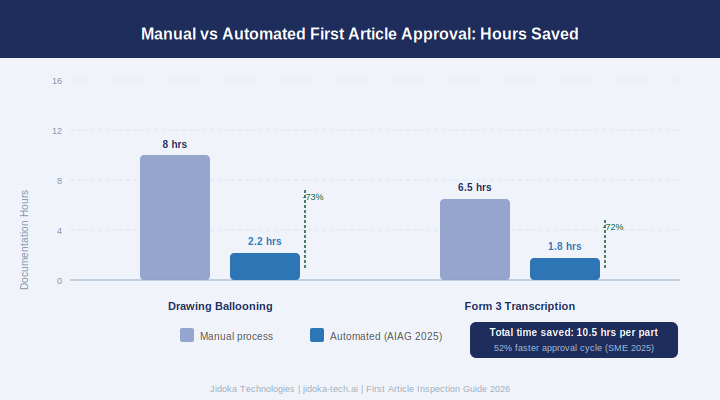
Figura 1: Horas de documentación FAI manual frente a automatizada: 73% de reducción en el tiempo de globado, 52% más rápido en el ciclo de aprobación
Independientemente de si su planta estandariza flujos de trabajo manuales o automatizados, la lógica de verificación subyacente sigue siendo la misma.
Cómo Jidoka Technologies respalda la inspección de primer artículo a velocidad de producción
Los fallos en la inspección dimensional a velocidad de producción suelen deberse a errores que los inspectores visuales pasan por alto en líneas de alta velocidad. Jidoka Technologies cierra esa brecha con sistemas de visión artificial que trasladan la precisión de la inspección de primer artículo a cada turno, no solo a la primera pieza.
- KOMPASS AI: Alcanza más del 99,8 % de detección de defectos de precisión en líneas de producción en tiempo real. Analiza cada fotograma en menos de 10 ms, incluso a una velocidad de más de 12 000 piezas por minuto.
- NAGARE AI: Realiza un seguimiento del 100 % de los pasos de ensamblaje a través de cámaras existentes. Identifica piezas faltantes o secuencias incorrectas en tiempo real, reduciendo el retrabajo entre un 20 % y un 35 %.
- Incorporación de nuevas variantes: Aprende nuevas variantes de piezas con entre un 60 % y un 70 % menos de muestras de entrenamiento que los sistemas de visión tradicionales, igualando la velocidad de los ciclos de calificación de nuevas piezas .
Descubra cómo KOMPASS y NAGARE se adaptan a su flujo de trabajo de lanzamiento de componentes. Reserve una evaluación de implementación con el equipo de ingeniería de Jidoka.
Conclusión
Los errores en las herramientas de producción cuestan 15 veces más de corregir después del lanzamiento que antes. La inspección del primer artículo cierra esa brecha. Un paquete completo de fabricación de informes FAIR, basado en los tres formularios de responsabilidad y confirmado mediante el globado de planos y la inspección de la primera pieza, le otorga una autorización de producción que resiste cualquier auditoría. Estandarice primero la secuencia de verificación.
Luego, deja que las herramientas de automatización aceleren el proceso. Reserva una llamada rápida para ver cómo la IA de visión de Jidoka respalda la aprobación del primer artículo desde el primer día.
Preguntas frecuentes
1. ¿Cuál es el objetivo principal de la inspección del primer artículo?
El objetivo principal de la inspección del primer artículo es verificar que las herramientas de producción y los procesos de fabricación puedan repetir con precisión las especificaciones de ingeniería. Proporciona una prueba física de que la línea de producción es capaz de fabricar componentes conformes antes de que comience la producción a gran escala.
2. ¿Qué incluye un paquete de fabricación para informes FAIR?
Un paquete FAIR completo incluye tres formularios de responsabilidad principales. Estos cubren los detalles del número de pieza, las certificaciones de materias primas, los registros de procesos especiales y una lista detallada que compara cada dimensión del plano numerado con los valores medidos reales.
3. ¿En qué se diferencia la inspección del primer artículo de la validación de prototipos?
La validación de prototipos prueba un concepto de diseño utilizando herramientas o métodos de impresión temporales. La inspección del primer artículo prueba el entorno de producción real, utilizando las herramientas, materias primas, velocidades de producción y operadores finales destinados al ensamblaje en masa.
4. ¿Cuándo debe un fabricante realizar una verificación parcial del primer artículo?
Se requiere una verificación parcial cuando ocurre un cambio menor en un proceso previamente aprobado. Los desencadenantes comunes incluyen una modificación en el inserto de la herramienta, un cambio de material de un proveedor secundario, una actualización de software en la máquina o revisiones menores en los planos de ingeniería.
5. ¿Por qué las auditorías aeroespaciales se centran tanto en la aprobación del primer artículo?
Los componentes aeroespaciales operan bajo estrés extremo donde el fallo de un componente pone en riesgo la seguridad. Las agencias reguladoras exigen registros de validación estrictos para garantizar una trazabilidad absoluta desde los bloques de materia prima hasta las dimensiones finales, demostrando que el proceso estuvo controlado desde el primer día.
6. ¿Cómo mejora la automatización por software el proceso de inspección?
La automatización por software utiliza reconocimiento óptico de caracteres para escanear planos al instante y completar hojas de cálculo de medición. Esto elimina horas de escritura, evita errores de entrada manual de datos y estandariza los formatos para acelerar los tiempos de aprobación de ingeniería bajo los protocolos de verificación del primer artículo.